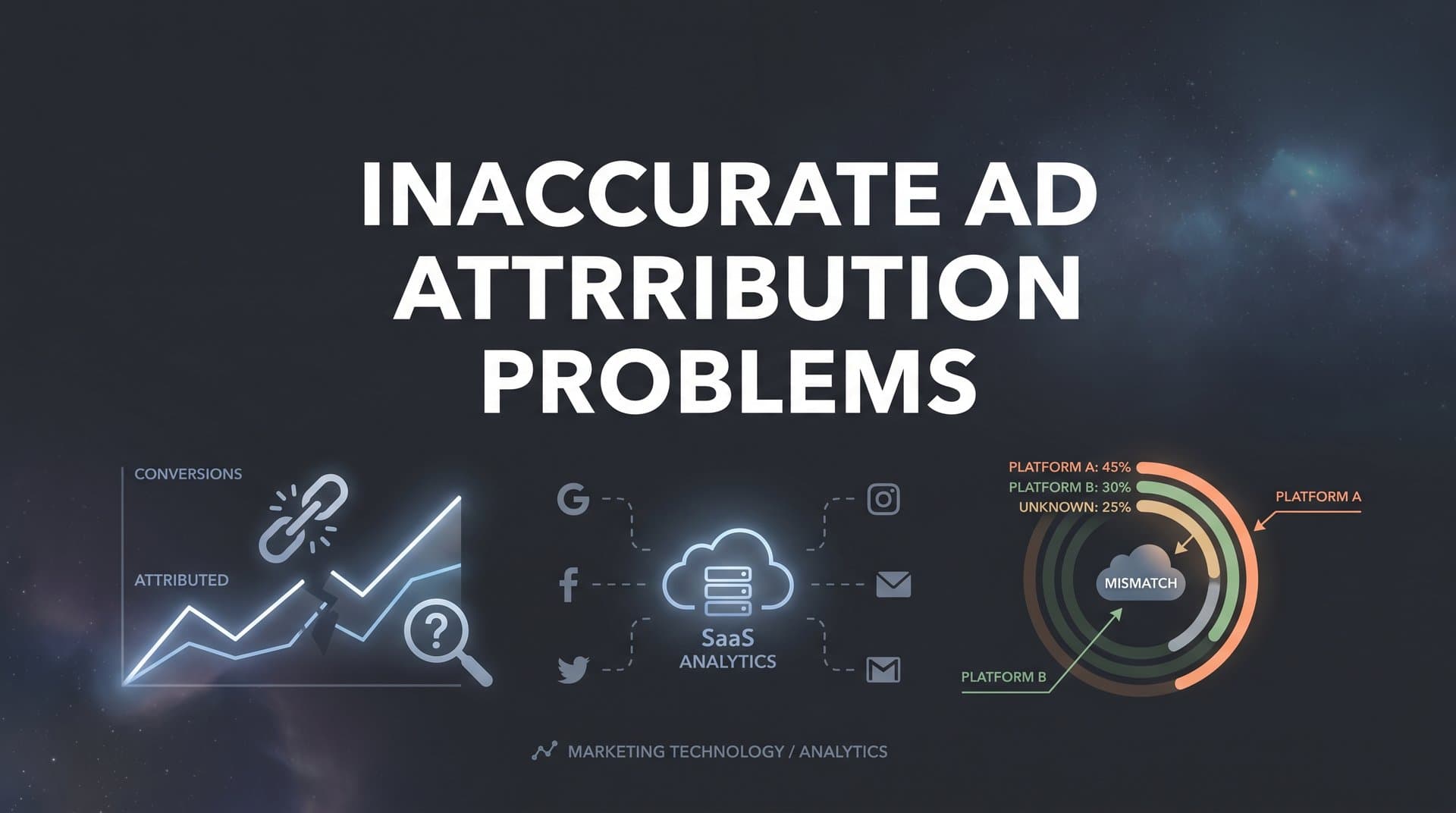
Picture this: it's the end of the month, and your marketing team is sitting around the table reviewing performance dashboards. Meta says it drove 400 conversions. Google claims 350. Your display network is taking credit for another 200. Add it all up, and you've got over 900 attributed conversions on paper. Your actual CRM shows 310 closed deals.
This is not a hypothetical edge case. It is the everyday reality for marketing teams running campaigns across multiple platforms, and it is one of the most expensive problems in digital advertising. Inaccurate ad attribution problems don't announce themselves with flashing warning signs. They hide inside dashboards that look healthy, reports that seem impressive, and ROAS numbers that feel too good to question.
The danger is that decisions made on top of this distorted data compound over time. You pour more budget into channels that look like winners but are simply better at claiming credit. You pull back on channels that are genuinely driving revenue but appear weak because they rarely get the last click. Your ad platform algorithms learn from the wrong signals and optimize toward the wrong audiences. Before long, your entire growth strategy is built on a foundation of bad data.
This article is a deep dive into exactly how attribution breaks down, what it costs you when it does, and how modern marketers are rebuilding their measurement systems to make decisions they can actually trust.
Why Your Attribution Data Is Lying to You
The problem starts with a fundamental conflict of interest baked into how ad platforms report results. Meta, Google, TikTok, and every other major ad network operate on self-attribution models. Each platform uses its own tracking methodology to measure conversions, and each one naturally attributes credit to itself whenever it has any reasonable claim to a touchpoint in the customer journey.
Think of it like asking three salespeople which one closed the deal. Each of them will point to themselves. That is not dishonesty so much as it is the predictable outcome of a system where every platform is both the advertiser and the scorekeeper.
This self-reporting bias creates what you might call attribution inflation. When you add up the conversions each platform claims, the total consistently exceeds your actual verified sales. The gap between platform-reported performance and real business outcomes is not a rounding error. For many advertisers running cross-channel campaigns, it is substantial enough to fundamentally distort strategy. Understanding why attribution data doesn't match across platforms is critical to diagnosing this issue.
Compounding this is the collapse of traditional pixel-based tracking. Apple's App Tracking Transparency framework changed the rules for mobile attribution by requiring explicit user consent before any cross-app tracking occurs. The majority of users opt out, which means a significant portion of conversions driven by iOS users simply disappear from platform reporting. Meanwhile, Google's evolving Privacy Sandbox continues to reshape how browser-level tracking works across the web.
The result is a world where client-side pixels, the workhorses of digital attribution for over a decade, are increasingly unreliable. They are blocked by ad blockers, restricted by browser privacy settings, and disrupted by the very privacy changes that users and regulators have demanded. The data that does get through is incomplete, and the gaps are not random. They disproportionately affect specific device types, browsers, and user segments.
Cross-device journeys add another layer of complexity. A customer might discover your product through a Meta ad on their phone during a commute, research it on a work laptop, and convert through a Google search on their home desktop three days later. Each platform sees only a fragment of that journey. Effective touchpoint attribution tracking requires connecting these fragmented interactions into a unified customer record.
The difference between platform-reported data and actual verified conversions is not a technical footnote. It is a strategic chasm, and it keeps widening as privacy regulations expand and tracking limitations multiply. Understanding this gap is the first step toward closing it.
The Hidden Costs of Bad Attribution on Your Budget
Bad attribution data does not just give you inaccurate numbers. It actively steers your budget in the wrong direction, and it does so quietly enough that many teams don't realize it's happening until significant damage has already been done.
The most direct cost is misallocated ad spend. When a channel appears to be outperforming based on inflated attribution, you naturally invest more in it. When another channel looks weak because it rarely captures the last click, you pull back or cut it entirely. The problem is that the channel you're scaling may be taking credit for conversions it didn't drive, while the channel you're defunding may be the one actually introducing customers to your brand at the top of the funnel.
This dynamic is especially common with upper-funnel channels like YouTube, display, and social awareness campaigns. These touchpoints rarely get the last click, but they often initiate the journey that eventually leads to a conversion. Under a flawed attribution model, they look like money pits. Under accurate multi-touch attribution, they often reveal themselves as essential drivers of downstream revenue. Learning about the importance of attribution models helps teams avoid this costly mistake.
Here's where the problem gets even more serious: flawed data doesn't just mislead your team. It actively corrupts the AI systems that ad platforms use to optimize your campaigns.
Meta's and Google's algorithms are sophisticated, but they are only as smart as the conversion signals you send them. When you pass back inflated, duplicate, or inaccurate conversion data, their systems learn from that data. They optimize your targeting and bidding toward audiences and behaviors that appear to convert well based on your signals, even if those signals don't reflect real business outcomes. Over time, this compounds. The algorithm gets better and better at finding people who generate attributed conversions, while your actual revenue growth stagnates or declines.
Garbage in, garbage out. At scale, that principle is expensive.
The ripple effects extend beyond the ad account. When leadership reviews monthly marketing reports and sees platform-reported ROAS that doesn't match CRM revenue, trust in marketing metrics erodes. Teams that invest in revenue attribution tracking tools can bridge this gap and restore confidence in their reporting.
This is the compounding cost of inaccurate ad attribution problems. It's not just a reporting inconvenience. It is a strategic liability that affects budget allocation, algorithm performance, and organizational confidence in marketing's ability to demonstrate real impact.
Five Specific Attribution Problems Marketers Face Today
Attribution failure is not a single problem. It is a cluster of related issues that show up in different ways depending on your channel mix, tracking setup, and business model. Here are the five most common ones marketers encounter.
Problem 1: Double-Counting Across Platforms. This is the most visible symptom of attribution inflation. When a customer clicks a Meta ad and later clicks a Google ad before converting, both platforms record a conversion. Your CRM records one sale. The result is that your combined platform reporting shows twice the actual revenue generated. At scale, across dozens of campaigns and thousands of conversions, this creates a wildly distorted picture of channel performance and makes it nearly impossible to make rational budget decisions. Dedicated strategies for solving attribution data discrepancies are essential for any cross-channel advertiser.
Problem 2: Last-Click Bias. Many advertisers, by default or by choice, still operate on last-click attribution models. This means 100% of the credit for a conversion goes to the final touchpoint before purchase, typically a branded search or a retargeting ad. The problem is that this model completely ignores everything that happened before that last click: the awareness campaign that introduced the customer to your brand, the educational content that built trust, the social proof that overcame objections. Last-click attribution systematically undervalues top-of-funnel efforts and leads teams to over-invest in bottom-funnel channels that capture demand rather than create it.
Problem 3: Missing Offline and CRM Conversions. For businesses where the sale happens off the website, through a sales call, a demo, or a signed contract, the gap between ad click and verified conversion is often invisible to standard tracking. If a lead clicks a Google ad, books a demo, and closes three weeks later, that revenue rarely gets connected back to the originating ad click. Your CRM knows the deal closed. Your ad platform has no idea. This means your highest-value conversions, the ones that actually matter most to the business, are often the least represented in your attribution data.
Problem 4: Delayed and Lost Conversion Data. Client-side pixels are fragile. They depend on the user's browser loading correctly, not having an ad blocker installed, not having JavaScript disabled, and not using a privacy-focused browser like Brave or Firefox with enhanced tracking protection. When any of these conditions are present, conversion events simply don't fire. The result is a systematic undercount of actual conversions, and the undercount is not evenly distributed. It disproportionately affects technically sophisticated users, exactly the kind of high-intent audience many advertisers are most eager to reach.
Problem 5: No Side-by-Side Attribution Model Comparison. Most marketers are stuck looking at performance through a single attribution lens, usually whatever default their ad platform or analytics tool provides. Without the ability to compare how different attribution models, such as first-click, last-click, linear, time-decay, or data-driven, interpret the same conversion data, it's impossible to develop a nuanced understanding of how your channels actually work together. Exploring the types of attribution models in digital marketing can help you understand which lens best fits your business.
Each of these problems is solvable. But solving them requires a different approach to how you collect, verify, and analyze attribution data in the first place.
Server-Side Tracking and Multi-Touch Models: The Modern Fix
The good news is that the tools to address inaccurate ad attribution problems have matured significantly. Two developments in particular have changed what's possible for marketers who want accurate, reliable measurement: server-side tracking and multi-touch attribution models.
Server-side tracking fundamentally changes where conversion data is captured. Instead of relying on a JavaScript pixel running in the user's browser, which is subject to ad blockers, browser restrictions, and privacy settings, server-side tracking captures conversion events at your server level and sends them directly to ad platforms via their APIs. The browser never has to cooperate. The data travels from your infrastructure to the platform's infrastructure, bypassing the entire layer of client-side fragility.
This approach captures conversions that client-side tracking routinely misses. Users with ad blockers, iOS users who have opted out of tracking, and visitors on privacy-focused browsers all generate conversion events that server-side tracking can capture. The result is a more complete picture of actual performance, and more complete data means better decisions.
Server-side tracking also gives you greater control over what data you send and when. You can enrich conversion events with CRM data, such as customer lifetime value or lead quality scores, before sending them to ad platforms. This means the signals that feed platform algorithms are not just more complete; they are more meaningful.
Multi-touch attribution addresses a different part of the problem. Instead of assigning 100% of the credit to a single touchpoint, multi-touch models distribute credit across all the interactions a customer had before converting. Understanding the difference between single source and multi-touch attribution is key to choosing the right approach for your business. Different models distribute that credit in different ways: linear models split it evenly, time-decay models give more weight to recent touchpoints, and data-driven models use machine learning to assign credit based on which touchpoints statistically correlate with conversion.
The practical benefit is that multi-touch attribution gives you a more honest view of how your channels work together. It surfaces the contribution of upper-funnel touchpoints that last-click models systematically ignore. It shows you which channels initiate journeys, which ones nurture prospects, and which ones close deals. That understanding is essential for making intelligent budget allocation decisions across a complex channel mix.
Critically, the value of better attribution data is only fully realized when you close the loop by syncing verified conversion signals back to ad platforms. When Meta and Google receive accurate, enriched conversion data, their algorithms can optimize toward real outcomes. Better data in means better targeting, better bidding, and better results over time. This conversion sync step is where accurate attribution translates directly into real-time attribution tracking that powers smarter campaign optimization.
Building an Attribution System You Can Actually Trust
Understanding the problems and knowing the solutions are two different things. The practical challenge is building an attribution system that actually works across your entire marketing stack, from first ad impression to closed revenue.
The foundation is data unification. Your ad platforms, CRM, and website all hold pieces of the customer journey, but they rarely talk to each other by default. Building a reliable attribution system means connecting these sources into a single, unified tracking environment where every touchpoint, from the first ad click to the final deal closed in your CRM, is captured and linked to the same customer record.
This unified view eliminates the silos that cause double-counting and missing conversions. When you can see the complete journey in one place, you can apply attribution models to the actual data rather than to the fragmented, platform-reported version of it. You can verify which conversions are real, which channels contributed to them, and what the actual revenue impact of each campaign was. Many teams find that comparing UTM tracking vs attribution software reveals the limitations of manual approaches and the need for a more robust system.
Once the data foundation is in place, AI-powered analysis becomes genuinely powerful. With complete, verified data across all touchpoints, AI can surface patterns that human analysts would struggle to find manually. It can identify which specific ads and campaigns are driving the highest-quality conversions, not just the most attributed ones. It can flag underperforming segments before they drain budget. And it can generate optimization recommendations grounded in real revenue data rather than platform-reported metrics.
This is where confidence in scaling decisions comes from. When you know that your attribution data reflects actual business outcomes, you can invest more in what's working without second-guessing whether the performance is real or an artifact of attribution inflation.
Cometly is built specifically to solve the problems outlined in this article. It connects your ad platforms, CRM, and website into a unified tracking system that captures every touchpoint from first click to closed deal. Server-side tracking ensures that conversion data is captured reliably, even when client-side pixels fail. Multi-touch attribution models give you a complete view of how your channels work together rather than a single, misleading snapshot. Conversion sync sends verified, enriched conversion signals back to Meta, Google, and other platforms so their algorithms can optimize based on real outcomes.
Beyond the tracking infrastructure, Cometly's AI-powered analysis identifies which ads and campaigns are genuinely driving revenue and delivers actionable recommendations for where to scale and where to pull back. You're not just getting better data. You're getting a system that translates that data into decisions.
For marketing teams that have been operating on platform-reported metrics and wondering why their CRM numbers never quite match, Cometly provides the clarity that makes confident, data-driven growth possible.
The Bottom Line on Attribution Accuracy
Inaccurate ad attribution is not a minor reporting inconvenience. It is a strategic liability that compounds quietly over time. Every day you optimize against flawed data, you are making budget decisions based on a distorted version of reality. You are feeding ad platform algorithms the wrong signals. You are undervaluing channels that drive real growth and over-investing in channels that are simply better at claiming credit.
The good news is that this is a solvable problem. Server-side tracking, multi-touch attribution, and conversion sync are not emerging concepts. They are proven approaches that modern marketing teams are using right now to build measurement systems they can actually trust.
The question worth asking today is straightforward: are your current marketing decisions based on verified revenue data, or on platform-reported metrics that may be significantly overstating actual performance? If you're not sure, that uncertainty itself is the answer.
Start by auditing your current attribution setup. Look at whether your platform-reported conversions align with your CRM data. Examine whether you're capturing conversions from iOS users and visitors using privacy-focused browsers. Consider whether your ad platforms are receiving accurate conversion signals or inflated ones.
If you find gaps, you're not alone. Most marketing teams do. The difference between teams that scale efficiently and those that spin their wheels is often not the quality of their ads. It's the quality of their attribution data.
Get your free demo and see how Cometly's AI-driven attribution platform connects every touchpoint to actual business outcomes, giving you the accurate, real-time data you need to make every ad dollar count.