You've spent thousands on ads this month. Your dashboard shows clicks, impressions, and even some conversions. But when leadership asks which campaigns actually drove revenue, you're stuck piecing together fragments from five different platforms, each telling a different story.
Sound familiar?
Most marketers operate in this frustrating gray zone—knowing something worked, but not knowing what. You see the results but can't trace them back to specific actions. That Facebook ad might have introduced prospects to your brand, but did it actually drive the sale? Or was it the retargeting campaign? The email sequence? The demo call?
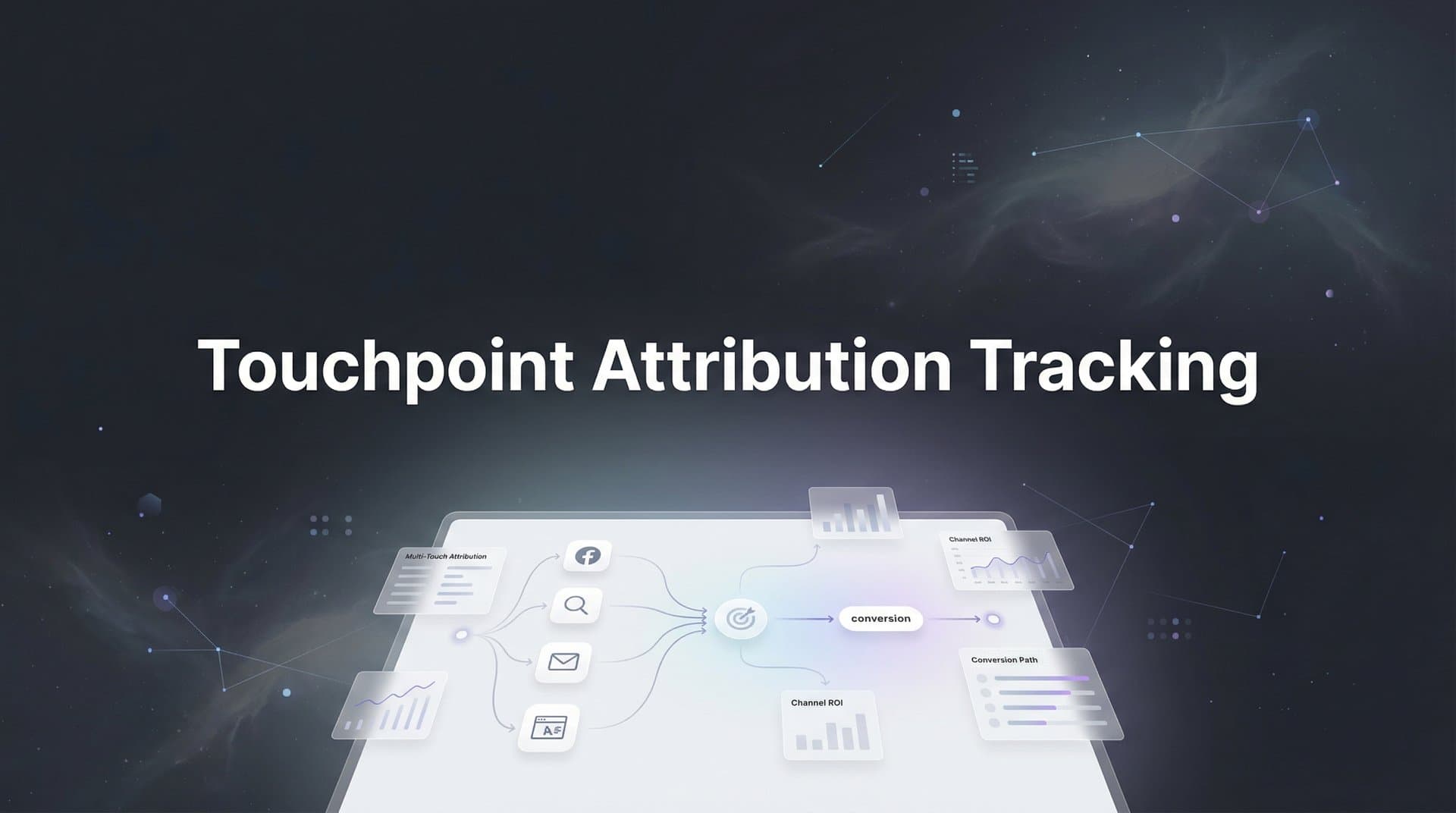
This is where touchpoint attribution tracking changes everything. Instead of guessing which marketing efforts deserve credit, you get a complete map of every interaction a customer has with your brand—from that first ad click all the way through to purchase and beyond. You stop relying on gut feelings and start making decisions based on actual customer behavior data.
Understanding the Customer Journey Through Marketing Touchpoints
A marketing touchpoint is any interaction between a potential customer and your brand. Think of it as a breadcrumb in the trail that leads to conversion.
These interactions come in many forms. An ad click on Facebook. An email open. A website visit. A whitepaper download. A demo request. A sales call. Each one represents a moment when someone engaged with your marketing, and each one plays a role in their decision-making process.
The challenge? These touchpoints don't happen in isolation, and they're rarely linear.
Consider a typical B2B customer journey. Someone sees your LinkedIn ad during their morning scroll but doesn't click. Three days later, they search for a solution to their problem and find your blog post. They read it, subscribe to your newsletter, and receive a case study via email. A week passes before they visit your pricing page. Then they request a demo. Two weeks after that demo, they finally convert.
That's seven touchpoints across multiple channels and nearly a month of interactions. If you're only tracking the last click before conversion, you're crediting the demo request for a sale that actually involved six other critical moments. Understanding customer touchpoint tracking helps you capture this complete picture.
Awareness Stage Touchpoints: These are your first impressions—social media ads, display campaigns, organic search results, podcast sponsorships. They introduce your brand to people who have a problem but might not know you exist yet.
Consideration Stage Touchpoints: Now prospects are actively evaluating solutions. They're reading your comparison guides, downloading resources, attending webinars, engaging with your content on social platforms. These touchpoints educate and build trust.
Decision Stage Touchpoints: This is where intent becomes action. Demo requests, pricing page visits, consultation calls, free trial sign-ups. These touchpoints signal that someone is ready to move forward.
Here's where it gets complicated: online and offline touchpoints need to connect for a complete picture. That LinkedIn ad impression happens online. The demo call happens over Zoom. But what about the conversation at a conference? The direct mail piece? The phone call to your sales team?
Many attribution systems only capture digital interactions, creating blind spots in your data. A prospect might discover you through a paid ad, but the final push to convert could be an offline conversation that never gets tracked. Without connecting these dots, you're making decisions based on incomplete information.
The Technical Foundation: How Attribution Tracking Captures Customer Behavior
Understanding what touchpoint attribution tracking does is one thing. Understanding how it works is what separates marketers who use it effectively from those who just install a tracking pixel and hope for the best.
Let's start with the basics. When someone clicks your ad, visits your website, or opens your email, you need a way to record that interaction and connect it to a specific person. This happens through several technical mechanisms working together.
Tracking Pixels: These are tiny pieces of code embedded in your website or emails that fire when someone takes an action. When a visitor lands on your pricing page, the pixel sends data back to your analytics platform noting that this specific user viewed that specific page at that specific time.
UTM Parameters: These are tags you add to your campaign URLs that identify the source, medium, and campaign name. When someone clicks a link with UTM parameters, your analytics tool knows exactly which email, ad, or social post drove that visit.
Cookies: For years, cookies were the primary way to track users across sessions. A cookie stored in someone's browser would remember them when they returned to your site, allowing you to connect multiple visits to the same person.
But here's the problem: this traditional tracking approach is breaking down.
Apple's iOS privacy changes have made cookie-based tracking significantly less reliable. When users opt out of tracking on their iPhones, traditional pixels and cookies can't follow their journey. Browser restrictions and cookie deprecation mean that the methods marketers relied on for the past decade are becoming increasingly ineffective. This is why cookieless attribution tracking has become a critical priority for forward-thinking marketers.
This is why server-side tracking has become essential for accurate attribution. Instead of relying on browser-based cookies that users can block, server-side tracking sends data directly from your server to your analytics platform. The tracking happens on the backend, making it more reliable and less susceptible to privacy restrictions.
But capturing individual touchpoints is only half the battle. The real magic happens through identity resolution—the process of connecting anonymous interactions to known users as they progress through your funnel.
Here's how it works. Someone clicks your Facebook ad but doesn't fill out a form. They're anonymous at this point—you know someone clicked, but not who. Three days later, that same person searches for your brand, visits your website, and downloads a guide by submitting their email address. Now they're known.
Identity resolution connects those anonymous early touchpoints to the email address they eventually provided. Suddenly, you can see that this person's journey started with that Facebook ad, not with the organic search that happened right before they converted.
Advanced attribution platforms use multiple identifiers—email addresses, phone numbers, device IDs, IP addresses—to build a unified profile of each customer's journey. They match anonymous sessions to known users, connect cross-device behavior, and create a complete timeline of every interaction. Implementing first-party data tracking is essential for building these unified customer profiles.
This is where Cometly's server-side tracking becomes particularly powerful. By capturing data at the server level and using sophisticated identity resolution, it can track the complete customer journey even when browser-based methods fail. You get accurate attribution data that accounts for iOS limitations and privacy restrictions.
Attribution Models: Deciding How to Distribute Credit
Once you're tracking touchpoints, you face a critical question: which interactions should get credit for the conversion?
This is where attribution models come in. An attribution model is simply a set of rules that determines how much credit each touchpoint receives when someone converts. Different models distribute credit in different ways, and choosing the right one depends on your business model and sales cycle.
First-Touch Attribution: This model gives 100% of the credit to the first interaction someone has with your brand. If a prospect clicked a Facebook ad three months before converting, that Facebook ad gets full credit—even if they interacted with ten other touchpoints in between.
First-touch attribution makes sense when you want to understand which channels are best at introducing new prospects to your brand. It's useful for top-of-funnel optimization and brand awareness campaigns. But it completely ignores everything that happened after that initial interaction.
Last-Touch Attribution: The opposite approach. This model gives 100% of the credit to the final touchpoint before conversion. If someone requested a demo and then purchased, the demo request gets all the credit.
Last-touch is what most ad platforms use by default. Google Ads credits the last Google ad someone clicked. Facebook credits the last Facebook interaction. This creates a distorted view where every platform claims responsibility for the same conversion.
Linear Attribution: This model distributes credit equally across all touchpoints. If someone had five interactions before converting, each one gets 20% of the credit. It's democratic but overly simplistic—it assumes every touchpoint contributed equally, which is rarely true.
Time-Decay Attribution: This model gives more credit to touchpoints that happened closer to the conversion. The logic is that recent interactions had more influence on the decision than early awareness touchpoints. It's useful for understanding which late-stage activities drive conversions, but it can undervalue the importance of initial discovery.
Position-Based Attribution: Also called U-shaped attribution, this model gives 40% of the credit to the first touchpoint, 40% to the last touchpoint, and distributes the remaining 20% among the middle interactions. It recognizes that both discovery and final conversion actions matter most.
So which model should you use? Understanding single source versus multi-touch attribution models helps clarify which approach fits your business.
If you have a short sales cycle—think e-commerce purchases that happen within days—simpler models like last-touch might suffice. The customer journey is quick, and the final interaction likely did drive the decision.
But if you're in B2B with a sales cycle that spans weeks or months, multi-touch attribution becomes essential. Your prospects interact with multiple channels over time. That initial blog post introduced them to your solution. The case study email built credibility. The webinar addressed their specific concerns. The demo request was just the final step in a long journey.
Multi-touch attribution captures this complexity. Instead of oversimplifying to a single touchpoint, it recognizes that modern customer journeys involve multiple interactions across multiple channels. It shows you which combinations of touchpoints tend to drive conversions, not just which individual action happened last. For a deeper dive, explore multi-touch attribution models and how they apply to your data.
The goal isn't to find the "perfect" attribution model—it's to choose one that aligns with how your customers actually buy and provides insights you can act on.
Turning Attribution Data Into Strategic Marketing Decisions
Raw attribution data is just numbers on a screen. The value comes from analyzing those numbers to understand what's actually working and what's wasting budget.
Let's start with the most important distinction: channels that drive conversions versus channels that just generate clicks.
You might have a campaign generating thousands of website visits and tons of engagement. It looks successful in your analytics dashboard. But when you examine the attribution data, you discover that very few of those visitors ever convert. They're clicking, but they're not buying.
Meanwhile, another campaign generates fewer clicks but consistently appears in the conversion paths of your highest-value customers. That's the campaign that deserves more budget.
This is where touchpoint attribution tracking pays for itself. Instead of optimizing for vanity metrics like impressions and clicks, you optimize for actual revenue impact. Implementing channel attribution for revenue tracking ensures you're measuring what actually matters.
But here's where it gets more nuanced: not every valuable touchpoint shows up as the final click before conversion.
Consider a LinkedIn ad campaign that introduces prospects to your brand. Very few people click that ad and immediately purchase. Most see it, remember your brand, and convert weeks later through a different channel. If you're using last-touch attribution, that LinkedIn campaign looks ineffective. In reality, it's playing a critical role in the customer journey—it's just not getting credit.
Multi-touch attribution reveals these undervalued touchpoints. You can see which channels consistently appear early in successful conversion paths, even if they rarely get the final click. These are your assist channels—the ones that don't close deals but make closing possible.
Understanding assists changes how you allocate budget. Instead of cutting spending on channels that don't drive last-click conversions, you recognize their role in the broader journey and fund them accordingly.
The next level of sophistication involves feeding your attribution insights back into your ad platforms.
Ad platform algorithms—Meta's, Google's, LinkedIn's—optimize based on the conversion data you send them. If you're only tracking last-click conversions, you're giving these algorithms incomplete information. They don't know about all the conversions that started with their ads but finished elsewhere.
When you send enriched conversion data back to ad platforms through conversion sync, you improve their targeting and optimization capabilities. You're telling Meta, "This person who clicked your ad three weeks ago just converted for $5,000." Meta's algorithm learns that users who look like this person are valuable, and it finds more of them.
This creates a virtuous cycle. Better attribution data leads to better ad targeting, which leads to more efficient customer acquisition, which generates more revenue to reinvest in marketing.
Solving the Most Common Attribution Tracking Challenges
Even with sophisticated tracking in place, most marketers still have blind spots in their attribution data. Let's address the three biggest gaps and how to close them. Understanding common attribution challenges in marketing analytics helps you proactively address these issues.
The Cross-Device Tracking Problem: Your prospect discovers you on their phone during their commute. They research you on their laptop at work. They convert on their tablet at home. If your attribution system can't connect these three devices to the same person, you're seeing three separate users instead of one complete journey.
Cross-device tracking is challenging because traditional cookie-based methods can't follow users across devices. Each device has its own cookies, creating fragmented data.
The solution involves identity resolution that connects devices through authenticated touchpoints. When someone logs into your platform, subscribes to your newsletter, or fills out a form, you capture an identifier—usually an email address—that persists across devices. Your attribution platform can then match anonymous sessions on different devices to that known user.
Server-side tracking also helps here. Because it doesn't rely on browser cookies, it can more reliably track users across sessions and devices by matching server-side identifiers.
The CRM-to-Ad-Platform Disconnect: This is one of the most expensive gaps in marketing attribution. Someone clicks your Facebook ad, fills out a form, and enters your CRM as a lead. Your sales team nurtures that lead for weeks. Eventually, they close a $10,000 deal.
But Facebook never learns about that conversion. As far as Meta's algorithm knows, that ad click generated a form fill worth maybe $50 in value. It has no idea it actually led to a $10,000 customer.
This disconnect means your ad platforms are optimizing for the wrong outcomes. They're finding people who fill out forms, not people who become high-value customers. Learning how to fix attribution discrepancies is essential for closing this gap.
The fix requires integrating your CRM with your attribution platform and syncing conversion data back to your ad platforms. When a lead converts to a customer in your CRM, that information flows back to Meta, Google, and LinkedIn. Now they can optimize for actual revenue, not just form submissions.
Cometly addresses this directly by capturing touchpoints from ad clicks through CRM events and syncing enriched conversion data back to ad platforms. You close the loop between marketing activity and revenue outcomes.
The Offline Conversion Gap: Not every conversion happens online. Someone might click your ad, visit your website, and then call your sales team directly. They might attend a conference, have a conversation at your booth, and convert weeks later. They might receive a direct mail piece that prompts them to reach out. Implementing marketing attribution for phone calls helps capture these critical offline touchpoints.
If your attribution system only tracks digital interactions, these offline conversions become invisible. You're missing a significant portion of your customer journey.
Closing this gap requires connecting offline conversion data to your online tracking. When someone converts through a phone call, your CRM should capture that conversion and match it to their digital touchpoint history. When someone mentions seeing your ad at a conference, that context should be recorded and connected to their profile.
This is where unified tracking systems become essential. Instead of using separate tools for ad tracking, website analytics, and CRM data, you need a platform that connects all three. When everything flows into a single attribution system, you can see the complete picture—digital and offline touchpoints working together to drive conversions.
Making Attribution Insights Actionable in Your Marketing Strategy
Attribution data is only valuable if you actually use it to make better decisions. Here's how high-performing marketing teams put touchpoint attribution to work.
Budget Reallocation Based on True ROI: Most marketers allocate budget based on surface-level metrics. Whichever channel generates the most leads gets more money. But leads aren't revenue.
With proper attribution tracking, you can see which channels drive actual revenue, not just activity. You might discover that your LinkedIn ads generate fewer leads than Facebook but those leads convert at three times the rate and spend twice as much. That changes where you invest.
Or you might find that organic search consistently appears in high-value customer journeys, suggesting you should increase your SEO investment even though it's harder to measure than paid ads.
The key is shifting from activity-based budgeting to outcome-based budgeting. Fund the channels and campaigns that drive revenue, even if they don't generate the most clicks.
Campaign Optimization by Funnel Stage: Different touchpoints serve different purposes in the customer journey. Your awareness campaigns should be optimized for reach and brand introduction. Your consideration campaigns should focus on education and trust-building. Your decision-stage campaigns should drive conversion actions. Managing attribution tracking for multiple campaigns helps you optimize each stage effectively.
Attribution data shows you which messages and offers work best at each stage. You might discover that case studies perform exceptionally well in the consideration stage but don't drive many immediate conversions. That's fine—they're doing their job by moving prospects closer to a decision.
You can refine your messaging based on what actually resonates at each touchpoint. If attribution data shows that prospects who engage with a specific blog topic convert at higher rates, create more content around that topic and promote it to early-stage prospects.
Scaling with Confidence: The biggest challenge in scaling marketing is knowing which campaigns will maintain their performance at higher spend levels. Attribution data gives you that confidence.
When you can see that a campaign consistently drives high-value conversions across multiple months and customer cohorts, you know it's not a fluke. You can increase budget knowing the underlying economics work.
Cometly's AI recommendations take this further by analyzing your attribution data and identifying which campaigns have the strongest performance patterns. Instead of manually analyzing every campaign, you get AI-driven insights that highlight where to scale spend for maximum impact.
The goal isn't just to collect more data. It's to make faster, smarter decisions based on what's actually driving results.
Building a Marketing Strategy on Attribution Intelligence
Touchpoint attribution tracking transforms marketing from an art into a science. You stop guessing which campaigns work and start knowing. You stop optimizing for clicks and start optimizing for revenue. You stop wasting budget on channels that look good but don't perform.
The marketers who win in 2026 and beyond are the ones who understand the complete customer journey—every ad impression, every website visit, every email open, every sales conversation. They know which combinations of touchpoints drive conversions and which ones just burn budget.
But understanding the journey is only the first step. The real value comes from connecting that understanding to action. Reallocating budget to high-performing channels. Feeding better data to ad platform algorithms so they find more qualified prospects. Closing the gaps between marketing activity and revenue outcomes.
This is where most attribution systems fall short. They show you data but don't help you act on it. They track touchpoints but don't connect them to revenue. They capture some of the journey but miss critical offline interactions.
Take an honest look at your current attribution setup. Can you see the complete customer journey from first touch to final purchase? Do you know which channels drive revenue, not just leads? Are you feeding accurate conversion data back to your ad platforms?
If the answer to any of these questions is no, you're making marketing decisions based on incomplete information. And in a competitive market, that's a luxury you can't afford.
Ready to elevate your marketing game with precision and confidence? Discover how Cometly's AI-driven recommendations can transform your ad strategy—Get your free demo today and start capturing every touchpoint to maximize your conversions.