

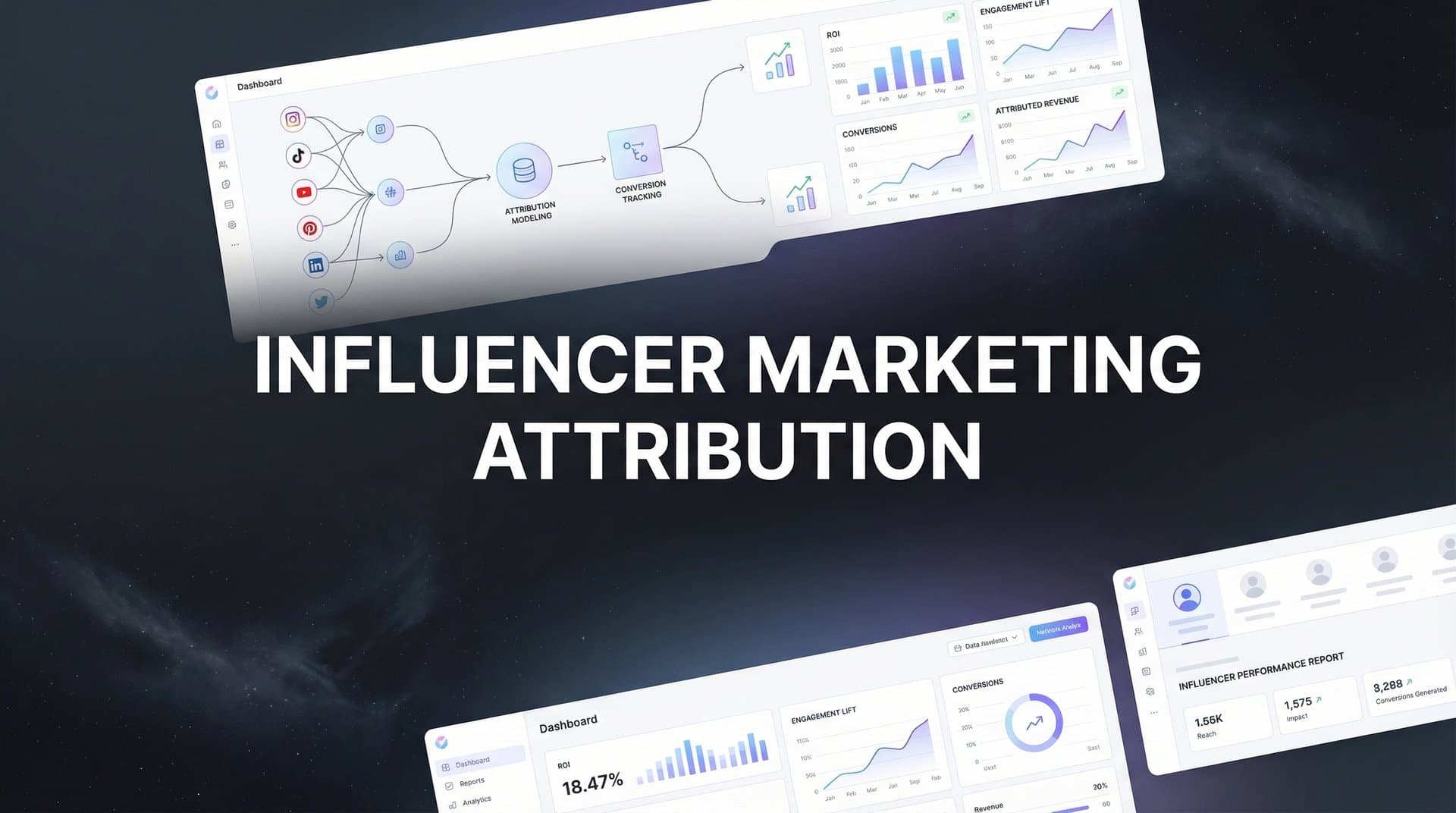
You just wrapped an influencer campaign. The content looked amazing. Engagement was through the roof. Your inbox filled with screenshots of Stories and comments. But when leadership asks about revenue impact, you're left piecing together promo code redemptions, guessing at traffic sources, and hoping the sales spike wasn't just coincidence.
This is the reality for most marketers running influencer campaigns. The content performs, the audience responds, but connecting those creator touchpoints to actual conversions feels like trying to solve a puzzle with half the pieces missing.
Influencer marketing attribution changes that equation entirely. It's the framework that connects every piece of creator content—from that fleeting Instagram Story to the YouTube review someone watches three times before buying—to the conversions and revenue they actually generate. Instead of measuring success by likes and shares, you measure it by the metric that matters: dollars in the door.
Why Traditional Tracking Falls Short for Creator Campaigns
Here's the fundamental problem: influencer content lives in environments that weren't built for tracking.
Instagram Stories disappear after 24 hours. TikTok videos get shared through DMs. YouTube viewers watch on their phone but purchase on their laptop two days later. Someone sees a creator's post, screenshots the product name, then searches for it directly on Google. Your tracking sees the Google search. It completely misses the influencer touchpoint that started the journey.
Traditional web analytics were designed for a simpler world where customers clicked an ad, landed on your site, and converted in the same session. Influencer marketing doesn't work that way. The path from awareness to purchase winds through multiple platforms, devices, and days.
Then iOS 14.5 arrived and made everything harder.
Apple's App Tracking Transparency framework gave users the power to opt out of cross-app tracking. Most did. Suddenly, the already-difficult job of connecting influencer touchpoints to conversions became nearly impossible for campaigns running through iOS apps. You could track that someone clicked a link in an Instagram bio, but if they didn't convert immediately, that connection vanished.
Browser cookie deprecation compounds the challenge. Chrome is phasing out third-party cookies. Firefox and Safari already block them by default. The tracking methods that marketers relied on for years are disappearing, and influencer campaigns—which depend on cross-platform, multi-session journeys—feel the impact most acutely.
The cost of flying blind isn't just frustration. It's real money.
Without proper attribution, you misallocate budgets. You cut partnerships with creators who actually drive conversions because you can't see their impact. You double down on influencers who generate impressive engagement metrics but zero revenue. You negotiate rates based on follower counts instead of conversion data. Every decision becomes a guess instead of a strategy.
Even worse, you miss optimization opportunities. Maybe long-form YouTube reviews drive 3x more conversions than Instagram posts, but you don't know it. Maybe certain product angles or content formats consistently lead to purchases, but that insight stays hidden. Without attribution, you're running campaigns in the dark.
The Building Blocks of Influencer Marketing Attribution
Let's start with the foundation: the tracking methods that make attribution possible.
UTM Parameters: These are tags you add to any URL an influencer shares. They tell your analytics exactly where traffic originated. A properly tagged link looks like: yoursite.com/product?utm_source=instagram&utm_medium=influencer&utm_campaign=spring2026&utm_content=creator_name. When someone clicks that link and converts, you know exactly which creator and which piece of content drove it.
Unique Discount Codes: Assign each influencer a distinct promo code. When customers use it at checkout, you have direct proof of that partnership's revenue impact. The limitation? Only captures conversions where customers actually use the code. Many buyers see the content, visit your site directly, and purchase without entering the code. You get the sale but miss the attribution.
Dedicated Landing Pages: Create unique URLs for each influencer or campaign. Traffic to that specific page came from that specific source. This works particularly well for product launches or limited-time collaborations where the landing page itself becomes part of the campaign narrative.
These methods form your tracking foundation, but they only tell you where traffic came from. They don't tell you which touchpoints actually influenced the conversion. That's where attribution models come in.
First-Touch Attribution: Gives 100% of the credit to the first interaction. If someone discovers your brand through an influencer's TikTok, then later sees your Facebook ad and converts, first-touch credits the TikTok. This model highlights which creators are best at generating awareness and bringing new customers into your ecosystem.
Last-Touch Attribution: Credits the final touchpoint before conversion. If that same customer's last interaction was clicking your Facebook ad, last-touch gives all credit to Facebook. This model shows what closes deals but often undervalues the awareness-building work influencers do early in the journey.
Multi-Touch Attribution: Recognizes that conversions rarely happen from a single interaction. It distributes credit across multiple touchpoints. This is where influencer attribution gets powerful because it reflects reality: customers see content from several creators, visit your site multiple times, and interact with various marketing channels before buying.
But here's the challenge: all these tracking methods rely on client-side data—cookies, browser storage, tracking pixels. When users block cookies or opt out of tracking, you lose visibility.
Server-side tracking solves this by capturing conversion data directly on your server instead of relying on the user's browser. When someone completes a purchase, your server logs that event along with any available attribution data. It's more reliable, respects privacy, and gives you conversion visibility even when client-side methods fail.
Think of it this way: client-side tracking is like asking customers to carry a tracking beacon as they shop. If they refuse, you lose them. Server-side tracking is like your checkout system automatically recording what was purchased and connecting it to marketing data you already have. It works regardless of browser settings or privacy preferences.
Connecting Influencer Touchpoints to Your Full Customer Journey
Understanding attribution models matters, but only if you can see the complete journey your customers take.
The typical path from influencer content to conversion looks something like this: Someone sees a creator's Instagram post about your product. They don't click immediately, but the brand registers in their mind. Three days later, they see another piece of content from a different influencer. Now they're curious. They search your brand name on Google and land on your site. They browse but don't buy. A week later, they see your Facebook retargeting ad and finally convert.
That's five touchpoints across three channels over ten days. Traditional last-click attribution would credit the Facebook ad. You'd optimize for more retargeting. Meanwhile, the two influencer touchpoints that created awareness and consideration would be invisible in your reporting.
This is why integrating influencer data with your complete marketing stack matters so much.
Your CRM holds customer data—email addresses, purchase history, lifetime value. Your ad platforms track paid media interactions. Your analytics show website behavior. Your influencer tracking captures creator touchpoints. When these data sources stay siloed, you see fragments. When you connect them, you see the full story.
Integration means you can answer questions like: Do customers who first discover us through influencers have higher lifetime value than those from paid search? Which creators drive the highest-quality leads that actually close? Are certain influencers better at top-of-funnel awareness while others excel at bottom-funnel conversion?
Here's where it gets strategically interesting: not all influencers serve the same function in your customer journey.
Some creators are awareness machines. They introduce your brand to new audiences. Their followers might not convert immediately, but they enter your ecosystem. They follow your social accounts, subscribe to your email list, or just remember your brand name for later. First-touch attribution reveals these influencers.
Other creators are conversion drivers. Their audience is already familiar with your category and ready to buy. When they recommend your product, conversions happen quickly. Last-touch attribution highlights these partnerships.
The most valuable insight comes from multi-touch attribution: identifying creators who appear multiple times in converting customer journeys. Maybe a customer first sees a lifestyle influencer's casual mention of your product, then watches a detailed review from a different creator, then converts after seeing a third influencer's discount code. All three contributed. A multi-touch marketing attribution platform shows you that pattern.
This visibility transforms how you build your influencer mix. Instead of just working with whoever has the biggest following, you strategically combine awareness creators, consideration creators, and conversion creators to move customers through the entire journey.
Choosing the Right Attribution Model for Your Influencer Strategy
Different campaign goals require different attribution approaches. Using the wrong model doesn't just skew your reporting—it actively misleads your optimization decisions.
Let's start with linear attribution, which distributes credit equally across all touchpoints in the customer journey.
This model works exceptionally well for brand awareness campaigns where you're working with multiple creators to build sustained visibility. If your goal is getting your brand in front of as many people as possible through varied content formats and creator styles, linear attribution shows which creators are contributing to that cumulative effect. It doesn't overvalue the last touchpoint or undervalue early interactions. Every creator who touched the customer journey gets recognized.
Use linear attribution when you're launching a new brand, entering a new market, or running a coordinated campaign where multiple influencers are creating content around the same theme or product launch. It rewards consistency and reach across your entire creator roster.
Time-decay attribution takes a different approach: it gives more credit to touchpoints that happened closer to the conversion.
This model makes sense for product launches and time-sensitive promotions. If you're running a two-week flash sale and working with creators to drive urgency, the influencer content that appeared right before someone purchased probably had more impact than content from three weeks earlier. Time-decay attribution reflects that reality.
It's particularly useful when you're optimizing for immediate conversions rather than long-term brand building. If your influencer brief emphasizes limited-time offers, exclusive access, or urgency-driven messaging, time-decay attribution shows which creators are best at driving fast action.
But here's where attribution gets sophisticated: data-driven attribution.
Instead of following a predetermined rule about how to distribute credit, data-driven models analyze your actual conversion data to identify patterns. They use algorithms to determine which touchpoints genuinely influence purchase decisions based on how converting customers behave differently from non-converting visitors.
Data-driven attribution requires sufficient conversion volume to work effectively. If you're only generating a handful of conversions per month, you don't have enough data for the algorithms to identify meaningful patterns. But once you reach scale—typically hundreds of conversions monthly—data-driven attribution becomes the most accurate way to understand influencer impact. Exploring data science for marketing attribution can help you understand how these algorithms work.
This approach reveals insights that simpler models miss. Maybe customers who see content from both a macro-influencer and a micro-influencer convert at 2x the rate of those who only see one or the other. Maybe video content has 3x more influence on conversion than static posts, even when engagement metrics suggest otherwise. Data-driven attribution surfaces these patterns automatically.
The practical takeaway? Start with simpler models while you build your program and data volume. Linear attribution works for most early-stage influencer programs. As you scale and generate more conversions, graduate to time-decay for promotional campaigns and data-driven for ongoing optimization.
Turning Attribution Insights into Smarter Partnership Decisions
Attribution data is only valuable if it changes how you operate. Here's how to translate insights into action.
Start by identifying your highest-value partnerships. Sort your influencers not by follower count or engagement rate, but by actual revenue generated. You'll likely find surprises. That mid-tier creator with 50,000 followers might be driving more revenue than the macro-influencer with 500,000 because their audience is more aligned with your ideal customer profile and their content style drives action.
Once you identify your revenue-generating creators, double down. Negotiate longer-term partnerships. Give them exclusive access to new products. Increase their compensation. These aren't expenses—they're investments in proven revenue channels. Meanwhile, critically evaluate partnerships that generate impressive vanity metrics but minimal conversions. Either optimize the approach or reallocate that budget to creators who actually drive results.
Attribution data also reveals what content works. Maybe you assumed that polished, professional content performs best, but your data shows that casual, authentic moments drive 2x more conversions. Maybe long-form YouTube reviews outperform quick Instagram posts. Maybe certain product angles or use cases consistently lead to purchases while others generate engagement but not sales.
Use these insights to optimize your creator briefs. If unboxing videos drive conversions, brief more creators to include unboxing moments. If before-and-after content performs, make that a standard element. If certain product benefits resonate more than others, emphasize those in your messaging guidelines. Let conversion data—not assumptions—shape your content strategy.
Here's a powerful but often overlooked application: feeding attribution data back to your ad platforms.
When you run paid amplification of influencer content or retarget people who engaged with creator posts, your ad platforms need conversion data to optimize. If you're only tracking last-click conversions, you're telling Facebook or Google that influencer-initiated journeys don't convert. They optimize accordingly, which means they stop showing your ads to people similar to those who discovered you through creators.
When you properly attribute conversions that started with influencer touchpoints and feed that data back to your ad platforms, their algorithms learn that these audiences are valuable. They optimize to find more people like them. Your paid and influencer strategies start working together instead of competing for credit. Understanding channel attribution in digital marketing helps you see how these pieces connect.
Putting It All Together: Your Influencer Attribution Action Plan
Ready to implement influencer marketing attribution? Here's your quick-start checklist.
Step 1: Implement UTM parameters on every link you give to influencers. Create a simple naming convention and stick to it. Include the source (platform), medium (influencer), campaign name, and creator name. This takes 10 minutes to set up and immediately gives you basic attribution data.
Step 2: Assign unique discount codes to each creator. Make them memorable and on-brand, but distinct enough that you can track usage. This captures direct conversions and gives influencers a clear call-to-action to share.
Step 3: Connect your analytics to your CRM and ad platforms. Even basic integration gives you visibility into how influencer traffic behaves after they land on your site and whether they eventually convert through other channels.
Step 4: Choose an attribution model that matches your current goals. If you're building awareness, start with first-touch or linear. If you're driving immediate sales, use last-touch or time-decay. Don't overcomplicate it initially—you can always evolve your approach as you gather more data.
Step 5: Review your attribution data weekly. Look for patterns. Which creators consistently appear in converting customer journeys? Which content formats drive action? Which partnerships look better or worse than their engagement metrics suggested? Let this data inform your next round of creator outreach and content briefs.
You'll know you've outgrown manual tracking when you're spending more time managing spreadsheets than optimizing campaigns. If you're copying and pasting data between platforms, manually calculating attribution credit, or losing visibility into cross-platform journeys, it's time for an integrated solution. Reviewing the best software for tracking marketing attribution can help you find the right fit.
The signs are clear: you're working with 10+ creators regularly, running campaigns across multiple platforms simultaneously, struggling to connect influencer touchpoints to downstream conversions, or your team is making budget decisions based on incomplete data because pulling accurate reports takes too long.
Here's the competitive advantage you gain when you nail influencer attribution: while your competitors are guessing which creators work and optimizing for vanity metrics, you're making data-driven decisions based on actual revenue impact. You know which partnerships to scale, which content to amplify, and which strategies to cut. You're not just running influencer campaigns—you're running a revenue-generating machine that gets smarter with every conversion.
The Shift from Guesswork to Growth
Influencer marketing attribution transforms creator partnerships from a branding experiment into a measurable, optimizable revenue channel. It replaces the anxiety of not knowing what's working with the confidence of having clear data about which creators, content, and strategies actually drive conversions.
The shift from measuring likes to marketing revenue attribution changes everything. Your budget conversations become easier because you can prove ROI. Your creator negotiations become more strategic because you know what performance actually looks like. Your content strategy improves because you're optimizing based on what converts, not what gets comments.
Most importantly, you stop leaving money on the table. Those converting customers who discovered you through influencer content but purchased through another channel? You see them now. Those high-performing creators who were undervalued because their impact wasn't visible? You identify and scale them. Those budget dollars going to partnerships that generate buzz but not revenue? You reallocate them to what works.
The marketers winning with influencer campaigns aren't necessarily working with bigger creators or spending more money. They're the ones who can see the complete customer journey, attribute conversions accurately, and optimize based on revenue data instead of engagement metrics. Overcoming attribution challenges in marketing analytics is what separates the leaders from the rest.
Ready to elevate your marketing game with precision and confidence? Discover how Cometly's AI-driven recommendations can transform your ad strategy—Get your free demo today and start capturing every touchpoint to maximize your conversions.



