You've just wrapped up another monthly marketing review, and the numbers don't add up. Google Ads claims credit for 150 conversions. Meta says they drove 180. Your email platform insists they influenced 90 deals. Add them all together, and you've somehow generated 420 conversions when your CRM shows only 200 actual leads came in.
Sound familiar?
This isn't just a reporting glitch. It's the fundamental challenge every marketer faces when trying to answer the most important question in marketing: where are my best leads actually coming from?
Understanding lead sources—the specific channels, campaigns, and touchpoints that bring potential customers into your pipeline—is the foundation of every smart marketing decision. When you know which sources generate leads that actually convert to revenue, you can confidently scale what works and cut what doesn't. When you're flying blind, you're essentially burning budget hoping something sticks.
The good news? Modern attribution technology has evolved to solve these tracking challenges. The shift from guesswork to data-driven strategy starts with understanding what lead sources really are, why traditional tracking methods fail, and how to build a system that shows you the complete truth about where your best customers originate.
What Makes Up a Lead Source
At its core, a lead source is the specific channel, campaign, or touchpoint that brings a potential customer into your business ecosystem. Think of it as the answer to "How did this person find us?" But that simple question has layers of complexity beneath it.
The most basic distinction is between first-touch sources and the full multi-touch journey. First-touch attribution identifies where someone initially discovered you—maybe they clicked a Facebook ad, found you through Google search, or heard about you from a colleague. This initial touchpoint matters because it represents the moment someone went from unaware to aware of your solution.
But here's where it gets interesting: most B2B buyers interact with your brand multiple times before converting. They might discover you through a LinkedIn ad, return via organic search a week later, download a guide from an email campaign, and finally convert after clicking a retargeting ad. Each of these represents a different lead source touchpoint in their journey. Understanding lead attribution helps you map these complex paths accurately.
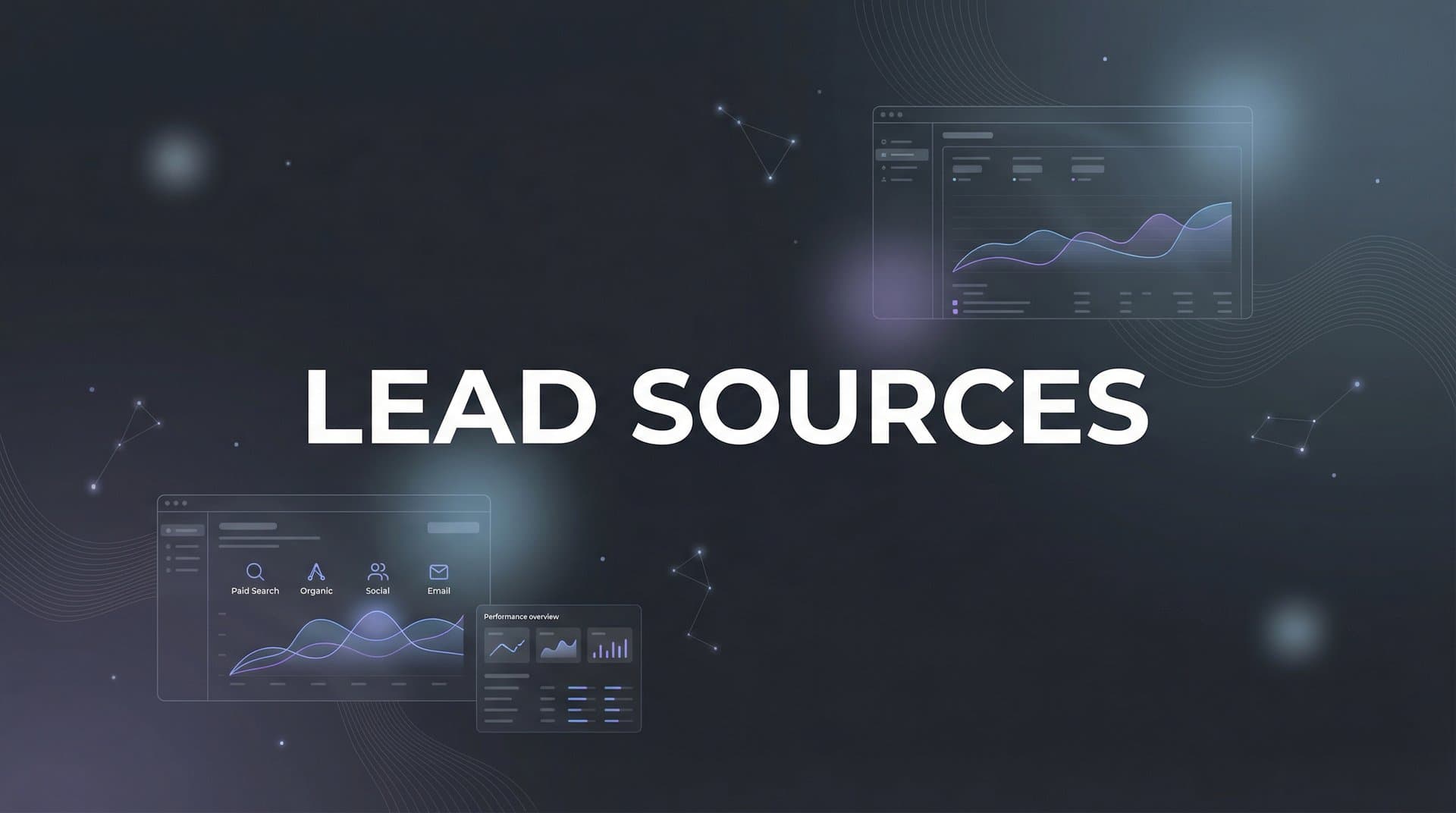
Lead sources operate at different levels of granularity. At the broadest level, you have source categories: paid advertising, organic traffic, referrals, direct visits, and offline channels. These categories help you understand the general mix of how leads find you.
Drill down further, and you get channel-specific sources. Within paid advertising, you might have Google Search, Meta ads, LinkedIn campaigns, and display networks. Within organic, you're looking at SEO traffic, content marketing, and social media engagement.
The most granular level tracks specific campaigns, ad sets, keywords, and even individual ads. This is where the real optimization power lives. You don't just know that "paid social" generated a lead—you know it came from your Q1 product launch campaign, specifically the carousel ad highlighting your automation features, targeted at marketing managers in SaaS companies.
This granularity transforms how you make decisions. Instead of vague observations like "social ads seem to work," you can confidently say "our automation-focused carousel ads to SaaS marketing managers generate leads with a 40% higher close rate than our general awareness campaigns." That specificity is what separates guessing from knowing.
Breaking Down Lead Source Categories
Different lead source categories attract prospects at different stages of awareness and with varying levels of intent. Understanding these distinctions helps you set realistic expectations and measure each source appropriately.
Paid Search: When someone searches for "marketing attribution software" and clicks your Google ad, they're demonstrating active intent. They have a problem and they're actively looking for solutions right now. Paid search typically brings in leads further along the buyer journey with higher immediate conversion potential but often at a higher cost per lead.
For a deeper dive into this space, see our AI banner ad generator guide.
Paid Social: Social platform ads work differently. Someone scrolling LinkedIn or Facebook isn't necessarily looking for your solution at that moment. Your ad interrupts their feed, which means you're often catching prospects earlier in their journey. The trade-off? Lower immediate intent but potentially higher volume at lower cost, with longer nurture cycles before conversion. Platforms like LinkedIn lead ads can be particularly effective for B2B targeting.
Display Advertising: Banner ads and programmatic display serve a different purpose. They build awareness and keep your brand visible across the web. Display sources often show up as assist touches in multi-touch attribution rather than direct converters. They're the background chorus that makes other channels more effective.
Organic Search: SEO-driven traffic represents people finding you through unpaid search results. These leads discovered you while actively researching solutions, similar to paid search but without the ad spend. The challenge? Organic search takes time to build and requires consistent content investment, but it compounds over time.
Content Marketing: Blog posts, guides, webinars, and educational resources attract prospects through value delivery. Someone who downloads your "Complete Guide to Attribution Models" is raising their hand as interested, even if they're not ready to buy today. Content sources build your pipeline with leads you can nurture over time.
Email Marketing: Your email list represents people who've already engaged with your brand. Email as a lead source typically indicates someone taking the next step in their journey—moving from subscriber to qualified lead. The conversion rates are often higher because of this existing relationship.
Referral Sources: When existing customers, partners, or industry peers send leads your way, you're benefiting from borrowed trust. Referral sources often convert at higher rates and close faster because they come pre-validated by someone the prospect already trusts.
Direct Traffic: When someone types your URL directly or uses a saved bookmark, they're categorized as direct traffic. This can mean strong brand awareness, but it's also a catch-all category that sometimes includes misattributed traffic from other sources due to tracking limitations.
The key insight? No single source category is inherently "best." A paid search lead might convert faster, but a content marketing lead might become a larger customer over time. Your job is understanding how each source fits into your overall acquisition strategy and measuring them by the metrics that actually matter for your business.
Where Traditional Tracking Breaks Down
Here's the uncomfortable truth: the lead source data you're looking at right now is probably incomplete, overlapping, or just plain wrong. Not because you're doing something wrong, but because the foundation of traditional tracking has fundamentally shifted.
The iOS privacy changes that rolled out starting in 2021 broke the browser-based tracking that marketers relied on for years. When Apple introduced App Tracking Transparency, users could simply opt out of cross-app tracking. The result? Ad platforms lost visibility into significant portions of user behavior, especially on mobile devices where much browsing happens.
Cookie deprecation compounds this challenge. As browsers phase out third-party cookies, the ability to track users across websites deteriorates. That prospect who clicked your LinkedIn ad, visited your site, left, then came back three days later via Google search? Traditional cookie-based tracking increasingly fails to connect those dots as the same person.
Cross-device journeys create another blind spot. Someone might discover you on their phone during their commute, research on their work laptop during the day, and convert on their home computer in the evening. Each device looks like a different person to cookie-based tracking systems, fragmenting what should be recognized as a single customer journey.
Then there's the attribution overlap problem. Each ad platform tracks conversions using its own attribution window and logic. Google Ads might use a 30-day click window and claim credit for any conversion that happens within 30 days of someone clicking your ad. Meta uses similar logic with their own windows. The problem? These windows overlap.
If someone clicks your Google ad on Monday, clicks your Facebook ad on Wednesday, and converts on Friday, both platforms claim that conversion. Multiply this across all your channels and you get the inflated numbers that don't match your CRM. The platforms aren't lying—they're each applying their own attribution rules independently, with no coordination.
The most critical gap, though, is between marketing-reported leads and actual revenue outcomes. Your ad platforms know someone filled out a form. What they don't know is whether that lead became a qualified opportunity, entered your sales pipeline, or eventually closed as a customer. They definitely don't know the deal size or lifetime value. This is why lead generation attribution tracking has become essential for modern marketing teams.
This disconnect means you're optimizing for the wrong metrics. You might pour budget into a source that generates high lead volume while unknowingly starving the source that generates fewer leads but far more revenue. Without connecting lead sources all the way through to revenue, you're making decisions based on incomplete information.
How to Build Reliable Lead Source Tracking
Accurate lead source tracking isn't magic—it's infrastructure. The good news is that the technology exists to solve the challenges we just outlined. The key is implementing a system that captures data reliably and connects it across your entire marketing and sales stack.
Start with proper UTM parameter implementation. UTM tags are the snippets you add to your URLs that identify the source, medium, campaign, and content of each link. When someone clicks a link with UTM parameters, those values travel with them and get captured when they convert. The catch? You need consistent naming conventions across all your campaigns, or you'll end up with fragmented data that's impossible to analyze.
Create a UTM naming structure and document it. Define how you'll label sources (google, facebook, linkedin), mediums (cpc, social, email), and campaigns (Q1-product-launch, webinar-series-march). Consistency here is non-negotiable. "Facebook" and "facebook" and "fb" all look like different sources in your analytics.
Server-side tracking represents the next evolution beyond browser-based methods. Instead of relying on cookies and client-side JavaScript, server-side tracking captures data directly from your server when events occur. This bypasses many of the privacy restrictions and tracking blockers that break traditional methods.
When someone submits a form on your site, server-side tracking sends that conversion event directly from your server to your analytics and ad platforms. This approach is more reliable, more privacy-compliant, and gives you better data accuracy. It also allows you to enrich conversion events with additional data from your CRM before sending them to ad platforms.
CRM integration is where lead source tracking transforms from interesting data into business intelligence. When you connect your marketing tools to your CRM, you can track leads through their entire lifecycle. You see not just which source generated a lead, but which sources generate leads that become opportunities, close as customers, and deliver the highest lifetime value.
This connection requires technical implementation—typically through native integrations, APIs, or marketing attribution platforms that sit between your ad channels and CRM. The investment pays off when you can finally answer questions like "Which lead source has the highest opportunity-to-close rate?" or "What's the average deal size from organic versus paid sources?"
Attribution models determine how credit gets distributed across touchpoints. First-touch attribution gives all credit to the initial source. Last-touch credits the final interaction before conversion. Linear attribution spreads credit equally across all touches. Time-decay gives more weight to recent interactions. U-shaped (position-based) emphasizes both the first and last touch while distributing some credit to middle interactions. Choosing the right lead attribution model depends on your sales cycle and business goals.
The model you choose changes which sources look most valuable. A first-touch model might make your awareness campaigns look great. A last-touch model favors your retargeting and bottom-funnel tactics. The reality? Most customer journeys involve multiple touches, so understanding the full path matters more than picking a single "winner." Multi-touch attribution models attempt to reflect this complexity by showing how different sources work together to drive conversions.
Transforming Data Into Budget Optimization
Having accurate lead source data is pointless if you don't act on it. The real value emerges when you start analyzing sources by quality metrics and making budget decisions based on revenue outcomes rather than vanity metrics.
Stop measuring lead sources by lead volume alone. A source that generates 100 leads sounds better than one that generates 20 leads—until you discover the first source converts at 2% to closed deals while the second converts at 30%. Suddenly those 20 leads are worth far more than the 100. This is where understanding lead quality score becomes critical.
Analyze your lead sources by conversion rate to opportunity. What percentage of leads from each source actually become qualified opportunities that your sales team pursues? This metric reveals which sources bring in tire-kickers versus serious buyers. You might find that your expensive paid search campaigns generate leads that convert to opportunities at three times the rate of cheaper display ads.
Look at average deal size by source. Different channels often attract different customer profiles. Enterprise customers might discover you through content marketing and organic search, while smaller businesses come through paid social. If your business model favors larger deals, you want to identify and scale the sources that attract bigger fish, even if they generate fewer total leads.
Consider sales cycle length. Some sources bring in leads that close quickly. Others require longer nurture periods. Neither is inherently better, but understanding these patterns helps you forecast pipeline and set realistic expectations. If you know LinkedIn leads typically take 90 days to close while Google search leads close in 45 days, you can plan your sales capacity and cash flow accordingly. Tracking time to qualified lead helps you benchmark these patterns.
The optimization process becomes straightforward once you have this quality data. Identify your high-performing sources—the channels that generate leads with strong conversion rates, good deal sizes, and acceptable sales cycles. These deserve more budget. Find your underperformers—sources that look good on lead volume but fail to convert to revenue. Scale back or eliminate this spend.
Here's where it gets powerful: feeding accurate conversion data back to ad platforms improves their optimization algorithms. When you send Facebook or Google data about which leads actually converted to customers, their machine learning systems get better signals about what a valuable user looks like. This creates a virtuous cycle where your ads get shown to more people who resemble your actual customers, improving performance over time.
Most ad platforms offer conversion APIs that allow you to send server-side conversion events back to them. When you implement this properly, you're not just telling Facebook that someone filled out a form—you're telling them when that lead became an opportunity, when they closed as a customer, and potentially the deal value. This enriched data makes their algorithms significantly more effective at finding similar high-value prospects.
Making Lead Source Intelligence Actionable
Understanding lead sources transforms from theoretical knowledge into competitive advantage when you systematically implement proper tracking, connect your data ecosystem, and analyze by the metrics that actually drive your business forward.
The implementation path is clear. First, audit your current lead source tracking. Can you reliably identify where every lead originated? Do you have consistent UTM parameters across all campaigns? Is your tracking working across devices and surviving privacy restrictions? Most marketers discover significant gaps in this audit. Following a structured approach to improving your lead tracking process can help address these gaps systematically.
Second, implement the infrastructure for accurate tracking. Set up server-side tracking to bypass browser limitations. Create and document your UTM naming conventions. Ensure every campaign link is properly tagged. Connect your ad platforms to your CRM so you can track leads through to revenue outcomes.
Third, shift your analysis from volume metrics to quality metrics. Build reports that show conversion rates by source, average deal size by source, and sales cycle length by source. Look at customer lifetime value by acquisition source if you have that data. These quality metrics reveal which sources actually drive business growth versus which ones just generate activity.
The competitive advantage is real. While your competitors are still arguing about whether Facebook or Google is "better" based on platform-reported conversions, you know exactly which campaigns, ad sets, and even individual ads drive qualified opportunities and closed revenue. You can confidently scale what works and kill what doesn't.
This clarity compounds over time. Every month of accurate lead source data makes your future decisions smarter. You identify patterns about which sources work best for different customer segments. You learn which combinations of touchpoints create the highest conversion rates. You build a proprietary understanding of your customer acquisition that competitors can't replicate.
Start by identifying the biggest gap in your current lead source tracking. Is it the technical implementation of tracking itself? The connection between marketing and CRM data? The analysis and reporting layer? Pick one gap and fix it this quarter. The incremental improvements add up to transformation.
The Path Forward
Understanding lead sources isn't just another marketing metric to track. It's the fundamental intelligence that separates confident, data-driven budget decisions from expensive guesswork. When you know exactly which sources drive your best customers, you gain the power to systematically scale what works and eliminate what doesn't.
The marketing landscape has evolved. Privacy changes, cookie deprecation, and cross-device journeys have broken traditional tracking methods. But the solution exists: server-side tracking, proper CRM integration, and attribution software that connects marketing activity to actual revenue outcomes.
The marketers who win in this environment are those who build the infrastructure to capture accurate lead source data and the discipline to act on it. They measure sources by quality, not just quantity. They feed enriched conversion data back to ad platforms to improve optimization. They make budget decisions based on revenue outcomes rather than platform-reported conversions.
This isn't about having perfect data—it's about having significantly better data than you have today, and using that data to make incrementally better decisions every week. The compound effect of those better decisions is what transforms marketing from a cost center into a predictable growth engine.
Ready to elevate your marketing game with precision and confidence? Discover how Cometly's AI-driven recommendations can transform your ad strategy—Get your free demo today and start capturing every touchpoint to maximize your conversions.