You're running ads on Meta, Google, LinkedIn, and TikTok. Leads are coming in. Your CRM is filling up with contact forms and demo requests. But when you open your reporting dashboards, something doesn't add up.
Meta claims 47 conversions. Google says 38. LinkedIn reports 22. Add them together and you've got 107 leads—but your CRM only shows 65 new entries this month. Each platform is taking credit for leads that don't exist, or worse, they're all claiming the same leads as their own wins.
You're spending thousands across these channels, but you have no clear answer to the most fundamental question in marketing: which campaigns actually drove those 65 leads? This isn't just a reporting annoyance. It's a strategic blindspot that's costing you money every single day you operate without clarity.
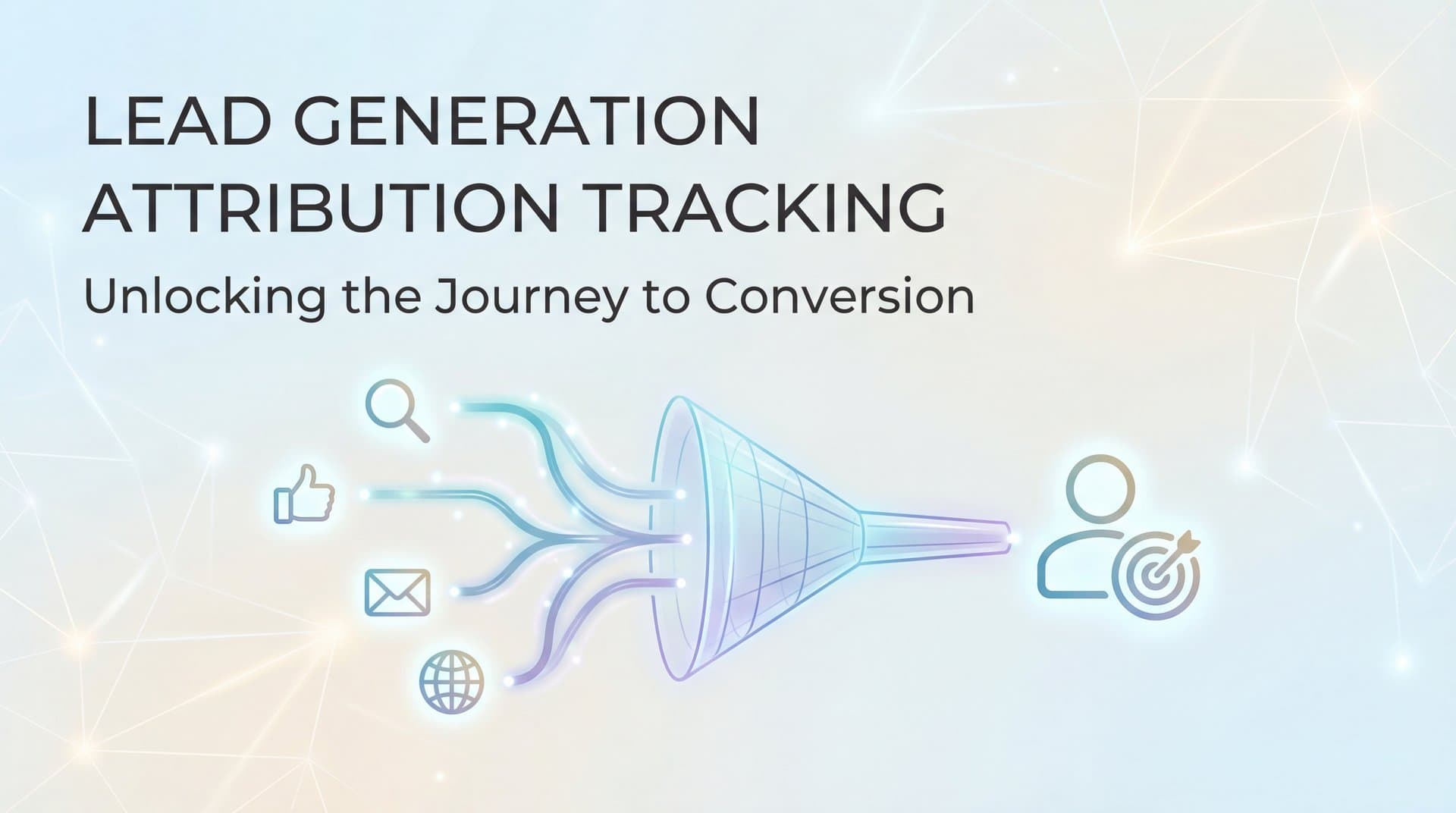
Lead generation attribution tracking solves this problem by connecting the dots between your marketing touchpoints and actual lead acquisition. It goes beyond what each ad platform reports to give you an independent, unified view of how leads really find you. This guide will walk you through what attribution tracking is, why it matters specifically for lead generation, and how to implement it so you can finally know which marketing efforts deserve more budget and which ones are wasting it.
The Gap Between Marketing Spend and Lead Reality
Lead generation attribution tracking is the systematic process of identifying and crediting the marketing interactions that contribute to someone becoming a lead. This is fundamentally different from basic conversion tracking or general website analytics.
Conversion tracking tells you that a form was submitted. Website analytics shows you traffic sources. But attribution tracking maps the complete journey—from the first ad click three weeks ago, through the organic search visit last Tuesday, to the email click yesterday that finally triggered the demo request.
Modern lead journeys are inherently multi-touch. Someone might see your LinkedIn ad on Monday during their commute, search for your brand on Google Wednesday afternoon, click a retargeting ad on Friday, and finally submit a contact form after reading a blog post the following week. That's four distinct touchpoints across three different channels before a single lead enters your system.
Here's where it gets messy: each platform wants to take credit. Meta's pixel fires when someone converts after clicking your ad—even if that click happened 28 days ago and wasn't the primary driver. Google Ads claims the conversion because the person searched your brand name before converting. LinkedIn counts it because their ad was in the initial consideration set.
They're all technically correct based on their own attribution windows and tracking logic. But they're also all wrong if you're trying to understand the actual sequence of events that led to that lead. Learning how to fix attribution discrepancies in data becomes essential for accurate reporting.
This isn't just a philosophical problem about credit assignment. It has real consequences for your marketing budget. If you believe Meta's reporting, you might think your Facebook campaigns are crushing it and deserve more spend. But if that traffic is actually just capturing demand created by your LinkedIn thought leadership or Google Search campaigns, you're optimizing based on false signals.
The disconnect gets worse when you factor in your CRM data. Platform pixels track conversions, but they don't know which leads actually qualified for sales conversations, which turned into opportunities, or which closed as customers. A lead source might generate high volume but terrible quality. Without attribution tracking that connects marketing touchpoints to CRM outcomes, you're flying blind on the metrics that actually matter for revenue.
Lead generation attribution tracking closes this gap by creating an independent source of truth. Instead of relying on what each platform claims, you track the complete customer journey from first interaction through lead capture and beyond, giving you a unified view of which marketing efforts actually drive the leads that matter.
How Attribution Models Shape Your Understanding of Lead Sources
Once you're tracking the complete lead journey, you need to decide how to assign credit across those touchpoints. This is where attribution models come in—and your choice dramatically changes which channels look like winners or losers.
First-Touch Attribution: This model gives 100% of the credit to the first interaction someone had with your marketing. If a lead's journey started with a LinkedIn ad, that's what gets credited—regardless of the five other touchpoints that happened afterward. First-touch makes sense when you're focused on top-of-funnel awareness and want to understand which channels are best at introducing new prospects to your brand. It's particularly useful for content-driven strategies where initial discovery matters more than conversion mechanics.
Last-Touch Attribution: The opposite approach—100% credit goes to the final touchpoint before conversion. If someone clicked a Google Search ad right before submitting your contact form, that ad gets all the credit. Last-touch is simple and aligns with how most ad platforms report by default. It works well for direct response campaigns where the goal is immediate conversion, but it completely ignores the nurturing that happened earlier in the journey.
Here's the problem with single-touch models: they're incomplete by design. In B2B and complex sales cycles, leads rarely convert on first contact. They research, compare, and return multiple times before taking action. Understanding the difference between single source attribution and multi-touch attribution models helps you choose the right approach for your business.
Linear Attribution: This model splits credit equally across all touchpoints. If someone had five interactions before becoming a lead, each one gets 20% credit. Linear attribution acknowledges that multiple channels contributed, which is more realistic than single-touch models. The downside? It assumes every touchpoint had equal influence, which probably isn't true. The initial awareness ad and the final retargeting click likely played different roles in the decision.
Time-Decay Attribution: This approach gives more credit to touchpoints closer to conversion. The logic is that recent interactions had more influence on the final decision than earlier ones. Time-decay works well when you have longer sales cycles where early research matters less than recent engagement. It's particularly useful for campaigns with strong remarketing components where you're nurturing leads over weeks or months.
Position-Based Attribution: Also called U-shaped attribution, this model assigns 40% credit to the first touch, 40% to the last touch, and splits the remaining 20% among middle interactions. It recognizes that discovery and conversion moments are typically most important while still acknowledging the nurturing that happened in between. Many B2B marketers prefer this model because it balances awareness and conversion without ignoring the journey.
So which model should you use? The honest answer is: it depends on your business model and sales cycle length. If you're running direct response campaigns with short consideration periods—think webinar signups or ebook downloads—last-touch attribution might give you the clearest optimization signals. You want to know what's driving immediate action.
If you're in B2B SaaS with 30-90 day sales cycles, position-based or time-decay models typically provide more realistic insights. Your leads are taking time to evaluate, and multiple touchpoints genuinely contribute to their decision. Ignoring that complexity with single-touch attribution leads to bad budget decisions. For a deeper dive, explore our guide on lead attribution models and their applications.
The most sophisticated approach is to analyze your data through multiple attribution lenses. Look at first-touch to understand your awareness engines. Check last-touch to see what's closing leads. Compare them to position-based to get the full picture. When you see consistent patterns across models—a channel performs well in all views—you've found a genuinely strong lead source worth scaling.
Building Your Attribution Tracking Infrastructure
Understanding attribution models is one thing. Actually tracking the data is another. Building reliable lead generation attribution requires connecting several technical pieces that work together to capture the complete customer journey.
Tracking Pixels and Tags: These are the foundation. You need pixels from each ad platform—Meta Pixel, Google Ads tag, LinkedIn Insight Tag—installed on your website to track when people from those platforms visit and convert. But here's the critical detail most marketers miss: you also need a first-party tracking solution that captures all traffic, not just paid sources. This becomes your independent source of truth that reconciles what each platform claims.
UTM Parameters: Every single marketing link you share should include UTM parameters that identify the source, medium, campaign, and content. This applies to paid ads, email campaigns, social posts, and any other trackable channel. UTM parameters are how you maintain attribution when someone moves between devices or when cookie-based tracking fails. They're simple to implement but require discipline—inconsistent UTM naming breaks your attribution data.
The structure matters. Use consistent naming conventions: lowercase, underscores instead of spaces, descriptive campaign names that you'll understand six months from now. "utm_campaign=q1_linkedin_awareness" is infinitely more useful than "utm_campaign=test123" when you're analyzing results later.
Server-Side Tracking: Browser-based tracking is increasingly unreliable. iOS privacy changes block many pixels. Ad blockers prevent tracking scripts from loading. Third-party cookies are being phased out across browsers. Server-side tracking solves this by sending conversion data directly from your server to ad platforms, bypassing browser limitations entirely.
This requires more technical setup—you're essentially building a bridge between your website backend and each ad platform's API—but it dramatically improves data accuracy. When someone submits a lead form, your server captures that event and sends it to Meta, Google, and other platforms with the associated click IDs that connect the conversion back to specific ads. Our comprehensive attribution tracking setup guide walks through this process step by step.
CRM Integration: This is where attribution tracking becomes truly valuable for lead generation. Your CRM is where leads live after they convert—where they get qualified, nurtured, and (hopefully) closed as customers. Connecting your attribution data to your CRM lets you track not just which channels drive leads, but which channels drive qualified leads and revenue.
The integration works both ways. Marketing data flows into the CRM so you can see which touchpoints preceded each lead. CRM data flows back to your analytics so you can calculate metrics like cost-per-qualified-lead and cost-per-customer by channel. Without this connection, you're optimizing for lead volume when you should be optimizing for lead quality.
The technical implementation varies by CRM platform, but the concept is consistent: every lead record should include attribution data showing which campaigns and channels contributed to that person becoming a lead. Many modern CRMs have native integrations with major ad platforms, but you'll likely need a dedicated attribution tool to capture the complete multi-touch journey. Explore top lead tracking software for marketers to find the right solution for your needs.
Cross-Device Identity Resolution: Someone might click your LinkedIn ad on their phone during lunch, research your product on their work laptop that afternoon, and submit a contact form on their tablet at home that evening. That's one person, one lead journey, three different devices. Without identity resolution, your attribution data sees three separate visitors and can't connect the dots.
Identity resolution uses signals like email addresses, phone numbers, and probabilistic matching based on behavior patterns to recognize when different sessions belong to the same person. When someone submits a lead form with their email, you can retroactively connect all their previous anonymous sessions to build the complete attribution picture.
The challenge is doing this while respecting privacy regulations. You need explicit consent to track individuals across sessions, clear privacy policies, and systems that honor opt-out requests. The technical complexity is real, which is why most companies use dedicated attribution platforms rather than building this infrastructure themselves.
From Raw Data to Revenue Insights
You've built the tracking infrastructure. Data is flowing. Now comes the part that actually impacts your marketing decisions: turning that attribution data into insights that tell you where to spend more and where to cut back.
Start by identifying your highest-performing lead sources at the campaign level, not just the channel level. "Google Ads" isn't specific enough. You need to know which specific campaigns, ad groups, and even individual ads are driving qualified leads. Attribution data lets you see this granularity because it connects individual touchpoints back to lead outcomes.
Pull a report showing all leads from the past 30 days with their complete attribution paths. Group them by first-touch source to understand your awareness engines. Then group by last-touch to see what's driving final conversions. Look for patterns: Are certain campaigns consistently appearing in high-value lead journeys? Are there channels that show up frequently in the middle of paths but rarely as first or last touch?
This analysis reveals your true marketing ecosystem. You might discover that LinkedIn ads are exceptional at initial awareness but rarely convert directly, while Google Search campaigns capture that demand later in the journey. That insight changes how you allocate budget—you need both channels working together, not competing for the same last-touch credit. Understanding cross channel attribution for marketing ROI helps you see this complete picture.
Calculate True Cost-Per-Lead: Platform-reported CPL numbers are misleading when multiple channels claim the same conversions. Your attribution data gives you the real number. Take your total marketing spend across all channels and divide by the actual number of unique leads in your CRM. That's your blended CPL—the true cost of lead acquisition.
Then calculate CPL by attribution model. Under first-touch attribution, what's your cost per lead for each channel? How does that change under last-touch or position-based models? Channels that look expensive under one model might be efficient under another, which tells you something about their role in the customer journey.
Go Deeper with Cost-Per-Qualified-Lead: Raw lead volume means nothing if those leads don't qualify for sales conversations. This is where CRM integration becomes critical. Tag leads in your CRM as marketing qualified, sales qualified, or disqualified based on your qualification criteria. Then calculate CPL for each tier by channel.
You might find that one channel drives high lead volume at low CPL, but most of those leads are unqualified. Another channel generates fewer leads at higher CPL, but they qualify at twice the rate. The second channel is more valuable even though its surface-level metrics look worse. Attribution data connected to CRM outcomes reveals this reality.
Budget Allocation Decisions: Armed with accurate CPL and CPQL data across attribution models, you can make informed budget decisions. Channels that perform well across multiple attribution views deserve more investment. Campaigns that consistently appear in high-value lead paths should scale even if their last-touch numbers look mediocre.
The key is to look at contribution, not just conversion. A channel might contribute to 60% of your qualified leads even if it only gets last-touch credit for 30%. That contribution matters. Cutting budget from that channel because its last-touch CPL looks high would damage your overall lead generation even if it improves that one metric. Leveraging marketing attribution analytics helps you make these nuanced decisions with confidence.
Set up a regular review cadence—weekly for fast-moving campaigns, monthly for longer sales cycles. Compare actual CRM lead outcomes against what each platform reported. Track how attribution patterns change as you adjust budgets. The goal is continuous optimization based on complete data, not reactive changes based on incomplete platform metrics.
Feeding Better Data Back to Ad Platforms
Attribution tracking isn't just about understanding what happened. It's also about improving what happens next. When you feed accurate conversion data back to ad platforms, their algorithms get smarter about finding more high-quality leads.
This process is called conversion sync or conversion API implementation. Instead of relying solely on browser pixels that miss conversions due to tracking limitations, you send conversion events directly from your server to ad platforms. But here's where it gets powerful: you can send enriched conversion data that includes lead quality signals the platforms wouldn't otherwise see.
Think about what happens with standard pixel tracking. Someone submits a lead form, the pixel fires, and Meta or Google records a conversion. That's all they know—someone converted. They don't know if that lead qualified for sales, what their company size was, whether they matched your ideal customer profile, or if they eventually became a customer.
With conversion sync connected to your CRM, you can send that additional context. When a lead gets marked as sales-qualified in your CRM three days after converting, you send an updated conversion event to the ad platforms with that qualification status. When they close as a customer 45 days later, you send another event with the revenue value. This approach to marketing attribution platforms with revenue tracking transforms how you optimize campaigns.
This feedback loop teaches ad platform algorithms what a valuable lead actually looks like for your business. Meta's algorithm learns that leads from certain demographics, interests, or behaviors are more likely to qualify and close. Google's smart bidding starts optimizing for qualified leads, not just any form submission. The platforms get better at finding your ideal prospects because you're giving them better training data.
The impact compounds over time. As algorithms learn from enriched conversion data, they surface your ads to more qualified audiences. Your cost per qualified lead decreases even as your cost per raw lead might stay the same or increase slightly. You're paying for better quality, which is exactly what you want.
Server-side conversion sync also solves attribution challenges on the platform side. When browser tracking fails due to iOS restrictions or ad blockers, platforms lose visibility into which ads drove conversions. This makes their algorithms less effective because they're optimizing with incomplete data. Server-side tracking recovers those lost conversions, giving platforms a more complete picture of campaign performance. For Facebook specifically, mastering Facebook attribution tracking is critical for accurate data flow.
The technical implementation requires API access and proper event matching. You need to send conversion events with identifiers that platforms can match back to ad clicks—typically hashed email addresses, phone numbers, or platform-specific click IDs. The setup complexity is why many companies use attribution platforms that handle conversion sync automatically rather than building custom integrations for each ad platform.
The strategic benefit is clear: your attribution insights don't just inform your decisions—they actively improve campaign performance by making ad platform algorithms smarter about who to target and how to bid.
Putting Attribution Tracking Into Action
You understand the concepts. You know why attribution tracking matters. Now here's your practical roadmap for implementation, broken down into actionable steps you can start today.
Implementation Checklist:
1. Audit your current tracking setup. Document which pixels are installed, how UTM parameters are being used, and what data is flowing into your CRM. Identify gaps where conversions might be happening without proper attribution.
2. Standardize your UTM naming conventions across all marketing channels. Create a documented structure that everyone on your team follows. Build templates for common campaign types to ensure consistency.
3. Implement server-side tracking for your key conversion events. Start with lead form submissions, then expand to other valuable actions like demo bookings or trial signups. This recovers conversions that browser-based tracking misses.
4. Connect your marketing data to your CRM. Ensure every lead record includes attribution information showing which campaigns and channels contributed to that lead. Set up fields for first-touch source, last-touch source, and all touches in between.
5. Define your lead qualification criteria and implement tagging in your CRM. You need consistent qualification standards to calculate meaningful cost-per-qualified-lead metrics by channel.
6. Choose your primary attribution model based on your sales cycle length and business model. Set up reporting dashboards that show performance under that model, but also include views of first-touch and last-touch for comparison. Review our comparison of attribution models for marketers to make an informed choice.
7. Configure conversion sync to send qualified lead events and closed customer events back to your ad platforms. This creates the feedback loop that improves targeting over time.
Key Metrics to Monitor: Track cost-per-lead and cost-per-qualified-lead by channel under your chosen attribution model. Monitor attribution path length—how many touchpoints leads have before converting. Watch for changes in lead quality by source as you optimize campaigns. Compare platform-reported conversions against your independent attribution data to understand discrepancies.
Review Cadence: Check attribution reports weekly if you're running active campaigns with significant spend. Look for sudden changes in attribution patterns that might signal tracking issues or campaign performance shifts. Conduct monthly deep dives where you analyze lead quality outcomes by source and adjust budget allocation based on CPQL trends. Quarterly, review your attribution model choice to ensure it still aligns with how your business and sales cycle have evolved.
Attribution tracking is not a set-it-and-forget-it implementation. Customer journeys change as you add new channels, adjust messaging, and enter new markets. Your tracking infrastructure needs to evolve with your marketing strategy. Build time into your workflow for ongoing optimization—refining UTM parameters, updating conversion events, and testing new attribution models as your data matures. Following 5 steps to improving your lead tracking process can help you maintain momentum.
Your Path to Data-Driven Lead Generation
Lead generation without attribution tracking is expensive guesswork. You're making budget decisions based on incomplete data, trusting platform reports that contradict each other, and optimizing for metrics that don't connect to actual business outcomes.
Attribution tracking transforms this reality. It gives you an independent, unified view of how leads actually find you across every touchpoint and channel. You see which campaigns drive awareness, which ones nurture consideration, and which ones convert—and you understand how they work together rather than competing for credit.
More importantly, attribution tracking connects marketing activity to revenue outcomes. You stop optimizing for lead volume and start optimizing for lead quality. You identify which sources generate prospects that actually qualify, engage with sales, and close as customers. That insight is worth infinitely more than knowing which platform claims the most conversions.
The implementation requires technical work—tracking pixels, server-side integration, CRM connections, and conversion sync. But the alternative is continuing to operate with a fundamental blindspot about which marketing investments actually drive your business forward. Every day without proper attribution is another day of budget waste you can't see and opportunities you can't identify.
Ready to elevate your marketing game with precision and confidence? Discover how Cometly's AI-driven recommendations can transform your ad strategy—Get your free demo today and start capturing every touchpoint to maximize your conversions.