You log into your ad dashboard the morning after a major iOS update drops. The numbers look wrong. Conversions are down sharply, cost per acquisition has spiked, and your best-performing campaigns suddenly look like money pits. You haven't changed a thing about your ads. Your landing pages are fine. Your offers haven't changed. But something broke overnight, and that something is your tracking.
This is a scenario that marketers across industries have lived through repeatedly since Apple introduced its App Tracking Transparency (ATT) framework with iOS 14.5 in April 2021. That update required apps to ask users for explicit permission before tracking their activity across other apps and websites. The majority of users, when presented with that choice, said no. And with that, ad platforms lost a significant portion of their visibility into what happens after someone clicks an ad on an iOS device.
What makes this particularly difficult is that it is not a one-time disruption you patch and move on from. Each subsequent iOS release has refined and extended these privacy restrictions, tightening the screws further on cross-app tracking, cookie-based attribution, and fingerprinting. The rules keep changing, and marketers who rely on platform pixels and browser-based tracking keep getting caught off guard.
Understanding why this happens is the first step toward building a tracking infrastructure that can actually survive it. This article breaks down the root cause, the real cost to your campaigns, and the practical steps you can take to rebuild accurate attribution in a privacy-first world.
Why Apple's Privacy Changes Broke Your Ad Data
To understand the damage, you first need to understand what the ATT framework actually changed. Before iOS 14.5, apps could access a device's Identifier for Advertisers (IDFA) without asking. This identifier allowed ad platforms to match a user's ad click on one app to a purchase or signup on another app or website. It was the backbone of mobile attribution.
ATT changed that completely. Starting with iOS 14.5, every app must display a prompt asking users whether they consent to being tracked across apps and websites. The language Apple uses in that prompt is deliberately plain: it tells users the app wants to track them to deliver personalized ads. Unsurprisingly, the majority of users decline. When they do, the IDFA is replaced with a string of zeros, making it essentially useless for cross-app attribution.
For ad platforms like Meta and Google, this created an immediate and significant data gap. When a user clicks a Facebook ad on their iPhone and then completes a purchase on a website, Meta can no longer reliably connect those two events if the user has opted out of tracking. The conversion happened, but Meta cannot see it. From the platform's perspective, the ad generated a click and nothing else. This is one of the core reasons Facebook ads stopped working after iOS 14 for so many advertisers.
The scale of this problem became clear quickly. Meta acknowledged on their Q4 2021 earnings call that ATT-related changes were expected to cost them approximately $10 billion in 2022 revenue. That figure reflects how fundamentally the change disrupted the ad ecosystem, not just for Meta but for the entire industry that depends on accurate conversion data to justify ad spend.
Here's where it gets more complicated. iOS 14.5 was just the beginning. Subsequent iOS updates have continued to expand Apple's privacy protections. Restrictions on third-party cookies, limits on browser-level fingerprinting, and tighter controls on cross-app data sharing have all been layered in over time. Each update closes another loophole that ad platforms and tracking vendors had been using to maintain some level of attribution visibility.
This means that if your tracking setup was built around browser pixels and third-party cookies, it was already fragile. iOS updates didn't create a new vulnerability so much as they exposed one that had always existed. Understanding tracking pixel limitations after privacy updates is essential for recognizing why this keeps happening. The difference now is that there is no going back. Privacy restrictions are the new baseline, and they will only become more stringent as Apple continues to refine its framework through iOS 19 and beyond.
The practical result is a world where a meaningful portion of your iOS conversions are either invisible to your ad platforms or are being estimated through statistical modeling rather than actual tracking. For marketers trying to make budget decisions based on real data, that is a serious problem.
The Real Cost of Missing Conversion Data
When conversion data goes missing, the most immediate consequence is underreporting. Campaigns that are actually driving results appear to be underperforming because the ad platform can't see the conversions happening on iOS devices. Profitable campaigns look unprofitable. Marketers cut budgets on ads that are working and shift spend toward campaigns that look better on paper but may not be generating real revenue.
This is not a minor calibration issue. It is a decision-making problem that compounds over time. When you make budget allocation decisions based on incomplete data, you systematically misallocate spend. If you've ever asked yourself why your conversion tracking numbers are wrong, this data gap from iOS opt-outs is likely a major contributor. The campaigns you scale may not be the ones that deserve scaling. The campaigns you cut may have been your best performers.
The compounding effect runs even deeper than budget decisions. Ad platforms like Meta and Google use conversion signals to fuel their machine learning algorithms. These algorithms decide who to show your ads to, when to show them, and how to bid for impressions. When the platform receives fewer conversion signals because iOS tracking is broken, the algorithm has less information to work with. Targeting degrades. Cost per acquisition rises. Audience matching becomes less precise.
Think of it like trying to navigate with a GPS that only receives signals half the time. You can still get somewhere, but you're going to take wrong turns, backtrack, and arrive later than you should. The algorithm is doing the same thing with your ad spend.
There is also a reporting and accountability dimension to this problem. When your attribution data is unreliable, it becomes difficult to communicate campaign performance to leadership or clients. You know intuitively that your ads are working, but you can't prove it with the numbers in your dashboard. That erodes confidence in the entire marketing function and makes it harder to justify investment in paid channels.
For agencies, this is particularly acute. Clients expect clear reporting that ties ad spend to outcomes. When tracking gaps make that impossible, the relationship becomes strained. Investing in the right ad tracking platforms for agencies can help bridge this gap. You end up in conversations where you're defending numbers you know are wrong, which is an uncomfortable position that undermines trust on both sides.
The bottom line is that lost tracking is not just a technical inconvenience. It has real business consequences: misallocated budgets, degraded algorithm performance, and eroded confidence in marketing data across the organization.
Platform Workarounds and Why They Fall Short
Ad platforms haven't been passive in response to these changes. Meta, Google, and TikTok have each introduced solutions designed to help advertisers maintain some level of attribution visibility despite iOS restrictions. Understanding what these solutions do, and where they fall short, is important before you invest significant resources in implementing them.
Meta's Aggregated Event Measurement (AEM): AEM was Meta's initial response to ATT. It allows advertisers to measure web and app events, but limits them to a maximum of eight conversion events per domain, ranked by priority. This creates real constraints for businesses with complex conversion funnels. Meta uses statistical modeling to fill in gaps where deterministic tracking is unavailable, which means a portion of reported conversions are estimates rather than confirmed events.
Meta's Conversions API (CAPI): CAPI sends conversion data directly from your server to Meta, bypassing browser-level restrictions. It's a meaningful improvement over the pixel alone, but it requires technical implementation and ongoing maintenance. Many teams struggle to set it up correctly, and even a well-implemented CAPI setup doesn't fully recover all lost attribution. Exploring dedicated Facebook tracking software can help recover more of that lost attribution data. It helps, but it doesn't solve the problem completely.
Google's Enhanced Conversions and Consent Mode: Enhanced Conversions works by hashing first-party customer data (like email addresses) and matching it to Google accounts to improve conversion measurement. Consent Mode adjusts how Google tags behave based on user consent status and uses modeling to fill gaps. Both are useful tools, but they share the same fundamental limitation: they rely on modeling and estimation where deterministic data isn't available.
TikTok's Events API: Similar in concept to Meta's CAPI, TikTok's Events API allows server-to-server data sharing to improve attribution. It addresses some browser-level tracking limitations but faces the same constraints when it comes to iOS opt-outs. For a deeper look at this platform specifically, see our guide on TikTok ads attribution tracking.
Here's the core limitation that applies to all of these solutions. Each platform is building its workaround in isolation, using only the data it can see within its own ecosystem. Meta can only model conversions based on Meta signals. Google can only model based on Google signals. Neither platform has visibility into the full customer journey that spans multiple channels.
This means you end up with multiple sets of modeled data, each telling a slightly different story about what drove a conversion. The numbers don't reconcile across platforms, and you still don't have a reliable, unified view of what's actually working. Platform-native solutions are a partial fix at best. They reduce the damage but don't address the underlying structural problem.
Server-Side Tracking: The Foundation for Accurate Attribution
If browser-based tracking is the vulnerability that iOS updates exploit, server-side tracking is the architecture that eliminates that vulnerability. Understanding how it works, and why it's more resilient, is essential for any marketer serious about accurate attribution in the current environment.
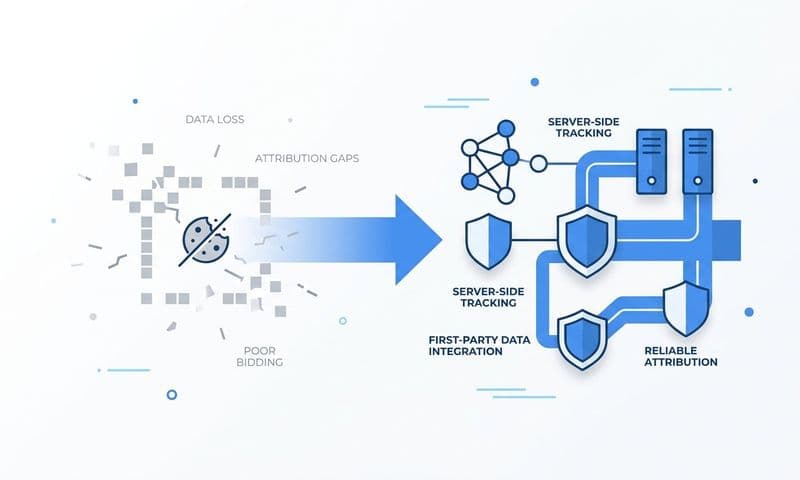
Traditional browser-based tracking relies on JavaScript pixels that fire in the user's browser when a conversion event occurs. When a customer completes a purchase, the pixel fires and sends data to the ad platform. The problem is that this process depends on the browser cooperating. iOS restrictions, browser privacy settings, ad blockers, and cookie limitations can all interfere with pixel firing, causing conversions to go unreported. Understanding the differences between server-side tracking vs pixel tracking makes it clear why this shift is necessary.
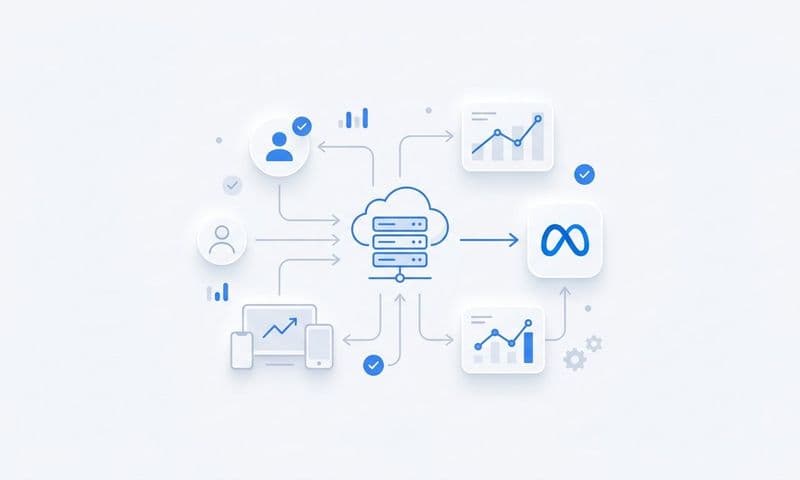
Server-side tracking works differently. Instead of relying on the user's browser to send data, your own server collects the conversion event and sends it directly to the ad platform. The data never has to pass through the browser environment where iOS restrictions apply. Because this happens at the server level, it is far more resilient to the privacy changes that have disrupted browser-based tracking.
This approach also allows you to work with first-party data, which is information you collect directly from your own customers through your website, app, or CRM. Building a strong first-party data tracking strategy doesn't depend on third-party cookies or cross-app tracking identifiers. It's data you own, which means privacy changes targeting third-party tracking don't undermine it in the same way.
In practice, a server-side tracking setup connects several layers of your marketing infrastructure. Your website captures conversion events. Your CRM records customer actions and attributes. Your server processes this data and sends enriched conversion signals to your ad platforms. The result is a centralized tracking layer that stitches together the full customer journey from first ad click through final conversion, without relying on browser pixels that iOS can block.
The key advantage is completeness. Because server-side tracking captures data at the source rather than depending on browser-level execution, you get a more accurate and more complete picture of what's happening across your funnel. Conversions that would have been invisible to browser pixels become visible again. The data you're working with is closer to reality, which means your decisions are better informed.
It's worth noting that server-side tracking is not a magic solution that makes privacy restrictions irrelevant. Users who opt out of tracking are still opting out, and you should respect those preferences. But for capturing your own first-party conversion data and sending it to ad platforms in a privacy-compliant way, server-side tracking is the most reliable foundation available.
How to Rebuild Your Tracking Stack After iOS Disruptions
Knowing that server-side tracking is the right foundation is one thing. Actually rebuilding your tracking stack is another. Here's a practical framework for approaching this systematically rather than reactively.
Step 1: Audit your current tracking gaps. Before you can fix anything, you need to understand what's broken. Compare your ad platform conversion data against your CRM or backend records. If your ad platforms are reporting significantly fewer conversions than your actual sales or signups, that gap represents your tracking loss. Identify which platforms, campaigns, and conversion events are most affected. This gives you a clear picture of where to focus your rebuilding efforts.
Step 2: Implement server-side tracking. Set up server-side event tracking for your key conversion events. Our server-side tracking setup guide walks through the process in detail. This typically involves deploying a server-side tag management solution or working with a platform that handles this infrastructure for you. Connect your website and app to send conversion events to your server, which then relays them to your ad platforms through their respective APIs (Meta CAPI, Google Enhanced Conversions, TikTok Events API).
Step 3: Build your first-party data collection. Capture customer data directly through your own properties. Email addresses collected at signup or purchase can be hashed and matched to ad platform accounts for improved attribution. CRM data about customer behavior and lifetime value enriches your conversion signals beyond simple event tracking.
Step 4: Sync enriched conversion data back to ad platforms. This is where conversion syncing becomes critical. Rather than letting ad platforms work with incomplete or modeled data, you send them accurate, enriched conversion events from your own tracking infrastructure. When Meta and Google receive better conversion signals, their algorithms can optimize more effectively. Choosing the right revenue attribution tracking tools is essential for making this process seamless. You're not just fixing your reporting; you're improving the quality of your ad platform's AI-driven targeting and bidding.
This is exactly what platforms like Cometly are built to handle. Cometly connects your ad platforms, CRM, and website data to track the entire customer journey in one place. It captures conversion events server-side, stitches together multi-touch attribution across every channel, and syncs enriched conversion data back to Meta, Google, and other platforms. Instead of each platform working with its own incomplete slice of data, your ad platforms receive the full picture, which improves their optimization and gives you accurate reporting you can actually trust.
The result is a tracking stack that is both more accurate and more durable. You're no longer dependent on browser pixels that iOS can disrupt. You're working with first-party data you own, feeding better signals to the algorithms that drive your campaign performance.
Building an Ad Tracking Strategy That Survives Future Updates
The pattern is clear at this point: privacy restrictions are tightening, not loosening. Apple's ATT framework established a new standard for mobile privacy, and that standard is spreading. Google has been developing its Privacy Sandbox initiative for Chrome, which aims to phase out third-party cookies in favor of privacy-preserving alternatives. Regulatory frameworks in Europe, the United States, and elsewhere continue to push for stricter limits on user tracking and data collection.
This means that any tracking strategy built around third-party cookies, cross-app identifiers, or browser-level pixels is a strategy with a shrinking shelf life. The next iOS update, the next Chrome privacy change, or the next regulatory requirement could further erode what's left of that infrastructure. Reacting to each change as it comes is exhausting and expensive. Learning more about tracking paid ads after an iOS update can help you stay ahead of these recurring disruptions.
The durable alternative is to own your tracking infrastructure. This means building a first-party data strategy where you collect, store, and activate data through your own systems rather than depending entirely on platform pixels and third-party identifiers. When you own the data layer, privacy changes to third-party tracking don't undermine your ability to measure what's working.
AI-powered attribution plays an increasingly important role in this environment. As raw tracking signals decline due to privacy restrictions, machine learning can help fill gaps by connecting touchpoints across the full funnel and identifying patterns that deterministic tracking alone cannot capture. Rather than reporting only on the conversions you can directly observe, AI-driven touchpoint attribution tracking gives you a more complete picture of how your channels are working together to drive revenue.
Cometly's AI capabilities are built for exactly this challenge. The platform uses AI to identify high-performing ads and campaigns across every channel, provides recommendations for scaling what's working, and helps you understand the full customer journey even when individual tracking signals are incomplete. As the privacy landscape continues to evolve, having AI in your attribution stack is not a luxury but a practical necessity for making confident decisions with imperfect data.
The marketers who will navigate the next wave of privacy changes successfully are the ones who stop treating tracking as a platform dependency and start treating it as a core piece of their own infrastructure.
Moving Forward with Confidence
Lost ad tracking after an iOS update is not a problem you solve once and move on from. It is an ongoing challenge that reflects a fundamental shift in how user data can be collected, shared, and used for advertising purposes. The marketers who recognize this and adapt their infrastructure accordingly will have a significant advantage over those who keep waiting for platform pixels to get better.
The key shift is moving from platform-dependent, cookie-based tracking to server-side, first-party data strategies that give you accurate visibility into what is actually driving revenue. That means auditing your tracking gaps, implementing server-side event collection, building first-party data assets, and syncing enriched conversion data back to your ad platforms so their algorithms can do their jobs effectively.
It also means accepting that this is an evolving challenge rather than a static problem. Each new iOS release, each Chrome privacy update, and each new regulatory requirement will create new pressures on your tracking stack. The answer is not to chase every change reactively but to build on a foundation of first-party data and server-side infrastructure that is resilient by design.
Cometly is built to support exactly this kind of modern attribution strategy. It connects your ad platforms, CRM, and website into a unified tracking layer, captures the full customer journey with server-side accuracy, and feeds enriched conversion data back to Meta, Google, and other platforms to improve their AI-driven optimization. You get clear, reliable attribution data in one place, and your ad platforms get the signals they need to perform at their best.
Ready to elevate your marketing game with precision and confidence? Discover how Cometly's AI-driven recommendations can transform your ad strategy. Get your free demo today and start capturing every touchpoint to maximize your conversions.