Your customer clicks a Facebook ad on their phone during lunch. Later that evening, they search your brand on Google from their laptop. The next morning, they receive an email, click through, but don't convert. Three days later, they see a retargeting ad on Instagram, click it, and finally make a purchase. Which channel deserves credit for that sale?
Traditional attribution models force you to choose: give all credit to Facebook (first-touch), Instagram (last-touch), or split it equally across all four touchpoints (linear). But here's the problem—none of these approaches reflect reality. That Facebook ad might have been crucial for awareness, while the retargeting ad sealed the deal. The email could have been completely irrelevant, or it might have been the turning point.
This is where machine learning transforms everything. Instead of applying rigid rules to every customer journey, ML algorithms analyze millions of actual conversion paths to understand which touchpoint combinations truly drive revenue. They identify patterns invisible to human analysis, adapt to your specific audience behavior, and continuously refine their accuracy as more data flows in. The result? Attribution that reflects the messy, complex reality of modern marketing rather than forcing it into oversimplified boxes.
The Breaking Point: Why Rule-Based Attribution Can't Keep Up
The average customer now interacts with brands across eight or more channels before converting. They might discover you through a podcast mention, research on mobile, compare options on desktop, abandon cart, receive an email reminder, see a retargeting ad, and finally convert through organic search. Each touchpoint plays a role, but traditional attribution models were built for a simpler era.
First-touch attribution tells you that podcast mention deserves all the credit. Last-touch gives everything to organic search. Both ignore the six touchpoints in between that kept the customer engaged and moving toward conversion. Linear attribution splits credit equally, which sounds fair until you realize it treats a critical product demo the same as a generic banner ad impression.
The fundamental issue? These models apply the same rules to every customer journey, regardless of context. They can't account for the fact that some customers need extensive nurturing while others convert immediately. They don't recognize that certain channel sequences correlate with higher-value purchases. They can't adapt when customer behavior shifts or when you launch new campaigns.
Then there's the scale problem. Your marketing generates millions of data points: ad impressions, clicks, page views, email opens, form submissions, CRM events. A human analyst might review a sample of conversion paths and develop hypotheses about what's working. But they'll never process the full dataset to uncover subtle patterns—like the fact that customers who see your brand on LinkedIn before clicking a Google ad convert at 3x the rate of those who don't.
Traditional models also struggle with the attribution window question. Should you credit touchpoints from the last 7 days? 30 days? 90 days? Different products have different consideration cycles, but static rules force you to choose one window for everything. Machine learning doesn't need you to guess—it learns from your actual data how long touchpoints remain influential for your specific audience.
The Intelligence Layer: How ML Approaches Attribution Differently
Machine learning brings three fundamental capabilities to attribution: pattern recognition at scale, probabilistic reasoning, and continuous learning. Let's break down how these translate into actual techniques that power modern attribution platforms.
Supervised Learning Models: These algorithms learn from your historical data by studying thousands of conversion paths alongside paths that didn't convert. They identify which touchpoint combinations, sequences, and timings correlate with successful outcomes. Think of it like training a model to recognize the "shape" of a converting customer journey versus one that fizzles out.
Logistic regression models, for example, can predict conversion probability based on touchpoint features: which channels appeared, in what order, with what frequency, and over what timeframe. Gradient boosting models take this further by building decision trees that capture complex interactions—like "customers who see both a webinar and a case study convert at higher rates, but only if the webinar comes first."
Markov Chain Models: This probabilistic approach treats your customer journey as a series of states (touchpoints) with transition probabilities between them. The model calculates what happens to overall conversion probability if you remove a specific channel from the mix. This "removal effect" reveals each channel's true contribution.
Here's why this matters: Markov chains can identify assist channels that never get credit in last-touch attribution but are crucial for moving customers through the funnel. They might reveal that your display ads rarely get last-touch credit but significantly increase the probability that customers will eventually convert through other channels. That's attribution insight you'd never get from rule-based models.
Shapley Value Attribution: Borrowed from game theory, this approach calculates each channel's marginal contribution by analyzing all possible combinations of touchpoints. It answers the question: "What is the average value this channel adds across every possible sequence it could appear in?"
The math gets complex, but the insight is powerful. Shapley values ensure that channels receive credit proportional to their actual impact, accounting for how they work in combination with other touchpoints. A channel that performs well in isolation but adds little value when other channels are present gets appropriately lower credit.
Neural Networks and Deep Learning: When customer journeys become truly complex—involving dozens of touchpoints across multiple devices and platforms—simpler models start to miss non-linear relationships. Neural networks excel at capturing these intricate patterns.
Deep learning models can identify that certain three-channel sequences drive conversions while similar two-channel or four-channel sequences don't. They can recognize that touchpoint timing matters differently for different customer segments. They can even incorporate external factors like seasonality, competitive activity, or economic indicators that influence conversion patterns.
The tradeoff? Neural networks are less interpretable than simpler models. You might not understand exactly why the model assigns specific attribution weights, but the predictive accuracy often justifies the black-box nature. Many platforms use ensemble approaches—combining multiple ML techniques to balance interpretability with accuracy.
From Theory to Practice: ML in Multi-Touch Attribution
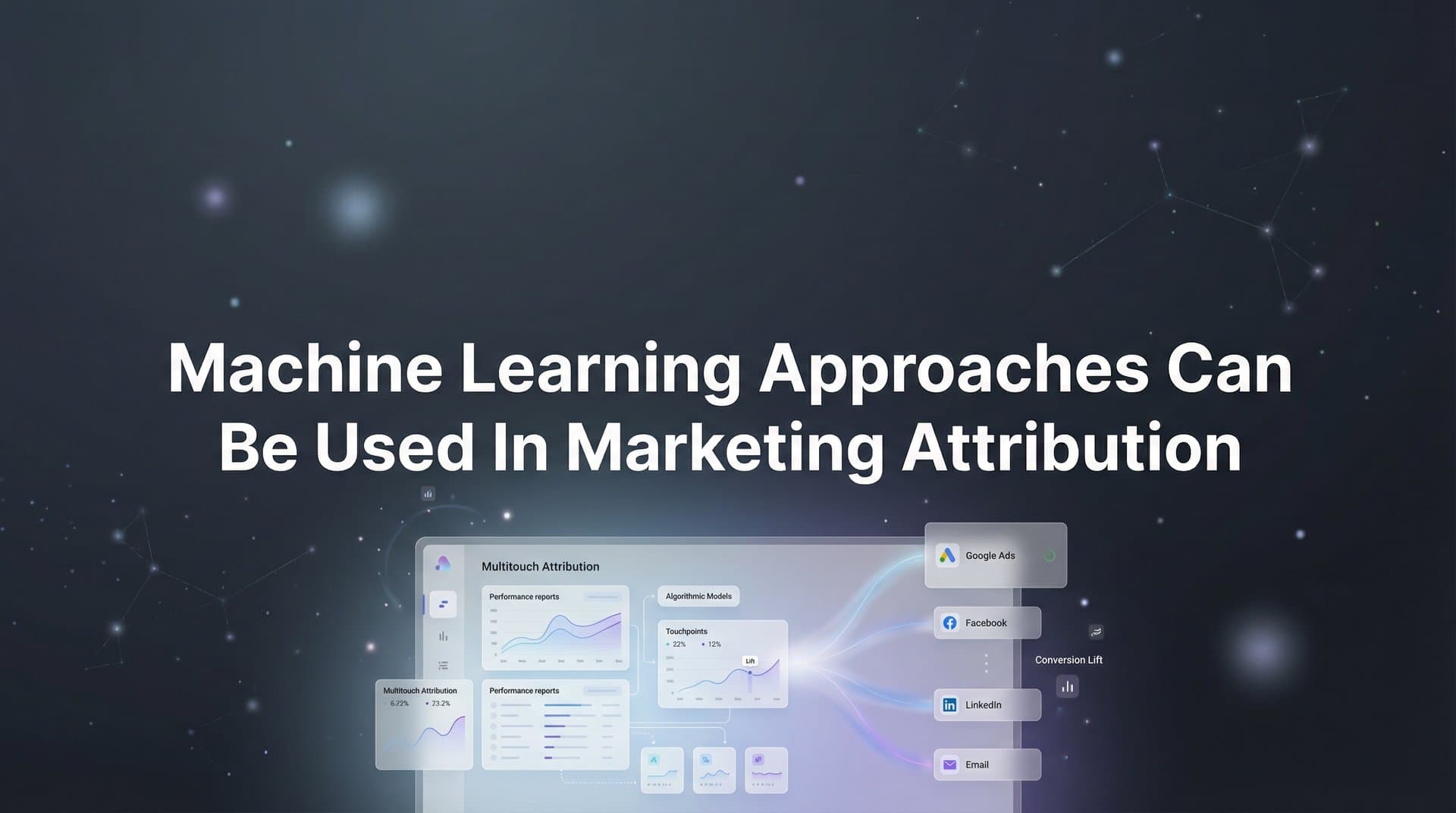
Understanding the algorithms is one thing. Seeing how they actually assign credit across real customer journeys is where machine learning's power becomes tangible. Let's walk through how multi-touch attribution platforms work in practice.
Intelligent Credit Distribution: Instead of splitting credit equally or following rigid rules, ML models weight each touchpoint based on its statistical influence on conversion. A customer journey might include ten touchpoints, but the model recognizes that three of them were particularly influential while the others provided minimal impact.
The model learns these weights from patterns across thousands of similar journeys. It might discover that for your business, the third touchpoint in a sequence tends to be decisive—perhaps that's when customers move from awareness to consideration. Or it might find that touchpoints occurring within 48 hours of conversion carry disproportionate weight, while earlier interactions matter less than you assumed.
This dynamic weighting adapts to your actual data rather than forcing assumptions. If customer behavior shifts—maybe economic conditions make your sales cycle longer—the model adjusts attribution weights accordingly without you manually updating rules.
Time-Decay Intelligence: Traditional time-decay models apply a fixed depreciation rate: touchpoints lose X% of their value for each day that passes. Machine learning replaces this assumption with learned decay curves specific to your business.
The algorithm might discover that for your B2B SaaS product, touchpoints remain highly influential for 14 days, then drop sharply. For your e-commerce site, influence might decay more linearly over 7 days. For high-ticket purchases, early touchpoints might retain significant influence for months. The model learns these patterns from your conversion data rather than requiring you to guess.
Even more sophisticated: ML can learn different decay rates for different channels. Your content marketing attribution might have a long tail of influence, while retargeting ads have immediate but short-lived impact. The attribution model captures these nuances automatically.
Cross-Device Journey Stitching: One of attribution's hardest challenges is connecting touchpoints when customers switch devices. Someone researches on mobile, compares options on desktop, and converts on tablet. Traditional tracking sees three separate users.
Machine learning helps solve this through probabilistic identity resolution. The model analyzes behavioral signals—browsing patterns, timing, location data, engagement patterns—to calculate the likelihood that touchpoints belong to the same person. When confidence is high, it stitches the journey together. When it's uncertain, it maintains separate paths rather than forcing incorrect connections.
This becomes critical for accurate attribution. Without proper identity resolution, you're attributing conversions to incomplete journeys, missing crucial touchpoints that happened on other devices. ML-powered stitching gives you visibility into the full path to purchase.
Channel Interaction Effects: Some channels work better together than in isolation. ML models can identify these synergies. They might discover that customers who see both your podcast ads and LinkedIn content convert at 4x the rate of those who see either alone—but only when the podcast comes first.
These interaction effects are nearly impossible to spot manually but become visible when algorithms analyze millions of journey combinations. The attribution model then assigns credit that reflects not just individual channel performance but how channels amplify each other's impact.
Beyond Measurement: Using ML for Active Optimization
Here's where machine learning attribution becomes truly transformative. Instead of just telling you what happened, ML models predict what will happen and recommend what you should do about it.
Conversion Probability Scoring: Once an ML model understands which touchpoint patterns lead to conversions, it can score active leads based on their current journey. A prospect who has engaged with three specific touchpoints in a particular sequence might get a 73% conversion probability score. Another with different engagement might score 22%.
This transforms how you prioritize. Your sales team focuses on high-probability leads first. Your marketing automation triggers different nurture sequences based on conversion likelihood. Your ad platforms receive signals about which users are most valuable to target. You're no longer treating all leads equally—you're allocating resources based on predicted outcomes.
The model continuously refines these predictions as it observes more outcomes. Leads it scored as high-probability either convert (confirming the model) or don't (teaching it to adjust). This feedback loop makes predictions increasingly accurate over time.
Budget Allocation Intelligence: ML models can analyze your current spend distribution across channels and predict how conversion volume would change if you reallocated budget. They might identify that shifting 20% of spend from Channel A to Channel B would increase total conversions by 15%, based on observed performance patterns and diminishing returns curves.
These recommendations account for factors humans struggle to balance simultaneously: current performance, trend direction, saturation effects, channel interactions, and competitive dynamics. The model processes all these variables to suggest optimal budget distribution.
Importantly, ML can also identify when you're hitting diminishing returns. Maybe your Google Ads are performing well, but the model recognizes you're approaching the point where additional spend yields minimal incremental conversions. It recommends diversifying into underutilized channels with more headroom for growth.
Real-Time Optimization Signals: Modern ad platforms like Meta and Google use their own ML algorithms to optimize targeting and bidding. But these algorithms are only as good as the conversion data you feed them. This is where ML attribution creates a multiplier effect.
When your attribution model identifies high-value conversion patterns, you can send enriched conversion events back to ad platforms. Instead of just reporting "conversion happened," you're sending "conversion happened with 85% confidence this channel was influential, and this user matches patterns of high-LTV customers."
The ad platform's algorithms use this richer signal to improve targeting. They learn to find more users who match your high-value patterns. They optimize bids based on predicted value rather than just conversion volume. Your attribution intelligence directly enhances the platform's optimization capabilities.
This feedback loop is particularly powerful with server-side tracking. By capturing conversion data more accurately than pixel-based tracking allows, you feed higher-quality signals to both your attribution model and ad platforms. Better data trains better models, which drive better performance, which generates more data to further refine the models.
Making ML Attribution Work: Requirements and Realities
Machine learning attribution isn't magic—it's mathematics applied to data. Understanding what you need to implement it successfully helps set realistic expectations and avoid common attribution challenges in marketing analytics.
Data Volume and Quality Requirements: ML models need sufficient data to identify meaningful patterns. As a general benchmark, you want hundreds of conversions minimum to train a basic model, and ideally thousands for more sophisticated approaches. Low-volume businesses might struggle to generate enough data for ML to outperform simpler attribution methods.
Quality matters more than quantity. If your tracking is incomplete—missing touchpoints, failing to capture cross-device journeys, or losing data due to ad blockers—the model learns from flawed information. Garbage in, garbage out applies forcefully to attribution ML. Server-side tracking has become essential for many businesses because it captures more complete, accurate data than browser-based pixels.
You also need consistent data collection. If you change tracking implementations frequently or have gaps in your data history, the model struggles to learn stable patterns. Clean, continuous data collection is the foundation everything else builds on.
Integration Essentials: ML attribution requires connecting multiple data sources to build complete customer journey views. At minimum, you need your ad platforms, website analytics, and conversion tracking integrated. For B2B businesses, B2B software marketing attribution requires CRM integration to track the full journey from lead to closed deal.
The technical challenge isn't just connecting these systems but ensuring they share a common identifier to link touchpoints to the same user. This is where identity resolution becomes critical. You need mechanisms to connect anonymous website visitors to known leads, match email addresses across platforms, and stitch together cross-device activity.
Many businesses find that implementing proper tracking infrastructure is the hardest part of ML attribution. The algorithms themselves are increasingly accessible, but getting clean, unified data flowing into them requires careful technical implementation and ongoing maintenance.
Interpreting ML Outputs: Attribution models don't deliver simple answers—they provide probabilistic insights that require interpretation. A channel might receive 23.7% attribution credit with a confidence interval of ±4%. Understanding what this means and how to act on it is crucial.
Confidence scores indicate how certain the model is about its attribution weights. Low confidence might mean insufficient data, high variability in channel performance, or that the channel's impact is genuinely unclear. High confidence means the model has observed consistent patterns across many journeys.
Attribution weights tell you relative influence, not absolute value. A channel with 30% attribution weight isn't necessarily worth 30% of your budget. You need to consider costs, scalability, and strategic factors the model doesn't capture. ML provides crucial input for decisions, but human judgment still matters.
The most successful marketers use ML attribution as a decision-support tool rather than autopilot. They review model outputs regularly, understand the patterns driving recommendations, and combine algorithmic insights with market knowledge and business context.
Moving Forward: Putting ML Attribution to Work
The shift from rule-based to machine learning attribution represents more than a technical upgrade—it's a fundamental change in how you understand marketing performance. Instead of imposing assumptions about which touchpoints matter, you're learning from actual customer behavior. Instead of analyzing performance in hindsight, you're predicting outcomes and optimizing in real-time.
For marketers ready to implement ML attribution, start by evaluating your current measurement gaps. Where are you most uncertain about which channels drive results? Which decisions would you make differently with better attribution data? These pain points guide where ML can provide immediate value.
Consider your data readiness. Do you have sufficient conversion volume for ML to identify patterns? Is your tracking infrastructure capturing complete customer journeys across channels and devices? Are your systems integrated enough to build unified attribution views? Address these foundational elements before investing in sophisticated models.
The competitive advantage of ML-powered attribution isn't just better measurement—it's faster, more confident decision-making. When you know with statistical confidence which channels drive revenue, you can scale successful campaigns aggressively rather than incrementally. You can cut underperforming spend decisively rather than hesitantly. You can test new channels with clear success criteria rather than vague hunches.
This advantage compounds over time. As your ML models learn from more data, their predictions become more accurate. As you act on better insights, your marketing performance improves, generating more conversions that further train the models. You enter a virtuous cycle where measurement and optimization continuously reinforce each other.
The marketers winning in 2026 aren't just using better tools—they're operating with fundamentally better information. They understand the true customer journey, predict which leads will convert, and optimize budget allocation based on data rather than intuition. Machine learning attribution is what makes this level of precision possible.
Ready to elevate your marketing game with precision and confidence? Discover how Cometly's AI-driven recommendations can transform your ad strategy—Get your free demo today and start capturing every touchpoint to maximize your conversions.