You're staring at three dashboards, five spreadsheets, and a dozen different reports. Your Facebook Ads Manager says one thing. Google Analytics tells a different story. Your CRM shows yet another version of reality. You know your marketing is generating results—you can see the revenue coming in—but you can't definitively say which campaigns, ads, or channels are actually responsible.
This is the paradox facing modern marketers: drowning in data but starving for insights.
Market analytics exists to solve exactly this problem. It's the bridge between raw numbers scattered across platforms and the clear, actionable intelligence you need to make confident decisions about where to invest your next dollar. Companies that master market analytics don't just outperform competitors—they operate in a different league entirely, making data-driven decisions while others rely on gut instinct and hope.
In this guide, you'll learn what market analytics really means in today's multi-platform environment, which metrics actually matter for driving revenue, how to build a framework that connects all your data sources, and most importantly, how to turn those insights into campaigns that scale profitably.
Beyond Spreadsheets: Understanding Modern Market Analytics
Market analytics is the practice of measuring, managing, and analyzing marketing performance data to maximize effectiveness and optimize ROI. But that clinical definition doesn't capture what it actually means in practice.
Think of market analytics as your marketing command center. It's where you see the complete picture of how prospects discover you, what they do along their journey, and which touchpoints ultimately convert them into customers. It's not just about collecting data—it's about connecting data analytics and marketing across every platform and channel to understand cause and effect in your marketing.
Modern market analytics operates on three levels, each building on the last.
Descriptive Analytics: This is your foundation—the "what happened" layer. It tells you that your Facebook campaign generated 1,500 clicks, your email sequence had a 23% open rate, and 47 people converted last week. Most marketers live here, reviewing past performance in platform-specific dashboards.
Predictive Analytics: This level answers "what might happen next" by identifying patterns and trends. It recognizes that leads who engage with three specific touchpoints convert at twice the rate of those who don't. It spots that traffic from LinkedIn has a higher customer lifetime value than other sources, even if conversion rates look similar initially.
Prescriptive Analytics: This is where analytics becomes truly powerful—the "what should we do about it" stage. It doesn't just show you that Campaign A outperforms Campaign B. It recommends shifting 30% of your budget from underperforming channels to high-ROI campaigns, identifies which ad creative elements drive conversions, and suggests which audience segments deserve more investment.
Here's what makes market analytics distinct from general business analytics: it's laser-focused on customer behavior, campaign performance, and channel effectiveness. While business analytics might examine operational efficiency or supply chain metrics, market analytics zeroes in on the questions that keep marketers up at night.
Which ad convinced someone to click? Which email pushed them toward a purchase? Did that podcast sponsorship actually generate revenue, or just warm fuzzy feelings? Market analytics connects these dots across every platform, device, and touchpoint to show you the real story behind your results.
The Metrics That Actually Move the Needle
Not all metrics are created equal. Some numbers look impressive in reports but have zero connection to revenue. Others seem modest but directly predict business growth.
Let's start with the metrics that actually matter.
Customer Acquisition Cost (CAC): This tells you exactly how much you're spending to acquire each new customer. Calculate it by dividing your total marketing spend by the number of customers acquired in that period. If you spent $10,000 on ads and gained 50 customers, your CAC is $200. This metric becomes your baseline for every optimization decision—can you reduce it without sacrificing quality?
We break down the leading options in our AI marketing image generator guide.
Customer Lifetime Value (CLV): This predicts the total revenue you'll generate from a customer over their entire relationship with your business. A customer who makes a $100 purchase might seem less valuable than one who spends $500—until you realize the first customer returns monthly for two years while the second never comes back. CLV reveals which acquisition channels bring customers worth keeping.
Return on Ad Spend (ROAS): This is your most direct profitability metric. If you spend $1,000 on ads and generate $4,000 in revenue, your ROAS is 4:1 or 400%. Unlike ROI, which factors in all costs, ROAS focuses specifically on ad spend efficiency. It answers the fundamental question: is this campaign making or losing money?
Conversion Rates Across the Funnel: Looking only at final conversion rates misses the story. Track conversion rates at every stage—ad click to landing page visit, visit to lead capture, lead to qualified opportunity, opportunity to customer. When you spot a 40% drop-off between landing page and lead form, you know exactly where to focus optimization efforts.
Now let's talk about attribution metrics—the measurements that separate sophisticated marketers from those guessing in the dark.
Attribution metrics reveal which touchpoints in the customer journey actually contribute to conversions. Did that Facebook ad deserve credit for the sale, or did it just happen to be the last thing they clicked before buying? Was the real driver that Google search three days earlier, or the email they opened last week? Understanding marketing analytics metrics at this level transforms how you evaluate campaign performance.
This matters because vanity metrics lie. Impressions, reach, and engagement numbers feel good but don't pay the bills. You can have a million impressions and zero revenue. You can have incredible engagement on social media while your actual sales come entirely from search ads you're barely monitoring.
Revenue-connected metrics cut through the noise. They track backward from actual conversions to identify which marketing activities genuinely drive results. When you know that LinkedIn ads generate leads with a 35% higher close rate than Facebook leads, you can confidently allocate budget accordingly. When you discover that customers who interact with both email and retargeting ads convert at 3x the rate of single-touchpoint prospects, you build campaigns around that insight.
The shift from surface-level metrics to revenue-connected measurements transforms marketing from a cost center into a growth engine. You stop celebrating "wins" that don't impact the bottom line and start optimizing for the numbers that actually matter.
Building Your Market Analytics Framework
Accurate market analytics requires a foundation of connected, clean data. Without it, you're building insights on quicksand.
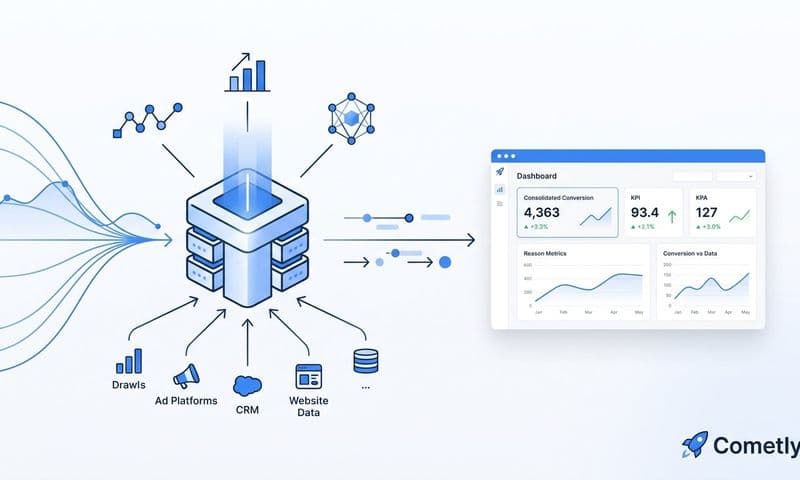
Your framework starts with data collection across three critical systems: ad platforms, your CRM, and website tracking. Each captures different pieces of the customer journey, and the magic happens when they talk to each other.
Ad platforms show you campaign performance—clicks, impressions, ad spend, and platform-reported conversions. Your CRM tracks leads, opportunities, and closed deals, connecting marketing activity to actual revenue. Website tracking captures behavior between the ad click and the conversion—which pages they visited, how long they stayed, what content resonated.
When these systems operate in silos, you get three partial stories. Connect them, and you see the complete narrative.
Here's what that connection looks like in practice. Someone clicks your Facebook ad, visits three pages on your website, downloads a resource, receives a nurture email sequence, returns via Google search, and finally converts. Without connected tracking, Facebook takes credit for the conversion. Google claims it too. Your email platform reports a conversion from the nurture sequence. Everyone's a hero, and you have no idea what actually worked.
With proper tracking, you see the full journey. You understand that Facebook introduced the prospect, your content educated them, email kept you top of mind, and Google search captured high-intent behavior when they were ready to buy. Each touchpoint played a role, and you can optimize accordingly.
Tracking the complete customer journey means capturing every meaningful interaction from first touch to conversion and beyond. This includes paid ad clicks, organic search visits, email opens and clicks, content downloads, demo requests, sales calls, and post-purchase behavior. The goal isn't tracking for tracking's sake—it's building a dataset that reveals patterns and opportunities.
Data hygiene practices make the difference between insights you can trust and garbage analysis. Clean data means consistent naming conventions across campaigns, properly tagged URLs, deduplicated records, and regular audits to catch tracking breaks before they corrupt your reporting. Investing in the right marketing data analytics software can automate much of this process.
When your Facebook campaigns use one naming structure, Google Ads uses another, and your email platform uses a third, analysis becomes impossible. Standardize everything. Use UTM parameters consistently. Ensure your CRM captures source data accurately. Build processes that catch errors early.
The payoff for this foundational work is enormous. With clean, connected data flowing from every marketing touchpoint into a unified view, you can finally answer questions that were previously guesswork. Which campaigns drive the highest-value customers? What's the optimal number of touchpoints before conversion? Which content pieces influence deals? Where should you invest your next dollar?
Attribution Models: Giving Credit Where It's Due
Attribution models are the frameworks you use to assign credit for conversions across multiple touchpoints. Choose the wrong model, and you'll optimize toward the wrong channels. Understand multiple models, and you'll see your marketing from every angle.
First-Touch Attribution: This model gives 100% credit to the first interaction that brought someone into your ecosystem. If a prospect clicked a LinkedIn ad three weeks before converting via Google search, LinkedIn gets all the credit. This model helps you understand which channels are best at generating awareness and starting customer relationships. It's valuable for top-of-funnel optimization but ignores everything that happened after that first click.
Last-Touch Attribution: This is the opposite approach—100% credit goes to the final touchpoint before conversion. Most ad platforms default to this model because it makes them look good. If someone interacted with five different campaigns but converted after clicking a retargeting ad, that retargeting campaign gets full credit. This model shows you what closes deals but completely misses the journey that made the conversion possible.
Linear Attribution: This model splits credit equally across all touchpoints. If someone interacted with four different campaigns before converting, each gets 25% credit. It's democratic but sometimes overly simplistic—not all touchpoints contribute equally to conversion decisions.
Time-Decay Attribution: This model gives more credit to touchpoints closer to the conversion. The logic is sound: interactions that happened yesterday likely influenced the purchase decision more than those from three weeks ago. It's particularly useful for longer sales cycles where recent engagement predicts conversion probability.
Data-Driven Attribution: This approach uses machine learning to analyze actual conversion patterns and assign credit based on statistical contribution. Instead of following predetermined rules, it looks at thousands of customer journeys to identify which touchpoints actually make a difference. Someone who saw a Facebook ad and converted has a different pattern than someone who saw the ad, visited your site three times, and then converted—data-driven attribution recognizes these differences.
So which model should you use? The answer is: compare multiple models to understand different dimensions of your marketing effectiveness.
First-touch attribution helps you evaluate awareness channels. Last-touch reveals what closes deals. Linear attribution shows the full journey. Time-decay highlights recent influence. Data-driven attribution provides the most accurate picture when you have sufficient conversion volume. Understanding these common attribution challenges in marketing analytics helps you navigate the complexity.
Looking at multiple models simultaneously reveals insights that any single model would miss. You might discover that LinkedIn generates valuable first touches but rarely appears in last-touch reports—meaning it's excellent for awareness but needs support from other channels to close deals. You might find that email nurture sequences rarely get first or last-touch credit but appear consistently in linear attribution—proving their value in the middle of the journey.
Modern attribution faces significant challenges that make accurate measurement harder than ever. iOS privacy changes starting with iOS 14.5 limited Facebook's ability to track conversions, creating blind spots in campaign reporting. Cookie deprecation across browsers means traditional pixel-based tracking captures less data. Cross-device tracking remains difficult—someone might click an ad on mobile, research on tablet, and convert on desktop, appearing as three different users in many systems.
These challenges make server-side tracking and first-party data collection increasingly critical. When you capture conversion data directly on your server and send it to ad platforms, you bypass browser restrictions and maintain measurement accuracy. When you build first-party data relationships through email capture and account creation, you can track customer journeys even when third-party cookies fail. The difference between marketing attribution software vs traditional analytics becomes especially clear in this privacy-first environment.
The attribution landscape is evolving rapidly, but the core principle remains constant: understand which marketing activities genuinely contribute to conversions so you can do more of what works and less of what doesn't.
Turning Analytics Into Action
Analytics without action is just expensive data storage. The real value comes from using insights to make better decisions about budget allocation, campaign optimization, and strategic direction.
Let's start with budget allocation—the highest-leverage decision you make regularly. When your analytics show that Google search campaigns generate a 6:1 ROAS while display ads return 2:1, the answer seems obvious: shift budget to search. But sophisticated analysis reveals additional layers.
Maybe those display ads generate first touches that lead to search conversions later. Maybe the search campaigns rely on brand awareness built by other channels. Maybe display ads attract different customer segments with higher lifetime value despite lower immediate ROAS. This is where multi-touch attribution and customer journey analysis become essential—they show you the interconnections that simplistic metrics miss.
The goal isn't finding a single "best" channel and putting all your eggs in that basket. It's understanding the role each channel plays in your marketing ecosystem and allocating budget to maximize total performance. High-performing channels deserve more investment until you hit diminishing returns. Underperforming channels need optimization or budget cuts. Channels that play supporting roles in customer journeys deserve continued investment even if they don't shine in last-touch reporting. Learning how to leverage analytics for marketing strategy makes this process systematic rather than guesswork.
Here's where market analytics creates a powerful feedback loop with ad platform algorithms. When you feed better conversion data back to Facebook, Google, TikTok, and LinkedIn, their machine learning systems can optimize more effectively.
Think about how ad platforms work. They show your ads to audiences, track which people convert, and gradually learn which user characteristics predict conversion probability. The more accurate your conversion data, the better they can optimize. When tracking is broken or delayed, ad platforms optimize toward incomplete information and waste spend on audiences that don't actually convert.
By sending enriched conversion data back to ad platforms—including conversion value, customer quality signals, and post-purchase behavior—you help their algorithms distinguish between high-value and low-value conversions. This improves targeting, reduces cost per acquisition, and increases return on ad spend. The platforms get smarter about who to show your ads to, and your campaigns perform better as a result. Discover the power of AI marketing analytics to accelerate this optimization cycle.
This creates a continuous optimization cycle: analyze performance, identify high-performing campaigns and audiences, feed better data back to ad platforms, test new variations, and scale what works.
Testing is where analytics transforms from reporting to growth engine. Every insight should generate hypotheses to test. If analytics show that video ads outperform static images, test different video lengths and styles. If certain audience segments convert at higher rates, test expanding into similar audiences. If specific landing pages drive more conversions, test applying those elements to other pages.
The key is systematic testing with clear success metrics. Don't change five variables at once and wonder what worked. Test one element at a time, measure results against your baseline, and scale winners while cutting losers. Your analytics platform should make this process clear—showing you exactly which tests drove improvement and which didn't move the needle.
As you accumulate winning tests, you build a knowledge base of what works for your specific audience, offer, and market. This compounds over time. Year one, you might improve ROAS by 20% through better targeting. Year two, you add another 15% through creative optimization. Year three, you gain another 10% through landing page improvements. Each layer builds on the last, and your competitive advantage grows.
Putting Your Analytics Strategy Into Practice
An effective market analytics approach combines several key components working in harmony. You need connected data flowing from all marketing touchpoints into a unified view. You need clean, accurate tracking that captures the complete customer journey. You need attribution models that reveal which activities drive conversions. And you need processes that turn insights into action through budget optimization, platform feedback loops, and systematic testing.
The competitive advantage of real-time, accurate marketing data can't be overstated. While competitors make decisions based on gut feel, delayed reporting, or platform-specific metrics that miss the bigger picture, you're operating with clarity. You know which campaigns are profitable before the month ends. You spot problems while there's still time to fix them. You identify opportunities and scale them before competitors notice the trend.
This is the difference between reactive marketing and proactive growth. Reactive marketers wait for monthly reports, discover what worked last month, and hope it still works this month. Proactive marketers see performance in real-time, understand why it's happening, and adjust strategy while the data is fresh. Exploring the future of marketing analytics reveals where these capabilities are heading next.
Take time to audit your current analytics setup. Can you definitively say which campaigns drove revenue last week? Do you know your true customer acquisition cost across all channels? Can you track a customer's journey from first touch through conversion? Are you comparing multiple attribution models to understand different dimensions of performance? Do you have processes for acting on insights, or does analysis sit in dashboards without driving decisions?
Identify the gaps in your customer journey tracking. Where do you lose visibility? Which touchpoints aren't being captured? Where does data quality break down? These gaps are costing you money—either through wasted spend on underperforming campaigns you can't identify, or missed opportunities in high-performing channels you're not measuring accurately. A multi-channel marketing analytics dashboard can help consolidate this visibility.
The path forward is clearer than it might seem. Start with your data foundation—ensure tracking is working correctly across all platforms. Build connections between your ad platforms, website, and CRM so data flows freely. Implement attribution models that reveal the full picture of marketing performance. Create processes for turning insights into action through regular optimization reviews and systematic testing. And most importantly, commit to using data as the foundation for every significant marketing decision.
Market analytics isn't about collecting more data—it's about connecting the right data to understand what truly drives revenue. It's not a one-time setup but an ongoing practice of measurement, analysis, optimization, and scaling. Companies that embrace this approach don't just improve their marketing incrementally—they transform it into a predictable, scalable growth engine.
Ready to elevate your marketing game with precision and confidence? Discover how Cometly's AI-driven recommendations can transform your ad strategy—Get your free demo today and start capturing every touchpoint to maximize your conversions.