

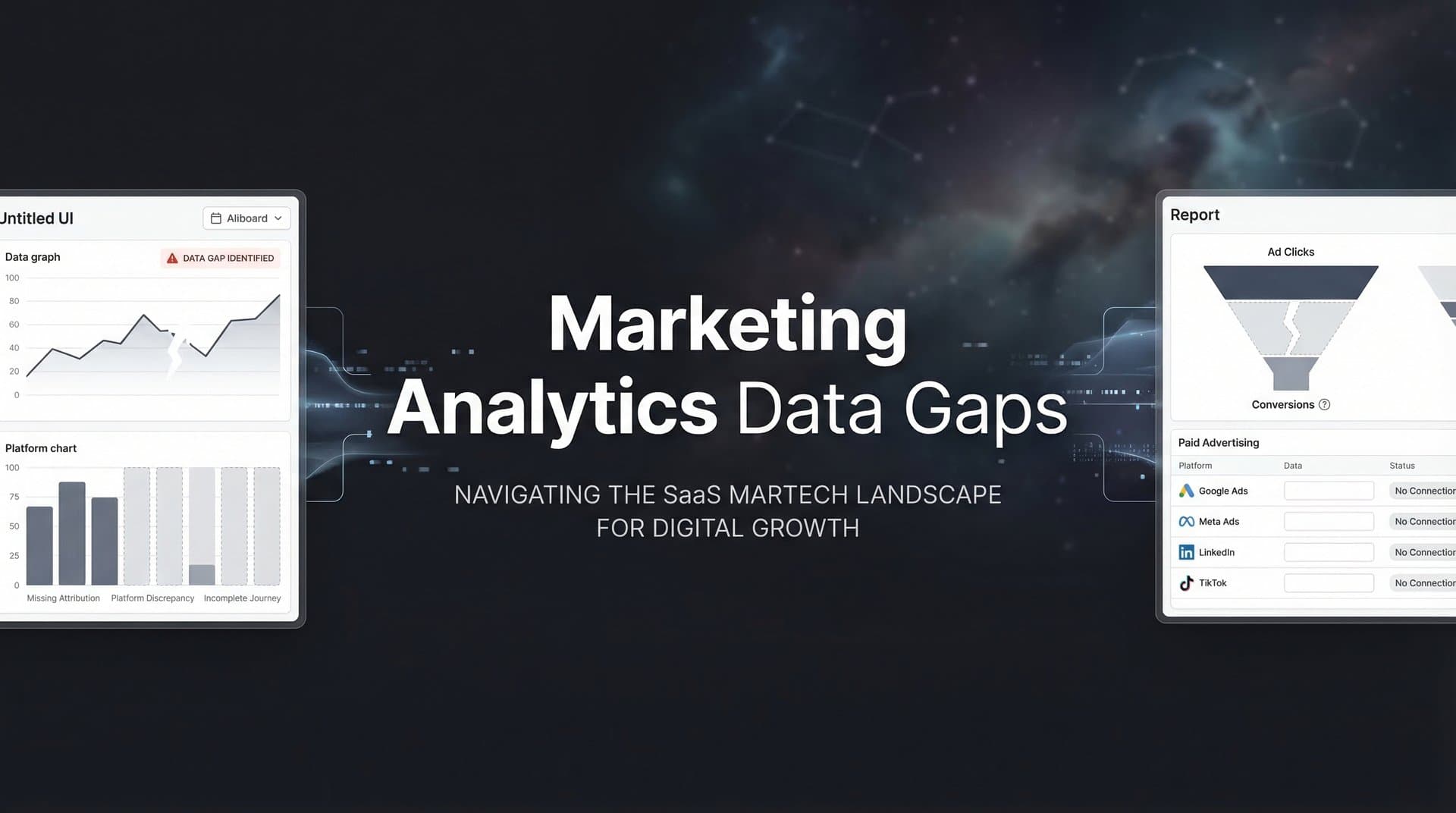
Your marketing dashboard shows a 40% conversion rate increase. Your ad platforms report record-breaking performance. The team celebrates with coffee and high-fives. Then you check revenue—and the numbers don't match. Not even close.
This isn't a tracking error. It's a data gap.
Marketing analytics data gaps are the invisible fractures in your measurement infrastructure where critical information simply vanishes. A customer clicks your Facebook ad on their phone, researches on their laptop, and converts three days later—but your analytics only sees fragments of this journey. The result? You're making million-dollar budget decisions based on incomplete information, scaling campaigns that don't actually drive revenue, and missing the channels that genuinely move the needle.
The challenge has intensified dramatically. Browser privacy restrictions, iOS tracking limitations, and cross-device behavior have transformed data gaps from occasional annoyances into systematic blind spots. For marketers managing multi-channel campaigns, these gaps mean the difference between confident scaling and expensive guesswork.
This guide breaks down exactly what marketing analytics data gaps are, why they're proliferating across the digital landscape, and how to build a measurement system that captures the complete truth about your marketing performance. You'll learn to identify where your data disappears, understand the real business cost of these gaps, and implement practical solutions that work in today's privacy-focused environment.
The Hidden Fractures in Your Marketing Data
Marketing analytics data gaps are missing, incomplete, or disconnected pieces of information that prevent you from accurately measuring how your campaigns actually perform. Think of them as blind spots in your customer journey—moments where people interact with your brand, but those interactions never make it into your analytics system.
Here's the critical distinction: data gaps aren't the same as data silos. A data silo means the information exists somewhere—it's just trapped in a separate system. Your CRM knows which leads closed, but that information never reaches your ad platforms. The data is there; it's just not connected.
A data gap is different. The information is genuinely missing. A customer views your ad while using a VPN, their browser blocks the tracking pixel, and that entire interaction simply never gets recorded anywhere. Or someone clicks your Google ad on their phone during lunch, researches on their work computer that afternoon, then converts on their tablet at home—and your analytics treats these as three completely different people.
The symptoms show up everywhere once you know what to look for. Your Facebook Ads Manager reports 150 conversions this month, but your CRM only shows 87 new customers from Facebook. Google Analytics attributes 60% of revenue to organic search, but when you survey customers, most discovered you through paid ads. Your attribution report credits the final click before purchase, completely ignoring the five previous touchpoints that actually convinced someone to buy.
These discrepancies aren't minor accounting differences—they fundamentally distort your understanding of what's working. When your measurement system has gaps, you're essentially navigating with a map where entire roads are missing. Understanding the root causes of unreliable marketing analytics data is the first step toward building systems that actually reflect reality.
The most dangerous aspect of data gaps is how invisible they are. Unlike a broken tracking pixel that stops recording all conversions, data gaps create partial visibility. You see some results, so everything appears to be working. The numbers look plausible. Your reports generate automatically. But underneath, you're missing 20%, 40%, sometimes 60% of the actual story.
Modern marketing operates across an increasingly complex landscape—multiple ad platforms, various devices, extended consideration periods, and privacy-conscious consumers. Each of these factors creates new opportunities for data to slip through the cracks. Understanding these fractures is the first step toward building a measurement system that actually reflects reality.
Why Your Tracking Keeps Breaking Down
The tracking infrastructure that worked reliably for years has fundamentally broken. This isn't a temporary glitch—it's a structural shift in how the internet handles user data, and it's creating data gaps at an unprecedented scale.
Browser privacy changes have systematically dismantled traditional tracking mechanisms. Safari and Firefox now block third-party cookies by default, preventing advertisers from following users across different websites. Google Chrome has announced similar restrictions, which will affect the majority of web traffic once implemented. These changes mean that when someone clicks your ad and visits your site, then returns days later from a different source, your analytics often can't connect these sessions to the same person.
The impact extends beyond cookies. Intelligent Tracking Prevention (ITP) in Safari actively limits how long tracking parameters persist in URLs and how scripts can access stored data. Ad blockers, used by a significant portion of internet users, prevent tracking pixels from firing at all. The result is that client-side tracking—the browser-based pixels and cookies that powered digital marketing for two decades—now captures only a fraction of actual user behavior.
iOS App Tracking Transparency delivered an even more dramatic disruption. Since iOS 14.5, apps must explicitly ask users for permission to track their activity across other apps and websites. Many users decline. When someone opts out, advertisers lose visibility into whether that person saw an ad, clicked it, and later converted. The Facebook pixel, Google tag, and similar tracking mechanisms simply stop working for opted-out users.
This creates a particularly frustrating scenario: you're still spending money to show ads to these users, they're still converting, but your analytics shows nothing. The conversion happens, revenue flows in, but your attribution system has no record of which ad or campaign drove that sale. From a reporting perspective, these conversions appear to materialize from nowhere. These are among the most common attribution challenges in marketing analytics that teams face today.
Cross-device behavior compounds these challenges exponentially. The typical customer journey no longer happens on a single device. Someone discovers your brand on their phone during a commute, researches options on their work laptop, compares prices on their tablet at home, and finally purchases on their desktop. Traditional tracking treats each device as a separate user, fragmenting a single customer journey into multiple disconnected sessions.
Even when someone uses the same device, privacy features regularly clear cookies and reset identifiers. A customer who visited your site last week might appear as a completely new visitor today because their browser automatically deleted tracking data. You lose the context of their previous interactions, making it impossible to understand their full journey or properly attribute their eventual conversion.
The cumulative effect of these changes is that the data reaching your analytics dashboard represents an increasingly incomplete picture of reality. You're not seeing measurement errors—you're seeing systematic information loss baked into the modern privacy landscape.
The Real Cost of Flying Blind
Data gaps don't just create reporting headaches—they directly drain your marketing budget and limit your growth potential. The business consequences show up in three critical areas: where you allocate money, how well your campaigns optimize, and which strategic decisions you make.
Budget misallocation happens when you scale the wrong channels based on incomplete data. Imagine your attribution report shows that Facebook drives 30% of conversions while Google drives 20%. You logically shift more budget to Facebook. But what if your data gaps disproportionately affect Google tracking? What if Google actually drives 35% of conversions, but privacy restrictions prevent you from seeing half of them? You've just reduced investment in your best-performing channel based on faulty intelligence.
This scenario plays out constantly across marketing teams. Channels that appear to underperform might actually be your most efficient revenue drivers—you just can't see their full contribution. Meanwhile, channels that look impressive in reports might be taking credit for conversions they didn't actually influence. The result is systematically misallocated budgets, where you're pouring money into underperformers while starving your best channels.
Optimization failures occur when ad platform algorithms receive inaccurate signals about what's working. Facebook's algorithm, Google's Smart Bidding, and similar systems rely on conversion data to learn which audiences and creative approaches drive results. When data gaps prevent conversions from being reported back to these platforms, the algorithms optimize based on incomplete information.
Picture this: your ads generate 100 actual conversions, but privacy restrictions and tracking gaps mean only 60 get reported to the ad platform. The algorithm thinks certain audiences and ad variations are underperforming because it never receives the conversion signal. It shifts budget away from what's actually working, toward what merely appears to work based on the limited data it can see. Your campaigns optimize toward the wrong goals, leaving performance on the table.
This problem intensifies as platforms rely more heavily on automated optimization. When you use conversion-focused bidding strategies, you're essentially handing control to algorithms that are only as good as the data they receive. Feed them incomplete conversion data, and they'll make systematically flawed decisions at scale. Understanding how data analytics can improve marketing strategy starts with ensuring your data is complete and accurate.
Strategic blind spots emerge when you can't see which touchpoints genuinely influence purchase decisions. Your last-click attribution model credits the final interaction before conversion, completely ignoring the Facebook ad that created initial awareness, the YouTube video that built consideration, and the retargeting campaign that overcame objections. You conclude that bottom-funnel tactics drive all your revenue and cut investment in upper-funnel channels—then watch your overall conversion volume decline as your awareness pipeline dries up.
The cost extends beyond individual campaigns. When you can't accurately measure channel performance, you can't confidently scale winning strategies. You're forced into conservative budget decisions because you don't trust your data. You miss opportunities to aggressively invest in what's working because you're not certain what's actually working. Growth stalls not because your marketing is ineffective, but because your measurement system can't tell you what to double down on.
These consequences compound over time. Every month you operate with data gaps, you're making suboptimal decisions that cost you revenue and efficiency. The gap between your actual performance and your measured performance widens, and your competitive advantage erodes as competitors with better attribution systems make smarter, faster optimization decisions.
Identifying Where Your Data Disappears
Finding data gaps requires systematic detective work. You need to compare what different systems report and identify where the numbers diverge—those discrepancies reveal where information is falling through the cracks.
Start with a fundamental audit: compare platform-reported conversions against actual business outcomes. Pull conversion numbers from each ad platform for the past month—Facebook, Google, LinkedIn, wherever you're running campaigns. Then pull the corresponding data from your CRM or revenue system for the same period. How many customers or deals actually came from each source? The difference between what platforms report and what actually happened is your data gap.
This comparison often reveals dramatic discrepancies. Ad platforms might report 200 conversions while your CRM shows 140 actual customers from those sources. That 30% gap represents real conversions happening without proper attribution, or false conversions being reported by platforms when users didn't actually complete the desired action. Either way, you're making decisions based on inflated or deflated numbers.
Next, trace the customer journey to pinpoint exactly where data disappears. Ask these diagnostic questions for each stage:
Ad Click to Website Visit: Are users clicking your ads but never appearing in your website analytics? This indicates tracking pixel failures, often caused by ad blockers or privacy tools preventing the analytics script from loading. Check your ad platform's click data against your website's session data from the same traffic sources.
Website Visit to Conversion Event: Do you see traffic in analytics but fewer conversion events than expected? This suggests issues with conversion tracking implementation—pixels not firing on thank-you pages, form submissions not triggering events, or tracking codes breaking when users navigate certain paths through your site.
Conversion Event to CRM Record: Are conversions recorded in your analytics but not appearing as leads in your CRM? This points to integration gaps where the handoff between systems fails. The conversion happens and gets tracked, but the lead data never makes it into your sales pipeline. Proper data analytics in digital marketing requires seamless connections between all your systems.
CRM Lead to Closed Revenue: Do leads exist in your CRM but lack proper source attribution? This means the lead entered your system, but the information about which marketing channel brought them in got lost along the way. Your sales team is closing deals from marketing efforts that get zero credit.
Common gap locations follow predictable patterns. The ad click to website transition loses data when users have strict privacy settings or use browsers that block tracking by default. The website to lead capture stage loses data when forms submit successfully but tracking pixels fail to fire, or when users complete conversions on different devices than they initially clicked the ad on.
The lead to closed sale stage often has the largest gaps because this transition typically happens days or weeks after the initial interaction, and many organizations never properly connect their CRM back to their marketing analytics. A lead converts to a customer in Salesforce, but Google Analytics never learns that this person—who clicked an ad three weeks ago—actually generated revenue.
Cross-device journeys create particularly stubborn gaps. Someone clicks your Instagram ad on mobile, browses your site, then returns on desktop to make a purchase. Your analytics sees two separate users: one mobile visitor who bounced, and one desktop visitor who converted with no clear source. The Instagram ad that drove initial discovery gets no credit, while the conversion appears to be direct traffic.
Test your tracking infrastructure by running controlled experiments. Create a test conversion yourself: click one of your ads, complete the conversion process, and verify that the conversion appears correctly in every system—the ad platform, your website analytics, and your CRM. If the conversion doesn't show up everywhere with proper attribution, you've identified a gap that's affecting real customer data too.
Document what you find. Create a simple map showing each stage of your customer journey and note where data loss occurs. This becomes your roadmap for which gaps to prioritize fixing first. Focus on the stages with the largest discrepancies—those represent the biggest opportunities to improve measurement accuracy and make better decisions.
Closing the Gaps: A Practical Framework
Fixing data gaps requires rebuilding your tracking infrastructure on a foundation that works with modern privacy restrictions rather than fighting against them. The solution centers on three core capabilities: server-side tracking, unified data connections, and enriched conversion feedback loops.
Server-side tracking fundamentally changes where data collection happens. Instead of relying on browser-based pixels that privacy tools can block, server-side tracking sends data directly from your server to analytics and ad platforms. When someone converts on your website, your server captures that event and transmits it to Facebook, Google, and your other platforms—regardless of whether the user has ad blockers, strict privacy settings, or has opted out of app tracking.
This approach is privacy-resilient because it doesn't depend on third-party cookies or cross-site tracking. You're collecting first-party data from interactions happening on your own properties, then sharing that data with platforms through secure server-to-server connections. The user's browser settings can't interfere with this data flow because the browser isn't involved in the transmission.
Implementing server-side tracking requires technical setup, but the payoff is substantial. You'll capture conversions that client-side pixels miss entirely, giving you a more complete picture of campaign performance. Ad platforms receive more accurate conversion data, which improves their algorithmic optimization. And you gain resilience against future privacy changes that might further restrict browser-based tracking.
The second critical piece is connecting ad platforms, website analytics, and CRM into a unified data ecosystem. Data gaps often occur at the boundaries between systems—when information needs to move from one platform to another and that handoff fails. A unified system eliminates these handoff points by maintaining consistent identity and attribution across your entire marketing stack. Learning how to use data analytics in marketing effectively requires this kind of integrated approach.
This means when someone clicks a Facebook ad, visits your website, submits a lead form, and eventually becomes a customer in your CRM, all of these events are connected to a single user profile with complete attribution history. Your analytics knows which ad they clicked, which pages they viewed, how many times they returned, and ultimately that they generated revenue. No data gets lost in translation between systems.
Building this unified view requires infrastructure that can track users across touchpoints while respecting privacy boundaries. First-party data becomes your foundation—information users provide directly to you through form submissions, account creation, and authenticated sessions. This data is both privacy-compliant and reliable, unaffected by browser restrictions.
The third component is feeding enriched conversion data back to ad platforms. When a lead becomes a customer in your CRM, that information needs to flow back to Facebook, Google, and your other ad platforms so their algorithms understand which campaigns drive actual revenue, not just form submissions. This closed loop transforms how platforms optimize your campaigns.
Without this feedback, ad platforms optimize toward proxy metrics—they maximize conversions or leads because that's the only signal they receive. But not all leads are equal. Some convert to high-value customers, others never engage with sales. When you send revenue data back to platforms, they can optimize toward the conversions that actually matter to your business, automatically shifting budget toward audiences and creative that drive valuable customers.
This feedback mechanism also helps platforms build better lookalike audiences. Instead of finding people similar to everyone who submitted a form, they find people similar to those who became paying customers. The targeting quality improves dramatically because the algorithm is learning from better data.
Practical implementation starts with audit results from the previous section. Prioritize fixing the gaps with the biggest impact—typically the connections between website conversions and CRM records, and the feedback loop from closed deals back to ad platforms. These are the gaps that most directly affect budget decisions and campaign optimization.
Choose tools and platforms that support server-side tracking natively and offer pre-built integrations with your existing marketing stack. The goal is to minimize custom development work while maximizing data completeness. Look for solutions that can capture conversion events server-side, maintain unified customer profiles across touchpoints, and automatically sync conversion data back to ad platforms.
Test your implementation thoroughly. Run conversions through your new tracking setup and verify that data flows correctly through every stage—from ad click to website event to CRM record to ad platform conversion feedback. Monitor for discrepancies and iterate until your systems show consistent, accurate attribution across all platforms.
Building a Gap-Proof Analytics Stack
A gap-proof analytics infrastructure isn't a one-time implementation—it's an ongoing system built with specific capabilities that maintain accuracy as the privacy landscape evolves and your marketing grows more complex.
Start by identifying essential capabilities your stack must have. First-party data infrastructure is non-negotiable. You need systems that collect and store data directly from your owned properties—your website, app, and authenticated user interactions. This data remains reliable regardless of browser restrictions or privacy regulations because it's information users willingly provide to you.
Multi-touch attribution is equally critical. Last-click attribution systematically creates data gaps by ignoring every touchpoint except the final one. Someone might interact with five different campaigns before converting, but last-click gives 100% credit to whichever campaign they happened to click last. The other four campaigns—which might have been essential to the conversion—get zero credit, creating a strategic blind spot about what actually drives results.
Your attribution model should track and credit all meaningful touchpoints across the customer journey. This doesn't mean every interaction gets equal credit—different attribution models weight touchpoints differently based on their position in the journey. But you need visibility into the full path, not just the last step. Implementing data science for marketing attribution can help you build more sophisticated models that capture the complete picture.
Real-time data sync keeps your systems aligned and prevents information from getting stale or lost. When a conversion happens, that event should propagate to all relevant systems immediately—your analytics dashboard, your CRM, and your ad platforms. Delays create opportunities for data to get dropped or misattributed. Real-time sync also enables faster optimization decisions because you're working with current information, not yesterday's data.
Attribution platforms have emerged as purpose-built solutions for bridging disconnected data sources. These platforms sit at the center of your marketing stack, ingesting data from ad platforms, website analytics, CRM systems, and other sources, then unifying that data into a single view of customer journeys and campaign performance.
The value of a dedicated attribution platform is that it's designed specifically to solve data gap problems. It handles the complex work of identity resolution across devices, maintains consistent attribution as users move between touchpoints, implements server-side tracking, and manages conversion data sync back to ad platforms. Rather than building these capabilities yourself through custom integrations, you get a tested solution that addresses the full scope of modern attribution challenges. Selecting the right marketing data analytics platform is one of the most important decisions you'll make.
When evaluating attribution platforms, prioritize those that offer comprehensive integrations with your existing tools. The platform should connect natively to your ad channels, website analytics, CRM, and any other systems that hold customer data. Pre-built integrations are vastly preferable to custom API work—they're faster to implement, more reliable, and easier to maintain.
Look for platforms that support advanced attribution models beyond last-click. You want the flexibility to analyze performance through different lenses—first-touch attribution to understand awareness drivers, linear attribution to credit all touchpoints equally, time-decay models that give more credit to recent interactions, or custom models tailored to your specific sales cycle.
Ongoing maintenance is where many marketing teams fall short. You can implement perfect tracking today, but if you don't maintain it, gaps will creep back in. Schedule regular attribution audits—quarterly at minimum—where you compare platform reports against actual revenue data and investigate any discrepancies that emerge.
Test your tracking infrastructure whenever you launch new campaigns, add new platforms, or make significant changes to your website or conversion process. Don't assume that tracking continues working correctly after changes—verify it. Run test conversions, check that they appear in all systems, and confirm attribution is accurate.
Stay informed about privacy landscape changes. When browsers announce new tracking restrictions or mobile platforms introduce additional privacy features, assess how these changes will affect your measurement capabilities and adapt your infrastructure proactively. The teams that maintain gap-proof analytics are those that treat attribution as an evolving system requiring ongoing attention, not a set-it-and-forget-it implementation.
Document your attribution methodology and ensure your team understands how data flows through your systems. When gaps do appear—and they occasionally will—you need people who can quickly diagnose where the breakdown occurred and implement fixes. Knowledge transfer and documentation are as important as the technical infrastructure itself.
Moving Forward with Complete Visibility
Marketing analytics data gaps are not an inevitable cost of doing business in a privacy-focused world. They're solvable problems with concrete solutions—but only if you approach them systematically rather than accepting incomplete data as the new normal.
The path forward starts with understanding exactly where your data disappears. Audit your current systems, compare platform reports against actual business outcomes, and map the specific points in your customer journey where information gets lost. These gaps represent not just measurement problems but real money left on the table through misallocated budgets and missed optimization opportunities.
Fixing these gaps requires infrastructure designed for today's privacy landscape. Server-side tracking provides resilience against browser restrictions and ad blockers. Unified data connections eliminate the handoff failures that occur when information moves between disconnected systems. Enriched conversion feedback loops ensure ad platforms optimize toward real business outcomes rather than proxy metrics. Together, these capabilities create measurement systems that capture the complete truth about marketing performance.
The business impact of closing data gaps extends far beyond cleaner reports. You gain the confidence to scale winning campaigns aggressively because you trust your attribution data. You optimize faster because your systems provide accurate signals about what's working. You make smarter strategic decisions because you see which touchpoints genuinely influence purchase behavior across the full customer journey.
Modern attribution platforms have evolved specifically to address these challenges. Rather than cobbling together custom solutions from multiple tools, purpose-built platforms provide the server-side tracking, unified data architecture, and real-time sync capabilities needed to maintain accurate attribution at scale. They handle the complexity of modern multi-touch journeys so you can focus on acting on insights rather than questioning data quality.
The competitive advantage increasingly belongs to marketing teams with superior attribution infrastructure. When your competitors are flying blind due to data gaps, your ability to see complete customer journeys and accurately measure channel performance becomes a decisive edge. You can move faster, optimize smarter, and scale more confidently because your decisions are grounded in complete data rather than partial visibility.
Ready to elevate your marketing game with precision and confidence? Discover how Cometly's AI-driven recommendations can transform your ad strategy—Get your free demo today and start capturing every touchpoint to maximize your conversions.



