Managing marketing analytics for a franchise network feels like trying to conduct an orchestra where every musician is in a different room. You're running national brand campaigns that need to resonate across dozens or hundreds of locations. At the same time, individual franchisees are launching their own local efforts—Facebook ads for the downtown location, Google campaigns for the suburban spot, direct mail in another territory. The result? A fragmented mess of data that makes it nearly impossible to understand what's actually driving revenue.
If you've ever stared at reports from multiple locations and wondered whether your corporate marketing budget is working, or which franchisee is wasting money on ineffective ads, you're not alone. The franchise model creates unique analytics challenges that traditional marketing tools simply weren't built to solve. You need visibility into performance at every location while maintaining a unified view of your brand's overall marketing effectiveness.
This guide breaks down exactly how to build an analytics infrastructure that works for multi-location brands. We'll cover why standard analytics platforms fall short for franchises, which metrics actually matter across territories, and how to implement tracking that scales from 10 locations to 500. Most importantly, you'll learn how to turn all that data into clear, actionable decisions that drive growth across your entire franchise network.
The Multi-Location Data Problem That Generic Analytics Can't Solve
Traditional marketing analytics platforms were designed with a simple assumption: one business, one website, one set of campaigns. That model breaks down completely when you're managing a franchise network where customer journeys cross corporate and local touchpoints constantly.
Picture this scenario: A potential customer sees your national TV commercial, searches for your brand name plus their city, clicks on a local franchise's Google Ad, visits your corporate website to browse services, then converts through a phone call to their nearest location. Which marketing effort deserves credit for that conversion? Your brand awareness campaign? The local Google Ad? The website experience? Without proper attribution, you're flying blind.
The complexity multiplies when each franchise location operates with different levels of marketing sophistication. Some franchisees might be running sophisticated multi-channel campaigns through professional agencies. Others are boosting Facebook posts from their personal accounts. A few might not be doing any digital marketing at all, relying entirely on your corporate efforts and walk-in traffic.
This creates data silos that make unified reporting nearly impossible. Location A uses one CRM system. Location B tracks leads in spreadsheets. Location C has a point-of-sale system that doesn't talk to anything else. Meanwhile, your corporate marketing team is running campaigns across Meta, Google, and traditional channels, with no clear way to connect those efforts to individual location performance. Understanding data analytics for digital marketing becomes essential for bridging these gaps.
The attribution challenge becomes even thornier when you consider the franchise business model itself. Corporate invests in brand building and awareness campaigns that benefit all locations. But how do you measure the ROI on that investment when conversions happen at the local level? How do you fairly compare the performance of a franchise in a major metro area with strong brand recognition against one in a smaller market where you're still building awareness?
Add in the technical challenges of modern digital marketing—iOS privacy changes, cookie deprecation, browser tracking limitations—and many franchise marketers find themselves making million-dollar budget decisions based on incomplete or inaccurate data. The tools that work fine for single-location businesses simply can't handle the complexity of tracking customer journeys across corporate brand touchpoints and local conversion events.
Performance Indicators That Matter Across Your Franchise Network
Not all metrics are created equal when you're managing marketing for multiple locations. The key is identifying performance indicators that give you both the bird's-eye view of overall brand health and the granular detail to spot opportunities or problems at individual franchises.
Start with location-level fundamentals: cost per lead, customer acquisition cost, and return on ad spend broken down by territory. These metrics tell you which locations are marketing efficiently and which ones need support. But here's where it gets interesting—you can't just compare raw numbers across locations and call it a day. A franchise in Manhattan will have different economics than one in rural Montana. Context matters.
Revenue per marketing dollar spent: This metric accounts for local market differences better than raw ROAS. It shows you which locations are generating the most business value from their marketing investments, regardless of their cost structure.
Lead-to-customer conversion rate by source: Track which marketing channels are bringing in leads that actually convert into paying customers at each location. You might discover that Google Ads generate tons of leads for Location A but those leads rarely convert, while Facebook drives fewer but higher-quality prospects. Implementing marketing analytics for Google Ads helps you understand these channel-specific patterns.
Customer lifetime value by acquisition channel: Some marketing channels attract one-time customers. Others bring in people who become loyal, repeat buyers. Understanding this distinction helps you invest in channels that build long-term franchise value, not just short-term transaction volume.
Cross-location comparison metrics reveal patterns that individual franchise owners might miss. When you can see that Location B consistently outperforms similar territories, you can investigate what they're doing differently. Maybe they've found a winning ad creative. Perhaps they've optimized their local landing pages. Or they might have a franchisee who's particularly skilled at follow-up with leads.
Top-performing creative elements across locations: Identify which ad images, headlines, and messaging resonate best across your network. This lets you take what's working in one market and scale it to others.
Market penetration relative to territory potential: Compare each location's performance not just to other franchises, but to the potential in their specific market. This helps you spot underperforming locations that should be doing better based on their demographics and competition.
Customer journey touchpoints from initial exposure through conversion deserve special attention in franchise analytics. Unlike single-location businesses, your customers might interact with your brand through multiple layers—corporate content, local ads, in-store experiences—before making a purchase decision.
Track the average number of touchpoints before conversion for each location. If customers in one territory typically need seven interactions before buying while another location converts after three, that tells you something important about brand awareness, local competition, or the effectiveness of that franchise's marketing funnel.
Monitor the time lag between first touch and conversion across locations. Longer sales cycles might indicate markets where you need more nurture campaigns or where local franchisees need better follow-up processes. Shorter cycles suggest opportunities to increase ad spend and capture demand more aggressively.
The goal isn't drowning in metrics. It's having the right data to answer critical questions: Which locations need more marketing support? Where should we increase budget? What campaigns can we scale across the network? Which franchisees are marketing most effectively and what can others learn from them?
Creating a Single Source of Truth for Multi-Location Marketing Data
Building unified analytics across a franchise network isn't just a technical challenge. It's an organizational one that requires getting corporate marketing, franchisees, and technology systems all working from the same playbook.
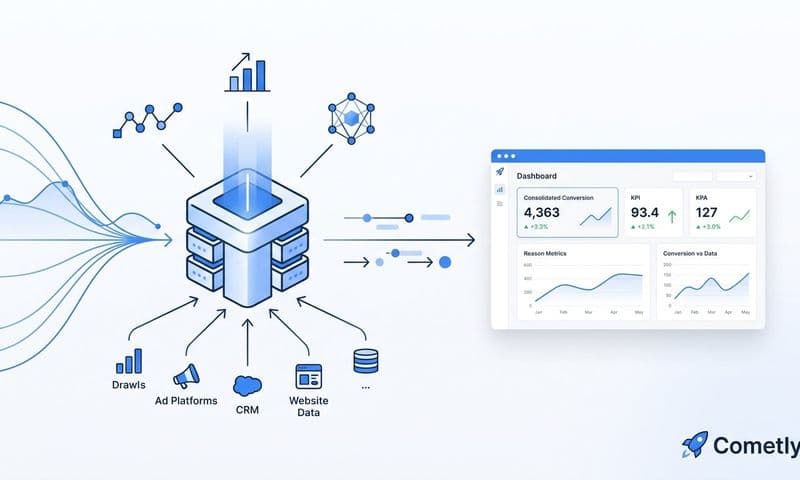
The foundation is connecting every data source into a single platform where customer journeys can be tracked from initial ad exposure through final conversion, regardless of which location or channel was involved. This means integrating your ad platforms, CRM systems, point-of-sale data, website analytics, and any other tools your franchise network uses to manage customer relationships. A robust marketing data analytics platform serves as this central hub.
Many franchise organizations approach this by mandating specific technology stacks for all locations. While this creates consistency, it often meets resistance from franchisees who've already invested in their own systems or prefer different tools. A more flexible approach involves building integration layers that can pull data from various sources into a unified analytics platform.
Server-side tracking has become essential for maintaining data accuracy in this environment. Browser-based tracking faces increasing limitations from iOS privacy features, cookie restrictions, and ad blockers. When you're managing hundreds of locations, these tracking gaps multiply into massive blind spots in your data.
Server-side tracking works by sending conversion events directly from your servers to ad platforms and analytics tools, bypassing browser limitations entirely. This approach captures significantly more accurate data about which ads and campaigns are driving results. For franchise businesses, this means you can track conversions at specific locations even when browser tracking fails.
Think of it like this: Browser tracking is like asking customers to carry a tracking device through their journey. Some will, but many won't due to privacy settings or technical limitations. Server-side tracking is like having security cameras at every touchpoint—you capture the data regardless of what customers do with their browser settings.
Standardized tracking protocols are crucial for making this work at scale. Every franchise location needs to follow the same UTM naming conventions, event tracking standards, and data formatting rules. Otherwise, you end up with a mess of inconsistent data that can't be aggregated or compared meaningfully.
Create a UTM taxonomy that works across your network: Define exactly how campaigns, sources, and mediums should be tagged. For example, utm_source might always indicate the platform (facebook, google, email), utm_medium indicates the channel type (paid, organic, social), and utm_campaign includes both the corporate campaign name and location identifier.
Standardize conversion event naming: Whether it's a lead form submission, phone call, or in-store visit, every location should track these events with identical naming and parameters. This lets you aggregate data across the network while still maintaining location-level detail. Platforms that offer real-time conversion tracking make this standardization much easier to implement.
Implement location identifiers in all tracking: Every conversion event should include a location ID or identifier that lets you attribute revenue to specific franchises. This seems obvious but is often overlooked in initial implementations.
The technical infrastructure should support both real-time and historical analysis. Franchise marketers need to see what's happening right now—which locations are getting leads today, which campaigns are performing well this week—while also analyzing trends over months or years to understand seasonal patterns and long-term growth trajectories.
Data governance becomes critical when you're handling information from multiple locations. You need clear policies about who can access what data, how franchisee performance information is shared, and how corporate uses location-level insights. Many franchise organizations struggle with this balance between transparency and privacy, especially when franchisees are independent business owners who don't want competitors seeing their numbers.
Making Sense of Multi-Touch Attribution in Franchise Marketing
Attribution modeling for franchise businesses requires accounting for a reality that single-location brands don't face: customers interact with both corporate brand-building efforts and local conversion-focused campaigns before making a purchase decision. Figuring out which touchpoints deserve credit for that sale determines where you invest your marketing budget.
Multi-touch attribution tracks every interaction a customer has with your brand across all channels and touchpoints, then assigns value to each interaction based on its role in the conversion path. For franchises, this means understanding how national campaigns, local ads, website visits, and in-person interactions work together to drive revenue.
Let's say a customer's journey looks like this: They see your YouTube pre-roll ad (corporate campaign), click a local franchise's Facebook ad two weeks later, visit your corporate website to read reviews, then convert by calling their nearest location after seeing a retargeting ad. Which marketing effort was most valuable? The answer depends on which attribution model you use.
First-touch attribution gives all credit to the initial YouTube ad. This model favors brand awareness campaigns and corporate marketing efforts, since those typically introduce customers to your brand. It's useful for understanding which channels are best at generating new interest, but it ignores everything that happened after that first interaction.
Last-touch attribution gives all credit to the final retargeting ad before conversion. This model favors conversion-focused campaigns and local marketing efforts, since those are typically the last touchpoint. It's great for understanding what closes sales, but it completely ignores the brand-building work that made the conversion possible.
Linear attribution splits credit equally across all touchpoints. In our example, the YouTube ad, Facebook ad, website visit, and retargeting ad would each get 25% of the credit. This model acknowledges that multiple interactions matter, but it assumes they're all equally important—which usually isn't true.
Time-decay attribution gives more credit to touchpoints closer to the conversion. This model recognizes that the retargeting ad that happened right before the sale probably had more influence than the YouTube ad from three weeks ago. It's particularly useful for understanding which campaigns are effective at moving customers through the final stages of decision-making.
Position-based attribution (also called U-shaped) gives the most credit to the first and last touchpoints, with remaining credit distributed among middle interactions. This model works well for franchise businesses because it values both the corporate brand-building that introduces customers and the local conversion campaigns that close sales.
Here's the thing about attribution models: there's no single "correct" one for franchise marketing. The best approach is comparing multiple models to understand how they tell different stories about your marketing effectiveness. When first-touch and last-touch attribution show dramatically different results, that reveals important insights about how your corporate and local marketing efforts work together. Learning how to leverage analytics for marketing strategy helps you interpret these attribution insights effectively.
Use attribution data to make smarter budget allocation decisions between corporate brand building and local franchise support. If your analysis shows that most conversions involve multiple touchpoints including both national and local campaigns, that's evidence for investing in both layers rather than choosing one over the other.
Attribution also helps you identify which locations are benefiting most from corporate marketing investments. Some franchises might convert primarily from local efforts with minimal assist from brand campaigns. Others might rely heavily on corporate awareness-building with local campaigns serving mainly as the final conversion trigger. Understanding these patterns helps you allocate co-op marketing funds and support resources more effectively.
The goal is moving beyond simple metrics like "this campaign generated X leads" to understanding the complex interplay of touchpoints that actually drives franchise revenue. That understanding transforms how you invest marketing dollars across your network.
Transforming Analytics Into Franchise-Wide Growth Strategies
Data without action is just expensive record-keeping. The real value of franchise analytics comes from using insights to make decisions that scale growth across your entire network.
Start by identifying high-performing ad creative and campaigns that can be rolled out across all locations. When you have unified analytics, you can spot patterns that individual franchisees would never see. Maybe a specific ad headline is crushing it in three different markets. That's not a coincidence—it's a winning message that should be tested everywhere.
Create a systematic process for taking local success stories and scaling them network-wide. When Location A discovers that carousel ads showcasing customer testimonials outperform single-image ads by 40%, don't let that insight die in their market. Package that creative approach, test it in a few more territories, and if results hold, roll it out as a recommended best practice for all franchises.
This is where AI-powered recommendations become incredibly valuable. Machine learning algorithms can analyze performance across hundreds of locations and thousands of campaigns to identify patterns that human analysts would miss. An AI marketing analytics platform might notice that franchises in college towns see better results from Instagram ads on weekends, while suburban locations perform better with Facebook ads on weekday evenings.
Related reading: our complete guide to AI Instagram ad image generator.
These AI systems can optimize budget allocation across territories in real time based on performance data. Instead of setting monthly budgets and hoping for the best, you can dynamically shift spend toward locations and campaigns that are converting efficiently right now. If Location B is seeing unusually strong lead quality this week while Location C is underperforming, the system can automatically adjust budgets to capitalize on that opportunity.
Feed better conversion data back to ad platforms to improve their targeting and optimization algorithms. Meta, Google, and other platforms use conversion data to learn which audiences are most likely to buy from you. When you send them accurate, detailed conversion information—including location-specific data and customer value metrics—their algorithms get smarter about finding similar high-value prospects.
This creates a compounding effect where your ads become more effective over time. Better data leads to better targeting, which drives more qualified traffic, which generates more conversions, which provides even better data for the algorithms to learn from. Franchise businesses with proper analytics infrastructure can achieve this flywheel effect across all locations simultaneously.
Use cross-location benchmarking to identify underperforming franchises that need support. When you can see that Location D is spending twice as much per lead as similar territories, that's a signal to investigate. Maybe they need help with ad creative. Perhaps their landing pages aren't optimized. Or they might benefit from training on lead follow-up processes. A cross-platform marketing analytics dashboard makes these comparisons straightforward.
The key is moving from reactive problem-solving to proactive optimization. Instead of waiting for franchisees to ask for help or complain about poor results, your analytics should surface opportunities and issues automatically. Build dashboards that highlight locations performing above or below expected benchmarks, campaigns that are scaling efficiently or wasting budget, and customer journey patterns that suggest optimization opportunities.
Share insights across your franchise network in ways that drive collective improvement. Regular reports showing which locations are achieving the best marketing efficiency, which campaigns are working across multiple territories, and which tactics are falling flat help franchisees learn from each other. Just be thoughtful about how you present this data—the goal is collaborative improvement, not creating competition or embarrassment among franchise owners.
Your Roadmap to Multi-Location Analytics That Actually Work
Implementing unified analytics across a franchise network doesn't happen overnight. A phased approach that demonstrates value quickly while building toward comprehensive tracking gives you the best chance of success.
Phase one focuses on quick wins that prove the concept to both corporate leadership and franchisees. Start by connecting your major ad platforms and implementing basic server-side tracking for conversions. Even this foundational step will reveal insights you're currently missing and improve data accuracy significantly. Choose three to five pilot locations that represent different market types and franchisee sophistication levels. Get them fully instrumented with proper tracking, then use their results to build the case for network-wide implementation. If you're new to this process, a guide to marketing analytics for beginners can help establish foundational knowledge.
Phase two expands tracking across all locations and data sources. This is where you integrate CRM systems, point-of-sale data, and any other customer touchpoint information. Establish your standardized UTM conventions and tracking protocols, then provide training and support to help franchisees implement them correctly. Build out your unified dashboard that shows both network-wide performance and location-specific details.
Phase three focuses on optimization and advanced analytics. Implement multi-touch attribution modeling, set up AI-powered recommendations, and create automated reporting that surfaces insights proactively. This is where you move from "we have data" to "we're using data to drive decisions that scale growth across the network." Exploring predictive analytics for marketing campaigns can help you anticipate performance trends before they happen.
Throughout this process, communication is as important as technology. Franchisees need to understand what you're tracking, why it matters, and how it benefits their individual businesses. Position the analytics infrastructure as a tool that helps them compete more effectively in their local markets, not as corporate oversight or control.
Provide ongoing training and support as you roll out new capabilities. Marketing analytics can be intimidating for franchisees who are focused on running their day-to-day operations. Make it easy for them to access the insights they need without becoming data analysts themselves. Clear, actionable dashboards that answer specific questions—"Are my ads working?" "Where should I spend more?" "What's my best performing campaign?"—get used. Complex analytics platforms that require extensive training gather dust.
Celebrate successes and share wins across the network. When a franchise uses analytics to identify an opportunity and drives significant revenue growth, tell that story. When corporate optimizes a campaign based on multi-location data and improves performance network-wide, show the results. These success stories build momentum and buy-in for your analytics initiatives.
Making Multi-Location Marketing Data Work for Your Franchise
Franchise businesses operate in a unique middle ground that generic analytics platforms simply weren't designed to handle. You need the brand consistency and economies of scale that come from corporate marketing, combined with the local relevance and conversion focus that individual franchisees bring to their markets. Making that combination work requires analytics infrastructure that can track complex customer journeys across both layers.
The goal isn't collecting more data for its own sake. It's gaining clearer visibility into what actually drives revenue at every location so you can make smarter decisions about where to invest marketing dollars. When you can see which campaigns work across multiple territories, which locations are marketing most efficiently, and how corporate brand-building interacts with local conversion efforts, you stop guessing and start optimizing.
The franchise organizations that win in today's marketing environment are those that solve the multi-location data challenge. They connect every touchpoint into a unified view of customer journeys. They use attribution modeling to understand how different marketing efforts work together. They leverage AI to identify patterns and opportunities across their network. And they feed accurate conversion data back to ad platforms to make their targeting smarter over time.
This isn't about replacing human judgment with algorithms or taking control away from franchisees. It's about giving everyone in your network—from corporate marketers to individual franchise owners—the insights they need to compete more effectively in their markets. When a franchisee can see exactly which ads are driving their best customers, they make better budget decisions. When corporate can identify winning campaigns to scale network-wide, everyone benefits.
The technical challenges of multi-location tracking are real, but they're solvable with the right platform and approach. Purpose-built attribution tools that understand the franchise model can handle the complexity that generic analytics platforms struggle with. They can track customer journeys across corporate and local touchpoints, maintain data accuracy despite browser limitations, and provide insights at both the network and location level.
Ready to elevate your marketing game with precision and confidence? Discover how Cometly's AI-driven recommendations can transform your ad strategy—Get your free demo today and start capturing every touchpoint to maximize your conversions.