Most marketing teams are drowning in data but starving for insight. You pull numbers from Google Ads, Meta, your CRM, and a handful of other platforms, then spend hours stitching them together in a spreadsheet that nobody reads. The result? Reports that look impressive but fail to answer the one question that matters: what should we do next?
A strong marketing analytics report does more than recap what happened. It connects ad spend to revenue, reveals which channels actually convert, and gives your team or your clients a clear path forward. The difference between a report that drives decisions and one that collects dust usually comes down to how it was built, not how much data it contains.
Whether you are an in-house marketer managing multi-platform campaigns or an agency reporting to a roster of clients, the process of building these reports follows the same core steps. Get the foundation right and everything downstream becomes easier: stakeholder conversations, budget decisions, creative testing, channel mix strategy.
This guide walks you through the entire workflow for building a marketing analytics reporting process that actually works. You will learn how to define the right objectives, select meaningful KPIs, centralize your data, choose the right attribution model, structure your report for clarity, translate insights into recommendations, and automate the whole process so it does not consume your week.
By the end, you will have a repeatable framework for creating marketing analytics reports that earn trust, save time, and inform smarter budget decisions. No fluff, no vanity metrics, just a practical system you can start implementing today.
Step 1: Define Your Reporting Objectives and Audience
Before you open a single spreadsheet or pull a single data export, you need to answer two questions: who is reading this report, and what decision do you want them to make after reading it?
These two questions shape everything. A CMO reviewing quarterly performance needs a high-level narrative about revenue contribution, channel mix, and strategic direction. A media buyer running daily campaigns needs granular data on ad set performance, creative fatigue signals, and cost-per-click trends. A client reviewing monthly results needs context, benchmarks, and clear recommendations. Building one report that tries to serve all three audiences usually serves none of them well.
Identify your primary reader: Pick one primary stakeholder per report. If you need to serve multiple audiences, build separate report views or summary layers rather than cramming everything into a single document.
Clarify the core question: Every report should be anchored to one central question. Are we hitting our revenue targets this quarter? Which campaigns should we scale heading into next month? Where is budget being wasted right now? When you can name that question clearly, the report almost writes itself because every section either answers it or builds toward answering it. Understanding the goals of marketing analytics can help you frame this question more effectively.
Set the right reporting cadence: Cadence matters more than most teams realize. Weekly reports work well for tactical optimization because they give you enough data to spot trends without over-indexing on daily noise. Monthly reports are better suited for strategic reviews where you are evaluating channel mix, testing outcomes, and budget allocation. Quarterly reports serve executive-level planning and should focus on big-picture performance against business goals.
Avoid the one-report-for-everyone trap: This is the most common pitfall in marketing analytics reporting. When you try to include every metric for every stakeholder, you end up with a 20-page document that nobody reads past page two. Focused reports get read. Bloated reports get skimmed and ignored.
Here is a simple test for whether your reporting objective is clear enough: can you state in one sentence what decision this report will help someone make? If you cannot, keep refining before you build anything else. That single sentence becomes your north star for every choice you make in the steps that follow.
Step 2: Choose the KPIs That Actually Matter
Once you know who your report is for and what question it needs to answer, you can select the metrics that belong in it. This is where many marketing teams go wrong by defaulting to whatever metrics are easiest to pull rather than the ones that are most meaningful.
The first move is separating vanity metrics from revenue-connected KPIs. Impressions and clicks are easy to report and easy to look good on, but they do not tell you whether your marketing is actually working. Revenue-connected KPIs like return on ad spend, cost per acquisition, customer lifetime value, and pipeline contribution connect your marketing activity directly to business outcomes. Those are the numbers that earn you a seat at the table.
Map KPIs to funnel stages: Not every metric belongs in every report, but every report should represent the full funnel. Awareness-stage metrics like reach, impressions, and branded search volume belong at the top. Consideration metrics like click-through rate, cost per click, and landing page conversion rate sit in the middle. Revenue metrics like cost per acquisition, ROAS, and closed revenue belong at the bottom. Exploring marketing funnel analytics can help you visualize how these stages connect in your reporting.
Balance leading and lagging indicators: Lagging indicators like closed revenue and ROI tell you what happened. Leading indicators like click-through rate trends, lead quality scores, and engagement rates give you early signals about what is likely to happen next. Including both makes your report forward-looking, not just backward-looking.
Limit your primary KPIs to five to eight per report: This is a practical discipline. When every metric gets equal weight, nothing stands out. Pick the five to eight KPIs that most directly answer your reporting objective, and treat everything else as supporting data that lives in an appendix or a drill-down view.
Always tie KPIs back to the business objective: Every metric in your report should pass a simple test: does this help answer the core question defined in Step 1? If a metric does not connect to that question, it probably does not belong in the primary report. This keeps your report focused and makes it far more useful for the people reading it.
Think of your KPI selection as building a dashboard for a pilot. You do not want every possible reading from every sensor. You want the gauges that tell you whether the plane is flying safely and heading in the right direction. Everything else is noise until something goes wrong.
Step 3: Centralize Your Data Sources for a Single Source of Truth
Here is where most marketing analytics reporting processes break down. You have great objectives. You have the right KPIs. But your data lives in six different platforms, each with its own attribution logic, counting methodology, and reporting window. Reconciling those numbers manually takes hours and still produces conflicting totals.
Start by mapping every platform that generates marketing data in your stack. This typically includes paid ad platforms like Meta, Google Ads, and TikTok; your CRM for lead and revenue data; your website analytics for on-site behavior; email marketing tools for engagement data; and any other demand generation channels you run. Write them all down. Most teams are surprised by how many sources they actually have.
Understand why siloed data creates problems: Each platform is built to attribute credit to itself. Meta's attribution window defaults differ from Google's. Your CRM may count a conversion when a deal closes while your ad platform counts it when a form is submitted. When you pull these numbers separately and try to add them together, you get double-counting, gaps, and contradictions that erode stakeholder trust in your reporting. Learning more about unreliable marketing analytics data can help you identify and address these inconsistencies.
Address tracking accuracy at the source: Privacy changes have made cross-platform tracking significantly harder. iOS privacy updates and browser restrictions on third-party cookies have reduced the visibility that pixel-based tracking once provided. Server-side tracking is increasingly the solution of choice because it sends conversion data directly from your server to ad platforms rather than relying on browser-based signals that can be blocked or lost. This improves data accuracy and gives you a more complete picture of what is actually happening in your campaigns.
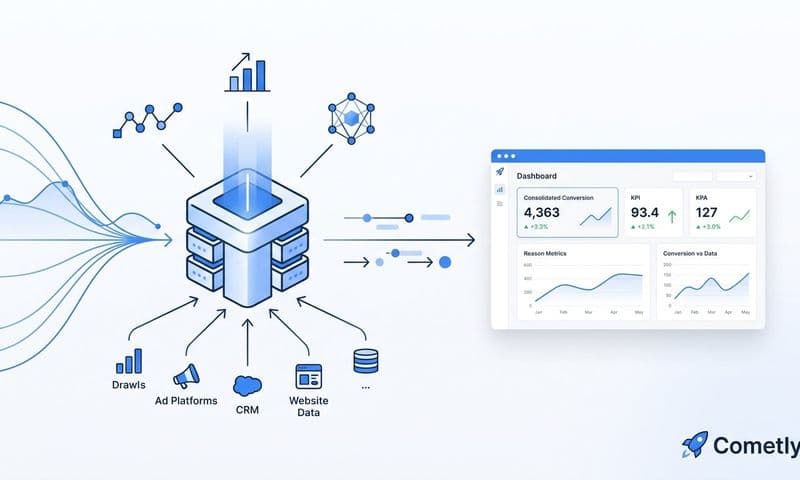
Bring everything into a single platform: This is the goal. Instead of toggling between dashboards and manually exporting CSVs, you want all your campaign data flowing into one place where you can analyze it with consistent attribution logic. A unified marketing analytics platform connects your ad platforms, CRM, and website data to track the full customer journey in one place, giving you a unified view of performance across every channel without the manual stitching.
The success indicator for this step is straightforward: all your campaign data flows into a single dashboard without manual exports. When you can open one platform and see cross-channel performance with consistent attribution, you have solved the data centralization problem and you can spend your time on analysis instead of data wrangling.
Step 4: Select the Right Attribution Model for Your Business
Attribution is the part of marketing analytics reporting that most teams either skip entirely or accept the platform default without questioning it. That is a mistake, because the attribution model you choose changes the entire story your report tells about which channels are working and which are not.
Here is a quick overview of the most common models and when each one makes sense.
Last-click attribution gives 100% of the credit to the final touchpoint before a conversion. It is simple, easy to explain, and useful for direct-response campaigns where the goal is a single, immediate action. The problem is that it completely ignores every earlier touchpoint that built awareness and consideration. In a multi-channel world, last-click systematically undervalues upper-funnel campaigns.
First-click attribution does the opposite, giving all credit to the first touchpoint. It is useful for understanding what initially brings customers into your funnel, but it ignores everything that nudges them toward conversion.
Linear attribution distributes credit equally across all touchpoints in the customer journey. It is more balanced than first or last-click but can underweight the touchpoints that actually drove the decision.
Time-decay attribution gives more credit to touchpoints that occurred closer to the conversion. This works well for shorter sales cycles where recency genuinely correlates with influence.
Data-driven or multi-touch attribution uses algorithmic modeling to assign credit based on the actual influence each touchpoint had on conversion. It is the most accurate model for businesses with longer sales cycles, multiple channels, and meaningful touchpoint data. It reveals the true contribution of upper-funnel campaigns that last-click would otherwise ignore entirely.
The practical challenge is that most businesses run reports using whatever attribution model their ad platform defaults to, which is almost always last-click. This systematically over-credits bottom-funnel retargeting campaigns and under-credits the awareness and consideration campaigns that filled the funnel in the first place. Over time, this leads to budget decisions that cannibalize your own pipeline. Understanding why attribution is important helps teams avoid these costly misallocations.
Cometly lets you compare attribution models side by side so you can see how different models value each channel. This is particularly valuable when you are making budget allocation decisions or trying to justify investment in upper-funnel campaigns to stakeholders who only look at last-click ROAS. Seeing the numbers shift across models makes the attribution conversation concrete rather than theoretical.
Step 5: Structure Your Report for Clarity and Action
You have your objectives, your KPIs, your centralized data, and your attribution model. Now it is time to build the actual report. Structure matters more than most people realize. A well-organized report that tells a clear story will get read and acted on. A data dump that requires the reader to do their own analysis will get ignored.
Start with an executive summary: The first thing anyone should see is a three to four sentence overview that covers performance highlights, key wins, and recommended next steps. This is the section that gets read by everyone, including the people who will not read the rest. Make it count. Be specific about whether you are ahead or behind on your primary goals, and name the one or two things that most need attention.
Organize by channel or campaign group, not by platform: This is a subtle but important distinction. Organizing by platform (here is everything from Meta, here is everything from Google) fragments the story. Organizing by campaign objective or channel type (here is our acquisition performance, here is our retargeting performance) gives readers a unified picture of how your marketing is working together. It also makes cross-channel comparisons much easier to draw. A unified marketing analytics dashboard can help you organize data this way automatically.
Always include comparison context: Raw numbers without context are almost meaningless. Every metric should be accompanied by at least one of the following: period-over-period comparison, performance against goal, or benchmark against industry norms. "CPA is $45" tells you nothing. "CPA is $45, down from $58 last month, and 10% below our target" tells you something actionable.
Use the right visualization for each data type: Bar charts work well for comparing performance across channels or campaigns. Line charts are better for showing trends over time. Tables are appropriate for granular breakdowns where readers need to scan specific numbers. Avoid using complex or decorative charts that require explanation. If a chart needs a legend and a paragraph of context to understand, simplify it.
End each section with a "so what" insight: This is the discipline that separates great reports from mediocre ones. Do not just report that CPA increased. Explain why it increased and what it means. "CPA increased because we expanded targeting to cold audiences. Early signals suggest these leads are progressing through the pipeline at a higher rate, which may improve downstream revenue even if immediate acquisition costs are higher." That is a sentence that leads to a conversation and a decision.
Keep monthly reports to three to five pages maximum. If it is longer than that, it will not get read in full, and the insights that matter most will get lost.
Step 6: Translate Data Into Actionable Recommendations
This is the step that separates reporting from strategy. Data without recommendations is just a history lesson. Your job as the person building the report is not just to show what happened but to tell your stakeholders what to do about it.
Every report should include a dedicated "Recommended Actions" section. This is not optional. If you skip it, you are leaving the most valuable part of the report on the table and forcing your readers to do the analytical work themselves. Most of them will not, which means the insights you worked hard to surface will not translate into any change in behavior.
Use this simple three-part framework for every recommendation:
Observation: State what happened in the data. "Our Google Search campaigns generated a cost per lead 40% below our target this month."
Insight: Explain why it matters and what it signals. "This suggests our keyword targeting and landing page messaging are well-aligned for high-intent buyers, and there is likely room to scale before efficiency degrades."
Action: Name the specific next step. "We recommend increasing the Google Search budget by 20% next month while monitoring CPA closely, and testing two new ad copy variations to identify whether messaging improvements can extend this efficiency further."
This framework works for both positive signals and problem areas. When something is underperforming, the same structure helps you explain the problem clearly and propose a concrete fix rather than just flagging a bad number.
Common actionable recommendations in marketing analytics reporting include reallocating budget from underperforming channels to high-ROAS campaigns, scaling creative that is outperforming benchmarks, pausing audience segments with deteriorating cost efficiency, and testing new channels based on competitive or behavioral signals. Leveraging AI marketing analytics can help surface these optimization opportunities faster across your campaigns.
AI-powered tools are increasingly useful here. Cometly's AI recommendations can surface optimization opportunities across channels automatically, identifying patterns in your data that would take hours to find manually. This is particularly valuable when you are managing campaigns across multiple platforms and need to spot cross-channel trends quickly.
Feeding enriched conversion data back to ad platforms like Meta and Google also matters here. When your attribution platform sends accurate, detailed conversion signals back to these platforms, their algorithms can optimize more effectively for the outcomes that actually matter to your business, not just the proxy events they can observe on their own. This creates a compounding improvement in campaign performance over time.
Step 7: Automate, Iterate, and Improve Your Reporting Process
If building your marketing analytics report takes more than a few hours each cycle, the process itself is the problem. Manual data pulling, copy-pasting between platforms, and formatting spreadsheets are not analysis. They are overhead. And overhead grows until it crowds out the strategic work that actually moves the needle.
Build report templates you can reuse: Once you have built a report structure that works for a given audience and objective, lock it in as a template. The narrative changes each cycle, but the structure, the KPIs, and the visualization format should stay consistent. Consistency also helps stakeholders read reports faster because they know where to look for what they need.
Set up automated data pipelines: The goal is for data to flow into your reporting environment automatically so that when it is time to build the report, the numbers are already there. Exploring the benefits of real-time marketing analytics can show you how automated data flows eliminate manual exports and keep your dashboards current without reconciliation. This alone can save several hours per reporting cycle.
Schedule regular stakeholder reviews: A report is only as good as the conversations it generates. Build in time each cycle to walk through the report with key stakeholders, gather feedback on what is useful and what feels like noise, and adjust accordingly. The first version of any report is rarely the best version. Iteration based on real feedback is how you build a reporting process that stakeholders actually rely on.
Evolve your KPIs as your business grows: The metrics that matter in month three of a campaign are not the same ones that matter in month eighteen. As campaigns mature and business goals shift, your reporting should shift with them. Review your KPI selection at least quarterly and be willing to retire metrics that no longer serve the core reporting objective.
The success indicator for a mature reporting process is simple: it takes less than 30 minutes per cycle, and stakeholders proactively reference the report in planning meetings without being prompted. When your report becomes the default starting point for strategic conversations, you have built something genuinely valuable.
Your Marketing Analytics Reporting Checklist
Building a marketing analytics reporting process that actually drives decisions is not about collecting more data. It is about connecting the right data to the right questions and making it easy for the right people to act on what they see.
Here is a quick-reference checklist for the seven steps covered in this guide:
1. Define your reporting objective and primary audience before building anything. State in one sentence what decision this report helps someone make.
2. Select five to eight revenue-connected KPIs that map to your funnel stages and tie directly back to your business objective.
3. Centralize all your data sources into a single platform with consistent attribution logic, eliminating manual exports and conflicting numbers.
4. Choose an attribution model that reflects how your customers actually buy, and compare models side by side before locking in your reporting view.
5. Structure your report with an executive summary first, organize by campaign objective rather than platform, and end every section with a "so what" insight.
6. Include a Recommended Actions section in every report using the Observation, Insight, Action framework so data always leads to a decision.
7. Automate your data pipelines, build reusable templates, and iterate based on stakeholder feedback until your reporting cycle takes under 30 minutes.
Platforms like Cometly simplify this entire process by centralizing cross-platform data, providing multi-touch attribution comparison, surfacing AI-powered recommendations, and feeding enriched conversion data back to ad platforms to improve their targeting and optimization. Instead of spending your week stitching together spreadsheets, you can spend it on the strategy and decisions that actually grow your business.
Take a look at your current reporting process against this framework and identify the biggest gap. Maybe it is data centralization. Maybe it is attribution model selection. Maybe it is the absence of actionable recommendations. Start there, fix that one thing, and the rest of the process will get easier from the inside out.
Ready to elevate your marketing game with precision and confidence? Discover how Cometly's AI-driven recommendations can transform your ad strategy. Get your free demo today and start capturing every touchpoint to maximize your conversions.