Setting up marketing analytics correctly can feel overwhelming, especially when you're managing multiple ad platforms, tracking pixels, and attribution models. Many marketers struggle with fragmented data, broken tracking, and analytics setups that fail to show which campaigns actually drive revenue.
The good news is that getting effective marketing analytics setup help doesn't require a massive budget or a team of data scientists.
This guide walks you through seven actionable strategies to get your analytics foundation right, from choosing the right tools to ensuring your data flows seamlessly across every touchpoint. Whether you're starting fresh or fixing a broken setup, these approaches will help you build an analytics system that delivers clear, actionable insights.
1. Start With a Clear Measurement Framework Before Touching Any Tools
The Challenge It Solves
Most analytics setups fail because marketers jump straight into installing tracking pixels without defining what success actually looks like. You end up with mountains of data but no clear path to actionable insights. Without a measurement framework, you're tracking everything and understanding nothing.
This approach creates analytics chaos where different team members interpret metrics differently, campaigns get judged by vanity metrics instead of business outcomes, and your data becomes noise rather than intelligence.
The Strategy Explained
A measurement framework is your blueprint for what to track, why it matters, and how it connects to revenue. Start by identifying your core business outcomes: leads, sales, revenue, customer lifetime value, or whatever metrics directly impact your bottom line.
Next, map your customer journey stages from awareness through consideration to conversion. Document the key questions your analytics must answer at each stage. What channels drive initial awareness? Which touchpoints influence consideration? What's the last interaction before purchase? Our guide to marketing analytics for beginners covers these foundational concepts in depth.
This framework becomes your filter for every tracking decision. If a metric doesn't help answer a critical business question, you don't need to track it.
Implementation Steps
1. List your top three business outcomes and the metrics that directly measure them (revenue per customer, cost per acquisition, customer lifetime value).
2. Map your customer journey stages and identify the key conversion events at each stage (form submission, demo request, purchase, repeat purchase).
3. Document the specific questions your analytics must answer for each marketing channel you use (Which Facebook campaigns drive qualified leads? What's the true ROI of our Google Ads spend?).
4. Create a data dictionary that defines how your team will consistently label campaigns, sources, and conversion events across all platforms.
Pro Tips
Keep your framework simple at first. You can always add complexity later, but starting with too many metrics creates paralysis. Focus on the 20% of metrics that drive 80% of your decisions. Share this framework with your entire marketing team so everyone tracks and reports consistently.
2. Audit Your Current Tracking Infrastructure for Gaps
The Challenge It Solves
Broken tracking is one of the most expensive invisible problems in digital marketing. When your pixels fire incorrectly, events get duplicated, or conversions go unattributed, you're making budget decisions based on fiction. Ad platforms optimize toward incomplete data, and you scale campaigns that might not actually be working.
Most marketers discover tracking issues only after wasting significant ad spend on what appeared to be winning campaigns.
The Strategy Explained
A comprehensive tracking audit reveals where your data collection breaks down. You're looking for broken pixels that don't fire, duplicate events that inflate your metrics, missing touchpoints in your customer journey, and discrepancies between what your analytics platform reports and what actually happened. Understanding marketing analytics data gaps is essential for identifying these issues.
This process involves testing every conversion path, comparing data across platforms, and identifying where the numbers don't add up. When Google Analytics reports 100 conversions but your CRM only shows 75 new customers, you have a tracking problem that's costing you money.
Implementation Steps
1. Test every conversion path manually by completing actions as a customer would (clicking ads, filling forms, making purchases) while monitoring whether tracking pixels fire correctly.
2. Compare conversion counts across all your platforms for the same time period and investigate any discrepancies larger than 10%.
3. Use browser developer tools or tag management preview modes to verify that tracking codes fire on the correct pages at the correct times.
4. Check for duplicate event tracking by looking for the same conversion being counted multiple times from a single user action.
5. Document every gap you find with screenshots and specific examples so you can prioritize fixes based on revenue impact.
Pro Tips
Schedule tracking audits quarterly, not just when you suspect problems. Privacy updates, website changes, and platform updates can break previously working tracking without warning. Create a testing checklist that covers every critical conversion path so audits become routine rather than reactive.
3. Implement Server-Side Tracking to Capture Data Others Miss
The Challenge It Solves
Traditional client-side tracking relies on browser pixels that can be blocked by privacy settings, ad blockers, and iOS restrictions. Since Apple's App Tracking Transparency framework launched, many marketers have seen 30-50% of their conversion data disappear from ad platforms. When Facebook or Google can't see conversions, their algorithms can't optimize effectively.
You're essentially flying blind, making it impossible to scale campaigns with confidence or understand true campaign performance.
The Strategy Explained
Server-side tracking sends conversion data directly from your server to ad platforms, bypassing browser-based limitations entirely. Instead of relying on a pixel that fires in someone's browser (which can be blocked), your server communicates directly with Facebook's Conversions API, Google's Enhanced Conversions, or other platform APIs.
This approach captures conversion data that client-side tracking misses, improves data accuracy, and gives ad platform algorithms more complete information to optimize campaigns. When platforms see more conversions, they can better identify patterns and find more customers like your best converters. Learn more about resolving marketing analytics data accuracy issues through proper tracking implementation.
Implementation Steps
1. Set up server-side tracking infrastructure through your analytics platform or implement it directly using platform APIs like Facebook Conversions API and Google Enhanced Conversions.
2. Configure your server to send conversion events with the same user identifiers (email, phone, external ID) that the client-side pixel would have captured.
3. Implement event deduplication so the same conversion isn't counted twice when both client-side and server-side tracking fire.
4. Test server-side events using platform testing tools to verify they're being received and matched correctly.
5. Monitor the increase in attributed conversions as server-side tracking captures data that was previously lost.
Pro Tips
Don't abandon client-side tracking entirely. Run both methods simultaneously with proper deduplication. Client-side pixels still capture valuable data when they work, and server-side fills the gaps when they don't. This dual approach gives you the most complete picture possible.
4. Connect Your CRM to Close the Revenue Attribution Loop
The Challenge It Solves
Ad platforms show you clicks and form submissions, but they can't tell you which leads actually became paying customers or how much revenue they generated. This disconnect means you're optimizing for lead volume instead of lead quality. A campaign that generates 100 leads at $10 each looks better than one generating 20 leads at $50 each, until you discover the expensive leads convert to customers at five times the rate.
Without CRM integration, you're making budget decisions based on incomplete information about what actually drives revenue.
The Strategy Explained
CRM integration connects your marketing analytics to your sales pipeline, allowing you to track which ads and campaigns generate not just leads, but actual customers and revenue. When someone clicks your Facebook ad, fills out a form, and eventually becomes a customer three weeks later, you can trace that entire journey back to the original ad.
This closed-loop attribution transforms how you evaluate marketing performance. Instead of celebrating high click-through rates, you focus on campaigns that drive qualified buyers. Implementing marketing analytics software with revenue tracking enables you to calculate true customer acquisition cost and lifetime value by channel.
Implementation Steps
1. Ensure your CRM captures the original marketing source for every lead through hidden form fields or UTM parameter passing.
2. Connect your CRM to your analytics platform using native integrations or API connections that sync customer and revenue data.
3. Map CRM stages (lead, qualified, customer, closed-lost) to your analytics platform so you can track conversion rates at each funnel stage.
4. Set up revenue tracking that attributes dollar amounts to specific campaigns, ads, and keywords based on which customers came from which sources.
5. Create reports that show cost per customer and revenue per channel, not just cost per lead.
Pro Tips
Work with your sales team to ensure CRM data quality. If sales reps don't update deal stages consistently or mark closed-won opportunities properly, your attribution will be inaccurate. Make CRM hygiene a shared priority between marketing and sales for reliable revenue attribution.
5. Choose the Right Attribution Model for Your Business
The Challenge It Solves
Different attribution models can tell completely different stories about which channels drive results. Last-click attribution gives all credit to the final touchpoint, making bottom-funnel channels look like heroes while ignoring the awareness and consideration channels that started the journey. First-click does the opposite, overvaluing top-of-funnel touchpoints.
Using the wrong attribution model for your business leads to misallocated budgets and strategic decisions based on incomplete understanding of your customer journey.
The Strategy Explained
Attribution models determine how credit for conversions gets distributed across the multiple touchpoints in a customer journey. The right model depends on your sales cycle length, average number of touchpoints before conversion, and business priorities. Companies with short sales cycles might find last-click attribution sufficient, while those with longer consideration periods need multi-touch models.
The key is understanding what each model reveals and comparing multiple models to get a complete picture. When you look at last-click, first-click, linear, and time-decay attribution side by side, patterns emerge that single-model analysis misses. Explore attribution challenges in marketing analytics to understand common pitfalls.
Implementation Steps
1. Analyze your typical customer journey to understand how many touchpoints prospects have before converting (3 touchpoints vs. 15 touchpoints requires different attribution approaches).
2. Compare last-click, first-click, linear, and time-decay attribution models for the same time period to see how credit distribution changes.
3. Choose a primary attribution model that aligns with your business goals while keeping other models available for comparison and validation.
4. Educate your team on what your chosen attribution model measures and what it doesn't, so everyone interprets reports consistently.
5. Review attribution model effectiveness quarterly as your marketing mix and customer journey evolve.
Pro Tips
Don't obsess over finding the "perfect" attribution model. Every model is a simplification of reality. The goal is consistent measurement that helps you make better decisions, not mathematical perfection. Many successful marketers use last-click for day-to-day optimization while reviewing multi-touch models monthly for strategic planning.
6. Centralize Your Data in One Analytics Dashboard
The Challenge It Solves
Managing marketing analytics across Facebook Ads Manager, Google Ads, LinkedIn Campaign Manager, and separate analytics platforms creates reporting chaos. Each platform uses different metrics, attribution windows, and reporting interfaces. Comparing performance requires opening multiple tabs, exporting spreadsheets, and manually reconciling numbers that never quite match.
This fragmentation slows decision-making and creates opportunities for important insights to slip through the cracks when data lives in silos.
The Strategy Explained
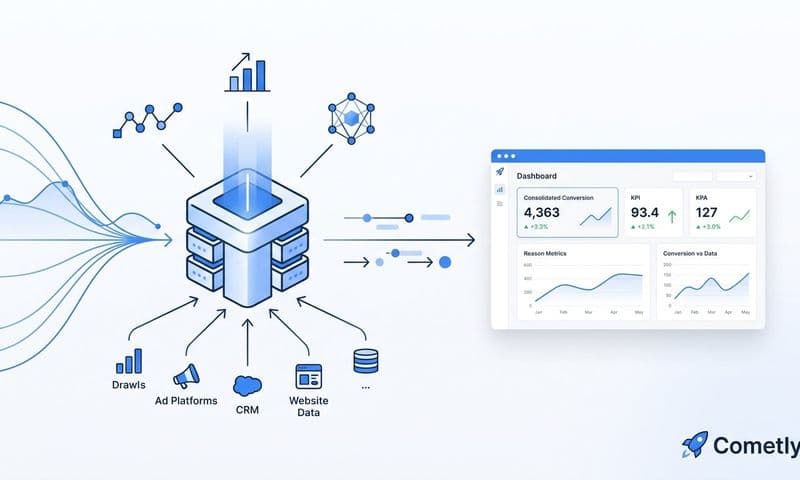
A centralized analytics dashboard pulls data from all your marketing platforms into one unified view with standardized metrics and consistent reporting. Instead of logging into five different platforms to understand campaign performance, you see everything in one place with apples-to-apples comparisons. A robust marketing data analytics platform makes this consolidation seamless.
This consolidation enables faster analysis, easier trend spotting, and more confident decision-making. When you can compare Facebook, Google, and LinkedIn performance side by side with the same attribution model and time frame, patterns become obvious that fragmented reporting obscures.
Implementation Steps
1. Choose an analytics platform that integrates with all your ad channels and provides unified reporting (platforms like Cometly connect multiple ad networks with CRM data for complete visibility).
2. Connect each advertising platform using API integrations that automatically sync campaign performance data daily.
3. Standardize your metrics across platforms by defining how you'll measure cost per acquisition, return on ad spend, and other key performance indicators consistently.
4. Build custom dashboards for different stakeholders (executive overview, campaign manager detail, channel-specific deep dives) so everyone sees relevant data. Review data visualization tools for marketing analytics to enhance your reporting.
5. Set up automated reporting that delivers key metrics to your inbox daily or weekly, eliminating the need to log in for routine performance checks.
Pro Tips
Start with a focused dashboard that tracks your most critical metrics rather than trying to visualize everything at once. You can always add complexity later. The best dashboards answer specific questions quickly rather than displaying every available data point.
7. Use AI-Powered Recommendations to Optimize Continuously
The Challenge It Solves
Human analysts can spot obvious trends and major performance shifts, but they miss subtle patterns across thousands of data points. You might notice when a campaign's performance drops 50%, but you won't catch the early warning signs when performance degrades 3% per day over two weeks. Manual analysis also struggles to identify complex interactions between variables.
This limitation means optimization opportunities get missed and problems aren't caught until they've already cost significant budget.
The Strategy Explained
AI-powered analytics continuously monitors your campaign performance, identifies patterns humans miss, and generates specific optimization recommendations. Instead of spending hours analyzing data to find insights, AI surfaces the most important findings and suggests concrete actions. Discover the power of AI marketing analytics and how it transforms campaign optimization.
These systems learn what "normal" performance looks like for your campaigns and alert you to meaningful deviations. They can identify which ad creatives perform best with specific audience segments, suggest budget reallocations based on efficiency trends, and highlight scaling opportunities when campaigns show consistent strong performance.
Implementation Steps
1. Implement an analytics platform with AI-powered recommendations that analyzes your campaign data automatically (Cometly's AI features identify high-performing ads and provide budget optimization suggestions across channels).
2. Set baseline performance metrics so AI can identify meaningful changes versus normal fluctuations in your data.
3. Review AI-generated recommendations daily and test the highest-confidence suggestions first to validate the system's accuracy.
4. Track which AI recommendations you implement and measure their impact to understand what types of optimizations work best for your business.
5. Use AI insights to inform creative testing, audience expansion, and budget allocation decisions rather than relying solely on manual analysis.
Pro Tips
Treat AI recommendations as a starting point for investigation, not automatic decisions. The best results come from combining AI pattern recognition with human strategic thinking. Let AI find the opportunities, then apply your business context and market knowledge to decide which ones to pursue.
Building Your Analytics Foundation for Long-Term Success
Getting marketing analytics setup help is less about finding the perfect tool and more about following a systematic approach. Start with your measurement framework so you know what questions your analytics must answer. Audit what you currently have to identify gaps and broken tracking that's costing you money.
Implement server-side tracking to capture conversion data that traditional pixels miss. Connect your CRM to see which campaigns drive actual revenue, not just leads. Choose attribution models that match your business reality, and centralize your data so you can make decisions faster.
The marketers who succeed with analytics are those who treat setup as a foundation, not an afterthought.
When your tracking captures every touchpoint and connects it to real revenue, you stop guessing and start scaling with confidence. You know which campaigns deserve more budget because you can trace them directly to customer acquisition and revenue growth. You catch performance issues before they waste significant spend because your analytics alerts you to meaningful changes.
This foundation transforms marketing from creative guesswork into a systematic, scalable growth engine. Every dollar you spend gets tracked, every conversion gets attributed, and every optimization decision gets informed by complete, accurate data.
Ready to elevate your marketing game with precision and confidence? Discover how Cometly's AI-driven recommendations can transform your ad strategy. Get your free demo today and start capturing every touchpoint to maximize your conversions.