You're tracking campaigns across Meta, Google, TikTok, and LinkedIn. Each platform tells you it's driving results. Your spreadsheets are overflowing with metrics. But when you look at your bank account, the numbers don't add up. Which ads actually drove that $50,000 deal? Which touchpoints mattered? Which channels deserve more budget?
This is the reality for most marketers today: drowning in data while starving for answers. Traditional analytics show you what happened—clicks went up, impressions increased, conversions occurred. But they don't tell you why it happened or what to do next.
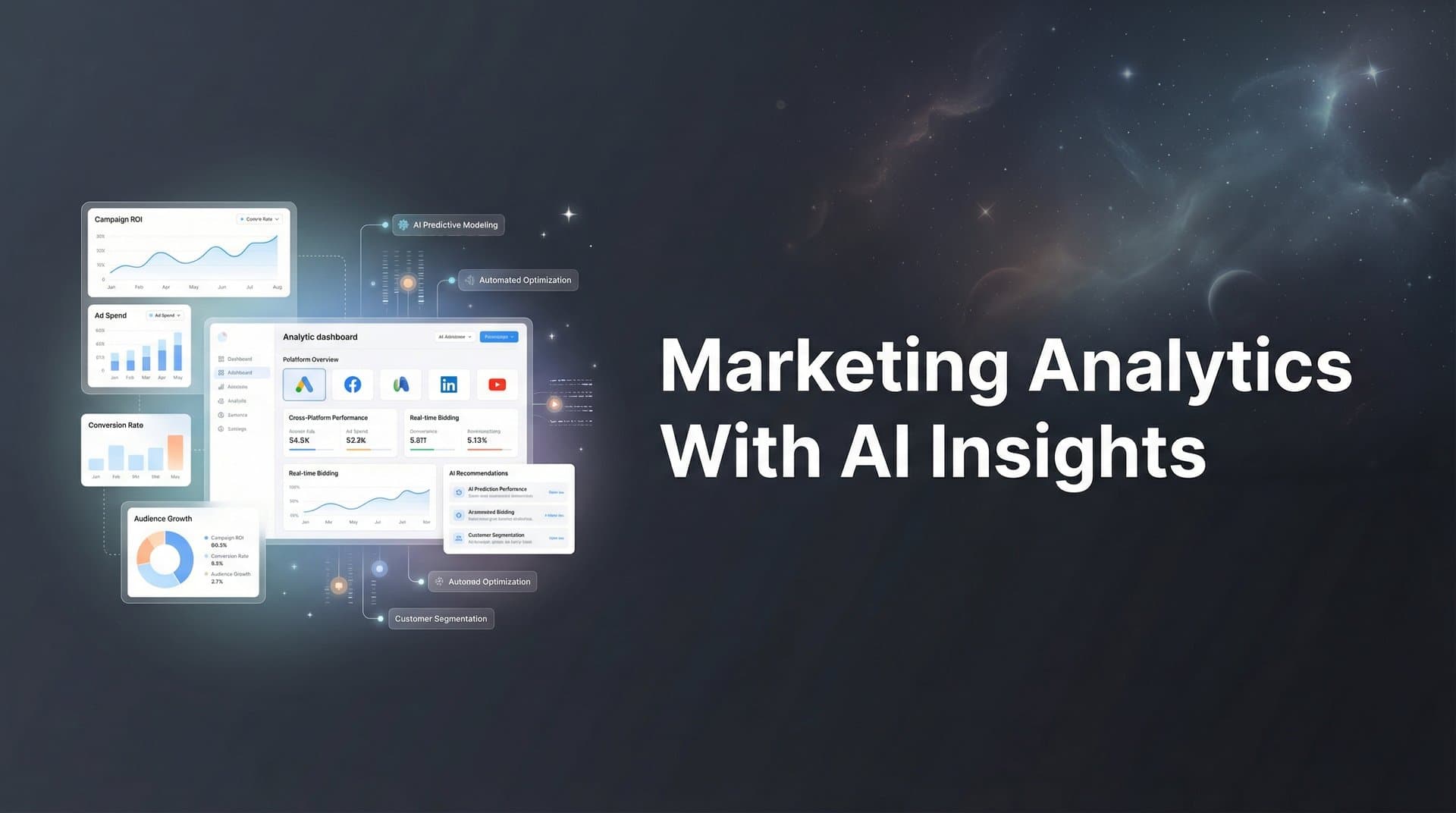
AI-powered marketing analytics changes everything. Instead of staring at disconnected dashboards trying to piece together the story, you get clear intelligence: which campaigns drive revenue, which touchpoints matter most, and where to invest next. This isn't about adding another tool to your stack. It's about transforming raw data into the kind of actionable intelligence that separates marketers who guess from marketers who know.
Beyond Dashboards: How AI Transforms Raw Marketing Data Into Revenue Signals
Traditional analytics are like looking at your business through a rearview mirror. You see where you've been, but you're driving blind into what's next. You know someone clicked your ad, visited your site, and eventually converted. But did that click actually matter, or did they find you through organic search three days later?
AI-powered analytics flip this model entirely. Instead of just recording events, machine learning identifies patterns across thousands of customer journeys simultaneously. It recognizes that customers who interact with your Facebook ad, then see a retargeting ad, then visit via Google search convert at higher rates than those who take different paths. More importantly, it quantifies exactly how much each touchpoint contributes to the final conversion.
Think of it like this: traditional analytics tell you it rained yesterday. AI analytics predict tomorrow's weather, explain why the storm is coming, and recommend exactly when to schedule your outdoor event. The difference isn't incremental—it's fundamental.
Pattern recognition becomes especially powerful when you're running campaigns across multiple channels. Let's say your LinkedIn ads consistently show low conversion rates in platform reporting, so you consider cutting budget. But AI analysis reveals something different: LinkedIn touchpoints appear early in 73% of high-value customer journeys, even though they rarely get credit for the final conversion. Without AI connecting these dots, you'd eliminate a crucial awareness channel based on incomplete data.
Real-time processing amplifies this advantage. Traditional analytics require you to wait for enough data to accumulate, then analyze it, then make changes. By the time you act, market conditions have shifted. AI processes data continuously, identifying opportunities and problems as they emerge. When an ad starts underperforming, you know within hours, not weeks. When a new audience segment shows promise, you can scale immediately.
The shift from retrospective to predictive changes how you allocate budget. Instead of asking "which campaign performed best last month?" you ask "which campaign will drive the most revenue if I add $10,000 tomorrow?" AI doesn't just report results—it forecasts outcomes and recommends specific actions based on what's likely to work.
This transformation matters most when you're managing significant ad spend. The difference between knowing what happened and predicting what will happen determines whether you scale winners or waste budget on campaigns that look good in isolation but underperform in reality.
The Core Capabilities That Power AI-Driven Marketing Intelligence
Predictive analytics sits at the heart of AI-powered marketing intelligence. Traditional forecasting relies on simple trend lines: if conversions increased 10% last month, maybe they'll increase 10% next month. AI predictive models incorporate dozens of variables simultaneously—seasonality, competitive dynamics, audience saturation, creative fatigue, and historical patterns across similar campaigns.
When you're considering increasing budget on a campaign, predictive analytics answers the critical question: what will actually happen? It analyzes how similar campaigns performed at different spend levels, identifies diminishing returns thresholds, and forecasts expected outcomes. You're not guessing whether to scale—you're making decisions based on probabilistic modeling of likely results.
Anomaly detection operates as your always-on analyst, monitoring hundreds of metrics across all campaigns simultaneously. An ad that's been converting steadily suddenly drops to half its normal rate. A channel that typically drives 15% of conversions jumps to 30%. Creative that performed well for weeks starts declining. AI flags these changes immediately, often before they're visible in standard reports.
The power of anomaly detection isn't just speed—it's context. When performance changes, AI determines whether it's a meaningful shift requiring action or normal statistical variation. It distinguishes between "your campaign is broken" and "it's Sunday, traffic is always lower." This context prevents both missed opportunities and false alarms that waste time investigating non-issues.
Cross-channel attribution represents perhaps the most valuable AI capability for modern marketers. Customer journeys span multiple platforms over days or weeks. Someone sees your Facebook ad, ignores it, later searches your brand on Google, visits your site, leaves, sees a retargeting ad, returns via direct traffic, and converts. Which touchpoint deserves credit?
AI attribution models analyze thousands of these journeys to understand actual influence. Instead of arbitrary rules like "first click gets credit" or "last click gets credit," machine learning identifies which touchpoints genuinely impact conversion probability. It recognizes that your Facebook awareness campaign drives value even when Google Search gets the final click, and it quantifies exactly how much value each channel contributes.
This matters enormously for budget allocation. Many marketers over-invest in bottom-funnel channels that get last-click credit while under-investing in awareness channels that initiate valuable journeys. AI attribution reveals the full picture, showing which channels work together to drive conversions rather than which ones happen to get the final touch.
Behavioral pattern analysis adds another dimension. AI identifies characteristics of your highest-value customers—which pages they visit, how long they stay, which content they engage with, what time of day they convert. Then it finds prospects exhibiting similar patterns and flags them for special attention. You're not just targeting demographics—you're targeting behaviors that correlate with conversion and revenue.
These capabilities compound when they work together. Predictive analytics forecasts campaign performance. Anomaly detection flags when actual performance deviates from predictions. Attribution analysis explains why the deviation occurred. Behavioral analysis suggests how to fix it. You move from reactive firefighting to proactive optimization based on comprehensive intelligence.
From Insight to Action: Practical Applications Across Your Ad Campaigns
Budget allocation becomes dramatically more effective when guided by AI insights. Picture this: you're managing a $100,000 monthly ad budget across five platforms. Traditional approach? You check each platform's dashboard, see which shows the best cost-per-conversion, and shift budget accordingly. But this misses the interconnected reality of how channels work together.
AI analysis reveals the actual impact. Maybe your TikTok campaigns show high cost-per-conversion in isolation, but they introduce prospects who later convert through Google at significantly higher rates than cold traffic. The AI recommendation: increase TikTok budget despite its standalone metrics because it improves performance across your entire funnel. This kind of cross-channel optimization is nearly impossible to identify manually but becomes clear with AI pattern recognition.
Audience targeting refinement moves beyond basic demographic targeting to behavioral intelligence. You launch a campaign targeting "marketing managers at B2B SaaS companies." Standard approach. But AI analysis of your existing customers reveals something more specific: marketing managers who visited your pricing page twice, engaged with video content, and came from LinkedIn convert at 4x the rate of those who don't exhibit these behaviors.
Now you're not just targeting job titles—you're targeting behavioral signals that indicate genuine intent. You create lookalike audiences based on these high-value behaviors, not just demographics. Your targeting becomes predictive rather than descriptive, finding prospects who act like your best customers before they've even entered your funnel.
Creative performance insights guide what to test and how to iterate. You're running five ad variations. Traditional analysis shows which has the highest click-through rate. AI analysis goes deeper: which creative drives clicks from people who actually convert? Which performs best with different audience segments? Which creative elements—headlines, images, calls-to-action—correlate with downstream revenue?
This changes how you approach creative testing. Instead of endless A/B tests hoping to stumble on winners, AI identifies specific elements that drive results. You learn that ads featuring customer results outperform product feature ads by 40% for conversions (not just clicks). You discover that video ads drive higher engagement but static image ads convert better for your specific audience. These insights compound as you apply them to new campaigns.
Campaign scaling decisions become more confident. You've found a winning campaign. Traditional question: should I double the budget? AI-powered question: what will happen if I double the budget, and what's the optimal increase based on historical patterns of similar campaigns? The AI might recommend a 60% increase rather than 100%, predicting that doubling would push into diminishing returns while 60% hits the sweet spot of maximized returns.
Real-time optimization happens automatically in some cases. AI identifies that your campaigns perform significantly better between 2pm-6pm for your target audience. Instead of manually adjusting bids throughout the day, the system automatically increases bids during high-performance windows and reduces them during low-performance periods. You're optimizing at a granularity and speed impossible through manual management.
Building Your AI Analytics Foundation: Data Requirements and Integration
AI insights are only as good as the data they analyze. The foundation starts with connecting every platform where marketing happens: ad platforms, website analytics, CRM, email marketing, and any other customer touchpoint. This isn't just about having data—it's about having connected data that tells a complete story.
Most marketers start with disconnected data sources. Facebook reports conversions. Google reports conversions. Your CRM tracks deals. But these systems don't talk to each other, so you're seeing three different versions of reality. Building an AI analytics foundation means unifying these sources so the same customer journey is tracked consistently across all platforms.
Server-side tracking becomes critical in this foundation. Traditional pixel-based tracking faces increasing limitations: iOS privacy features block tracking, browser settings prevent cookies, ad blockers eliminate visibility. Server-side tracking solves this by processing data on your server before sending it to platforms, bypassing many browser-level restrictions and providing significantly more reliable data.
Think about the practical impact: with pixel-only tracking, you might capture 60-70% of actual conversions due to iOS limitations and browser restrictions. With server-side tracking, you're capturing 95%+ of conversions. This isn't a minor improvement—it's the difference between making decisions based on incomplete data and making decisions based on reality. When AI analyzes more complete data, its recommendations become proportionally more accurate.
Data enrichment strategies take this further by adding context that makes data more valuable. You're not just tracking that someone converted—you're tracking their entire journey, their engagement level, their behavior patterns, and ultimately their revenue value. This enriched data feeds back to ad platforms, improving their optimization algorithms. Facebook's AI learns which audiences actually drive revenue, not just which audiences click. Google's algorithm optimizes for high-value conversions, not just conversion volume.
CRM integration completes the picture by connecting marketing touchpoints to actual business outcomes. You see which campaigns drive qualified leads versus tire-kickers. Which channels attract customers with high lifetime value versus one-time buyers. This connection between marketing activity and business results transforms how you evaluate performance. You're optimizing for revenue and customer quality, not just conversion counts.
The technical implementation matters less than the outcome: creating a unified view of customer journeys from first touch to final conversion and beyond. When AI can see the complete picture—every ad interaction, every website visit, every email open, every CRM stage change—it identifies patterns and opportunities invisible in siloed data.
Measuring What Matters: KPIs That AI Analytics Unlock
Vanity metrics dominate traditional marketing reporting: impressions, clicks, click-through rates. These numbers feel good but don't answer the critical question: did this marketing activity actually contribute to revenue? AI analytics shifts focus to metrics that matter for business outcomes.
True revenue attribution connects every dollar spent to every dollar earned. Instead of "this campaign generated 50 conversions," you see "this campaign generated $75,000 in revenue from 50 conversions, with an average customer value of $1,500 and a 3x return on ad spend." More importantly, AI attributes revenue accurately across the entire customer journey, not just to the last click.
This changes everything about how you evaluate campaigns. That Facebook campaign showing a high cost-per-conversion might actually deliver your highest-value customers with the longest lifetime value. That Google campaign with the lowest cost-per-conversion might attract price-sensitive customers who churn quickly. Without revenue attribution, you optimize for the wrong metrics and make decisions that hurt profitability.
Incremental lift measurement answers an even more important question: what results did this campaign drive that wouldn't have happened anyway? Some conversions would occur regardless of your marketing. Someone searches your brand name, clicks your ad, and converts. Would they have found you anyway? Incremental lift analysis isolates the actual impact of your marketing by comparing outcomes with and without specific campaigns.
AI makes this analysis practical by creating control groups and measuring differences. It identifies customers who would have converted anyway versus those your marketing actually influenced. You discover that your brand search campaigns have low incremental lift (people searching your brand name were likely to find you regardless) while your awareness campaigns have high incremental lift (they introduce customers who wouldn't have discovered you otherwise).
Attribution model comparison reveals how different perspectives change your understanding of what works. First-click attribution credits the initial touchpoint. Last-click credits the final touchpoint. Linear attribution spreads credit equally. Time-decay gives more credit to recent touchpoints. Data-driven attribution uses AI to weight touchpoints based on their actual influence.
The insight isn't that one model is universally correct—it's that different models reveal different aspects of truth. First-click shows which channels best introduce new customers. Last-click shows which channels close deals. Data-driven attribution synthesizes everything to show actual influence. By comparing models, you understand the full role each channel plays in your marketing ecosystem.
Customer lifetime value metrics extend measurement beyond initial conversion. Two campaigns both generate 100 conversions at $50 cost-per-conversion. Traditional analysis says they're equal. AI analysis reveals Campaign A customers spend $500 over their lifetime while Campaign B customers spend $2,000. Suddenly they're not equal at all—Campaign B is dramatically more valuable despite identical upfront metrics.
This forward-looking measurement changes how you allocate budget. You're willing to pay more to acquire customers from channels that deliver higher lifetime value. You optimize for long-term profitability rather than short-term conversion costs. The marketers who embrace these deeper metrics gain compounding advantages over those stuck optimizing for surface-level KPIs.
Putting AI Insights Into Practice: Your Path Forward
Starting with AI-powered marketing analytics doesn't require rebuilding your entire marketing operation overnight. The path forward begins with unified data collection. Connect your ad platforms, website, and CRM so you're tracking complete customer journeys rather than disconnected touchpoints. This foundation enables everything else.
Many marketers hesitate because the technical implementation seems daunting. But the core requirement is straightforward: ensure every marketing touchpoint and conversion is tracked in a centralized system that can connect interactions to outcomes. Whether you implement this through a dedicated marketing analytics platform or build custom integrations matters less than achieving unified visibility.
Once you have connected data, start using AI recommendations to test and scale with confidence. Instead of guessing which campaigns to expand, follow data-driven suggestions about where additional budget will drive the best returns. When AI identifies high-performing audience segments or creative elements, test those insights systematically. The recommendations are only valuable if you act on them.
The key is treating AI insights as hypotheses to validate rather than absolute truths. When AI suggests increasing budget on a specific campaign, start with a measured increase and monitor results. When it identifies a promising audience segment, test it against your current targeting. This approach builds confidence in the system while limiting downside risk from any individual recommendation.
Continuously feeding enriched conversion data back to ad platforms creates a compounding advantage. As platforms receive more accurate data about which conversions drive actual value, their optimization algorithms improve. Better optimization drives better results. Better results provide more data. The cycle accelerates over time, creating growing separation between your performance and competitors working with less complete data.
This feedback loop explains why early adopters of AI-powered analytics often see results that compound over months. The first month, you gain visibility into what's actually working. The second month, you reallocate budget based on that visibility. The third month, ad platforms start optimizing based on enriched data you're feeding back. By month six, you're operating with fundamentally better intelligence than when you started, and the gap keeps widening.
The Compounding Advantage of Intelligent Marketing
Marketing analytics with AI insights represents more than a new tool or technique—it's a fundamental shift in how you understand and optimize your marketing. The difference between reactive reporting and proactive intelligence determines whether you're constantly catching up or consistently ahead.
Traditional analytics tell you what happened after it's too late to change it. AI analytics predict what will happen and recommend specific actions to improve outcomes. This shift from retrospective to predictive gives you an edge that compounds over time. Better decisions lead to better results. Better results provide more data. More data improves AI recommendations. The cycle accelerates.
The marketers who embrace this approach gain advantages that multiply: they identify winning campaigns faster, scale them more confidently, optimize across channels instead of in silos, and feed better data back to platforms for improved algorithmic optimization. Meanwhile, marketers relying on traditional analytics continue making decisions based on incomplete data and delayed insights.
Your competitive advantage isn't just having AI-powered analytics—it's using those insights to make faster, smarter decisions about where to invest your marketing budget. Every day you operate with better intelligence widens the gap between your results and those of competitors working blind.
Ready to elevate your marketing game with precision and confidence? Discover how Cometly's AI-driven recommendations can transform your ad strategy—Get your free demo today and start capturing every touchpoint to maximize your conversions.