

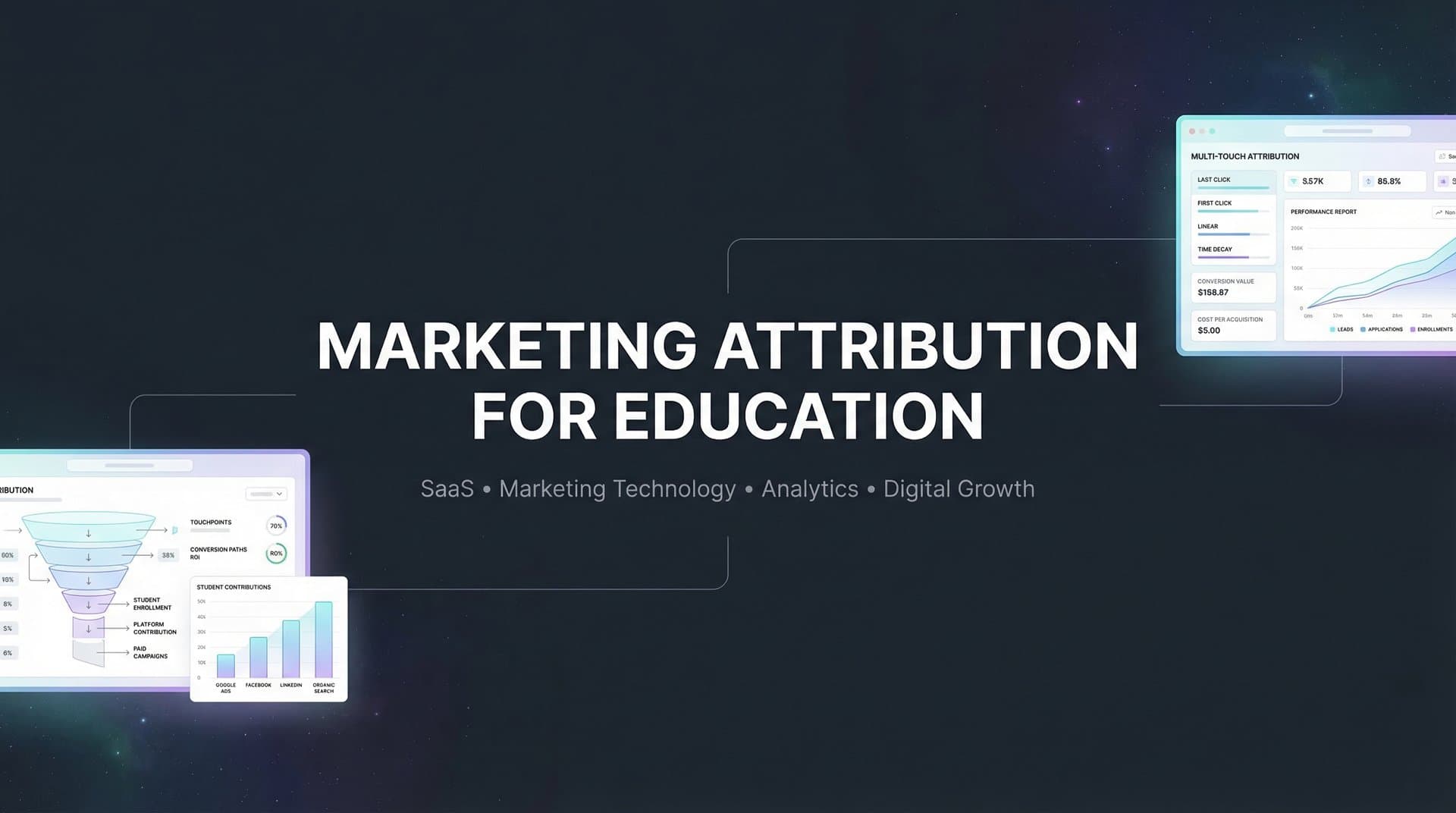
Picture this: A high school junior clicks your Facebook ad in September, downloads a program guide in November, attends a virtual open house in February, tours campus in April, and finally submits an application in October—thirteen months after that first click. Now ask yourself: which marketing touchpoint gets credit for that enrollment?
If you're like most education marketers, your analytics platform probably says "organic search" or "direct traffic"—because that's what the student typed into their browser the day they applied. But you know the real story is more complex.
Education marketing operates in a fundamentally different reality than most industries. While e-commerce brands celebrate same-day conversions and SaaS companies track 30-day trials, you're managing enrollment journeys that stretch across semesters, involve multiple decision-makers, and blend digital interactions with campus visits and phone calls. Traditional analytics tools weren't built for this complexity, which means they're systematically misleading you about what's actually working.
The Extended Journey Problem: Why Education Marketing Breaks Standard Analytics
The average prospective student interacts with your institution 15 to 30 times before applying. That's not a typo. From that first Instagram ad to the final application submission, months of touchpoints accumulate—each one nudging the decision forward in ways that standard analytics completely miss.
Here's what makes education marketing attribution uniquely challenging: your "conversion window" isn't measured in days or weeks. It's measured in academic cycles. A sophomore who downloads your virtual tour might not apply for another 18 months. A transfer student researching programs in January might not enroll until the following fall. Every gap in your tracking means attribution data that's incomplete at best, completely wrong at worst.
The decision-making complexity multiplies the challenge. You're not tracking one person's journey—you're tracking parallel journeys that eventually converge. The student browses your TikTok content on their phone. Their parent researches tuition costs on a laptop. A guidance counselor downloads your academic catalog on a school computer. These separate digital footprints all contribute to a single enrollment decision, but traditional analytics treats them as unrelated visitors.
Then there's the offline-to-online problem that education marketers know all too well. Campus tours don't generate pixels. College fairs don't fire tracking events. Phone calls with admissions counselors don't show up in Google Analytics. Yet these offline touchpoints often carry more weight than any digital interaction. Without a way to connect these experiences to your digital attribution data, you're making budget decisions based on an incomplete picture.
Privacy changes have made everything harder. iOS 14.5 and subsequent updates broke pixel-based tracking for millions of mobile users—exactly the demographic you're trying to reach. When a prospective student first discovers your institution through a Meta ad on their iPhone in their junior year, then applies on a desktop computer as a senior, that connection is lost. Your attribution shows the application came from nowhere, and the awareness campaign that started the journey gets zero credit.
The result? Education marketers systematically underinvest in the top-of-funnel campaigns that actually drive long-term enrollment, while overvaluing bottom-funnel tactics that simply capture demand you've already created. It's not a strategy problem—it's a measurement problem.
Choosing the Right Attribution Model for Enrollment Decisions
Last-click attribution is killing your enrollment marketing budget. There, we said it. If you're giving 100% credit to the final touchpoint before an application, you're essentially telling your analytics that the only marketing that matters is whatever happened right before someone clicked "submit." Every awareness campaign, every nurture email, every piece of content that built consideration over months? Worthless, according to your data.
This is why so many education marketers see their brand awareness budgets slashed while retargeting campaigns get unlimited funding. Last-click attribution creates a feedback loop where only bottom-funnel tactics appear to work, so you invest more there, which makes them appear to work even better, while the campaigns that actually create demand in the first place slowly starve.
Multi-touch attribution fixes this by distributing credit across the entire enrollment journey. But not all multi-touch models work equally well for education marketing. Let's break down your options.
Linear attribution gives equal credit to every touchpoint in the journey. A student who interacted with your institution 20 times over 12 months? Each interaction gets 5% of the credit. This approach recognizes that enrollment decisions build over time, but it treats a casual social media impression the same as an in-depth campus visit. For education marketing, that's too simplistic.
Time-decay attribution gives more credit to recent touchpoints while still acknowledging earlier interactions. This model assumes that touchpoints closer to the enrollment decision matter more—which makes intuitive sense. The campus tour that happened last month probably influenced the decision more than the display ad from six months ago. Many education marketers find time-decay attribution strikes a good balance between recognizing the full journey and weighting high-intent interactions appropriately.
Position-based attribution (sometimes called U-shaped attribution) gives significant credit to the first and last touchpoints, with remaining credit distributed among middle interactions. This model acknowledges two critical moments: the initial discovery that put your institution on the student's radar, and the final engagement that converted consideration into action. For education marketing, this often reveals the true value of awareness campaigns that create that crucial first impression.
Here's the thing: the "best" attribution model depends on your specific enrollment funnel and marketing mix. An institution running heavy brand awareness campaigns needs a model that credits top-of-funnel touchpoints. A graduate program with a shorter consideration cycle might find time-decay attribution more accurate. The key is choosing a model that reflects how prospective students actually make enrollment decisions—not just defaulting to whatever your analytics platform offers.
But even the most sophisticated attribution model fails if it can't properly weight different touchpoint types. A display ad impression and a campus tour are not equivalent interactions, yet standard analytics treats them the same. The most effective education marketing attribution systems allow you to assign custom weights based on engagement depth. A webinar attendance might count 3x more than a page view. A campus visit might count 5x more than a social media click. These weightings should reflect your institutional knowledge about what actually moves students toward enrollment.
Building the Complete Picture: Connecting Every Step of the Student Journey
Your CRM knows who enrolled. Your ad platforms know who clicked. Your website analytics knows who visited. The problem? These systems don't talk to each other, which means you're making million-dollar budget decisions based on fragmented data that tells three different stories.
Integration is where attribution moves from theoretical to transformational. When you connect your CRM data—whether you're using Slate, Salesforce Education Cloud, Ellucian, or another enrollment management system—with your ad platform tracking and website analytics, something powerful happens. You stop measuring inquiries and start measuring enrollments. You stop guessing which campaigns work and start knowing which investments drive actual tuition revenue.
This integration creates unified student profiles that track the complete journey. An anonymous website visitor who downloads your program guide becomes a known prospect in your CRM. That CRM record connects back to the original ad click, the subsequent email opens, the webinar registration, and eventually the campus visit. When that prospect enrolls, you can trace the entire path backward and forward, understanding exactly which marketing touchpoints contributed to the decision.
But here's where most education marketers hit a wall: traditional pixel-based tracking can't maintain these connections across long conversion windows and multiple devices. That high school junior who clicked your ad on their iPhone, researched programs on their school laptop, and eventually applied on their home desktop? Standard analytics sees three different people. The attribution breaks, and you lose the thread of the journey.
Server-side tracking solves this by moving the tracking mechanism from the user's browser to your server. Instead of relying on cookies and pixels that break with iOS privacy changes and cross-device journeys, server-side tracking maintains persistent identity through first-party data. When a prospective student fills out an inquiry form, that CRM record becomes the source of truth that connects all future interactions—regardless of device, browser, or privacy settings.
This technical shift matters enormously for education marketing. Your conversion windows are longer than almost any other industry, which means you have more opportunities for tracking to break. Server-side tracking ensures that the social ad campaign you ran in September still gets proper credit for the enrollment that happens the following October, even if the student switched devices five times in between.
The implementation requires connecting your ad platforms, website, and CRM through a unified tracking system. Events flow from your website to your server, get enriched with CRM data, and sync back to ad platforms with complete conversion information. This creates a closed loop where every marketing touchpoint connects to enrollment outcomes, giving you attribution data that actually reflects reality.
Offline Touchpoint Integration
Campus visits, phone calls, and college fairs don't generate pixels, but they absolutely influence enrollment decisions. The most sophisticated education marketing attribution systems include offline touchpoint tracking through CRM integration. When an admissions counselor logs a campus tour in your CRM, that event becomes part of the attribution data. When a student attends a college fair and scans their badge, that interaction connects to their digital journey.
This offline-to-online connection reveals insights that pure digital attribution misses. You might discover that students who attend campus tours have 3x higher enrollment rates, which means the digital campaigns that drive tour registrations deserve more credit than last-click attribution would suggest. Or you might find that phone consultations with financial aid counselors are the highest-weighted touchpoint in your entire funnel, which should dramatically shift how you think about resource allocation.
Tracking Metrics That Actually Matter for Enrollment Success
Cost-per-inquiry is a vanity metric. There, we said it again. If you're optimizing your marketing campaigns to generate the cheapest possible inquiries, you're probably filling your CRM with prospects who will never enroll while starving the channels that attract serious students.
The metric that actually matters is cost-per-enrolled-student. This is your true north. How much marketing investment does it take to generate one enrolled student who pays tuition? Everything else is a leading indicator at best, a distraction at worst.
This shift in measurement changes everything about how you evaluate marketing performance. That Facebook campaign generating inquiries at $15 each looks amazing until you track those prospects through to enrollment and discover only 0.5% actually enroll. Meanwhile, the Google Search campaign with $80 inquiries might convert at 8%, making it dramatically more efficient despite the higher upfront cost.
Cost-per-enrolled-student reveals the true ROI of your marketing mix. It accounts for conversion rates at every stage of the funnel, from inquiry to application to enrollment. It shows you which channels attract serious prospects versus tire-kickers. Most importantly, it lets you calculate actual return on ad spend based on lifetime tuition value, not just lead volume.
But even cost-per-enrolled-student isn't the complete picture. The most sophisticated education marketers track downstream outcomes: which channels produce students who persist? A marketing campaign that enrolls 100 students who drop out after one semester is far less valuable than a campaign that enrolls 80 students who complete their degrees. Persistence rates, graduation rates, and student success metrics should factor into your attribution analysis.
This requires connecting marketing attribution data with institutional research data—not easy, but incredibly valuable. When you can trace enrollment cohorts back to their original marketing sources, you discover which channels attract students who succeed. Maybe students from organic search have higher persistence rates than students from paid social. Maybe campus visit attendees graduate at higher rates than students who never visited. These insights should influence not just your marketing budget allocation, but your entire enrollment strategy.
Building Attribution Dashboards That Drive Decisions: Your attribution dashboard should answer three questions instantly: What's working? What's not? Where should we invest more? Start with channel-level performance showing cost-per-enrolled-student across all marketing sources. Add funnel conversion rates to identify where prospects drop off. Include trend data to spot improving or declining performance. Make the dashboard accessible to everyone who makes budget decisions, from marketing managers to executive leadership.
Revenue Attribution, Not Just Lead Attribution: The ultimate attribution metric connects marketing investment to tuition revenue. Which campaigns generate enrolled students with the highest lifetime value? Which channels attract students who enroll in high-tuition programs versus lower-revenue options? Revenue attribution transforms marketing from a cost center into a measurable revenue driver with clear ROI.
Turning Attribution Data Into Enrollment Growth
Attribution data is worthless if it sits in a dashboard. The value comes from using those insights to systematically improve your marketing performance through continuous optimization.
Start with budget reallocation based on cost-per-enrolled-student. If your attribution data shows that Google Search campaigns enroll students at $2,000 each while display advertising costs $8,000 per enrollment, the action is obvious: shift budget from display to search. This isn't about eliminating underperforming channels entirely—it's about right-sizing investment based on actual results.
The reallocation process should be gradual and test-driven. Move 10-20% of budget from low-performing channels to high-performers, measure the impact over a full enrollment cycle, then adjust again. Education marketing moves slowly, which means you need patience to see results. But the compounding effect of better budget allocation is enormous over time.
Feeding conversion data back to ad platforms creates a powerful optimization loop. When you sync enrollment events back to Meta, Google, and other platforms, their algorithms learn which types of users actually convert into enrolled students—not just inquiries. This improves targeting over time, showing your ads to more prospects who match the profile of successful enrollments. The result is lower costs and higher quality leads without changing your creative or targeting strategy.
Conversion sync is especially powerful for education marketing because the platforms' algorithms are optimizing for the wrong outcome by default. Facebook thinks it's succeeding when someone fills out an inquiry form. But you know success is enrollment, which might happen 12 months later. By sending enrollment events back to the platform, you teach the algorithm what real success looks like, and targeting improves accordingly.
The continuous optimization loop looks like this: measure attribution across all channels, identify the highest-performing sources, reallocate budget toward those channels, sync conversion data back to platforms, measure the impact, repeat. Each cycle makes your marketing more efficient, which means more enrollments at lower costs, which means more budget to invest in growth.
Creative Optimization Through Attribution Insights: Attribution data doesn't just tell you which channels work—it tells you which messages resonate. When you track enrollment outcomes by campaign, ad set, and creative, you discover which value propositions actually drive decisions. Maybe ads emphasizing career outcomes enroll students at 2x the rate of ads focused on campus life. That insight should reshape your entire creative strategy.
Audience Refinement Based on Enrollment Quality: Use attribution data to build lookalike audiences of enrolled students, not just inquiries. Upload lists of enrolled students to ad platforms and create expansion audiences that match their characteristics. This shifts targeting from "people who might be interested" to "people who look like students who actually enroll," dramatically improving lead quality.
Making Attribution Your Enrollment Advantage
Education marketing attribution isn't a nice-to-have analytics upgrade. In competitive enrollment landscapes where institutions fight for every qualified applicant, attribution is the difference between guessing and knowing what drives results. It's the difference between spreading budget across channels that feel right and investing strategically in the tactics that actually fill seats.
The institutions winning the enrollment battle right now aren't necessarily the ones with the biggest marketing budgets. They're the ones with the clearest visibility into what's working. They know which campaigns create awareness, which touchpoints build consideration, and which final interactions convert prospects into enrolled students. They use that knowledge to optimize continuously, getting more efficient every enrollment cycle while competitors keep running the same campaigns with the same unclear results.
The compounding value of accurate attribution is enormous. Better data leads to smarter budget allocation. Smarter budget allocation leads to more efficient enrollment. More efficient enrollment means lower cost-per-student, which means more budget available for growth. Better conversion data fed back to ad platforms improves targeting, which further reduces costs and improves quality. The flywheel accelerates over time, creating a sustainable enrollment advantage.
But here's the reality: implementing proper attribution for education marketing requires more than just installing another analytics tool. It requires connecting your ad platforms, website, and CRM into a unified system that tracks the complete student journey across months of touchpoints. It requires server-side tracking to maintain attribution accuracy despite privacy changes and long conversion windows. It requires commitment to measurement-driven decision making, even when the data challenges your assumptions about what works.
The institutions that invest in this infrastructure now will dominate enrollment in the years ahead. Those that continue relying on last-click attribution and fragmented data will keep wondering why their marketing feels increasingly expensive and less effective.
Ready to elevate your marketing game with precision and confidence? Discover how Cometly's AI-driven recommendations can transform your ad strategy—Get your free demo today and start capturing every touchpoint to maximize your conversions.


