

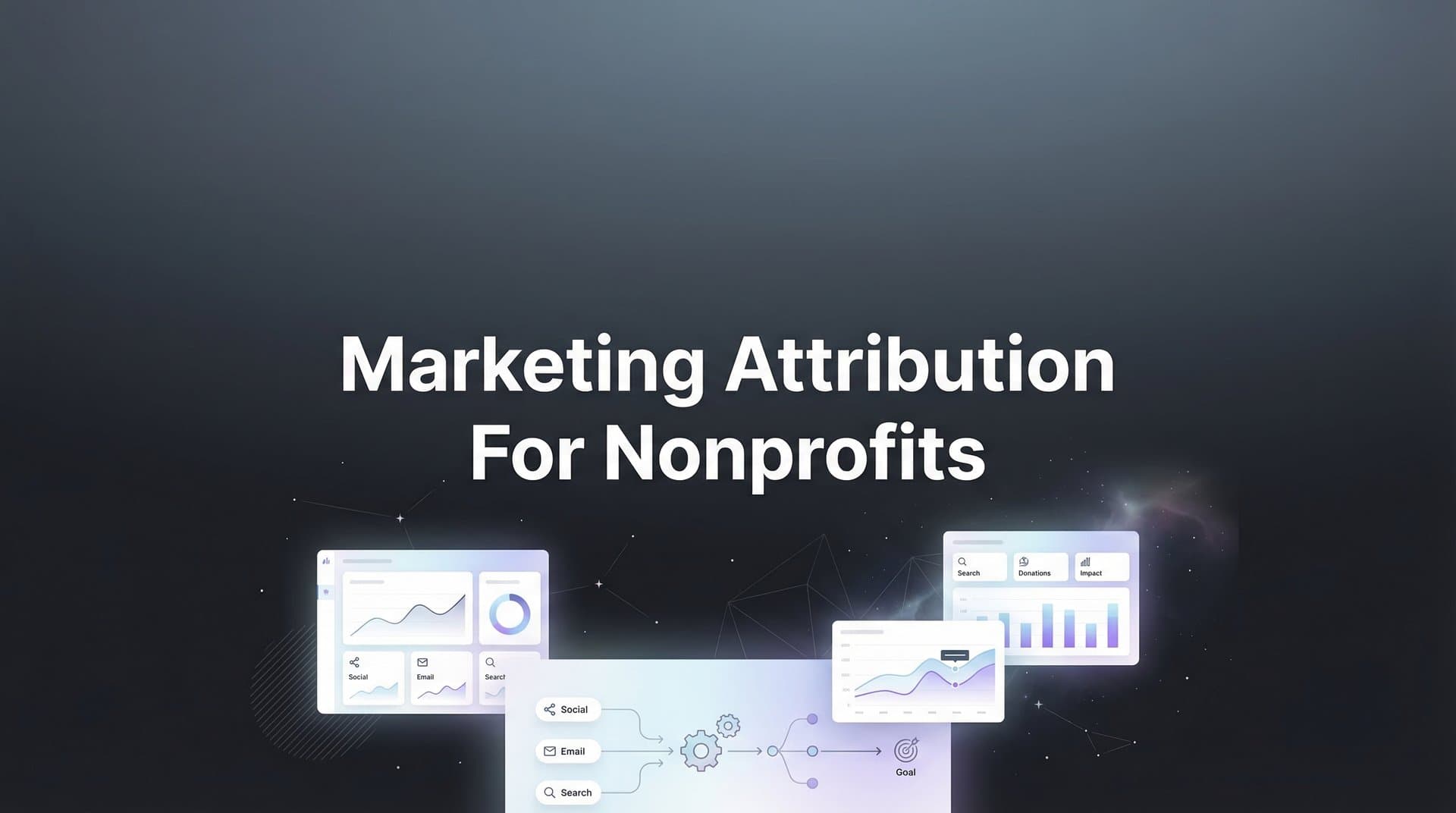
Nonprofit organizations face a unique challenge: every dollar spent on marketing must be justified to donors, board members, and stakeholders who expect maximum impact from limited budgets. Yet most nonprofits struggle to answer a fundamental question—which marketing efforts actually drive donations, volunteer sign-ups, and supporter engagement?
Marketing attribution bridges this gap by connecting your outreach activities to measurable outcomes. Unlike for-profit businesses focused solely on revenue, nonprofits must track diverse conversion types including one-time donations, recurring giving programs, event registrations, volunteer applications, and email list growth.
This complexity makes attribution both more challenging and more essential. The strategies outlined here are specifically designed for nonprofit marketing teams working with constrained resources, multiple stakeholder groups, and mission-driven goals that extend beyond simple transaction tracking.
1. Define Your Nonprofit-Specific Conversion Events Beyond Donations
The Challenge It Solves
Most nonprofits make a critical mistake: they only track completed donations as conversions. This creates a massive blind spot in your marketing data. When you ignore the smaller actions supporters take before giving—newsletter signups, event registrations, volunteer applications, petition signatures—you can't see which marketing efforts are actually building your supporter base.
Think of it like judging a garden only by the fruit you harvest while ignoring the seeds you planted and the shoots that are growing. You need visibility into the entire cultivation process, not just the final harvest.
The Strategy Explained
Build a conversion hierarchy that reflects your donor journey reality. At the top, track your ultimate goals: first-time donations, recurring gift enrollments, and major gift conversions. In the middle tier, track engagement actions like event attendance, volunteer applications, and petition signatures. At the foundation, track micro-conversions including email signups, content downloads, and social media follows.
Each level represents a different stage of supporter commitment. When you track all three tiers, you can identify which marketing channels excel at awareness-building versus direct conversion. Some channels might generate few immediate donations but consistently deliver engaged subscribers who convert months later.
Implementation Steps
1. Map your typical supporter journey from first awareness to donation, identifying every meaningful action someone can take along the way.
2. Assign value to each conversion type based on how it typically leads to donations—for example, if 20% of newsletter subscribers donate within a year, that signup has quantifiable worth. Understanding the marketing revenue attribution formula helps you calculate these values accurately.
3. Configure tracking for each conversion event in your analytics platform, ensuring every form submission, button click, and page view that indicates interest gets captured.
4. Create separate conversion tracking for different supporter segments such as individual donors versus corporate sponsors, since their journeys follow different patterns.
Pro Tips
Don't overlook offline conversions. If your direct mail campaigns drive people to your website or phone donations, create tracking parameters that connect those channels. Many nonprofits find their most valuable supporters engage across both digital and traditional channels before making their first gift.
2. Implement Multi-Touch Attribution to Understand Donor Journeys
The Challenge It Solves
When you rely on last-click attribution, you're crediting only the final touchpoint before a donation—usually your donation page or a direct email appeal. This completely ignores the awareness campaigns, social media content, and educational resources that introduced supporters to your mission in the first place.
It's like thanking only the person who handed you the finished meal while ignoring everyone who grew the ingredients, prepared the components, and cooked the dish. Your Facebook awareness campaign might deserve credit even though the supporter ultimately donated through an email link.
The Strategy Explained
Multi-touch attribution distributes conversion credit across all the touchpoints in a supporter's journey. Instead of giving 100% credit to the last interaction, you acknowledge that awareness-building activities, nurture campaigns, and conversion-focused messages all played a role.
Different attribution models weight touchpoints differently. Linear attribution spreads credit equally across all interactions. Time-decay models give more credit to recent touchpoints while still acknowledging earlier awareness activities. Position-based models emphasize both the first interaction that introduced your organization and the final touchpoint that prompted the donation. For a deeper dive, explore our multi-touch marketing attribution platform complete guide.
Implementation Steps
1. Audit your current tracking to ensure you're capturing all touchpoints including social media interactions, email opens, website visits, and ad clicks across your supporter journey.
2. Choose an attribution model that reflects your organizational reality—if you run long cultivation campaigns, time-decay or position-based models often provide more actionable insights than linear attribution.
3. Implement tracking that connects touchpoints to individual supporters rather than treating each interaction as isolated, using email addresses or donor IDs as the connecting identifier.
4. Run parallel analysis comparing your multi-touch model against simple last-click attribution to identify which channels are getting shortchanged in your current reporting.
Pro Tips
Pay special attention to how your attribution model handles awareness campaigns that don't generate immediate conversions. Many nonprofits find their brand-building efforts on social media or content marketing contribute significantly to eventual donations even though they rarely get last-click credit. Multi-touch attribution reveals this hidden value.
3. Connect Your CRM Data to Marketing Touchpoints
The Challenge It Solves
Your donor management system contains valuable information about supporter behavior—donation history, volunteer participation, event attendance, and engagement patterns. Meanwhile, your marketing platforms track website visits, ad clicks, and email interactions. When these systems don't talk to each other, you're making decisions with incomplete information.
You might be spending heavily on Facebook ads to acquire new supporters without realizing you're actually reaching existing donors who would have given anyway. Or you could be missing opportunities to re-engage lapsed donors because your email platform doesn't know who stopped giving last year.
The Strategy Explained
Integration creates a unified view of each supporter by connecting your CRM data with marketing touchpoint information. When someone clicks an ad, visits your website, and eventually donates, that entire journey gets linked to their donor record. This connection reveals which marketing activities influence different supporter segments.
The integration works bidirectionally. Marketing data flows into your CRM, enriching donor profiles with engagement information. CRM data flows into your marketing platforms, enabling segmentation and personalization based on giving history, volunteer status, and supporter lifecycle stage. Organizations using Salesforce can benefit from dedicated marketing attribution Salesforce software for seamless integration.
Implementation Steps
1. Identify your core systems that need connection—typically your donor CRM, email marketing platform, advertising accounts, and website analytics.
2. Implement tracking that captures a consistent identifier across systems, usually email addresses for known supporters or browser/device IDs for anonymous visitors who later convert.
3. Set up automated data syncs that regularly update your CRM with marketing engagement data and push CRM segments to your marketing platforms for targeting.
4. Create unified supporter profiles that display both CRM information like donation history and marketing data like campaign interactions in a single view.
Pro Tips
Start by connecting your email marketing platform to your CRM since email addresses provide a reliable identifier that works across systems. Once that integration is solid, expand to advertising platforms and website analytics. Many nonprofits find the email-CRM connection alone reveals significant insights about which messages drive donations from different supporter segments.
4. Use Server-Side Tracking to Capture Accurate Data
The Challenge It Solves
Browser-based tracking through pixels and cookies is becoming increasingly unreliable. iOS App Tracking Transparency lets users opt out of cross-app tracking. Browser updates block third-party cookies by default. Ad blockers prevent tracking scripts from loading entirely. The result is massive data loss that makes your marketing attribution incomplete and unreliable.
When significant portions of your supporter interactions go untracked, you can't accurately assess which campaigns work. You might cut spending on effective channels because your measurement system can't see their full impact. Understanding these attribution challenges in marketing analytics is the first step toward solving them.
The Strategy Explained
Server-side tracking captures conversion data on your web server before sending it to analytics and advertising platforms. Instead of relying on browser pixels that users can block, your server records the conversion and communicates directly with marketing platforms through secure server-to-server connections.
This approach maintains measurement accuracy regardless of browser privacy settings or ad blockers. When someone donates on your website, your server captures that conversion and sends the data to Facebook, Google Ads, and your analytics platform through direct API connections that bypass browser restrictions.
Implementation Steps
1. Implement server-side tracking for your most critical conversion events starting with donation completions, recurring gift enrollments, and high-value form submissions.
2. Configure your server to capture relevant conversion data including donation amounts, campaign sources, and supporter identifiers that you can pass to marketing platforms.
3. Set up server-to-server connections with your advertising platforms using their Conversion APIs, ensuring your server can authenticate and send conversion data securely.
4. Run parallel tracking with both browser pixels and server-side implementation initially to verify accuracy, then transition to relying primarily on server-side data as your source of truth.
Pro Tips
Server-side tracking is particularly valuable for nonprofits using Google Ad Grants. Since you're working with free ad spend, maximizing performance through accurate conversion data helps you get more value from this resource. Better conversion tracking leads to improved campaign optimization and more donations from the same ad budget.
5. Build Campaign-Specific Attribution for Grant Reporting
The Challenge It Solves
Funders and board members want to see specific ROI for the campaigns they support. When a foundation funds your digital marketing initiative or a major donor sponsors your awareness campaign, they expect clear documentation of results. Generic marketing reports that blend all activities together don't provide the campaign-specific accountability stakeholders require.
Without structured campaign tracking, you're stuck manually piecing together spreadsheets and making educated guesses about which donations resulted from funded initiatives. This creates reporting delays and reduces confidence in your numbers.
The Strategy Explained
Campaign-specific attribution isolates the performance of individual initiatives by creating distinct tracking structures for each funded program. You build separate conversion funnels, use unique tracking parameters, and segment your data so you can report precisely on each campaign's outcomes.
This approach requires planning your tracking architecture before campaigns launch. You define what success looks like for each initiative, identify which conversions to attribute to that campaign, and set up tracking that captures the complete supporter journey within that specific program. A dedicated marketing campaign attribution platform simplifies this process significantly.
Implementation Steps
1. Create a tracking taxonomy that includes campaign identifiers in all your URLs, ads, and email links using consistent UTM parameters or custom tracking codes.
2. Build dedicated landing pages for grant-funded campaigns rather than sending traffic to generic pages, making it easier to isolate campaign-specific conversions.
3. Set up filtered views or segments in your analytics platform that show only the touchpoints and conversions associated with each funded initiative.
4. Document your attribution methodology in your grant proposals and reports so funders understand exactly how you're measuring campaign impact and ROI.
Pro Tips
Include both direct and influenced conversions in your campaign reports. A supporter might first learn about your organization through a grant-funded awareness campaign but donate months later through a different channel. Multi-touch attribution helps you demonstrate how funded campaigns contribute to eventual conversions even when they don't generate immediate donations.
6. Optimize Ad Platform Performance with Enriched Conversion Data
The Challenge It Solves
Facebook, Google Ads, and other advertising platforms use machine learning to optimize your campaigns. But their algorithms can only work with the conversion data you provide. When you send minimal information—just that a conversion happened—the platforms can't effectively identify patterns in who converts and optimize targeting accordingly.
This leads to wasted ad spend reaching people unlikely to support your cause and missed opportunities to find more supporters who match your ideal donor profile. Your campaigns plateau because the platform algorithms lack the data they need to improve performance.
The Strategy Explained
Enriched conversion data sends detailed information about each conversion back to advertising platforms. Instead of just reporting that someone donated, you pass additional context including donation amount, whether it's a recurring gift, the supporter's engagement history, and their lifetime value to your organization.
This enriched data helps platform algorithms distinguish between low-value and high-value conversions. Facebook can learn that certain audience segments tend to become recurring donors while others make one-time gifts. Google can optimize toward supporters who attend events and volunteer, not just those who donate once and never engage again. Implementing marketing attribution platforms with revenue tracking makes this data enrichment possible.
Implementation Steps
1. Identify which conversion attributes matter most for your organization such as donation amounts, recurring versus one-time gifts, volunteer applications, and event registrations.
2. Configure your tracking to capture these data points at the moment of conversion and prepare them for transmission to advertising platforms.
3. Implement Conversion APIs for Facebook and enhanced conversions for Google Ads that allow you to send enriched data beyond basic conversion notifications.
4. Create custom conversion events for high-value actions like recurring gift enrollments or major donations so platforms can optimize specifically toward these outcomes.
Pro Tips
Don't just send historical donation data—include predictive indicators of supporter quality. If someone downloads your annual report, attends a webinar, or follows you on social media before donating, those engagement signals help advertising platforms identify similar high-intent audiences. The more context you provide, the better platforms can optimize your targeting.
7. Create Attribution Dashboards for Different Stakeholder Groups
The Challenge It Solves
Your executive director cares about overall fundraising ROI and cost per new donor. Your development team wants to see which campaigns generate the most engaged supporters. Board members need high-level proof that marketing investments deliver results. Your grants manager requires campaign-specific performance data for funder reports.
A single attribution report can't effectively serve all these audiences. When you try to create one-size-fits-all dashboards, you end up with cluttered reports that overwhelm some stakeholders with detail while leaving others without the specific insights they need.
The Strategy Explained
Tailored dashboards present attribution data in formats optimized for each stakeholder group's priorities and data literacy. Executive dashboards focus on high-level metrics and trends. Development team dashboards drill into channel performance and supporter journey details. Board dashboards emphasize ROI and year-over-year growth. Grant reporting dashboards isolate specific campaign results.
Each dashboard uses the same underlying attribution data but presents different views and aggregations. This approach ensures everyone gets the information they need without forcing them to wade through irrelevant details or interpret complex marketing metrics. Learn more about building effective unified dashboards for marketing and sales attribution.
Implementation Steps
1. Interview each stakeholder group to understand what questions they need attribution data to answer and what decisions they make based on marketing performance.
2. Design dashboard layouts that prioritize the top three to five metrics each audience cares about most, resisting the temptation to include every available data point.
3. Use clear visualizations appropriate for each audience's data sophistication—simple trend lines and comparison charts for board members, detailed funnel analysis for marketing teams. Explore attribution reporting for marketing teams to see best practices in action.
4. Schedule automated delivery of dashboards on cadences that match decision-making cycles such as monthly for development teams, quarterly for board meetings, and on-demand for grant reporting.
Pro Tips
Include narrative context in your dashboards, not just numbers. A brief text explanation of what changed and why helps non-marketing stakeholders understand the story behind the data. When your board sees that cost per donor increased but donor quality improved significantly, that context prevents misinterpretation of the metrics.
Putting It All Together
Implementing marketing attribution for your nonprofit doesn't require enterprise-level budgets—it requires strategic thinking about what to measure and how to connect your data. Start by defining your full conversion hierarchy beyond donations, then work toward connecting your CRM and marketing platforms for complete journey visibility.
The organizations that master attribution gain a significant advantage: they can confidently scale campaigns that work, cut spending on channels that don't perform, and demonstrate clear ROI to donors and funders. As privacy changes continue reshaping digital marketing, nonprofits with robust server-side tracking and enriched conversion data will maintain accurate measurement while others lose visibility.
Your mission deserves marketing that can prove its impact—attribution makes that possible. When you can show board members exactly which campaigns drive recurring donors, demonstrate to funders how their investment generated measurable results, and optimize your limited budget toward the channels that truly work, you transform marketing from a necessary expense into a strategic advantage.
Cometly's AI-driven platform helps nonprofits capture every touchpoint across your supporter journey, from initial awareness through donation and beyond. With server-side tracking that maintains accuracy despite privacy changes, multi-touch attribution that reveals your true marketing impact, and enriched conversion data that optimizes ad platform performance, you gain the visibility needed to maximize every marketing dollar.
Ready to elevate your marketing game with precision and confidence? Discover how Cometly's AI-driven recommendations can transform your ad strategy—Get your free demo today and start capturing every touchpoint to maximize your conversions.



