You're spending $50,000 a month across Meta, Google, and LinkedIn. Your dashboard shows thousands of clicks, hundreds of leads, and dozens of conversions. But when you ask your sales team which campaigns actually closed deals, they shrug. Your CFO wants to know the ROI on that ad spend, and you're piecing together spreadsheets, guessing at attribution, and hoping your best estimate is somewhere close to reality.
This isn't just frustrating—it's expensive. When you can't connect ad spend to actual revenue, you're flying blind. You might be doubling down on campaigns that look good but convert poorly, while starving the channels that quietly drive your best customers.
Marketing attribution services solve this exact problem. They connect every touchpoint in your customer journey—from the first ad click to the final purchase or closed deal—and show you what's actually driving revenue. Not vanity metrics. Not platform-reported conversions that mysteriously add up to 200% of your actual sales. Real data that tells you where to invest and where to cut.
This guide breaks down how marketing attribution services work, what separates effective solutions from glorified dashboards, and how to choose the right service for your business. Whether you're running ecommerce campaigns, generating B2B leads, or scaling a SaaS product, you'll learn how to turn fragmented data into clear, actionable insights that improve your bottom line.
The Revenue Visibility Problem Most Marketers Face
Here's a scenario that plays out in marketing teams everywhere: You check your Meta Ads Manager and see 150 conversions this month. Google Ads reports 120 conversions. LinkedIn claims 45. Add them up and you've got 315 conversions. But your actual sales? Only 180.
Each platform is claiming credit for conversions it didn't solely drive. A customer might click your Meta ad, search your brand on Google, and then convert through a LinkedIn retargeting ad. All three platforms claim that conversion. This isn't malicious—it's just how platform-level tracking works. Each system only sees its own touchpoints and assumes it deserves the credit.
The problem gets worse when you factor in iOS privacy changes. Apple's App Tracking Transparency framework and Intelligent Tracking Prevention have severely limited pixel-based tracking. When users opt out of tracking, your Meta pixel loses visibility into their behavior. You might be driving conversions you can't even see, or you might be getting credit for conversions that came from other sources. Understanding attribution challenges in marketing analytics helps you recognize these blind spots before they derail your strategy.
Cookie deprecation adds another layer of complexity. As browsers phase out third-party cookies, traditional tracking methods lose effectiveness. Users who browse on mobile, switch devices, or clear their cookies regularly become invisible to your tracking setup. Your attribution data develops blind spots you don't even know exist.
This disconnected data creates real business consequences. You allocate budget based on incomplete information. You might kill campaigns that actually drive revenue because they don't show up in your last-click reports. Or you scale campaigns that look profitable in isolation but cannibalize better-performing channels. Without accurate attribution, every budget decision is partially guesswork.
The marketing teams that win aren't the ones with the biggest budgets—they're the ones who know exactly which campaigns drive revenue and can reallocate resources accordingly. That clarity requires a system that tracks the entire customer journey across platforms, devices, and touchpoints. It requires marketing attribution services that go beyond what individual ad platforms can report.
How Marketing Attribution Services Actually Work
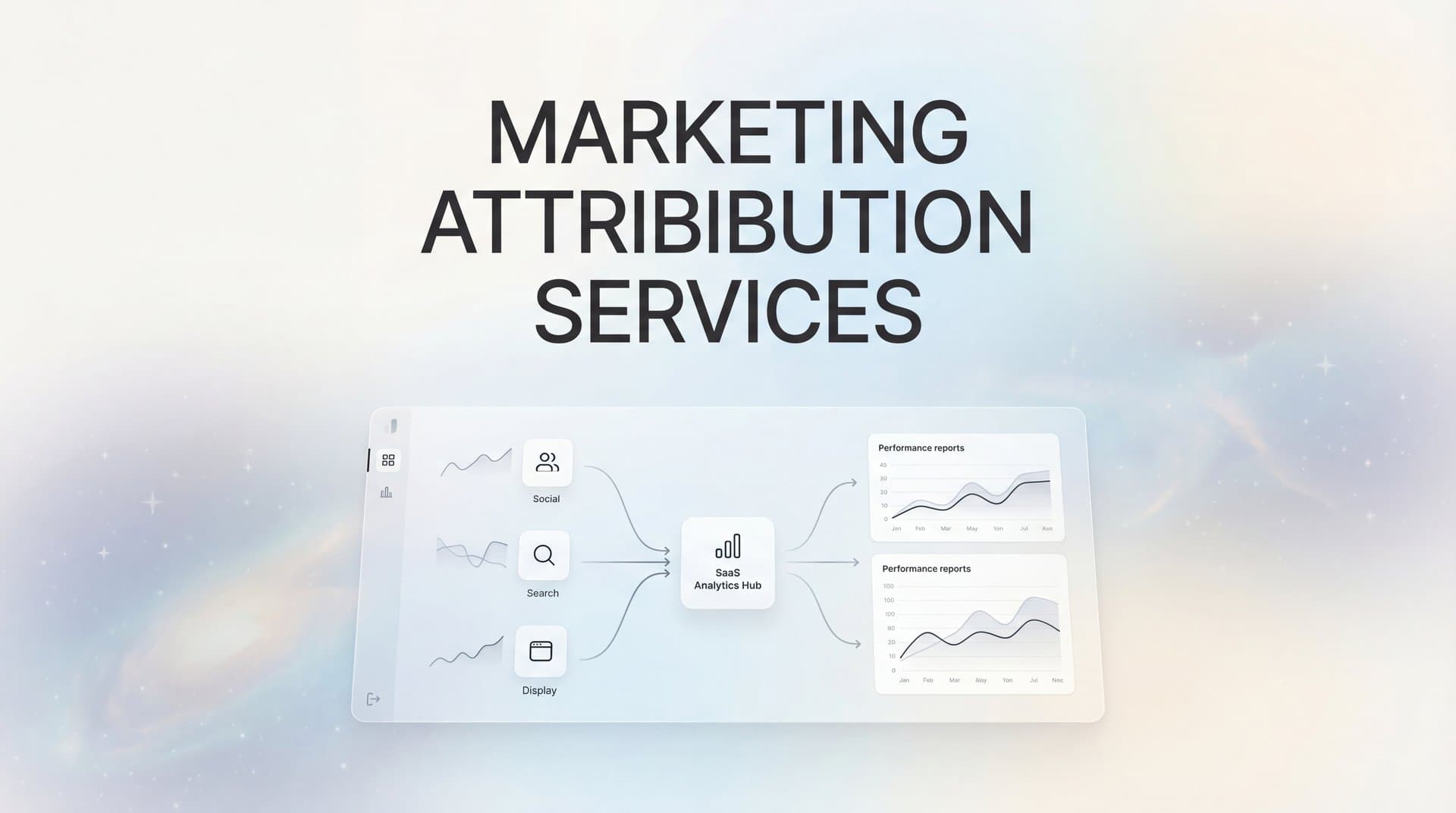
Think of marketing attribution services as the connective tissue between all your marketing tools. While each ad platform, analytics tool, and CRM operates in its own silo, attribution services create a unified view by tracking users across their entire journey and connecting those touchpoints to actual business outcomes.
The core function is deceptively simple: identify a user when they first interact with your marketing, track every subsequent touchpoint, and connect those interactions to conversions—whether that's a purchase, a qualified lead, or a closed deal in your CRM. The execution, however, requires sophisticated tracking infrastructure and data management.
Server-side tracking has become the foundation of accurate attribution. Unlike pixel-based tracking that relies on browser cookies and can be blocked by privacy tools, server-side tracking collects data directly from your servers. When someone clicks an ad, that interaction gets recorded on your server before the user even reaches your website. When they convert, that event is also captured server-side and matched to their earlier touchpoints.
This approach solves the iOS tracking problem. Even when users opt out of app tracking, server-side systems can still connect their journey using first-party data—information collected directly through your website and tools rather than third-party cookies. The data is more accurate, more complete, and more resistant to privacy restrictions.
The integration architecture is where attribution services prove their value. They connect to your ad platforms through APIs, pulling in campaign data, ad spend, and click information. They integrate with your website through tracking scripts that capture visitor behavior. And crucially, they connect to your CRM or ecommerce platform to see what happens after the initial conversion—which leads become opportunities, which opportunities close, and what revenue each customer generates. Platforms focused on marketing attribution revenue tracking excel at connecting these data points.
This creates a data flow that looks something like this: A user clicks your Meta ad. The attribution service records that click with a unique identifier. The user visits your website, where tracking scripts capture their behavior and associate it with that same identifier. They fill out a lead form, and that conversion gets logged. The lead syncs to your CRM, where it's assigned to a sales rep. Two weeks later, the deal closes for $15,000. The attribution service connects all these events back to that original Meta ad click.
Now you know not just that the ad generated a lead, but that it generated a specific amount of revenue. That's the difference between lead attribution and revenue attribution—and it changes how you evaluate campaign performance entirely.
The technical implementation varies by service, but the principle remains consistent: create a persistent identifier for each user, track their interactions across platforms, and connect those interactions to business outcomes. The services that do this well use a combination of first-party cookies, server-side tracking, and identity resolution to maintain accuracy even as privacy restrictions tighten.
Attribution Models Explained: Choosing How Credit Gets Assigned
Once you've captured the complete customer journey, you face a critical question: how do you assign credit when multiple touchpoints contribute to a conversion? A customer might see your display ad, click a search ad three days later, read two blog posts, and then convert through an email campaign. Which touchpoint gets credit for that sale?
Attribution models answer this question by establishing rules for credit distribution. The model you choose fundamentally changes how you evaluate channel performance and where you allocate budget. There's no universally "correct" model—the right choice depends on your business model, sales cycle, and strategic priorities. Understanding the types of marketing attribution models available helps you make an informed decision.
Single-touch models offer simplicity. First-click attribution gives all credit to the touchpoint that started the customer journey. This makes sense when you're focused on top-of-funnel awareness and want to understand which channels introduce new customers to your brand. If you're running cold acquisition campaigns and want to know which channels bring in net-new prospects, first-click attribution highlights your discovery channels.
Last-click attribution assigns all credit to the final touchpoint before conversion. This model works well for businesses with short sales cycles where the last interaction genuinely drives the decision. If you're running ecommerce campaigns where customers typically convert within hours of their first visit, last-click attribution can be sufficient. But for longer sales cycles with multiple touchpoints, it systematically undervalues your awareness and nurture efforts.
Multi-touch attribution models distribute credit across multiple interactions. Linear attribution splits credit evenly among all touchpoints. If five interactions contributed to a conversion, each gets 20% credit. This model works when you believe every touchpoint matters equally, though it can dilute the impact of particularly influential interactions. Explore multi-touch marketing attribution software options to implement these models effectively.
Time-decay attribution gives more credit to touchpoints closer to conversion. The logic: recent interactions matter more because they're fresh in the customer's mind when they decide to convert. This model makes sense for businesses where momentum matters—where staying top-of-mind through consistent touchpoints drives conversions.
Position-based attribution (also called U-shaped) gives the most credit to the first and last touchpoints, with remaining credit distributed among middle interactions. Typically, first and last touchpoints each get 40% credit, with the middle 20% split among everything else. This model acknowledges that discovery and conversion moments are particularly important while still recognizing the role of nurture touchpoints.
Data-driven attribution represents the next evolution. Instead of following predetermined rules, these models use machine learning to analyze your actual conversion patterns and determine which touchpoints statistically correlate with conversions. The AI examines thousands of customer journeys, identifies patterns, and assigns credit based on each touchpoint's actual influence on conversion probability. Learn more about how machine learning can be used in marketing attribution to understand this approach.
For example, a data-driven model might discover that users who interact with your webinar content are 3x more likely to convert than those who don't, even when other touchpoints are similar. It would then assign more credit to webinar touchpoints than to channels that show less correlation with conversions. The model continuously learns and adjusts as it processes more data.
The practical impact of model choice is significant. A campaign that looks mediocre under last-click attribution might be your top performer under first-click attribution. A channel that seems expensive under linear attribution might be cost-effective under data-driven attribution. Many marketers find value in comparing multiple models to understand how different perspectives change their channel evaluation.
Key Features That Separate Effective Attribution Services
Not all marketing attribution services deliver the same value. Some provide basic tracking that barely improves on what your ad platforms already report. Others offer sophisticated capabilities that fundamentally change how you optimize campaigns. Understanding which features actually matter helps you separate tools worth investing in from glorified dashboards. When comparing marketing attribution software features, focus on capabilities that directly impact your decision-making.
Real-time tracking and reporting capabilities determine how quickly you can act on insights. When attribution data updates in real time, you can identify winning campaigns immediately and scale them while they're hot. You can catch underperforming ads before they waste significant budget. Delayed reporting—where data takes 24-48 hours to process—means you're always optimizing based on yesterday's performance instead of today's reality.
The best attribution services update continuously. When a conversion happens, it appears in your dashboard within minutes, already connected to the touchpoints that drove it. This enables agile decision-making. You can adjust bids, pause campaigns, or shift budget between channels based on what's working right now, not what worked two days ago.
Cross-platform unification creates a single source of truth for your marketing data. Instead of logging into five different platforms to piece together performance, you see everything in one unified dashboard. More importantly, the service connects user behavior across those platforms—showing you when the same person interacts with your Meta ads, clicks your Google search ads, and converts through your email campaign. Dedicated cross-channel marketing attribution software specializes in this unified tracking approach.
This unified view reveals patterns invisible in platform-level reporting. You might discover that Meta ads rarely drive direct conversions but consistently introduce users who later convert through search. Or that LinkedIn generates low-volume but extremely high-value leads. These insights only become visible when you can track users across platforms rather than evaluating each channel in isolation.
Conversion sync functionality represents one of the most valuable features in modern attribution services. Instead of just tracking conversions for your analysis, these services send enriched conversion data back to your ad platforms. When someone converts, the attribution service tells Meta or Google not just that a conversion happened, but the quality of that conversion—the revenue generated, the customer lifetime value, whether the lead became an opportunity.
This feeds better data into ad platform algorithms. Meta's algorithm can optimize for high-value conversions instead of just any conversion. Google can identify patterns among your best customers and find similar users. The platforms learn faster and target more accurately because they're working with complete information instead of partial data filtered through browser-based pixels.
Integration depth determines how much of your customer journey the service can actually track. Surface-level integrations might pull basic campaign data but miss crucial touchpoints. Deep integrations connect to your ad platforms, website, CRM, email tools, and any other system that touches customer interactions. The more touchpoints captured, the more complete your attribution picture becomes.
Evaluating Marketing Attribution Services for Your Business
Choosing the right attribution service requires matching capabilities to your specific business model and marketing complexity. A solution perfect for ecommerce might fall short for B2B lead generation. A service built for small businesses might lack features enterprise teams need. Start your evaluation by asking questions that reveal whether a service can actually solve your attribution challenges.
Integration depth should be your first consideration. Ask which platforms the service connects to natively and how deep those integrations go. Can it track not just conversions but revenue? Does it sync with your CRM to track leads through to closed deals? Can it capture events from your marketing automation platform? If you're running campaigns across Meta, Google, LinkedIn, and TikTok, the service needs robust integrations with all four—not just basic API connections but full bidirectional data flow.
Data accuracy methodology matters more than most marketers realize. Ask how the service handles user identification across devices and sessions. Does it rely primarily on cookies, or does it use server-side tracking? How does it deal with iOS privacy restrictions? Services that depend heavily on third-party cookies are building on a foundation that's actively crumbling as browsers phase out cookie support. The best software for tracking marketing attribution prioritizes server-side solutions.
Support for your tech stack determines whether the service can actually integrate with your existing tools or requires you to replace systems you've already invested in. If you use HubSpot for CRM, Klaviyo for email, and Shopify for ecommerce, the attribution service needs to work with all three. Services with limited integration options force you into their preferred ecosystem, which might not align with your needs.
Several red flags should make you cautious. Over-reliance on cookies without server-side alternatives means the service's accuracy will degrade as privacy restrictions increase. Limited platform support—especially if it's missing channels where you spend significantly—creates blind spots in your attribution. Lack of CRM integration means you can't connect marketing touchpoints to actual revenue, limiting you to lead attribution instead of the more valuable revenue attribution.
Matching service capabilities to your business model is crucial. Ecommerce businesses need strong integration with their platform (Shopify, WooCommerce, Magento) and the ability to track revenue per transaction. Specialized ecommerce marketing attribution software addresses these specific requirements. Lead generation businesses need CRM integration to track leads through the sales process and connect marketing touchpoints to closed deals. SaaS companies need both—tracking initial signups and connecting them to subscription revenue over time.
For businesses with long sales cycles, look for services that can track attribution over months, not just days or weeks. B2B purchases often involve multiple stakeholders and numerous touchpoints over 3-6 months. Your attribution service needs to maintain user identity and track interactions across that entire timeline, not just the final week before conversion. Companies in this space should explore marketing attribution tools for B2B SaaS companies designed for complex buyer journeys.
Budget considerations extend beyond the subscription price. Implementation costs, required technical resources, and ongoing management time all factor into total cost of ownership. Some services require significant technical setup and ongoing maintenance. Others offer turnkey solutions that work out of the box. Neither is inherently better—it depends on your team's capabilities and available resources.
Putting Attribution Data to Work: From Insights to Action
Having accurate attribution data is valuable, but the real ROI comes from acting on those insights. The most successful marketers use attribution data to make three types of decisions: budget reallocation, touchpoint optimization, and continuous improvement loops that compound over time.
Budget reallocation based on attribution insights typically reveals surprising opportunities. You might discover that a channel you considered supplementary actually drives a disproportionate share of high-value conversions. Or that a campaign you're scaling aggressively performs well on last-click attribution but poorly when you examine the full customer journey. These insights let you shift budget from underperforming channels to those that genuinely drive revenue.
The key is looking beyond surface metrics. A channel with a high cost per lead might actually have a low cost per closed deal when you track conversions all the way through your sales process. A campaign with modest conversion volume might consistently attract customers with 3x higher lifetime value than your average. Attribution data reveals these patterns that platform-level metrics obscure. Building a comprehensive marketing attribution report helps you communicate these insights to stakeholders.
Identifying undervalued touchpoints often uncovers quick wins. Many marketers find that certain content assets, retargeting sequences, or awareness campaigns consistently appear in converting customer journeys but receive minimal budget because they don't drive last-click conversions. Attribution data reveals their contribution, justifying increased investment.
For example, you might discover that customers who engage with your comparison content are twice as likely to convert as those who don't, even though that content rarely gets last-click credit. This insight suggests investing more in promoting that content and creating similar assets. Or you might find that users who interact with your brand across three or more channels convert at much higher rates, indicating that cross-channel campaigns deserve premium budget allocation.
Creating feedback loops that continuously improve performance is where attribution data delivers compounding returns. Set up regular review cycles—weekly or biweekly—where you examine attribution data, identify patterns, and test optimization hypotheses. Each cycle builds on insights from previous cycles, creating a system that gets smarter over time.
These feedback loops work best when you connect attribution insights to specific tests. If attribution data suggests that users who see your video ads before clicking search ads convert at higher rates, test increasing video ad spend and measure the impact on search ad conversion rates. If data shows that certain ad creative consistently appears in high-value customer journeys, test similar creative approaches in other campaigns.
The goal isn't just understanding what happened—it's using that understanding to make what happens next more effective. Attribution services provide the data foundation, but the real value comes from building processes that turn data into decisions and decisions into improved results.
Making Attribution Work for Your Business
Marketing attribution services transform the fundamental question marketers face: from "How many conversions did this campaign generate?" to "How much revenue did this campaign actually drive?" That shift from vanity metrics to business outcomes changes everything about how you evaluate, optimize, and scale your marketing.
The marketers winning today aren't necessarily the ones with the biggest budgets—they're the ones who know exactly which campaigns drive revenue and can reallocate resources with confidence. They're not guessing which channels work. They're not piecing together spreadsheets and hoping their attribution estimates are close. They're working from complete data that connects every touchpoint to actual business results.
This clarity compounds over time. Each optimization based on accurate attribution data improves your efficiency. Each budget reallocation shifts resources toward genuinely high-performing channels. Each insight about customer journey patterns informs your strategy. The gap between marketers with accurate attribution and those flying blind widens with every campaign cycle.
The right marketing attribution service doesn't just track conversions—it captures every touchpoint in your customer journey, reveals what's actually driving revenue, and feeds better data back to your ad platforms so they can optimize more effectively. It connects your ad platforms, website, and CRM into a unified system that shows you the complete picture of how marketing drives business results.
Ready to elevate your marketing game with precision and confidence? Discover how Cometly's AI-driven recommendations can transform your ad strategy—Get your free demo today and start capturing every touchpoint to maximize your conversions.