You're spending thousands on Meta ads, Google campaigns, and LinkedIn promotions. Your dashboard shows clicks, impressions, and conversions across every platform. But here's the question that keeps you up at night: which campaigns actually drive revenue?
Every platform claims credit for your conversions. Meta says its ads generated 500 conversions this month. Google reports 450. Your email tool credits itself with 200. Add them up, and you've apparently generated more conversions than you actually had customers.
This isn't just confusing—it's expensive. When you can't see which touchpoints genuinely move prospects toward purchase, you're making budget decisions in the dark. You might be starving your best-performing campaigns while pouring money into channels that look good on paper but don't actually close deals.
Marketing attribution software solves this by connecting the dots across your entire customer journey. Instead of fragmented snapshots from individual platforms, you get a complete view of how prospects interact with your brand from first click to closed deal. This clarity transforms marketing from educated guessing into data-driven strategy.
The Hidden Cost of Flying Blind on Ad Performance
Think about your last customer who converted. They probably didn't see one ad and immediately buy. They likely encountered your brand multiple times across different channels before making a decision.
Maybe they first clicked a Meta ad on their phone during their morning commute. Later that day, they searched for your product category and clicked your Google ad. They visited your website but didn't convert. A few days later, they received your email campaign and clicked through. Finally, they returned via direct traffic and completed the purchase.
Here's where the problem starts. Meta's pixel fires and records a conversion—it saw that person before they bought. Google's conversion tracking does the same thing. Your email platform claims credit too. Each system operates in isolation, tracking what it can see but blind to the broader journey.
This creates what marketers call attribution chaos. You're not just dealing with slightly different numbers—you're getting fundamentally conflicting stories about what's working. One platform suggests doubling down on display ads. Another indicates search is your winner. Your gut says email drives the most qualified leads, but the data doesn't clearly support it. Understanding the differences between marketing attribution software vs traditional analytics helps clarify why platform-reported data falls short.
The business impact goes beyond confusion. When you can't accurately attribute revenue to specific touchpoints, you make budget allocation decisions based on incomplete information. You might cut spending on campaigns that play a crucial early-stage role in the customer journey because they don't show last-click conversions. Or you might overspend on channels that get credit for conversions they didn't actually influence.
Consider the real cost: if you're spending $50,000 monthly across multiple channels and even 20% of that budget goes to underperforming campaigns you can't identify, that's $120,000 annually in wasted spend. Meanwhile, the channels that actually drive revenue remain underfunded because their contribution stays hidden in the noise.
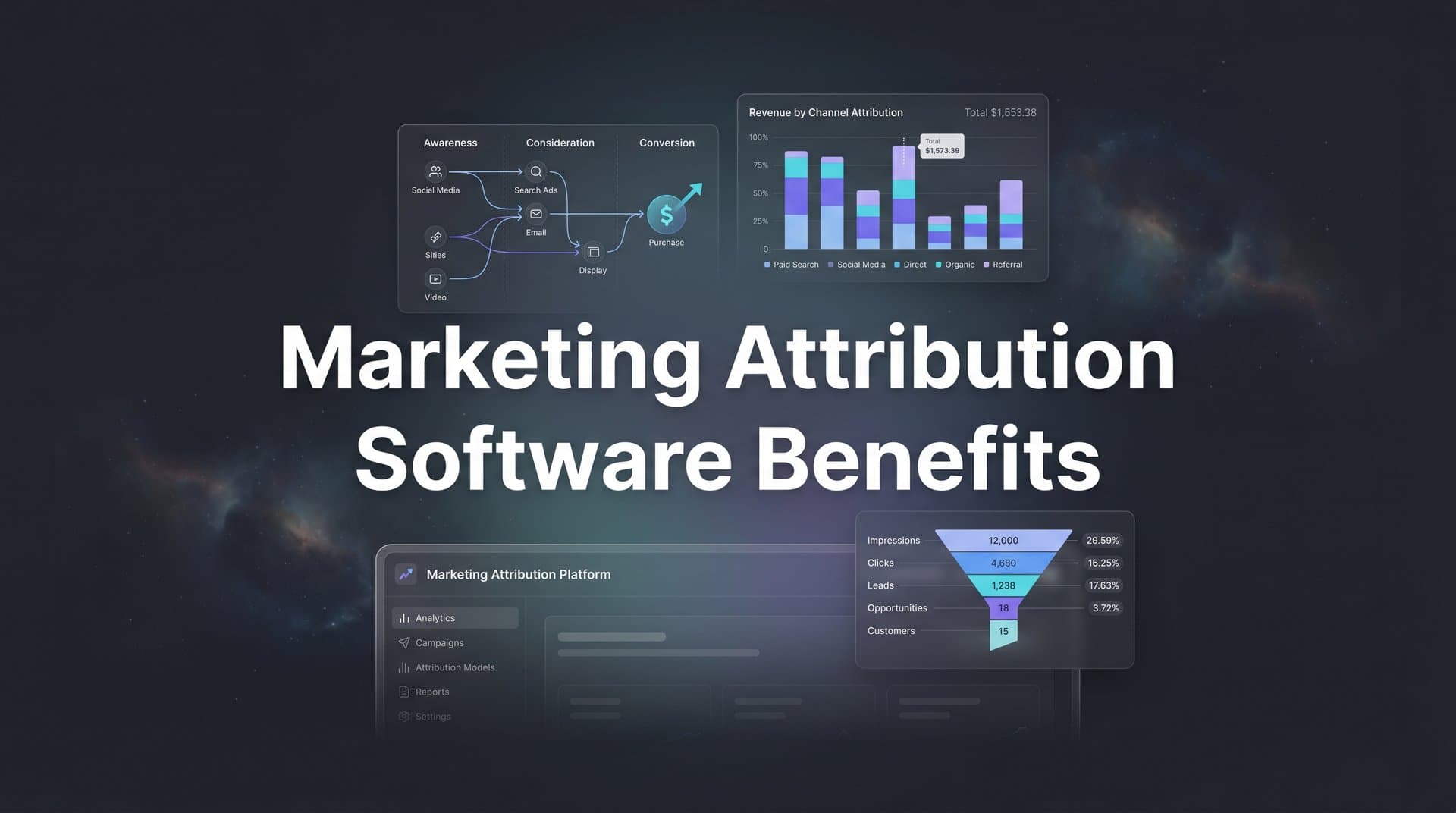
Marketing attribution software addresses this by tracking the complete customer journey across all touchpoints. Instead of each platform operating in isolation, attribution software creates a unified view that shows how different channels work together to drive conversions. It captures every interaction—ad clicks, website visits, email engagement, social media touches—and connects them to actual revenue outcomes.
This comprehensive tracking reveals patterns that individual platforms can't show you. You might discover that Meta ads rarely drive direct conversions but play a critical awareness role that makes your Google search ads more effective. Or you might find that prospects who engage with both email and paid social convert at twice the rate of those who only see one channel.
Complete Visibility Across Every Marketing Touchpoint
Platform-reported data tells you what happened within each silo. Attribution software shows you what happened across your entire marketing ecosystem.
When you rely on individual platform dashboards, you're seeing fragments of the customer journey. Meta shows you ad impressions, clicks, and conversions tracked by its pixel. Google Analytics displays website sessions and goal completions. Your CRM records form submissions and deal progression. Each system captures valuable data, but none of them talk to each other.
Attribution software acts as the central nervous system that connects these disparate data sources. It captures interactions across ad platforms, tracks website behavior, monitors email engagement, and pulls in CRM events—all in one unified view. This integration transforms isolated data points into a complete customer journey map. Implementing cross channel marketing attribution software ensures you capture every interaction across platforms.
Here's what this looks like in practice. A prospect's journey might start with a LinkedIn ad impression on Monday. They don't click, but they see your brand. On Wednesday, they search for a solution to their problem and click your Google ad. They browse your website for five minutes but leave without converting. On Friday, they receive your nurture email and click through to a case study. The following Tuesday, they return to your site via direct traffic and request a demo.
Without attribution software, you'd see these events as separate, unconnected actions in different systems. LinkedIn would show an impression with no click. Google would report a click with no immediate conversion. Your email platform would credit itself with the demo request because it was the last tracked touchpoint. Your CRM would show a demo request with limited context about how that prospect discovered you.
With attribution software tracking the complete journey, you see the full story. You understand that LinkedIn created initial awareness even without a click. You recognize that Google captured intent when the prospect was actively searching. You see how email engagement moved them closer to conversion. And you know that multiple touchpoints worked together to generate that demo request.
This visibility extends beyond just ad clicks. Modern attribution platforms track website interactions like page views, video watches, and content downloads. They capture email opens, clicks, and engagement patterns. They pull in CRM data about sales conversations, deal stages, and closed revenue. They even track offline touchpoints like event attendance or phone calls when integrated with the right systems.
The difference between siloed platform data and connected journey tracking becomes most apparent when you're trying to answer strategic questions. Which channel should get more budget? Isolated platform data can't tell you because each platform only sees its own contribution. Attribution software reveals how channels work together, showing you which combinations drive the best results.
Should you invest more in top-of-funnel awareness or bottom-of-funnel conversion campaigns? Platform data shows you last-click conversions, which naturally favors bottom-funnel tactics. Attribution software shows you the entire journey, revealing how awareness campaigns create the pipeline that conversion campaigns close. Exploring multi touch marketing attribution software helps you understand how each touchpoint contributes to conversions.
This comprehensive visibility also reveals the true path customers take before converting—and it's rarely as straightforward as marketers assume. You might discover that your highest-value customers typically interact with five or more touchpoints before purchasing, while lower-value customers convert after just one or two. This insight changes how you structure campaigns and set expectations for conversion timelines.
The unified view also helps you identify gaps in your customer journey. If you notice prospects frequently engage with ads and visit your website but rarely convert, you might need stronger website content or clearer calls-to-action. If prospects engage heavily with educational content but don't request demos, you might need better nurture sequences that bridge the gap between education and sales conversations.
Revenue-Based Insights That Go Beyond Vanity Metrics
Clicks and impressions tell you about activity. Revenue attribution tells you about results.
Most marketing dashboards overflow with metrics that feel important: click-through rates, cost per click, impression share, engagement rates, website sessions. These numbers provide useful tactical feedback, but they don't answer the question that actually matters: which marketing activities drive revenue?
A campaign with a 5% click-through rate sounds impressive until you discover those clicks rarely convert to customers. A channel with a high cost per click might seem inefficient until you realize it drives your highest-value deals. Surface-level metrics create the illusion of performance without revealing actual business impact. Learning how marketing revenue attribution transforms your ad spend decisions helps you focus on what truly matters.
Attribution software shifts the focus from activity metrics to revenue outcomes. Instead of just tracking that someone clicked your ad, it connects that click to downstream events: form submissions, demo requests, opportunity creation, and ultimately closed deals. This connection reveals the true ROI of each marketing touchpoint.
Consider two marketing channels with different profiles. Channel A generates 1,000 clicks monthly at $2 per click, with a 5% conversion rate to leads. Channel B generates 200 clicks monthly at $10 per click, with a 2% conversion rate to leads. Based on these metrics alone, Channel A looks like the clear winner—lower costs, higher volume, better conversion rate.
But when you connect touchpoints to revenue, the picture changes. Channel A's leads have an average deal value of $1,000 and a 10% close rate. Channel B's leads have an average deal value of $10,000 and a 30% close rate. Suddenly, Channel B becomes far more valuable despite its higher costs and lower conversion rate. It's driving significantly more revenue per dollar spent.
This revenue-based perspective transforms budget allocation from guesswork into data-driven strategy. Instead of asking "which channel has the lowest cost per click?" you ask "which channel has the highest revenue per dollar invested?" The answer often surprises marketers who've been optimizing for the wrong metrics.
Revenue attribution also reveals how different touchpoints contribute at different stages of the customer journey. A social media campaign might generate awareness that doesn't immediately convert but creates pipeline for other channels to close. A retargeting campaign might show poor first-touch attribution but excellent last-touch performance because it converts prospects who were already familiar with your brand.
Understanding these contribution patterns helps you build more sophisticated marketing strategies. You stop expecting every campaign to drive immediate conversions and start designing integrated approaches where different touchpoints play specific roles in moving prospects toward purchase. For B2B companies, B2B marketing attribution software provides the specialized tracking needed for longer sales cycles.
The shift to revenue-based insights also changes how you evaluate campaign performance over time. A campaign that shows declining click-through rates might still be worth continuing if it consistently drives high-value conversions. A new channel that starts slowly might deserve patience if early conversions show strong revenue potential.
This approach particularly matters for businesses with longer sales cycles. When weeks or months pass between initial touchpoint and closed deal, surface-level metrics provide almost no useful guidance. You need to track how early-stage interactions connect to late-stage revenue to make informed decisions about what's working.
Revenue attribution also helps you prove marketing's value to leadership. Instead of reporting on clicks and impressions, you can show exactly how marketing activities contribute to pipeline and closed revenue. This clarity makes budget conversations more productive and helps secure investment in channels that drive real business outcomes.
Smarter Ad Platform Performance Through Better Data
Your ad platforms are only as good as the data you feed them. When they receive incomplete or inaccurate conversion signals, their algorithms optimize toward the wrong outcomes.
Meta, Google, TikTok, and other advertising platforms use machine learning to improve targeting and bidding. They analyze which users convert after seeing your ads and use those signals to find similar high-value audiences. They adjust bids in real-time based on conversion likelihood. They optimize ad delivery to show your content to people most likely to take action.
But here's the problem: these algorithms only work well when they receive accurate, comprehensive conversion data. If your tracking only captures a fraction of actual conversions due to browser restrictions or tracking limitations, the algorithm optimizes based on incomplete information. If conversion signals arrive days late, the algorithm can't make real-time adjustments. If you're only sending basic conversion events without value data, the algorithm can't distinguish between high-value and low-value conversions.
Attribution software improves ad platform performance by feeding enriched conversion data back to these systems. Instead of relying solely on browser-based pixels that miss conversions due to privacy restrictions, attribution platforms use server-side tracking that captures more complete data. Instead of just telling Meta that a conversion happened, they send detailed information about conversion value, customer quality, and downstream outcomes. Reviewing the best software for tracking marketing attribution in 2026 helps you find solutions with robust server-side capabilities.
This enhanced data flow creates a virtuous cycle. When Meta's algorithm receives better conversion signals, it gets better at identifying which users are likely to convert. As it improves at finding high-intent users, your cost per acquisition drops and conversion rates improve. As performance improves, you can scale spending with confidence, knowing the algorithm will maintain efficiency at higher volumes.
The impact becomes particularly significant for businesses with complex conversion paths. If you're a B2B company where the valuable conversion isn't a purchase but a demo request that leads to a sales process, you need to send that context back to ad platforms. Attribution software can track when demo requests turn into opportunities and closed deals, then feed that information back to inform future targeting.
This approach also helps you move beyond optimizing for quantity to optimizing for quality. Instead of just maximizing conversions, you can optimize for high-value conversions. Attribution software identifies which conversions lead to actual revenue and sends those signals back to ad platforms. Over time, the algorithms learn to prioritize users who look like your best customers, not just users who are likely to convert.
The benefits compound over time. In the first month, better data might improve your conversion rate by helping algorithms target more accurately. In the third month, as algorithms accumulate more quality signals, performance improves further. In the sixth month, you're operating with targeting precision that would be impossible with standard pixel-based tracking alone.
This improved platform performance also gives you more flexibility in campaign strategy. When algorithms have rich conversion data, you can test broader targeting knowing the system will optimize toward the right audiences. You can experiment with different creative approaches and let the algorithm identify which variations drive the best results. You can scale budgets more aggressively because you trust the algorithm's ability to maintain performance.
AI-Powered Recommendations for Scaling What Works
Modern attribution platforms don't just track data—they analyze it to surface insights you might miss.
When you're managing campaigns across multiple platforms with hundreds of ads, thousands of keywords, and complex audience segments, patterns get buried in the noise. You might notice that a specific ad is performing well, but miss that it performs exceptionally well when combined with a particular audience segment on certain days of the week. You might see that a channel drives conversions, but not realize that its performance depends heavily on what other channels are active simultaneously.
AI marketing attribution software analyzes performance patterns across all your channels to identify opportunities that aren't obvious from surface-level reporting. They examine which combinations of touchpoints drive the highest conversion rates. They identify ads and campaigns that consistently contribute to high-value customer journeys. They spot emerging trends before they're visible in aggregate data.
This analysis goes beyond simple reporting to provide actionable recommendations. Instead of just showing you that Campaign A has a better ROI than Campaign B, AI can tell you that Campaign A performs best with audiences who've previously engaged with specific content, and suggest scaling that combination. Instead of just reporting that conversions are up, AI can identify which specific changes drove that improvement and recommend doubling down on those tactics.
The value of AI recommendations becomes particularly clear when you're trying to scale successful campaigns. Scaling isn't just about increasing budgets—it's about understanding what makes something work and replicating those conditions. AI can analyze successful campaigns to identify common elements: audience characteristics, creative approaches, messaging angles, timing patterns. It then suggests how to apply those insights to new campaigns or channels.
AI also helps you identify underperforming elements worth cutting. When you're running dozens of campaigns, some inevitably underperform. But which ones should you pause, and which just need optimization? AI can distinguish between campaigns that are fundamentally flawed and those that show potential with adjustments. It might recommend pausing a campaign that consistently drives low-value conversions while suggesting creative refreshes for one that drives quality traffic but needs better messaging.
These recommendations become more valuable over time as the AI accumulates more data about your specific business. It learns which audience segments convert best for you. It understands your typical customer journey patterns. It recognizes seasonal trends in your performance. This accumulated knowledge makes recommendations increasingly relevant and accurate. When comparing marketing attribution software features, prioritize platforms with robust AI capabilities.
AI-powered analysis also helps you make faster optimization decisions. Instead of waiting until month-end to review performance and plan adjustments, you can receive real-time recommendations based on emerging patterns. If a new ad is showing early signs of strong performance, AI can flag it for increased budget before you'd notice it in manual reporting. If a previously successful campaign starts declining, AI can alert you to investigate before significant budget is wasted.
The confidence that comes from AI-backed recommendations changes how you approach marketing strategy. Instead of making decisions based on intuition or limited manual analysis, you're operating with comprehensive data analysis that considers more variables than any human could track. This doesn't replace marketing judgment—it enhances it by providing a foundation of data-driven insights to inform your decisions.
Putting Attribution Software to Work for Your Team
Marketing attribution software delivers four core benefits that transform how you understand and optimize campaign performance.
First, you gain complete visibility across every marketing touchpoint. Instead of fragmented data scattered across platform dashboards, you see unified customer journeys that reveal how different channels work together to drive conversions. This comprehensive view helps you understand the true path customers take before purchasing and identify gaps in your marketing funnel.
Second, you shift from vanity metrics to revenue-based insights. Rather than optimizing for clicks, impressions, or engagement, you focus on the metrics that actually matter: pipeline contribution and closed revenue. This clarity helps you allocate budgets to channels that drive real business outcomes instead of just generating activity.
Third, you improve ad platform performance through better data. By feeding enriched conversion signals back to Meta, Google, and other platforms, you help their algorithms target more accurately and optimize more effectively. This creates a compounding benefit where better data leads to better targeting, which leads to higher ROI, which generates more data to further improve performance.
Fourth, you leverage AI-powered recommendations to scale what works. Instead of manually analyzing performance across all channels, AI surfaces insights about high-performing campaigns and suggests specific actions to improve results. This helps you make faster, more confident optimization decisions based on comprehensive data analysis.
When evaluating attribution solutions, focus on integration capabilities and real-time tracking. The platform needs to connect seamlessly with your ad channels, CRM, website, and other marketing tools to create that unified view. It should provide real-time data rather than delayed reporting so you can make timely optimization decisions. And it should offer flexible attribution modeling that lets you analyze customer journeys from multiple perspectives.
The right attribution software doesn't just report what happened—it helps you understand why it happened and what to do next. It transforms marketing from a discipline based on educated guessing into a data-driven practice where you know exactly which investments drive results.
Ready to elevate your marketing game with precision and confidence? Discover how Cometly's AI-driven recommendations can transform your ad strategy—Get your free demo today and start capturing every touchpoint to maximize your conversions.