You're spending $50,000 a month across Meta, Google, TikTok, and LinkedIn. Your dashboard shows clicks, impressions, and conversions flowing in from every platform. But when your CFO asks which campaigns actually generate revenue, you're stuck piecing together conflicting reports that don't add up.
Sound familiar? You're not alone. Most marketers are flying blind, making budget decisions based on incomplete data and platform-reported metrics that tell wildly different stories. One platform claims credit for 80% of your conversions. Another swears it drove the same customers. Meanwhile, your actual revenue doesn't match either report.
This is where a marketing attribution system changes everything. It's the infrastructure that connects every touchpoint—from the first ad click to the final purchase—and shows you exactly which campaigns drive real business outcomes. Not just clicks. Not just "conversions" that platforms want to claim credit for. Actual revenue.
Think of it as the central nervous system for your marketing data. It captures signals from every channel, unifies them into a single customer journey, and gives you the clarity to make confident decisions about where to invest your budget. In this guide, we'll break down how these systems work, why they've become essential in today's privacy-first landscape, and how to build one that transforms your marketing from guesswork into a revenue-generating machine.
The Anatomy of Modern Attribution: How These Systems Actually Work
A marketing attribution system isn't just another analytics dashboard. It's a sophisticated data infrastructure that captures, connects, and interprets every interaction a customer has with your brand before they convert. Understanding how these systems function under the hood helps you see why they're so much more powerful than cobbling together native platform reports.
At the foundation, you have tracking mechanisms that capture customer behavior. This includes browser-based pixels that fire when someone visits your website, server-side events that record actions directly from your backend, and conversion APIs that send enriched data to ad platforms. These tracking layers work together to capture touchpoints that traditional cookie-based tracking misses—especially important as browsers crack down on third-party cookies and iOS limits ad tracking.
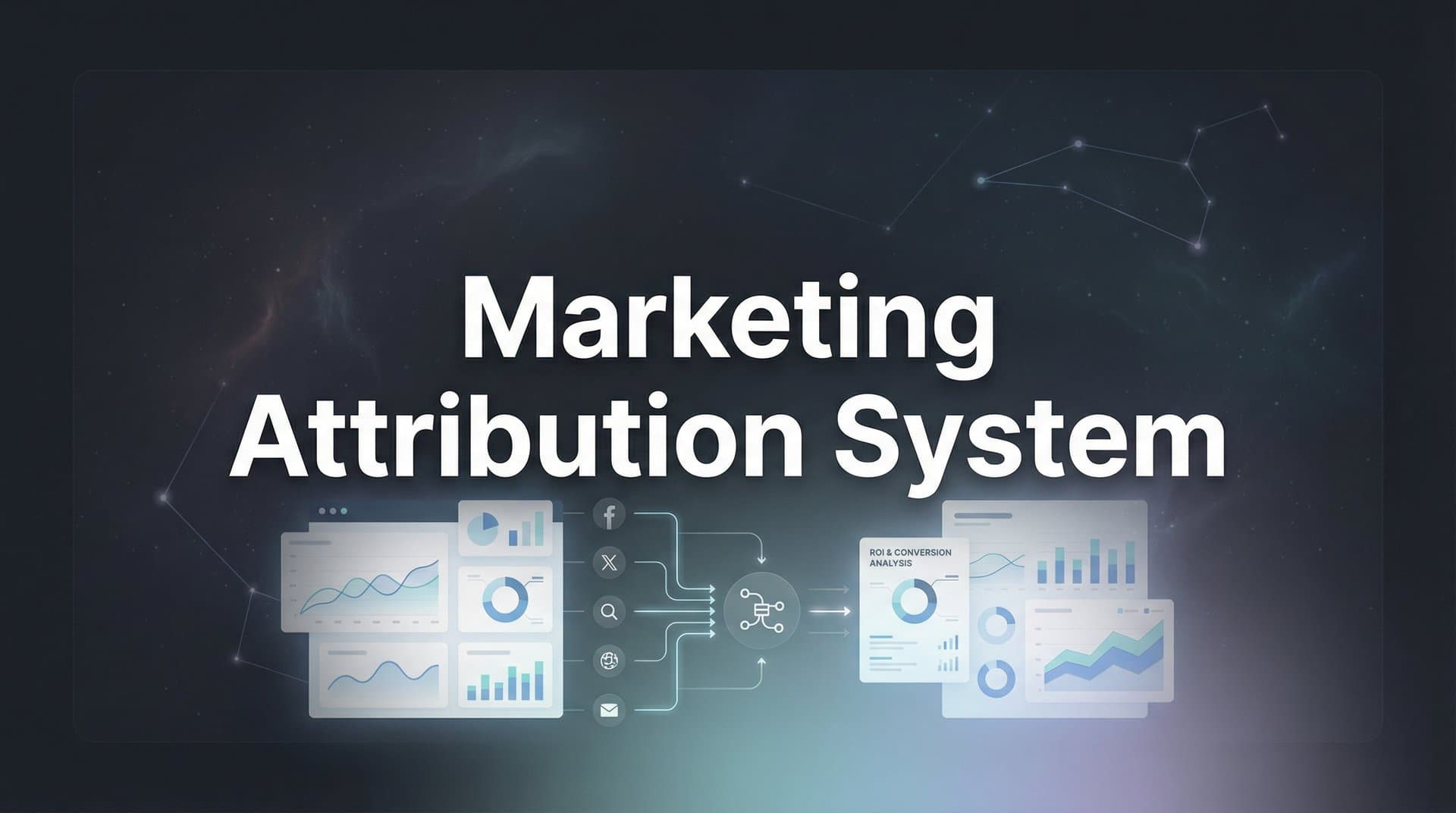
The real magic happens in the data unification layer. Your attribution system pulls in data from multiple sources: ad platform APIs (Meta, Google, TikTok), your website analytics, your CRM, and even offline conversion data from sales teams. It then stitches all these disparate signals into coherent customer journeys. When someone clicks a Facebook ad on their phone, visits your website on their laptop two days later, and converts via a Google search a week after that, your attribution system connects these dots into a single story.
This is where identity resolution becomes critical. Attribution systems use sophisticated matching logic to recognize that the anonymous visitor from Facebook, the email subscriber from your nurture campaign, and the customer who eventually purchased are all the same person. They match across devices, browsers, and sessions using identifiers like email addresses, phone numbers, and probabilistic modeling when deterministic matching isn't possible.
Once the system has unified your customer journeys, it applies attribution models to assign credit to each touchpoint. This isn't arbitrary—modern systems let you compare multiple models side by side or use machine learning to determine which touchpoints actually influence conversions based on historical patterns. The system then surfaces these insights through dashboards that show performance by channel, campaign, ad set, and even individual creative.
But here's what separates truly powerful attribution systems from basic analytics: they close the loop by feeding enriched conversion data back to your ad platforms. When your attribution system knows that a customer didn't just fill out a form but actually became a $10,000 client, it can send that revenue data back to Meta and Google. This helps their algorithms optimize for high-value conversions, not just form fills that may never close.
The result? You get a complete, unified view of what's actually driving revenue—not just what each platform wants to take credit for. You can see the real contribution of every channel, identify which campaigns deserve more budget, and make decisions based on actual business outcomes rather than vanity metrics.
Attribution Models Explained: Choosing the Right Lens for Your Data
Your attribution system captures all the data. But how does it decide which touchpoints deserve credit for a conversion? That's where attribution models come in—they're the rules that determine how credit gets distributed across the customer journey. Choosing the right model isn't just a technical decision; it fundamentally changes how you interpret your marketing performance.
Single-Touch Attribution: The simplest approach assigns 100% of the credit to one touchpoint. First-click attribution gives all credit to the initial interaction—the blog post that introduced someone to your brand, the Facebook ad they first clicked. Last-click attribution does the opposite, crediting only the final touchpoint before conversion—typically that branded Google search or direct visit.
When do single-touch models still make sense? First-click works well when you're focused on top-of-funnel awareness and want to understand which channels bring new audiences into your ecosystem. Last-click is useful for businesses with very short sales cycles where the last interaction truly drives the decision. But for most businesses running multi-channel campaigns with longer consideration periods, single-touch models create blind spots. They ignore the nurturing that happened between first touch and conversion.
Multi-Touch Attribution Models: These distribute credit across multiple touchpoints in the journey. Linear attribution splits credit evenly—if someone had five interactions before converting, each gets 20%. It's democratic but doesn't account for the reality that some touchpoints matter more than others.
Time-decay attribution gives more weight to touchpoints closer to conversion. That retargeting ad someone saw yesterday gets more credit than the blog post they read three months ago. This model assumes that recent interactions have more influence on the final decision—often true for considered purchases where momentum builds over time.
Position-based attribution (also called U-shaped) gives extra credit to the first and last touchpoints—typically 40% each—while distributing the remaining 20% among middle interactions. The logic? The first touch creates awareness, the last touch drives conversion, and everything in between nurtures the relationship. This model works well when you value both customer acquisition and conversion optimization.
Data-Driven Attribution: This is where modern attribution systems really shine. Instead of using predetermined rules, data-driven models use machine learning to analyze thousands of conversion paths and determine which touchpoints actually correlate with conversions. The algorithm identifies patterns: maybe customers who engage with both your webinar and case study content convert at 3x the rate of those who only see ads. The model adjusts credit accordingly.
Data-driven attribution requires significant conversion volume to work effectively—typically hundreds of conversions per month minimum. But when you have the data, it provides the most accurate picture of what is marketing attribution model performance and what's actually influencing customer decisions. It adapts as your marketing mix changes, unlike static rule-based models.
Here's the thing: there's no universally "correct" attribution model. The best approach is comparing multiple models side by side. When you see that a channel performs well across all models, you know it's genuinely valuable. When performance varies dramatically by model, you need to dig deeper into what role that channel plays in your funnel. A sophisticated attribution system lets you toggle between models instantly, giving you different perspectives on the same data.
The goal isn't finding the perfect model—it's using attribution models as analytical lenses that reveal different truths about your marketing. First-click shows you what builds awareness. Last-click shows you what closes deals. Multi-touch models show you the full journey. Together, they give you the complete picture you need to make smart budget decisions.
Why Traditional Tracking Falls Short in a Privacy-First World
Remember when you could drop a Facebook pixel on your site and trust that it captured every conversion? Those days are over. The tracking infrastructure that marketers relied on for a decade has fundamentally broken—and if you're still depending on it, you're making decisions based on incomplete data.
Apple's iOS changes started the earthquake. When iOS 14.5 introduced App Tracking Transparency, it required apps to ask permission before tracking users across other apps and websites. The result? Most users opted out. Facebook's pixel, which relied heavily on cross-site tracking, suddenly went blind to huge portions of mobile traffic. Conversions that definitely happened simply disappeared from your Facebook dashboard because the platform couldn't see them anymore.
But iOS wasn't the only culprit. Safari's Intelligent Tracking Prevention and Firefox's Enhanced Tracking Protection have been blocking third-party cookies for years. Chrome announced it's phasing them out entirely. The browser-based tracking that powered digital marketing for the past decade is dying, and cookie-based attribution is dying with it.
The impact goes beyond missing data. Platform-reported metrics have become increasingly unreliable. Each ad platform uses its own attribution window and methodology. Facebook might claim credit for a conversion that happened within 7 days of an ad click. Google might claim the same conversion because the customer also clicked a Google ad within their 30-day window. Both platforms report the conversion. Your actual revenue doesn't double.
This creates a dangerous situation: you're optimizing campaigns based on inflated metrics that don't reflect reality. You might think your Facebook campaigns are crushing it because the platform reports 500 conversions. Meanwhile, your actual sales data shows only 300 new customers total across all channels. The math doesn't work, but you're making budget decisions anyway. Understanding these common attribution challenges in marketing analytics is the first step toward solving them.
Server-side tracking solves these problems by fundamentally changing where and how data gets captured. Instead of relying on browser pixels that can be blocked, server-side tracking records events directly from your backend. When someone completes a purchase, your server sends that conversion data to your attribution system and ad platforms—no pixel required, no browser restrictions involved.
This approach is privacy-compliant because you're tracking actions on your own properties using first-party data. You're not following users across the web; you're recording what happens on your website and in your systems. It's accurate because it captures conversions that browser-based tracking misses. And it's reliable because it doesn't depend on cookies that browsers can block or users can delete.
The shift to server-side tracking isn't optional anymore—it's the foundation for accurate attribution in a privacy-first world. Without it, you're building your marketing strategy on a foundation of incomplete, conflicting data. With it, you finally see what's actually happening.
Building Your Attribution Tech Stack: Essential Integrations
A marketing attribution system is only as powerful as the data it can access. To get a complete view of your customer journeys, you need to connect every platform where marketing happens and revenue gets tracked. Here's how to build an attribution tech stack that actually captures the full picture.
Ad Platform Connections: Your attribution system needs direct API access to every advertising platform you use. This means connecting Meta Ads, Google Ads, TikTok Ads, LinkedIn Campaign Manager, and any other paid channels in your mix. These integrations pull in campaign structure, spend data, impressions, clicks, and platform-reported conversions.
But the real power comes from bi-directional data flow. Your attribution system doesn't just pull data from ad platforms—it sends enriched conversion data back through Conversion APIs. When your system knows that a lead became a $15,000 customer, it sends that revenue value back to Meta and Google. This helps their algorithms optimize for high-value conversions rather than just any conversion. The ad platforms learn which audiences and creative actually drive revenue, making their targeting smarter over time.
CRM Integration: This is where attribution connects to actual business outcomes. Integrating your CRM (Salesforce, HubSpot, Pipedrive, or whatever system tracks your deals) lets your attribution system see beyond form fills and demo requests. It can track which marketing touchpoints led to qualified opportunities, closed deals, and actual revenue.
This integration reveals the truth about lead quality. Maybe your Facebook campaigns generate 3x more leads than LinkedIn, but LinkedIn leads close at 5x the rate and generate higher contract values. Without CRM integration, you'd keep pouring budget into Facebook because it "performs better." With CRM data connected, you see that LinkedIn is your real revenue driver. This is especially critical for B2B marketing attribution where sales cycles are longer and lead quality matters more than volume.
The CRM connection also enables closed-loop reporting. You can track a customer journey from the first ad click all the way through to deal close and even customer lifetime value. This long-term view transforms how you think about marketing ROI—you're not just measuring cost per lead, but cost per customer and revenue per marketing dollar.
Website and Conversion Tracking: Your attribution system needs to capture what happens on your website between the ad click and the conversion. This means implementing tracking that records page views, form submissions, button clicks, video views, and any other on-site behavior that signals buying intent.
Modern attribution platforms use a combination of client-side and server-side tracking to capture website activity. The client-side component (typically a lightweight JavaScript tag) tracks user interactions in the browser. The server-side component records conversions and critical events directly from your backend, ensuring accuracy even when browser tracking gets blocked.
You'll also want to track conversion events that matter to your business: free trial signups, demo requests, purchases, subscription upgrades, and any other actions that indicate customer progression. These events become the foundation for your attribution analysis—they're the outcomes you're trying to connect back to marketing touchpoints.
Additional Data Sources: Depending on your business model, you might integrate email marketing platforms (to track email engagement as touchpoints), customer support systems (to see how pre-sale conversations influence deals), or analytics tools like Google Analytics for additional behavioral data. The goal is creating a unified data layer that captures every meaningful interaction.
The key to making these integrations work is consistent event naming and data structure across platforms. When your attribution system receives a "purchase" event, it needs to mean the same thing whether it came from your website, your CRM, or your email platform. This standardization is what allows the system to unify data into coherent customer journeys.
From Data to Decisions: Using Attribution Insights to Scale Campaigns
You've built your attribution system. Data is flowing. Now comes the part that actually matters: using these insights to make better marketing decisions. This is where attribution transforms from a tracking exercise into a growth engine.
Identifying True Performers: Your attribution system reveals which channels and campaigns actually drive revenue, not just which ones generate clicks or cheap conversions. Start by comparing platform-reported conversions against your attribution system's revenue data. You'll often find that the campaign Facebook says is your best performer is actually middle-of-the-pack when you measure by actual closed deals.
Look for channels that appear in high-converting customer journeys consistently. If 80% of your best customers interacted with your case study content before converting, that's a signal to invest more in content marketing—even if it doesn't get last-click credit. If customers who engage with both Facebook and LinkedIn ads convert at 3x the rate of single-channel prospects, that's your cue to run coordinated multi-channel campaigns rather than treating each platform in isolation.
Pay attention to conversion rates at each stage of the funnel. A channel might bring in high volume at the top of the funnel but fail to produce qualified opportunities. Another might generate fewer leads but at much higher quality. Your attribution system shows you these patterns so you can optimize for outcomes that matter, not just vanity metrics.
Budget Reallocation Based on Revenue Impact: This is where attribution drives tangible ROI. Instead of distributing budget based on gut feel or last month's performance, you allocate spend based on actual revenue contribution. If your attribution system shows that Google Search drives 40% of your revenue but only receives 20% of your budget, that's a clear reallocation opportunity.
Use your attribution data to set channel-specific targets. If LinkedIn consistently delivers customers at $500 cost per acquisition while Facebook averages $800, you know LinkedIn deserves aggressive scaling while Facebook needs optimization before you increase spend. This precision prevents the common mistake of cutting budgets from channels that play important assist roles in the customer journey. Understanding cross channel attribution marketing ROI helps you see the full picture of how channels work together.
Watch for diminishing returns as you scale. Your attribution system can show you when increasing spend in a channel stops producing proportional results. Maybe your first $10,000 in Facebook spend generates $50,000 in revenue, but the next $10,000 only generates $30,000. That's your signal to diversify rather than keep pouring money into a saturated channel.
Feeding Better Data Back to Ad Platforms: Here's a strategy most marketers miss: your attribution system doesn't just help you make better decisions—it helps ad platforms make better decisions too. When you send enriched conversion data back through Conversion APIs, you're teaching Meta and Google which conversions actually matter.
Instead of just reporting "form submission" as a conversion, send the actual revenue value. Tell the platform when a lead becomes a qualified opportunity, when they close as a customer, and what their contract value is. The ad platform's algorithm uses this data to find more customers like your best customers, not just more people who fill out forms.
This creates a virtuous cycle. Better data leads to better ad optimization, which drives higher-quality traffic, which generates more valuable conversions, which gives you even better data to feed back. Over time, your campaigns become increasingly efficient at finding and converting your ideal customers.
The most sophisticated marketers use attribution insights to inform creative strategy too. If your system shows that customers who engage with video content convert at higher rates, that's a signal to invest more in video creative. If carousel ads consistently appear in high-value customer journeys, double down on that format. Let your attribution data guide not just budget allocation but creative production.
Putting Your Attribution System Into Action
Define What Matters: Before you implement any attribution system, get crystal clear on what conversions actually matter to your business. Is it demo requests? Free trial signups? Purchases? Qualified sales opportunities? Map out your conversion funnel and identify the events that indicate real customer progression, not just engagement.
Different businesses need different conversion definitions. A SaaS company might track free trial starts, trial-to-paid conversions, and expansion revenue. An e-commerce brand focuses on purchases, average order value, and repeat purchase rate. A B2B service business tracks demo requests, qualified opportunities, and closed deals. Your attribution system should measure what drives your specific business model forward.
Audit Your Current Tracking: Most businesses have significant tracking gaps they don't realize. Before implementing a new attribution system, audit what you're currently capturing. Are all your ad platforms properly tagged? Is your website tracking configured correctly? Are conversions being recorded in your CRM? Do you have server-side tracking in place or are you still relying on browser pixels that miss conversions?
Identify where data is siloed. If your marketing team looks at ad platform dashboards while your sales team works in the CRM, you're making decisions based on incomplete pictures. Your attribution system should break down these silos by unifying all relevant data sources. Evaluating marketing attribution software vs traditional analytics can help you understand what capabilities you're missing.
Commit to Ongoing Analysis: Here's what separates teams that get value from attribution from those who don't: treating it as a continuous practice rather than a one-time setup. Your attribution system isn't a set-it-and-forget-it tool. It's a decision-making framework that requires regular analysis and action.
Build a rhythm of weekly or monthly attribution reviews. Look at which channels are trending up or down. Identify new patterns in customer journeys. Test hypotheses about what drives conversions. Use attribution insights to inform your next round of campaign optimization, creative testing, and budget allocation.
The marketers who win are the ones who make attribution a core part of their workflow—not just another dashboard they log into occasionally. They use attribution data to challenge assumptions, justify budget increases, and continuously improve their marketing mix based on what actually drives revenue.
Moving Forward with Confidence
A marketing attribution system isn't a nice-to-have anymore. It's the foundation for making confident, data-driven decisions in a landscape where traditional tracking has broken and every platform wants to take credit for your success. Without it, you're guessing which campaigns drive revenue. With it, you know.
The shift from platform-reported metrics to unified attribution transforms how you think about marketing. You stop chasing vanity metrics and start optimizing for actual business outcomes. You reallocate budget based on revenue contribution rather than gut feel. You feed better data back to ad platforms so their algorithms optimize for high-value conversions. You finally have the clarity to scale what works and cut what doesn't.
The teams that embrace attribution as a core capability will outperform competitors still flying blind. They'll make smarter budget decisions, generate higher ROI, and build marketing systems that actually scale profitably. The question isn't whether you need attribution—it's whether you're ready to commit to using it as the decision-making framework it's meant to be.
Ready to elevate your marketing game with precision and confidence? Discover how Cometly's AI-driven recommendations can transform your ad strategy—Get your free demo today and start capturing every touchpoint to maximize your conversions.