You're running campaigns across Meta, Google, email, SMS, and your CRM. Each platform has its own dashboard, its own metrics, and its own version of what's working. Meanwhile, your team is manually updating audiences, triggering follow-up sequences, and trying to piece together which touchpoints actually drive revenue. It's exhausting, error-prone, and nearly impossible to scale.
This is where marketing automation systems step in. Not as a magic fix, but as the operational backbone that connects your fragmented marketing efforts into a coordinated, data-driven machine. These platforms handle the repetitive tasks that consume your day while giving you the visibility to see which campaigns truly convert.
In this guide, we'll break down how marketing automation systems work, what they can actually automate, and how to evaluate them based on your business needs. More importantly, we'll show you why automation without accurate attribution is just expensive guesswork—and how to avoid that trap.
The Engine Behind Modern Marketing Campaigns
Marketing automation systems are software platforms designed to handle repetitive marketing tasks across multiple channels without constant manual intervention. Think of them as the operating system for your marketing stack—coordinating actions across email, ads, social media, SMS, and your CRM based on customer behavior and predefined rules.
At their core, these systems consist of four main components that work together to create intelligent, responsive campaigns.
Workflow Builders: Visual interfaces where you map out customer journeys and define what happens at each stage. If a prospect downloads a lead magnet, the workflow automatically sends a welcome email, adds them to a nurture sequence, and updates their CRM record. No manual data entry, no forgotten follow-ups. Understanding marketing workflow automation principles helps you design these systems effectively.
Audience Segmentation: The ability to group customers based on behavior, demographics, purchase history, or engagement level. These segments update dynamically as people take actions, ensuring your messaging stays relevant. Someone who opens every email gets different treatment than someone who hasn't engaged in 30 days.
Trigger-Based Actions: Automated responses to specific customer behaviors. When someone abandons a cart, visits a pricing page three times, or reaches a certain engagement score, the system executes predetermined actions across channels. This is where automation becomes truly responsive rather than just scheduled.
Cross-Platform Coordination: The connective tissue that syncs data between your email platform, ad accounts, CRM, and analytics tools. When a lead converts in your CRM, that information flows back to your ad platforms to optimize targeting and to your email system to adjust messaging. Without this coordination, you're running disconnected campaigns that can't learn from each other.
Here's the critical distinction: basic email automation sends scheduled messages based on time delays. Comprehensive marketing automation systems orchestrate entire customer journeys based on behavior, engagement, and conversion data across every touchpoint. The difference is the gap between sending three emails over two weeks versus creating an intelligent system that responds to how prospects actually interact with your brand.
The most effective systems don't just automate tasks—they create feedback loops where customer actions inform next steps, and campaign results continuously refine your approach. This is what separates platforms that save time from platforms that actually improve performance.
Five Core Functions That Drive Results
Marketing automation systems deliver value through specific functions that would be impossible to execute manually at scale. Let's break down the five capabilities that separate effective platforms from glorified email schedulers.
Lead Nurturing Sequences That Respond to Behavior: Traditional email sequences send the same messages to everyone on the same schedule. Behavioral lead nurturing adjusts content and timing based on how prospects engage. If someone clicks on a pricing link, they receive case studies and ROI calculators. If they engage with educational content instead, they get more how-to guides and webinars. The system tracks engagement signals—opens, clicks, page visits, content downloads—and routes leads through different paths based on their demonstrated interests. This creates relevance at scale, moving prospects through your funnel at their own pace rather than forcing everyone through the same rigid sequence.
Multi-Channel Campaign Orchestration: Your customers don't live in a single channel, and your marketing shouldn't either. Effective automation coordinates messages across email, paid ads, social media, SMS, and your website to create cohesive experiences. When someone enters a campaign, the system might send an initial email, show them relevant ads on Meta and Google, send a follow-up SMS after three days, and adjust website content based on their journey stage. Each channel reinforces the others, and the system prevents message fatigue by coordinating frequency across all touchpoints. This orchestration ensures you're not sending an email promotion while simultaneously showing ads for a different offer—a common mistake when channels operate independently. Learn how to track marketing campaigns across these channels for better coordination.
Dynamic Audience Segmentation: Static lists become outdated the moment you create them. Dynamic segmentation continuously updates audience groups based on real-time behavior and conversion data. Someone moves from "cold lead" to "engaged prospect" to "customer" automatically as they take actions. The system tracks engagement scores, purchase history, email interaction, ad clicks, and website behavior to keep segments current. This means your messaging stays relevant without manual list management. When a customer makes a second purchase, they automatically move into a VIP segment with different offers and communication frequency. When someone goes cold, they shift into a re-engagement workflow. The segmentation engine ensures the right message reaches the right person at the right time without constant human intervention.
Conversion Tracking and Attribution Integration: Automation without measurement is blind. The most valuable systems connect marketing actions directly to revenue outcomes. They track which automated sequences generate conversions, which channels contribute to the customer journey, and which touchpoints move prospects closer to purchase. This integration between automation and attribution shows you not just that someone converted, but which automated workflows, messages, and channel combinations influenced that decision. You can see that your abandoned cart sequence recovers 15% of potential lost sales, or that leads who receive both email nurture and retargeting ads convert at twice the rate of those who only get email. Implementing marketing automation analytics properly transforms this data into actionable insights.
Personalization at Scale: True personalization goes beyond inserting a first name in an email. Advanced automation systems adjust content, offers, timing, and channels based on individual behavior patterns and preferences. Someone who always opens emails in the morning gets messages timed for morning delivery. A prospect who engaged with case studies sees more social proof in their nurture sequence. A customer who buys seasonally receives pre-season reminders. The system learns from patterns across your entire customer base and applies those insights to personalize experiences for each individual. This level of customization would require an army of marketers if done manually—automation makes it possible with existing resources.
These five functions work together to create marketing that feels personal and responsive while operating at scale. The key is ensuring each function is powered by accurate data—which brings us to the critical relationship between automation and attribution.
Where Attribution Meets Automation
Here's the uncomfortable truth: most marketing automation runs on incomplete data. Teams automate campaigns based on surface-level metrics like email opens or ad clicks, without understanding which touchpoints actually drive conversions. This leads to optimized workflows that efficiently scale the wrong activities.
Think about it. Your automation system triggers a re-engagement sequence when someone hasn't opened an email in 30 days. But what if that person visited your website three times, clicked two ads, and is actively researching your product? The email metric says they're disengaged. The complete customer journey data says they're highly interested. Without accurate attribution connecting all touchpoints, your automation makes decisions based on partial information.
This is why attribution isn't just a reporting tool—it's the foundation that makes automation intelligent rather than just automatic.
Tracking Every Touchpoint Enables Smarter Triggers: When your automation platform receives complete customer journey data, it can trigger actions based on actual buying signals rather than single-channel metrics. Instead of sending a discount offer because someone hasn't opened emails, you send it when their engagement score across all channels indicates they're comparing options. Instead of assuming someone who clicked an ad is ready to buy, you route them into education content if attribution shows they're in early research phase. Complete tracking transforms your automation from reactive to predictive. Exploring multi-touch marketing attribution software options helps you capture these complete journeys.
The challenge is that traditional client-side tracking misses significant portions of the customer journey. iOS privacy updates, cookie restrictions, and ad blockers create blind spots in your data. Someone might click your Meta ad on their phone, research on their laptop, and convert on their tablet—appearing as three separate "users" in platforms that rely on cookies. Your automation system sees fragmented data and makes suboptimal decisions as a result.
Server-Side Tracking Closes the Data Gap: Server-side tracking captures customer actions directly on your server rather than relying on browser cookies or device identifiers. This approach bypasses many privacy restrictions while providing more complete, accurate data about customer journeys. When your automation platform receives server-side data, it sees the full path—every ad click, website visit, email interaction, and conversion event connected to the same customer. This completeness enables automation rules that reflect actual behavior patterns rather than fragmented snapshots. Your workflows become responsive to real buying signals instead of reacting to incomplete data.
Conversion Sync Feeds Better Data Back to Ad Platforms: The relationship between attribution and automation isn't one-way. When your attribution system accurately tracks conversions, it can feed that enriched data back to your ad platforms through conversion sync. Meta and Google's algorithms optimize based on the conversion data they receive. If you're only sending them last-click conversions, they optimize for last-click interactions. When you send them complete conversion data showing all touchpoints that contributed, their AI can identify better audiences and optimize for actual buying patterns. This creates a feedback loop where accurate attribution improves ad performance, which generates better results for your automation to work with.
Many marketing teams invest heavily in automation software but underinvest in the attribution infrastructure that makes automation effective. They build sophisticated workflows on top of flawed data, then wonder why their automated campaigns underperform manual efforts. The missing piece isn't better automation—it's better measurement. Understanding marketing revenue attribution principles helps bridge this gap.
When you connect accurate, multi-touch attribution to your automation platform, several things happen. Your trigger conditions become more sophisticated because they're based on complete journey data. Your segmentation becomes more precise because it reflects actual behavior across channels. Your personalization becomes more relevant because you understand what really drives each customer. And most importantly, you can measure which automated workflows actually contribute to revenue rather than just engagement metrics.
This integration between attribution and automation is what separates marketing systems that save time from marketing systems that drive growth. One automates tasks. The other automates intelligence.
Building Your First Automated Workflow
The biggest mistake teams make when implementing automation is trying to automate everything at once. They map out elaborate multi-branch workflows across every channel, spend months on setup, and launch systems so complex that troubleshooting becomes impossible. Start simpler. Pick one high-impact workflow, build it properly, measure it accurately, and expand from there.
Choose Your Starting Point: Three workflows consistently deliver immediate value. Abandoned cart recovery targets people who added items but didn't complete purchase—typically converting 10-15% of otherwise lost sales. Lead welcome sequences engage new prospects when interest is highest, establishing the relationship and setting expectations. Re-engagement campaigns target customers who've gone quiet, using special offers or new content to reignite interest. Pick the one that addresses your biggest current leak. If you're losing sales at checkout, start with abandoned cart. If leads go cold after signing up, start with welcome sequences. If customer retention is your challenge, start with re-engagement.
Map the Journey Before Building the Workflow: Don't jump straight into your automation platform. First, document the actual customer journey you're trying to improve. What actions indicate someone is in this stage? What information do they need? What objections are they likely facing? What next step moves them forward? For an abandoned cart workflow, the journey might look like: cart abandonment → first reminder email at 1 hour → second email at 24 hours with social proof → final email at 72 hours with limited-time discount. But the timing and content should reflect your actual customer behavior, not generic best practices. If your attribution data shows people typically need 48 hours to make decisions, adjust accordingly.
Identify Trigger Points Where Automation Adds Value: Effective automation responds to specific customer behaviors rather than just time delays. The trigger isn't "three days after signup"—it's "three days after signup with no product usage" or "three days after signup with two feature explorations." The more specific your triggers, the more relevant your automation becomes. Look for moments where customer behavior indicates intent or need. Someone visiting your pricing page three times in a week signals buying consideration. Someone downloading multiple resources signals active research. Someone's usage dropping 50% signals potential churn. These behavioral triggers create automation that feels responsive rather than robotic.
Set Up Measurement From Day One: This is non-negotiable. Before you activate any automated workflow, connect it to your attribution system so you can track actual performance. Tag every email, ad, and message in the workflow with proper UTM parameters. Set up conversion tracking for each workflow goal. Create a dashboard showing workflow performance—not just open rates and click rates, but actual conversions and revenue. Many teams launch automation, see decent engagement metrics, and assume success. Then they discover the workflow generates lots of clicks but few conversions. Learning how to measure marketing campaign effectiveness prevents this waste.
Start your first workflow in a limited capacity. Test it with a small segment before rolling it out broadly. Monitor not just whether it works, but why it works. Which messages drive the most engagement? Which triggers are most predictive? Which segments respond best? Use this learning to refine the workflow, then expand to your full audience. Once you've proven one workflow delivers results, apply those lessons to your next automation project.
The goal isn't to automate everything—it's to automate the right things properly. One well-built, properly measured workflow that drives real results is worth more than ten elaborate systems that you can't accurately evaluate.
Choosing the Right System for Your Stack
Marketing automation platforms range from simple email tools to comprehensive systems that orchestrate entire customer journeys. Choosing the wrong one means either outgrowing your platform quickly or paying for capabilities you'll never use. Here's how to evaluate options based on what actually matters. Reviewing the top marketing automation platforms gives you a solid starting point for comparison.
Integration Depth With Your Existing Stack: The most important question isn't what the platform can do in isolation—it's how well it connects with your current tools. Can it sync bidirectionally with your CRM so customer data stays current in both systems? Does it integrate with your ad platforms to coordinate messaging and track cross-channel performance? Can it pull data from your attribution system to trigger actions based on complete customer journeys rather than single-channel metrics? Surface-level integrations that only push data one way create data silos. Deep integrations that sync data in real-time enable the coordinated experiences that make automation valuable.
Data Accuracy and Attribution Capabilities: Ask potential vendors specific questions about how they track conversions and attribute results. How do they handle multi-touch attribution? Can they track customers across devices and sessions? Do they support server-side tracking to improve data accuracy? What happens when someone interacts with multiple channels before converting—which touchpoint gets credit? Many automation platforms claim attribution capabilities but only offer last-click attribution, which misses most of the customer journey. If the platform can't show you the complete path to conversion, you'll be automating based on incomplete data.
Real-Time Data Synchronization: Time delays between customer actions and system updates create missed opportunities. Someone converts in your CRM, but your email system doesn't know for 24 hours, so they receive another sales email. Someone opts out of SMS, but the update doesn't sync to your ad platform, so they keep seeing ads. Real-time sync ensures your automation responds to current customer status rather than outdated information. Ask vendors about their sync frequency and what triggers immediate updates versus batch processing.
Workflow Complexity and Flexibility: Simple platforms work great until you need to do something slightly more sophisticated than their templates allow. Complex platforms offer unlimited flexibility but require dedicated technical resources to manage. Find the balance that matches your team's capabilities and growth trajectory. Can you build the workflows you need today without custom development? Can the platform grow with you as your automation becomes more sophisticated? Test the workflow builder during demos—if it feels unintuitive or overly complicated, that friction will slow down every campaign you build.
Revenue Connection and ROI Visibility: The platform should connect marketing actions directly to revenue outcomes. Can you see which automated workflows generate actual sales rather than just engagement? Can you track customer lifetime value by acquisition source and nurture sequence? Can you measure the revenue impact of multi-channel campaigns versus single-channel efforts? If the platform only reports on marketing metrics without connecting to business outcomes, you'll struggle to justify your automation investment or optimize based on what actually drives growth. Many marketers struggle when they can't prove marketing ROI to leadership—the right platform solves this problem.
Red Flags to Avoid: Walk away from platforms that operate in silos without connecting to your broader marketing stack. Avoid systems that make integration difficult or charge premium fees for basic connections. Be wary of vendors who can't clearly explain their attribution methodology or data accuracy approach. Question platforms that promise "AI-powered optimization" but can't show you what data the AI uses or how it makes decisions. And be cautious of systems that lock you into proprietary formats that make it difficult to export your data if you decide to switch platforms later.
The right automation system isn't the one with the most features—it's the one that integrates seamlessly with your stack, provides accurate data, and connects marketing actions to revenue outcomes. Choose based on these fundamentals rather than flashy capabilities you may never use.
Putting It All Together: From Automation to Optimization
We've covered the mechanics of marketing automation systems—what they do, how they work, and how to choose one. But the real value isn't in automating tasks. It's in creating a system where automation and attribution work together to continuously improve performance.
This progression happens in stages. First, you automate repetitive tasks to save time and reduce errors. Your team stops manually sending follow-up emails or updating audience lists. Second, you use behavioral triggers to make automation responsive rather than just scheduled. Your campaigns react to what customers actually do instead of following rigid timelines. Third, you integrate attribution data so automation decisions are based on complete customer journeys rather than single-channel metrics. Your triggers become smarter because they're informed by what actually drives conversions. Following marketing automation best practices accelerates this progression.
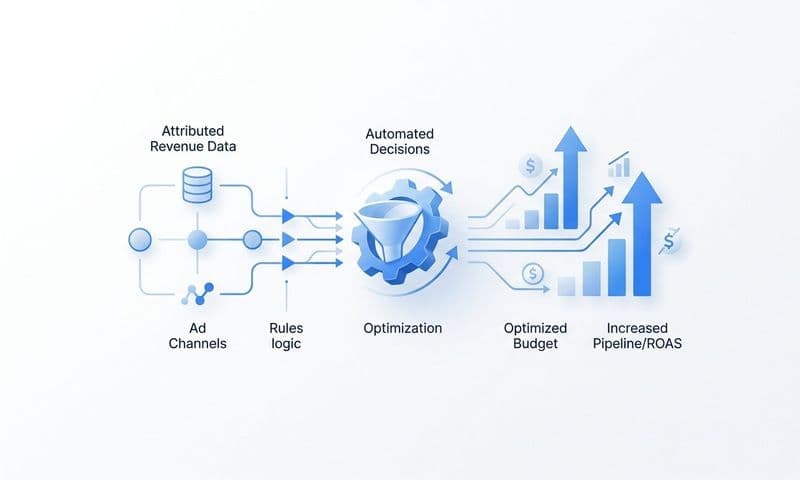
The final stage is where automation becomes optimization. Your system doesn't just execute workflows—it learns from results and adjusts automatically. Campaigns that drive revenue get more resources. Sequences that generate engagement but not conversions get refined or paused. Budget flows toward channels and messages that your attribution data proves are working. This is where marketing automation transforms from a productivity tool into a growth engine.
But here's the critical piece: this progression only works if you're measuring accurately from the start. Automation built on flawed data just scales your mistakes efficiently. You need to know which touchpoints actually drive conversions before you automate and scale those activities. You need to see the complete customer journey before you build workflows that respond to partial information. You need attribution that connects every ad click, email open, and website visit to actual revenue outcomes.
This is why the most successful marketing teams don't just implement automation—they build attribution-first systems where accurate measurement informs every automated decision. They capture every touchpoint across channels. They use server-side tracking to close data gaps that client-side tracking misses. They feed enriched conversion data back to ad platforms so algorithms optimize based on real buying patterns. And they continuously refine their automation based on what their attribution data proves is working.
Marketing automation systems are powerful, but they're only as intelligent as the data feeding them. The difference between automation that saves time and automation that drives growth is the quality of your attribution infrastructure. Get the measurement right first, then automate with confidence.
Ready to elevate your marketing game with precision and confidence? Discover how Cometly's AI-driven recommendations can transform your ad strategy—Get your free demo today and start capturing every touchpoint to maximize your conversions.