To really understand if your marketing is working, you first have to decide what “working” actually means. That starts with setting clear, business-focused goals and then choosing the right Key Performance Indicators (KPIs)—like Customer Acquisition Cost (CAC) and Return on Ad Spend (ROAS)—to track your progress.
This initial step is all about making sure every dollar you spend is tied directly to real, tangible growth, not just surface-level buzz.
Setting a Clear Foundation for Campaign Measurement
Jumping into a marketing campaign without a clear definition of success is like setting sail without a map. Sure, you’ll be busy, but you'll have no idea if you're actually getting closer to your destination. Too many teams get caught up in the excitement of launching new ads, only to realize weeks later they have no real way to prove if their efforts made any difference.
The real power of measurement comes from the groundwork you lay before a single dollar is ever spent.
Before you get bogged down in the technicals of setting up tracking, it’s worth taking a step back to understand what it means to measure marketing campaign effectiveness. This isn't just about counting clicks and impressions; it's about drawing a straight line from your marketing actions to your business's bottom line.
Moving Beyond Vanity Metrics
The first, and maybe most important, step is to learn the difference between the metrics that make you feel good and the ones that actually drive your business forward. Vanity metrics, like social media likes or raw page views, are often misleading. They show activity, but they rarely correlate with revenue or customer growth.
Instead, your focus needs to be on actionable KPIs that tell a financial story. These are the numbers that get your leadership team’s attention and justify your budget.
Here’s what you should be obsessed with:
- Customer Acquisition Cost (CAC): This tells you exactly how much you're spending to get each new customer. It's the ultimate measure of marketing efficiency.
- Return on Ad Spend (ROAS): For every dollar you put into your ads, how many dollars in revenue are you getting back? This is non-negotiable for any paid campaign.
- Customer Lifetime Value (CLV): This metric helps you understand the long-term worth of a customer, which lets you make much smarter decisions about how much you can afford to spend to acquire them.
- Conversion Rate: This is the percentage of people who take the action you want them to, whether that’s making a purchase or signing up for a demo. It’s a direct signal of how well your messaging and user experience are working.
The goal is to create a direct line of sight between marketing activities and the company's balance sheet. When you can say, "We spent X on this campaign and generated Y in attributable revenue," you shift the conversation from marketing as a cost center to marketing as a growth engine.
To help clarify, here’s a quick breakdown of the metrics that matter versus those that just look good on a slide.
Essential KPIs vs. Vanity Metrics
Metric CategoryActionable KPI (Track This)Vanity Metric (Avoid Relying On This)AcquisitionCustomer Acquisition Cost (CAC)Raw Traffic/Page ViewsRevenueReturn on Ad Spend (ROAS)Social Media Likes/FollowersValueCustomer Lifetime Value (CLV)Email Open Rates (without clicks)EfficiencyConversion RateImpressions/Reach
Focusing on the "Actionable KPI" column ensures your reporting is always tied to business outcomes, which is what ultimately proves your value and secures more budget.
Mapping the Customer Journey
Knowing your KPIs is only half the battle. You also need to map out the entire customer journey to identify every single touchpoint that might influence a conversion. A customer rarely sees one ad and immediately buys; their path is often a winding road with multiple stops across different channels.
This journey might start with a social media ad, lead to a visit to your blog, then to an email newsletter signup, and finally, a click on a retargeting ad that leads to a purchase. Each of these steps is a critical touchpoint that needs to be tracked if you want a complete and accurate picture of what’s really driving sales.
Skipping this step is why so many marketers struggle with attribution—they only see the last click, not the full story. You can find more details in our complete guide on marketing effectiveness measurement.
Connecting spend directly to revenue is the clearest way to measure effectiveness, yet a surprising number of brands struggle with it. In 2023, global digital ad spend hit about $733 billion, meaning even small gains in efficiency can have a massive impact.
Despite 72% of marketing budgets now going to digital channels, a Nielsen report found that over half of global marketers (52%) still focus on basic metrics because they lack confidence in measuring holistic ROI. This gap highlights just how critical building a solid measurement foundation truly is.
Building Your Tracking and Attribution System
Once you've locked in your goals and KPIs, it's time to build the engine that actually captures the data. A solid tracking system is the absolute foundation for measuring anything. Without it, your goals are just wishful thinking because you'll be making decisions based on incomplete—or worse, just plain wrong—information.
The digital world today is actively hostile to old-school tracking. We're dealing with ad blockers, browser privacy updates like iOS 14+, and the slow death of cookies. All this creates massive "signal loss," where traditional tracking pixels just don't fire, leaving huge gaps in your data. It's why a more resilient approach isn't just nice to have; it's essential.
This flow shows how the foundational steps—defining KPIs, mapping the journey, and setting benchmarks—all feed directly into the tracking system you're about to build.
 How to Measure Marketing Campaign Effectiveness for Real Growth
Each piece builds on the last. This ensures your technical setup is perfectly aligned with your business goals from the get-go.
The Critical Shift to Server-Side Tracking
To fight back against signal loss, the sharpest marketing teams have already moved to server-side tracking. Instead of just hoping a user's browser sends conversion data to platforms like Meta or Google, events get sent from your website's server directly to the ad platform's server.
This method is infinitely more reliable. It bypasses browser settings and ad blockers, ensuring you capture a much, much higher percentage of your actual conversions. It’s the difference between guessing your performance and knowing it.
Putting this into practice means setting up your tracking pixels for the initial browser-side events, but then beefing them up with server-side events for your most important conversions. This dual approach gives you the most complete dataset possible.
Choosing the Right Attribution Model
Okay, so your tracking is capturing data accurately. Now what? The next big question is how you assign credit to all the different touchpoints that led to a sale. This is where attribution models come in, and the one you choose will completely change how you value each channel.
- First-Touch Attribution: Gives 100% of the credit to the very first interaction a customer had with you. It’s great for figuring out which channels are bringing new people into your world.
- Last-Touch Attribution: The complete opposite. This gives 100% of the credit to the final touchpoint before someone converted. It's simple and shows what closes the deal, but it ignores the entire journey that came before it.
- Linear Attribution: This model spreads the credit equally across every single touchpoint. It offers a more balanced view but can sometimes undervalue the really influential moments.
- Data-Driven Attribution: This is the most sophisticated model. It uses machine learning to analyze every converting and non-converting path, assigning credit based on how much each touchpoint actually contributed. It's the most accurate view, but also the most complex.
There is no single "best" model for everyone. The right choice depends on your sales cycle, business model, and how complex your customer journey is. An e-commerce brand with a short, impulse-buy cycle might be fine with last-touch. But a B2B SaaS company with a six-month sales cycle absolutely needs a multi-touch model to see the full picture.
Platforms like Cometly make this way less intimidating by letting you switch between models without needing a data science degree. You can instantly see how your ROAS changes when you look at it through a first-touch lens versus a linear one, helping you make smarter, more nuanced budget decisions.
Unifying Your Data for a Single Source of Truth
The biggest headache in measuring marketing is almost always data fragmentation. Your Google Ads data is in one dashboard, your Meta Ads data is in another, and your CRM data is somewhere else entirely. Trying to get a holistic view is next to impossible with this siloed approach.
The struggle is real. Research shows that only 23% of marketers feel they have the quality data needed to maximize their budgets. For performance marketers managing serious ad spend, unifying every touchpoint—from the first ad click to the final revenue in the CRM—into a single, real-time view is the only way to calculate true ROAS.
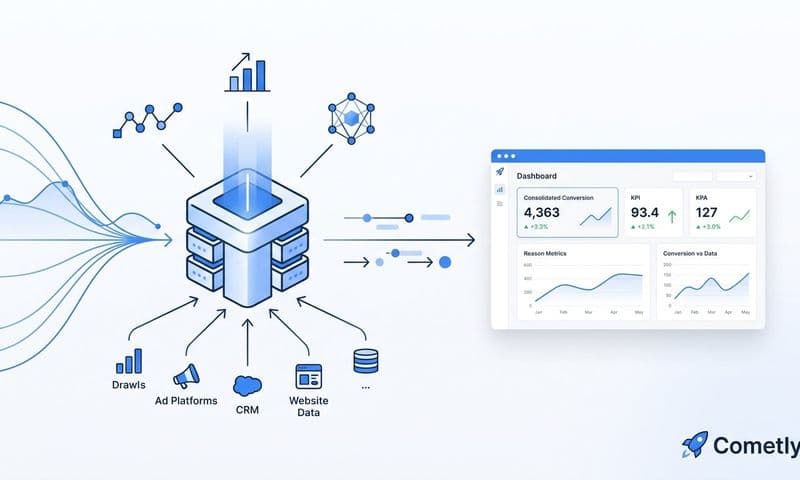
This is where a unified platform like Cometly becomes your single source of truth. It pulls in data from all your channels, de-duplicates conversions, and lays it all out in one cohesive dashboard.
Of course, none of this works without consistent tracking links. Understanding what UTMs are and how to use them is a non-negotiable skill for any marketer who's serious about attribution. These simple tags are the fundamental building blocks that allow any platform to correctly identify where your traffic is coming from.
How to Validate and Unify Your Campaign Data
Once your tracking infrastructure is in place, the real work begins: making sure the data you're collecting is actually trustworthy. I’ve seen it a hundred times—teams collect mountains of flawed data, which is often worse than having no data at all. It leads to terrible decisions and wasted ad spend. You need a rock-solid system to validate every stream and pull it all into one cohesive view.
This process always starts with a data audit. It’s incredibly common to see revenue figures in your Facebook Ads Manager that don't quite line up with what’s in your Shopify or Stripe account. These gaps pop up for all sorts of reasons—duplicate conversions, mismatched attribution windows, or signal loss—and create a confusing, unreliable picture of performance.
 How to Measure Marketing Campaign Effectiveness for Real Growth
Conducting a Data Audit
First things first, create a simple checklist to compare data across your platforms for a specific time period. The goal here is to spot inconsistencies early and figure out the root cause before you start making strategic calls based on faulty numbers.
Your audit should dig into these common problem areas:
- Duplicate Conversions: Check if a single purchase is being counted multiple times. This happens a lot if someone refreshes a thank-you page. It can artificially inflate your ROAS and trick you into scaling a campaign that isn't truly profitable.
- Mismatched Revenue: Compare the total revenue reported in your ad platforms against your actual payment processor data. They'll rarely match perfectly, but big differences are a red flag for tracking failures.
- Missing UTM Parameters: Make sure all your ad links are properly tagged with UTMs. Any gaps here create "dark traffic" that you can't attribute to a specific campaign, making it impossible to accurately measure marketing campaign effectiveness.
Think of your data like a supply chain. A problem at any single point—from the initial click to the final sale confirmation—can corrupt the entire end-to-end process. Regular audits are your quality control, ensuring the insights you rely on are built on a solid foundation.
The Power of Data Normalization
Once you’ve sniffed out the issues, the next step is data normalization. This is just a fancy way of saying you need to standardize your data so it’s consistent across all channels. For instance, you might have one platform that labels a channel "Facebook" while another calls it "meta." Normalization ensures both are treated as the same source in your reports.
This consistency is what makes your reports actually make sense. Without it, you'll burn countless hours manually cleaning up spreadsheets and trying to reconcile conflicting information. A unified platform like Cometly handles this for you, connecting to your various data sources and standardizing the information as it flows in.
Unifying Disparate Data Sources
Ultimately, the goal is to tear down the data silos. Your marketing data lives all over the place—Google Ads, Meta, TikTok, Shopify, Stripe, your CRM—and each one only tells a small piece of the story. To see the full picture, you have to bring them all together.
Here’s a classic example: a customer might click a TikTok ad, browse your site, and then convert three days later from a Google retargeting ad. Without a unified view, both platforms might take full credit for that sale. A centralized system de-duplicates these events and shows you the entire customer journey, as it actually happened.
This kind of integration eliminates the painful, time-sucking process of exporting CSVs and wrestling with pivot tables. Instead, you get a real-time, holistic dashboard that serves as your single source of truth. By connecting everything from ad spend to final revenue, you can finally measure true performance with confidence.
For those looking to go deeper on this, our guide on data integration best practices provides a detailed roadmap for connecting your tools the right way.
Analyzing Performance and Crafting Actionable Reports
Once your data is clean and unified, the real work begins. This is where you graduate from just collecting numbers to actually uncovering game-changing insights. It’s the part where raw data points get woven into a compelling story that answers critical business questions and tells you exactly what to do next.
Think of it this way: your analysis and reporting framework is the bridge between what happened and what you should do about it. The goal isn't just to build a pretty dashboard; it's to create a decision-making engine that fuels growth.
 How to Measure Marketing Campaign Effectiveness for Real Growth
From Data Points to Strategic Narratives
First things first: you have to segment your data to see what’s really going on. Looking at campaign-wide averages is one of the most misleading things you can do. A campaign with a mediocre 2.5 ROAS might actually contain a hyper-profitable segment crushing it at an 8.0 ROAS while another segment is just burning cash and dragging the average down.
This is why segmentation is absolutely non-negotiable if you're serious about measuring campaign effectiveness.
Start by slicing your data across these key dimensions:
- By Channel: See how Google, Meta, TikTok, and email stack up. Where are your most valuable customers really coming from?
- By Campaign: Drill down into specific initiatives. Is your "Black Friday" campaign actually outperforming your "Summer Sale" on a cost-per-acquisition basis?
- By Audience: Analyze how different customer segments perform. Do new customers from lookalike audiences have a higher lifetime value than those from interest-based targeting?
- By Creative: Pinpoint which ad visuals, headlines, and calls-to-action are hitting the mark. Sometimes, a simple creative swap can double your conversion rate.
This level of detail shows you what’s truly working, allowing you to double down on your winners and cut your losses fast.
Unlocking Long-Term Value with Cohort Analysis
While immediate ROAS gets all the attention, the most sophisticated marketers are playing the long game with profitability. This is where cohort analysis becomes your secret weapon. A cohort is just a group of customers acquired during the same time period, like "January Signups" or "Q2 Buyers."
By tracking these groups over time, you can answer critical questions about customer lifetime value (CLV). For example, you might find that customers acquired through organic search in January have a 30% higher CLV after six months compared to customers from paid social during the same period.
We break down the leading options in our paid media tracking platform guide.
This insight is pure gold. It tells you that even if the initial CAC for organic is higher, the long-term payback is far greater. This knowledge empowers you to invest confidently in channels that build sustainable growth, not just short-term wins.
This approach shifts your focus from one-off sales to building lasting customer relationships. It’s a much more mature way to measure marketing campaign effectiveness that aligns directly with the overall health of the business.
Building Reports That Actually Drive Action
The final piece of the puzzle is presenting your findings in a way that’s clear, concise, and impossible to ignore. Ditch the cluttered spreadsheets and 50-page slide decks. Your reports should tell a story that even a non-marketer can understand instantly.
A simple, well-structured report is your best tool for getting buy-in. Here’s a basic template you can adapt for your weekly or monthly reporting needs.
Campaign Performance Report Template
This table provides a simple yet effective structure for a monthly campaign performance report. It's designed to give stakeholders a quick overview while providing the necessary context and actionable next steps.
Executive Summary should give a high-level snapshot of performance using metrics like total spend, total revenue, overall ROAS, and new customers. For example, you could say: “This month, we invested $50k to generate $200k in revenue, achieving a 4.0 ROAS. We successfully acquired 1,200 new customers at a CAC of $41.67.” This section is designed to instantly communicate the business outcome and whether performance is trending in the right direction.
Channel Performance breaks down results by channel using metrics like spend, ROAS, CPA, and conversion rate (CVR) for each platform. A clear insight might look like: “Google Ads delivered the highest ROAS (5.5), while TikTok had the lowest CPA ($35). Meta drove the most volume but with a lower ROAS (3.2).” This section helps you understand which channels are driving profitability, which are driving volume, and where budget adjustments should happen.
Top Performing Campaigns highlights the best-performing campaigns, typically the top three by revenue and ROAS. A strong example would be: “The ‘Winter Collection Launch’ campaign was our top performer, generating $75k in revenue at a 6.2 ROAS, driven primarily by our retargeting efforts.” This section helps you identify what’s working so you can scale it, replicate it, and learn from it.
Key Learnings & Next Steps turns the data into action by summarizing the biggest takeaways and outlining what you’ll change next. For example: “Based on performance, we will shift 15% of our budget from Meta prospecting to Google Shopping and test new creatives for our underperforming audiences.” This section is where reporting becomes useful, because it translates insights into specific decisions that improve results in the next cycle.
This simple format moves beyond just reporting data; it provides interpretation and outlines a clear path forward. If you want to dive deeper, you can find more inspiration in our guide on building the perfect marketing performance dashboard.
Ultimately, great reporting closes the loop, turning your past performance data into a roadmap for future success.
Turning Data-Driven Insights Into Campaign Optimizations
Collecting and analyzing data is only half the battle. Let's be honest, measurement without action is just expensive trivia. The real value—the part that actually grows your business—kicks in when you use those clean, unified insights to make tangible improvements to your campaigns.
This is where the top-performing teams pull away from the pack. They build a systematic feedback loop where data directly fuels smarter decisions. It's not about guesswork or gut feelings; it's a repeatable workflow for testing, learning, and iterating over and over again. After you've done the hard work of analyzing your data, the next move is to put those insights to work, especially through effective post-campaign optimization for influencer initiatives and other channel-specific strategies.
Creating a Systematic Testing Framework
At the heart of any solid optimization workflow is methodical testing. Instead of making random changes and just hoping for the best, you need to isolate variables and test specific hypotheses that are grounded in your performance data. This is how you systematically chip away at inefficiencies and drive better results over time.
A good testing framework usually involves a few key experiments:
- Ad Creative Testing: Your data shows a high click-through rate (CTR) but a pitiful conversion rate. What does that tell you? The ad is grabbing attention, but the offer isn't landing. Time to test a different call-to-action (CTA) or maybe highlight a completely different product benefit.
- Landing Page A/B Testing: Maybe your ad is a masterpiece, but the landing page is where everyone drops off. In that case, you could A/B test a new headline, simplify the lead form, or swap out the hero image to see what keeps more people on the page and clicking "buy."
- Audience Targeting Refinement: Your analysis might uncover that a specific demographic—let's say, women aged 35-44—is delivering a much higher ROAS. That’s a massive signal. The next logical step is to create a dedicated campaign targeting that exact segment with messaging tailored just for them.
Don't underestimate on-site changes. Data shows that 74% of CRO programs report increased sales, and personalized calls-to-action can convert a staggering 42–202% better than generic ones. Yet, a shockingly low 17% of marketers actually use landing page A/B tests to improve conversions. That's a huge performance gap just waiting to be closed by anyone willing to use their data to fuel these high-impact tests.
Allocating Budgets with Confidence
One of the most powerful moves you can make with good data is reallocating your budget. When you have a unified attribution platform, you're no longer guessing which channels or campaigns deserve more of your investment. The numbers tell you exactly where to put your money for the best returns.
This is about shifting from a "set it and forget it" budget to a dynamic, performance-based allocation. When your data is trustworthy, you can confidently move spend from underperforming campaigns to your proven winners in real-time, maximizing your overall ROI without spending a penny more.
Imagine you're spending $1,000/day across two campaigns. Campaign A has a ROAS of 2.1, while Campaign B is absolutely crushing it with a ROAS of 5.8. The decision becomes dead simple: scale back Campaign A and funnel that budget directly into Campaign B to amplify what’s already working.
Platforms like Cometly make this even easier by syncing conversion data back to the ad platforms themselves, which helps their algorithms find more people who look just like your best customers.
Building a Continuous Feedback Loop
The ultimate goal here is to create a self-improving marketing engine. This happens when your data doesn't just inform one-off decisions but becomes part of a continuous feedback loop.
It's a cycle: campaign performance data leads to insights, those insights fuel optimization tests, and the results from those tests generate new data. Lather, rinse, repeat.
Modern tools accelerate this cycle dramatically. Instead of waiting weeks for a report, you get real-time insights that allow for nimble, on-the-fly adjustments. You can find a ton of great ideas in our guide on conversion optimisation strategies.
This creates a workflow where data-driven optimization isn't some quarterly project; it's a daily habit. And that habit compounds over time, steadily improving your ability to measure marketing campaign effectiveness and drive real, sustainable growth.
Answering Your Top Campaign Measurement Questions
Even with a solid framework in place, you’re bound to run into a few tricky questions when you start measuring campaign effectiveness. Let's tackle some of the most common stumbling blocks we see marketers face every day.
Think of this as your field guide for navigating those frustrating "why doesn't this match?" moments.
What Is the Best Attribution Model to Use?
This is the million-dollar question, and the honest-to-goodness answer is: it depends entirely on your business. There’s no single "best" model that fits every single company. The right choice really hinges on how complex your customer journey is.
- Short Sales Cycles: If you're an e-commerce brand selling products that are often impulse buys, a simple last-touch model is probably all you need. It tells you exactly what closed the deal.
- Long Sales Cycles: For B2B companies or anyone selling high-ticket items, the journey is much longer. A multi-touch model like linear or time-decay gives you a more balanced and realistic view of what influenced the final purchase.
- Data-Rich Environments: A data-driven model is the most accurate, using algorithms to assign credit based on actual influence. But be warned, it needs a serious amount of conversion data to work its magic.
My advice? Start with the model that best reflects your typical sales cycle. You can always get more sophisticated as your data and understanding grow. Don't overcomplicate it from day one.
How Often Should I Review My Campaign Performance?
The ideal review cadence is all about matching the pace and budget of your campaigns. A one-size-fits-all schedule just doesn't work here.
For high-spend, fast-moving paid media campaigns on platforms like Meta or Google, daily or at least weekly check-ins are essential. This is your chance to spot issues, identify winning ads, and move budget around before you waste a significant amount of money.
On the other hand, for longer-term strategies like SEO or organic content marketing, a monthly or quarterly review makes way more sense. These channels build momentum over time, so checking daily won't show you anything meaningful. The key is to find a rhythm that aligns with the channel's natural pace.
Why Do My Ad Platform and Analytics Data Not Match?
Ah, the classic headache. This is an incredibly common and frustrating problem for marketers. The discrepancy almost always boils down to differences in tracking methods, attribution windows, and the signal loss we talked about earlier.
Ad platforms are notorious for taking more credit than they deserve. They often use longer attribution windows and count "view-through" conversions, which naturally inflates their own performance numbers. Your website analytics, meanwhile, might be using a completely different model.
The only real solution is to establish a single source of truth. Rely on a dedicated, third-party attribution tool that uses server-side tracking to unify and de-duplicate your data. Use this platform for strategic decisions, and use the ad platform data for in-platform optimizations like ad delivery.
What Are the First Steps if My Tracking Is a Mess?
If your data feels like a tangled web of contradictions, don't panic. The absolute worst thing you can do is keep making decisions based on flawed information. It's far better to pause, fix the foundation, and restart with clean data.
- Conduct a Data Audit: First things first, map out every tracking tool and pixel you're currently using. Compare reports for the same time period and pinpoint exactly where the biggest discrepancies are.
- Define Primary Conversions: Go back to basics. What are the one or two conversion events that truly matter to your business? Forget everything else for a moment and focus on getting the tracking for these right.
- Implement a Centralized Solution: It's time to set up a unified tracking platform with server-side capabilities. This will become your reliable source of truth, cleaning up the mess and giving you the confidence to measure performance accurately from now on.
Ready to eliminate data discrepancies and get a crystal-clear view of your campaign performance? Cometly unifies all your marketing data into a single source of truth, providing accurate attribution so you can scale what works and stop wasting ad spend. See for yourself how it can transform your measurement strategy at https://www.cometly.com.