

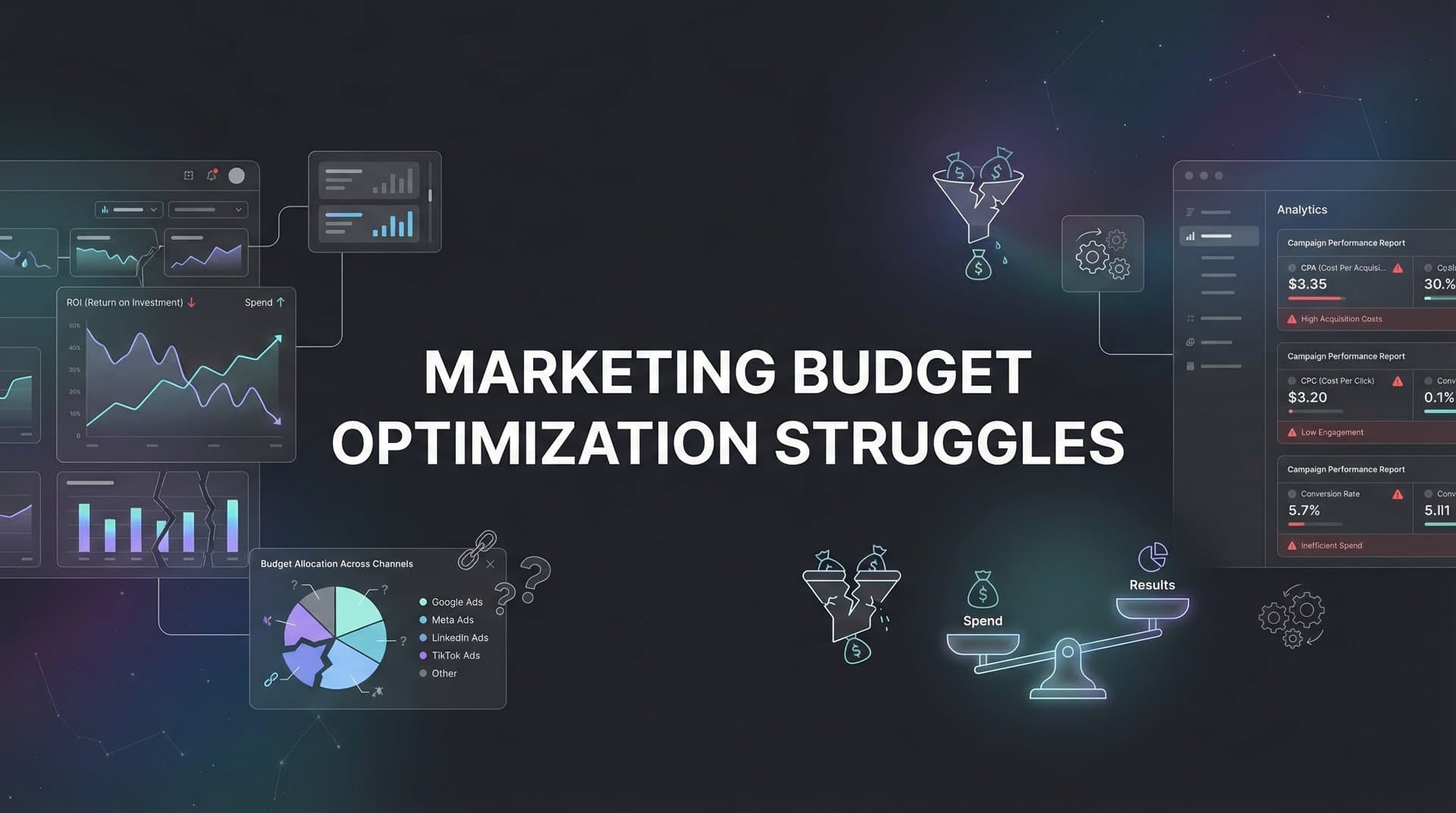
You've just walked out of another leadership meeting where the CMO asked the same question: "Which channels should we invest more in?" You pulled up your spreadsheets, toggled between five different dashboards, and gave an answer that felt more like an educated guess than a confident recommendation. Sound familiar?
Most marketing teams aren't struggling with budget optimization because they lack talent or effort. They're struggling because they're trying to make million-dollar decisions with incomplete, conflicting data scattered across platforms that don't talk to each other. When Google Ads claims credit for 500 conversions, Meta reports 450, and your CRM shows 300, how do you confidently decide where to allocate next quarter's budget?
This article breaks down the root causes of marketing budget optimization struggles and provides actionable strategies to transform your approach from reactive guesswork into confident, data-driven decision-making.
The Data Fragmentation Problem That Haunts Marketing Teams
Picture this: You open Google Ads and see a 4.2x ROAS. You switch to Meta Ads Manager and find a 3.8x ROAS. Your analytics platform shows different conversion numbers than either ad platform. Your CRM attributes revenue to sources that don't match any of the above. Each system is telling you a different story about what's working.
This is the reality for most marketing teams. Every platform operates in its own silo, tracking conversions through its own lens, using its own attribution methodology. Google wants to prove Google works. Meta wants to prove Meta works. Your analytics platform is trying to piece together a story from incomplete data.
The problem compounds when you try to make budget decisions. If you're managing campaigns across Meta, Google, TikTok, LinkedIn, and maybe a few other channels, you're juggling five different reporting interfaces, each with its own metrics, dashboards, and conversion tracking methods. There's no single source of truth, which is why understanding marketing budget allocation across channels becomes so critical.
Many teams default to spreadsheet-based budget management. You export data from each platform, manually reconcile the numbers, calculate some averages, and make your best judgment call. By the time you've compiled everything, the data is already outdated. Markets shift, campaign performance changes, and you're making decisions based on last week's reality.
The fragmentation creates another insidious problem: you can't see the complete customer journey. A prospect might discover your brand through a TikTok ad, research you via a Google search, engage with a Meta retargeting campaign, and finally convert through a LinkedIn ad. Which channel deserves credit? Which one should get more budget?
Without unified tracking that connects these touchpoints, you're essentially flying blind. You might cut budget from awareness campaigns because they don't show direct conversions, not realizing they're feeding qualified traffic to your bottom-funnel campaigns. You might double down on last-click channels while starving the upper-funnel activities that actually generate demand.
The reactive nature of spreadsheet-based optimization means you're always looking backward. You notice a trend, investigate it, discuss it in meetings, and implement changes days or weeks after the opportunity window has passed. Meanwhile, your competitors with real-time unified data are shifting budgets dynamically, capturing opportunities while they're hot.
Attribution Blind Spots That Drain Your Budget
Even if you could consolidate all your platform data perfectly, there's a bigger problem: much of that data is incomplete or inaccurate. Privacy changes have fundamentally altered how marketing tracking works, and most teams are still operating with significant blind spots.
iOS App Tracking Transparency hit the marketing world like a freight train. When Apple gave users the ability to opt out of cross-app tracking, the majority did exactly that. Suddenly, pixel-based tracking—the foundation of digital marketing attribution—started missing huge chunks of conversions. The ads were still working, but platforms couldn't see the full picture anymore.
Browser cookie restrictions compound the issue. Safari's Intelligent Tracking Prevention, Firefox's Enhanced Tracking Protection, and Chrome's evolving privacy features all limit how long tracking cookies persist and how they can be used. A customer who takes a week to make a purchase decision might not be trackable back to the original ad that introduced them to your brand.
These tracking limitations create a dangerous scenario: your data shows declining performance, but it's often measurement decline, not actual performance decline. Teams respond by cutting budgets from campaigns that appear to be underperforming, when in reality those campaigns are working—you just can't see it anymore. This is one of the core attribution challenges in marketing analytics that teams must overcome.
The attribution blind spots particularly hurt awareness and consideration campaigns. A prospect sees your brand awareness campaign, doesn't click immediately, but searches for your brand a few days later and converts through a Google search ad. Traditional tracking gives all the credit to the search ad. The awareness campaign that actually generated the demand gets zero credit and looks like a budget drain.
This creates a vicious cycle. You cut budget from upper-funnel campaigns because they don't show direct conversions. Your bottom-funnel campaigns start seeing higher costs and lower quality traffic because the awareness pipeline has dried up. You respond by increasing bottom-funnel budgets to compensate, further starving the demand generation that feeds your entire funnel.
Many teams still rely on last-click attribution because it's the default in most platforms. It's simple to understand: the last thing someone clicked before converting gets the credit. But this methodology systematically overvalues bottom-funnel touchpoints and undervalues everything that happened earlier in the journey.
The hidden cost is enormous. You're potentially spending thousands on channels that look effective in last-click attribution but are actually just capturing demand created by other campaigns. Meanwhile, the campaigns actually generating new demand appear inefficient and get their budgets slashed.
Cross-Channel Complexity: When More Platforms Means Less Clarity
The more channels you run, the harder budget optimization becomes. It's not a linear increase in complexity—it's exponential. Managing three channels isn't three times harder than managing one; it's nine times harder because every channel interacts with every other channel.
Each platform has its own reporting dashboard with its own interface, metrics, and terminology. What Meta calls "conversions," Google might call "conversion actions." LinkedIn measures "leads" differently than TikTok. Comparing performance across platforms means translating between different languages and methodologies.
Platform-native reporting has an inherent bias: every platform wants to prove its value. They use attribution windows that maximize their claimed conversions. They report on metrics that make their performance look strongest. When you add up all the conversions each platform claims credit for, the total often exceeds your actual conversion count by 50% or more. This is why marketing budget allocation based on data requires unified measurement.
This overlap makes it nearly impossible to calculate true channel efficiency. If Meta and Google both claim credit for the same conversion, how do you determine which channel actually drove it? How do you calculate accurate cost-per-acquisition when the same acquisition is counted twice?
Campaign types add another layer of complexity. You're not just comparing Meta to Google—you're comparing Meta prospecting campaigns to Meta retargeting campaigns to Google Search to Google Display to TikTok video ads to LinkedIn sponsored content. Each has different objectives, different audience types, and different positions in the funnel.
Trying to create apples-to-apples comparisons across these campaign types is like trying to compare the ROI of your sales team to your customer service team. They serve different functions in the customer journey. A brand awareness video campaign should be measured differently than a retargeting campaign, but most reporting systems force you to evaluate them using the same metrics.
The cognitive load of managing this complexity is exhausting. Marketing teams spend hours each week just trying to understand what's happening, leaving less time for strategic optimization. You're constantly context-switching between platforms, trying to hold multiple mental models of performance in your head simultaneously.
Building a Foundation for Smarter Budget Decisions
Solving marketing budget optimization struggles starts with addressing the root cause: fragmented, incomplete data. You need a unified view of the customer journey that connects all your marketing touchpoints, regardless of which platform delivered them.
The first step is connecting your ad platforms, CRM, and website data into a single system that tracks the complete customer journey. This means implementing tracking that follows a prospect from their first brand interaction through every touchpoint to final conversion and beyond. When you can see that a customer interacted with three different campaigns across two platforms before converting, you can make intelligent decisions about which campaigns deserve credit and budget.
Server-side tracking has become essential for accurate measurement in the privacy-focused era. Instead of relying solely on browser-based pixels that can be blocked or limited, server-side tracking captures conversion events directly from your server to the tracking platform. This approach bypasses many of the limitations imposed by iOS changes and browser restrictions, giving you a more complete picture of actual performance.
The technical implementation matters. You need tracking that can capture events from your website, your CRM, your payment processor, and any other system where conversions happen. A prospect might fill out a form on your website, but the actual conversion happens days later when a sales rep closes the deal in your CRM. Your attribution system needs to connect those dots, which is why marketing attribution and optimization must work together seamlessly.
Multi-touch attribution models distribute credit across the customer journey instead of giving everything to the last click. A time-decay model might give 40% credit to the last touchpoint, 30% to the second-to-last, 20% to the third-to-last, and 10% to everything earlier. A linear model distributes credit equally across all touchpoints. Different models serve different purposes, but all of them provide more accurate insight than last-click attribution.
The key is having the flexibility to compare different attribution models. A campaign that looks weak in last-click attribution might show strong performance in a time-decay or first-click model. Understanding how your campaigns perform across different attribution lenses helps you make more nuanced budget decisions.
Data enrichment amplifies the value of your tracking. When you can attach customer lifetime value, revenue amount, product purchased, and other business metrics to each conversion, you move beyond simple conversion counting to true revenue attribution. You can see not just which campaigns drive the most conversions, but which campaigns drive the most valuable customers.
This foundation transforms budget optimization from guesswork into science. When you have accurate, unified data showing true channel contribution, you can confidently answer the question "where should we invest more?" with data instead of intuition.
From Struggle to Strategy: Practical Optimization Approaches
Once you have unified attribution in place, the actual process of budget optimization becomes dramatically simpler. Real-time visibility into cross-channel performance enables proactive decision-making instead of reactive firefighting.
With accurate attribution data, you can identify scaling opportunities as they emerge. You notice that your TikTok campaigns are generating high-quality leads at 30% below target CPA. Instead of waiting until next week's budget meeting, you can shift budget from underperforming channels to TikTok immediately, capturing the opportunity while it's hot. Implementing real-time marketing budget allocation strategies makes this kind of agility possible.
AI-powered recommendations take this a step further by analyzing patterns across all your campaigns and surfacing optimization opportunities you might miss manually. The AI might notice that campaigns targeting a specific demographic are consistently outperforming, or that certain ad creative themes drive higher conversion rates, or that budget reallocation between two campaigns could improve overall efficiency by 15%.
These recommendations work because they're based on complete data across your entire marketing ecosystem. Human marketers are excellent at strategic thinking and creative problem-solving, but we're not great at simultaneously analyzing performance patterns across dozens of campaigns, hundreds of ad sets, and thousands of individual ads. Leveraging an AI marketing optimization tool excels at exactly this type of pattern recognition.
The most sophisticated optimization approach involves feeding enriched conversion data back to ad platforms. Meta's algorithm and Google's algorithm are incredibly powerful at finding and converting your ideal customers—but only if you give them accurate signals to learn from. When you send back complete, accurate conversion data including revenue amounts and customer quality indicators, the platform algorithms get smarter at finding similar high-value customers.
This creates a virtuous cycle. Better tracking leads to better data. Better data improves platform optimization. Better platform optimization improves campaign performance. Improved performance generates more conversions to learn from. The cycle compounds over time, with each iteration making your campaigns more efficient.
Budget optimization becomes less about manual spreadsheet management and more about strategic decision-making. You're not spending hours reconciling data—you're spending that time analyzing trends, testing hypotheses, and developing creative strategies. The tactical optimization happens automatically or with minimal input, freeing you to focus on higher-level strategy.
Your Budget Optimization Action Plan
Transforming your budget optimization process doesn't happen overnight, but you can start making progress immediately by addressing the right issues in the right order.
Start by auditing your current attribution setup. Ask yourself: Can I see the complete customer journey from first touch to conversion? Do I know which campaigns are actually generating demand versus which are just capturing existing demand? Can I reconcile conversion numbers across all my platforms? If the answer to any of these questions is no, that's your starting point.
Prioritize foundational improvements over quick fixes. It's tempting to focus on tactical optimizations—adjusting bids, testing new ad creative, trying a new platform. These can help, but they're building on a shaky foundation if your underlying data and attribution are flawed. Fix the foundation first, then the tactical optimizations become much more effective. A dedicated marketing budget optimization platform can accelerate this process significantly.
Quick wins might include implementing server-side tracking for your most important conversion events, connecting your CRM to your ad platforms to close the attribution loop, or switching from last-click to a multi-touch attribution model in your analysis. These changes can provide immediate improvements in data accuracy and decision quality.
Move from reactive to proactive budget management by setting up real-time dashboards that show cross-channel performance in a unified view. Instead of discovering problems during weekly reporting meetings, you see them as they develop and can respond immediately. Instead of reallocating budgets based on last week's data, you're making decisions based on current performance.
Build confidence in your budget decisions by testing and validating your attribution model. Run holdout tests where you intentionally pause certain campaigns and measure the downstream impact. Compare your attributed conversions to actual revenue. The more you validate your attribution model, the more confidently you can make budget decisions based on it.
Making Budget Optimization Work for You
Marketing budget optimization struggles don't stem from lack of effort or expertise. They stem from trying to make complex decisions with incomplete, fragmented data. You're not failing at optimization—you're succeeding despite working with broken tools and limited visibility.
The solution isn't working harder or hiring more analysts. It's fixing the foundational data and attribution issues that make optimization difficult in the first place. When you can see the complete customer journey, track accurate conversions despite privacy changes, and understand true channel contribution, budget optimization transforms from a struggle into a strategic advantage.
Teams that solve these foundational issues don't just optimize better—they move faster, scale more confidently, and consistently outperform competitors who are still operating with fragmented data. They shift from defensive budget management to offensive growth strategies because they know what's working and can double down with confidence.
The gap between teams struggling with budget optimization and teams excelling at it isn't talent or budget size. It's data infrastructure and attribution accuracy. Close that gap, and everything else becomes easier.
Ready to elevate your marketing game with precision and confidence? Discover how Cometly's AI-driven recommendations can transform your ad strategy—Get your free demo today and start capturing every touchpoint to maximize your conversions.


