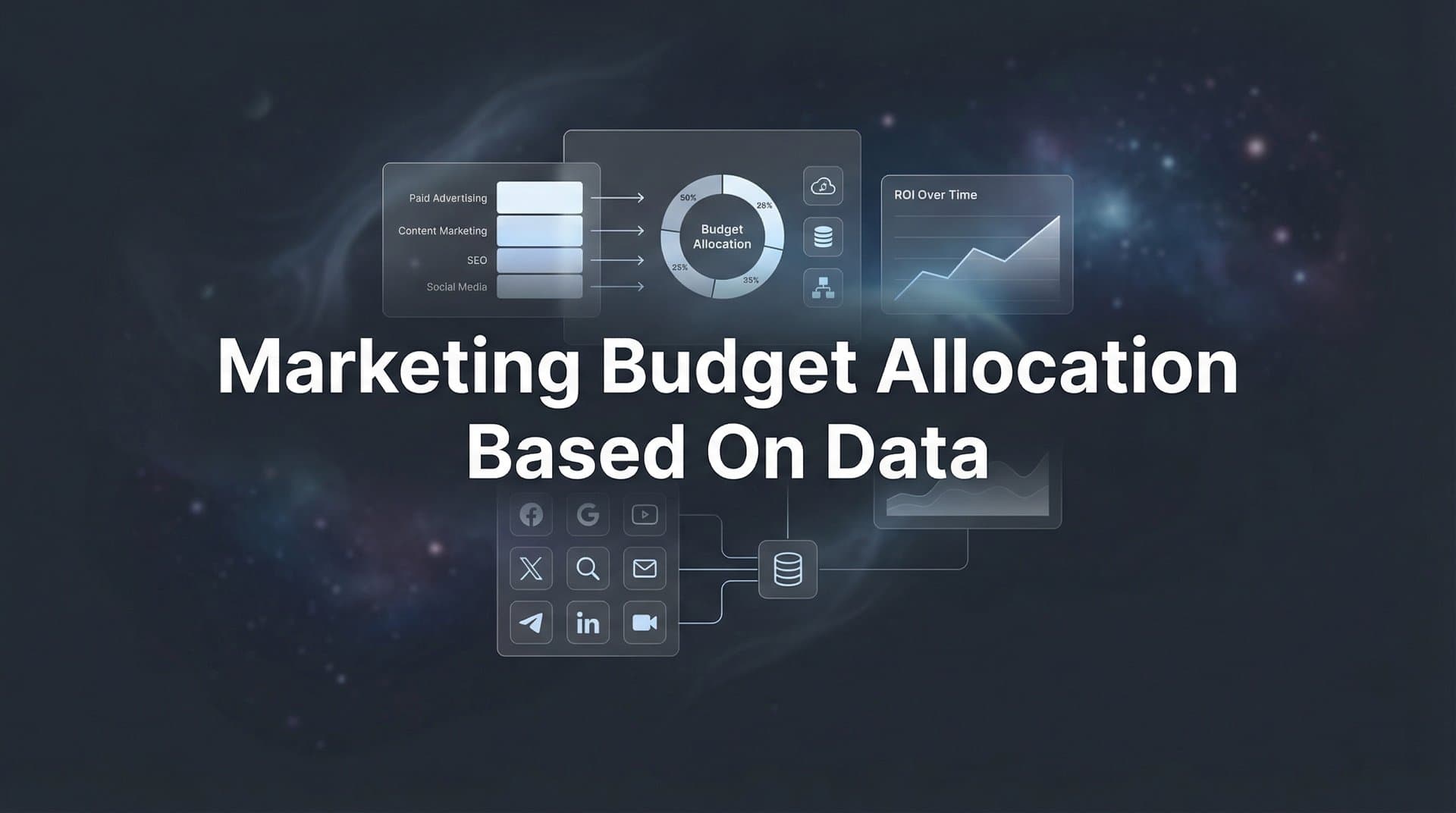
Most marketing teams still allocate budgets based on gut feelings, historical precedent, or whoever argues loudest in the meeting room. The result? Money flows to channels that look busy but don't actually drive revenue.
Data-driven budget allocation flips this approach—letting actual performance metrics guide where every dollar goes.
This guide walks you through a practical process for shifting from intuition-based budgeting to allocation decisions backed by real attribution data. You'll learn how to audit your current spend, establish the right tracking foundation, analyze true channel performance, and build a reallocation framework you can use quarter after quarter.
Whether you're managing a $10K monthly budget or $500K, these steps work the same way. The difference between successful marketers and those burning cash isn't the size of their budget—it's how precisely they can connect spend to outcomes.
Step 1: Audit Your Current Budget Distribution and Performance Gaps
Before you can reallocate intelligently, you need a clear picture of where your money currently goes and what you're actually getting for it.
Start by pulling the last 90 days of spend data from every marketing channel you're running. This includes paid search, social ads, display campaigns, content promotion, email tools, SEO investments, and any other marketing expenses. Export this data into a single spreadsheet or dashboard where you can see everything side by side.
The 90-day window gives you enough data to spot patterns while remaining recent enough to reflect current market conditions. Shorter timeframes get distorted by weekly fluctuations, while longer periods might include outdated strategies you've already changed.
Next, calculate your current cost-per-acquisition and return on ad spend for each channel using the conversion data each platform reports. Write these numbers down even if you suspect they're inaccurate—you'll need this baseline to measure improvement later.
Here's where it gets revealing: Compare where your budget actually goes versus where your conversions come from. Many marketing teams discover they're spending heavily on channels that generate impressive click volumes but minimal actual conversions.
Create a simple two-column comparison. Column one shows budget allocation by percentage. Column two shows conversion contribution by percentage. The gaps between these columns reveal your opportunities.
For example, you might find that paid social receives 40% of your budget but only delivers 15% of conversions. Meanwhile, paid search gets 25% of budget but drives 45% of conversions. These misalignments show exactly where reallocation will have immediate impact.
Document which channels lack proper tracking entirely. You'll often discover that some marketing efforts—particularly offline channels, certain content campaigns, or partner marketing—have no conversion tracking at all. These blind spots prevent accurate budget decisions and need addressing in Step 2.
Pay special attention to channels where the platform-reported conversions seem suspiciously high compared to your actual sales data. This discrepancy usually indicates attribution inflation, where platforms claim credit for conversions they didn't actually drive. Understanding marketing data accuracy improvement methods becomes essential for identifying these discrepancies.
By the end of this audit, you should have a clear spreadsheet showing current spend, platform-reported performance, and identified tracking gaps. This becomes your baseline for measuring progress as you implement the remaining steps.
Step 2: Establish Unified Tracking Across All Marketing Touchpoints
Accurate budget allocation requires accurate data. If your tracking foundation is weak, every decision you make will be built on quicksand.
The first priority is connecting your ad platforms, website analytics, and CRM into a single attribution system. When these systems operate in isolation, you get three different versions of the truth—and none of them complete. This is a common issue known as the marketing data silos problem that undermines decision-making.
Most marketing teams rely exclusively on browser-based tracking through pixels and cookies. This approach has become increasingly unreliable as privacy regulations tighten, browsers block third-party cookies, and users adopt ad blockers.
Server-side tracking solves this problem: Instead of relying on browser pixels that can be blocked or deleted, server-side tracking captures conversion data directly from your server to the advertising platforms. This method provides more accurate data and survives the privacy changes that break traditional tracking.
Implementing server-side tracking typically involves integrating your CRM or backend systems with your advertising platforms through an attribution tool. When a conversion happens in your CRM, the data flows directly to your ad platforms without depending on browser cookies.
Next, audit your conversion events. Many marketers track vanity metrics like form submissions or content downloads without connecting these events to actual revenue. Set up conversion events that track real business outcomes—completed purchases, signed contracts, qualified sales opportunities, or whatever represents actual value in your business model.
This means going beyond the standard "thank you page" tracking. Connect your attribution system to your CRM or sales database so you can track which marketing touchpoints led to closed revenue, not just initial interest.
For e-commerce businesses, this might mean tracking completed purchases with actual order values. For B2B companies, it means tracking qualified opportunities that enter your sales pipeline and eventually close as customers.
Once your tracking is in place, verify its accuracy by comparing your attribution data against actual sales records. Pull a report showing attributed conversions from your tracking system, then compare it to your actual customer list from your CRM or order management system.
The numbers should match closely. If your attribution system shows 200 conversions but your CRM only shows 150 new customers, you have a tracking problem that needs fixing before you make budget decisions.
This verification step catches common issues like duplicate conversion tracking, test transactions being counted as real sales, or conversions firing on the wrong page. Fix these problems now, because inaccurate tracking leads to inaccurate budget allocation.
With unified tracking established, you now have a foundation for understanding which marketing efforts actually drive results. Every channel feeds data into the same system, giving you a complete view of the customer journey from first click to final purchase.
Step 3: Analyze True Channel Performance Using Multi-Touch Attribution
Last-click attribution gives all the credit to whichever channel a customer touched right before converting. This approach systematically undervalues channels that initiate customer journeys and overvalues channels that simply happen to be present at the end.
Multi-touch attribution reveals the complete picture by showing every touchpoint in a customer's journey and distributing credit appropriately across all contributing channels.
Think of it like a relay race. Last-click attribution gives all the credit to the anchor leg runner, ignoring the three runners who got the team into position to win. Multi-touch attribution recognizes that all four runners contributed to the victory.
Start by examining your customer journey data: Look at the typical path customers take from first awareness to final conversion. You'll often discover that customers interact with multiple channels before buying—perhaps they first discover you through paid social, return via organic search, engage with email content, and finally convert through a paid search ad.
Identify which channels typically initiate customer journeys versus which channels close deals. Some marketing efforts excel at generating initial awareness and interest, while others work better at converting people who are already familiar with your brand.
For example, paid social and display advertising often introduce new audiences to your brand but show weak last-click conversion numbers. Meanwhile, branded search and retargeting campaigns show strong last-click conversions because they target people already aware of your company.
Under last-click attribution, you might conclude that paid social performs poorly and branded search performs excellently. Multi-touch attribution reveals that paid social is actually driving the initial awareness that makes those branded search conversions possible. Learning to navigate attribution challenges in marketing analytics helps you avoid these common misinterpretations.
Calculate true customer acquisition cost by accounting for all touchpoints in the conversion path. Add up the total marketing spend across all channels that contributed to a conversion, then divide by the number of conversions. This gives you a more accurate CAC than looking at individual channels in isolation.
This analysis often reveals that your actual CAC is higher than you thought—because you weren't accounting for all the marketing touches required to generate a conversion. Better to know the real number and make informed decisions than to operate on incomplete data.
Look specifically for channels that appear underperforming in last-click reports but actually assist many conversions. These are your hidden value channels—marketing efforts that deserve continued investment even though they don't get credit in traditional attribution models.
Content marketing, awareness-stage paid social, and educational email campaigns often fall into this category. They rarely get last-click credit, but they play crucial roles in moving prospects through your funnel.
With multi-touch attribution data in hand, you can now make budget decisions based on actual contribution rather than arbitrary credit assignment. Channels that initiate valuable customer journeys deserve appropriate budget, even if they don't close deals directly.
Step 4: Build Your Reallocation Framework with Clear Decision Rules
Data without a decision framework is just interesting information. You need clear rules that translate performance data into specific budget actions.
Start by setting performance thresholds that automatically trigger budget increases or decreases. These thresholds remove emotion from budget decisions and create consistency across your marketing team.
For example, you might establish a rule that any channel achieving a ROAS above 4:1 for two consecutive months receives a 20% budget increase. Conversely, channels falling below 2:1 ROAS for two months get a 20% budget decrease.
The specific numbers depend on your business economics, but the principle remains the same—define clear triggers that tell you when to scale, when to hold steady, and when to cut back. Reviewing marketing budget allocation best practices can help you establish appropriate thresholds for your industry.
Create a tiered system for different channel maturity levels: Winning channels with proven performance get aggressive scaling. Uncertain channels still in testing phase get stable budgets and close monitoring. Consistent losers get budget cuts or elimination.
This tiered approach prevents you from killing potentially valuable channels too quickly while also protecting you from throwing good money after bad. Not every channel will be a winner, but some need adequate testing time before you can make that determination.
Establish minimum viable budgets for channels in testing phase. Some marketing channels require a certain threshold of spend before their algorithms can optimize effectively or before you can gather statistically significant data.
For paid social platforms, this might mean maintaining at least $1,000-2,000 monthly spend during testing periods. For paid search, it might mean ensuring each campaign gets enough budget to generate at least 30-50 conversions per month for reliable optimization.
Below these minimums, you're essentially wasting money because the channel can't perform at its potential. Either commit to testing properly or don't test at all.
Define how quickly you'll shift budget based on data confidence levels. Channels with extensive historical data and consistent performance can receive faster budget adjustments. Newer channels with limited data require more cautious changes.
For example, you might allow immediate 30% budget increases for established channels showing strong performance, but limit new channel adjustments to 10% changes until you have at least 90 days of data.
Document these rules in a simple framework document that anyone on your marketing team can reference. When budget reallocation discussions happen, you're consulting the framework rather than debating opinions.
This documentation also builds institutional knowledge. When team members change or new people join, the framework ensures consistent decision-making rather than starting from scratch each time.
Step 5: Execute Budget Shifts in Controlled Increments
You've identified opportunities and built your framework. Now comes execution—and this is where many marketers sabotage their own success by moving too aggressively.
Make budget changes in 10-20% increments rather than dramatic swings. Large budget shifts disrupt the machine learning algorithms that power most advertising platforms, forcing them to essentially start over with optimization.
When you double a campaign's budget overnight, the platform's algorithm needs time to adjust its bidding strategy, audience targeting, and ad delivery. During this learning period, performance often drops temporarily—which can cause you to panic and reverse the change before the algorithm stabilizes.
Think of it like adjusting a thermostat: Small, gradual changes reach the desired temperature smoothly. Cranking it to maximum creates wild temperature swings and wastes energy.
Allow adequate time for algorithm learning periods on paid platforms. Most advertising platforms need 7-14 days to adapt to significant budget changes. Make your adjustment, then wait at least two weeks before evaluating the results or making another change.
This patience is difficult when you're eager to scale winners or cut losers, but it's essential for accurate assessment. Judging performance during a learning period tells you nothing about actual potential.
Monitor for diminishing returns as you scale winning channels. Every marketing channel has a point where additional spend produces progressively smaller returns. The first $10K might generate a 5:1 ROAS, but the next $10K might only achieve 3:1 as you exhaust the most responsive audience segments.
Watch your efficiency metrics closely as you scale. If ROAS or CPA starts degrading significantly, you've likely hit diminishing returns. At this point, either accept the lower efficiency to maintain volume or redirect incremental budget to other channels.
Keep a reserve budget for emerging opportunities and rapid testing. Don't allocate 100% of your budget to existing channels—maintain 10-15% in reserve for new platform tests, creative experiments, or unexpected opportunities.
This reserve gives you flexibility to capitalize on market changes without having to pull budget from performing channels. When a new advertising platform launches or a competitor makes a mistake that opens an opportunity, you can move quickly without disrupting your core strategy.
Track every budget change you make, along with the rationale and expected outcome. A marketing campaign tracking spreadsheet becomes invaluable for understanding what works and what doesn't in your specific business context.
Step 6: Create a Monthly Review Cycle That Keeps Allocation Optimized
Budget allocation isn't a set-it-and-forget-it decision. Markets shift, competitors adjust, and platform algorithms evolve. Your allocation needs regular review to stay optimized.
Build a dashboard showing spend versus attributed revenue by channel. This dashboard should update automatically, giving you real-time visibility into performance without manual data compilation. Implementing real-time marketing budget allocation strategies ensures you're always working with current data.
Include key metrics like spend, conversions, attributed revenue, ROAS, CPA, and conversion rate. Add trend lines showing whether these metrics are improving or declining over time.
The goal is creating a single view that answers the question: "Which channels are efficiently driving revenue, and which aren't?"
Schedule monthly reallocation reviews with standardized metrics: Put a recurring meeting on the calendar where your team examines performance data and makes budget decisions. Use the same metrics and evaluation criteria each month for consistency.
During these reviews, compare actual performance against your framework thresholds. Which channels hit the criteria for budget increases? Which ones triggered decrease thresholds? Make the indicated adjustments unless there's a compelling reason to override the framework.
Document what changed and why to build institutional knowledge. Keep a simple log showing the date, which channels received budget adjustments, the reasoning, and the expected outcome.
This documentation serves multiple purposes. It helps you learn which types of adjustments work best in your specific context. It provides continuity when team members change. And it prevents you from repeating past mistakes.
For example, you might discover through documentation that budget increases during your slow season consistently underperform, teaching you to maintain steady spend during that period rather than trying to force growth.
Adjust for seasonality and market shifts without abandoning data discipline. Some businesses have predictable seasonal patterns that affect channel performance. E-commerce companies see different performance around holidays. B2B companies often see slowdowns during summer and year-end.
Build these patterns into your framework rather than treating them as surprises each time they occur. If you know that Q4 typically shows 30% higher efficiency in paid search, plan budget increases in advance rather than reacting mid-quarter. Consider exploring automated budget reallocation for campaigns to handle these predictable adjustments systematically.
Similarly, watch for market shifts that might require framework adjustments. New competitors, platform policy changes, or economic conditions can all impact what "good performance" looks like. Your framework should evolve as market conditions change.
The monthly review cycle creates a rhythm of continuous improvement. Each month, you're making small optimizations based on fresh data. Over time, these incremental improvements compound into significant performance gains.
Turning Data Into Decisive Action
Data-driven budget allocation isn't a one-time project—it's an ongoing discipline that compounds over time. As your tracking improves and data accumulates, your allocation decisions become increasingly precise.
Quick checklist to get started: audit current spend distribution, establish unified tracking across all channels, analyze performance using multi-touch attribution, build clear reallocation rules, execute changes incrementally, and review monthly.
The marketers who master this process don't just save money on wasted spend—they discover scaling opportunities their competitors miss entirely. While others argue about which channel "feels" right, you'll be systematically moving budget toward proven performance.
Start with Step 1 this week, and within 90 days you'll have a budget allocation system that actually reflects what drives your revenue. The difference between guessing and knowing where to invest your next dollar is the difference between hoping for growth and engineering it.
Ready to elevate your marketing game with precision and confidence? Discover how Cometly's AI-driven recommendations can transform your ad strategy—Get your free demo today and start capturing every touchpoint to maximize your conversions.