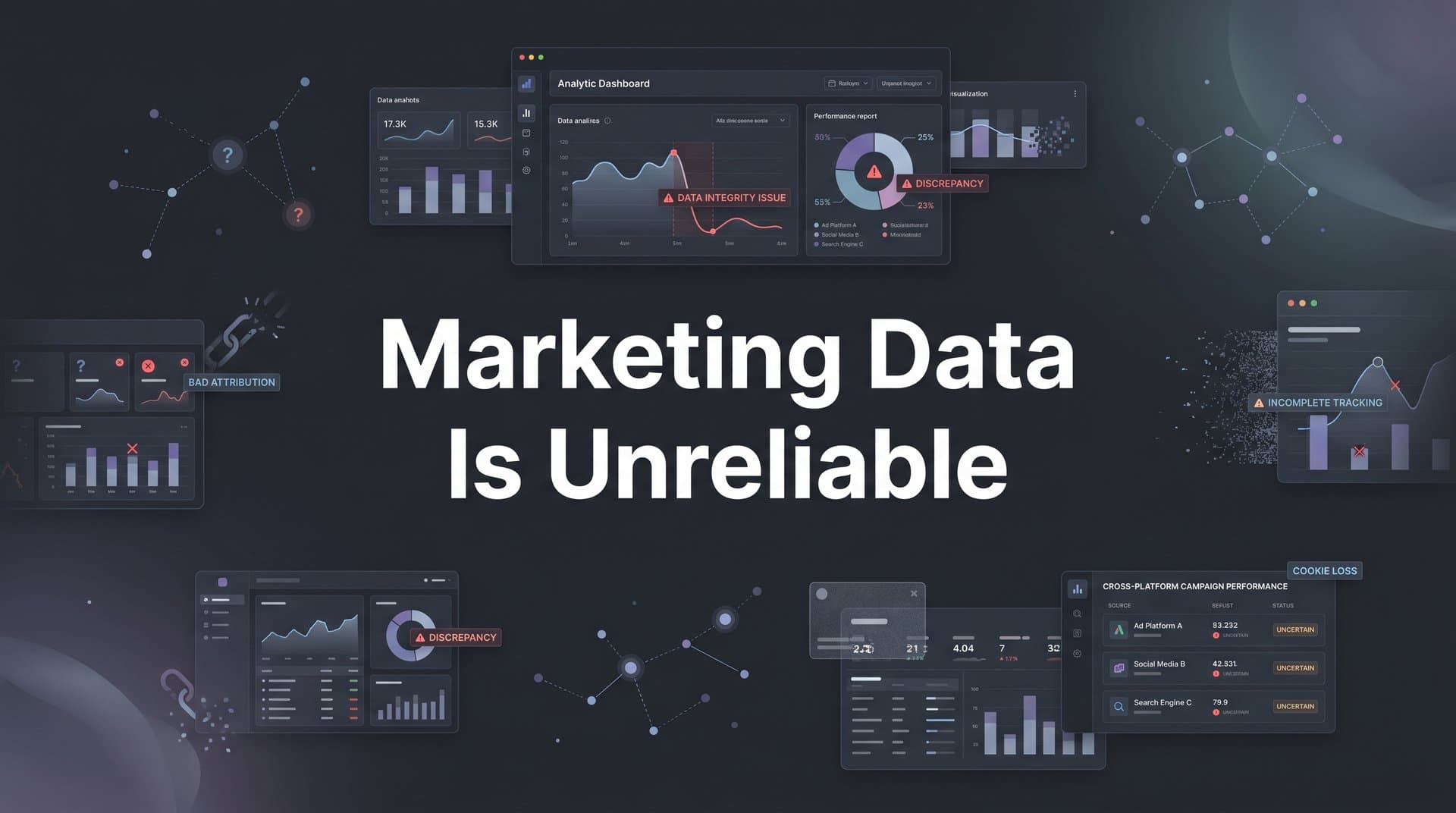
Picture this: it's Monday morning, and you're pulling together the weekly performance report. You open Google Ads, then Meta Ads Manager, then your CRM. The numbers stare back at you, and none of them agree. Google says it drove 80 conversions. Meta claims 95. Your CRM shows 60 actual customers. Add it all up and you've somehow attributed 175 conversions to a campaign that produced 60 real sales.
This isn't a rounding error. It's a fundamental problem with how marketing data gets collected, reported, and trusted, and it's happening inside marketing teams everywhere.
The problem has grown significantly worse over the past few years. Privacy changes from Apple and ongoing shifts in how browsers handle cookies have quietly dismantled the tracking infrastructure that digital marketers spent a decade building. Meanwhile, customer journeys have become more fragmented than ever, spanning multiple devices, sessions, and channels before a single purchase is made. And the platforms selling you ads? They're also the ones grading their own homework.
The result is a marketing data crisis that shows up as conflicting reports, misallocated budgets, and leadership teams who no longer trust what the marketing department tells them. If you've ever felt like you're flying blind despite having dashboards full of data, you're not alone, and you're not wrong to be skeptical.
This article breaks down exactly why marketing data is unreliable, where the breakdowns happen, and what you can do to rebuild a data foundation that actually supports confident decision-making.
The Trust Gap: Why Platform-Reported Numbers Don't Add Up
Every major ad platform, whether it's Meta, Google, or TikTok, operates with its own attribution model. Each one has its own rules for how long a conversion window stays open, whether view-through conversions count, and how credit gets assigned when a user interacts with multiple ads before buying. These models are not designed to work together. They're designed to make each platform look as valuable as possible.
Here's a concrete example of how this plays out. A user clicks a Meta ad on Tuesday, then searches on Google and clicks a Google ad on Thursday, and finally converts on Friday. Meta's default attribution window (7-day click, 1-day view) claims the conversion. Google's attribution model also claims the conversion. Your CRM records one sale. But when you pull reports from both platforms, you see two conversions attributed to a single customer. This is called double-counting, and it's endemic to multi-platform advertising. Understanding inconsistent data across marketing platforms is the first step toward solving this problem.
The conflict of interest here is worth naming directly. The same company that sells you ad inventory is also the one measuring whether that inventory performed. There's no independent auditor in the room. Each platform has a structural incentive to report the most favorable version of its own performance, and the default attribution settings they choose reflect that incentive.
The downstream effect is a trust gap that grows wider over time. Marketing teams spend hours each week in spreadsheets trying to reconcile numbers that were never designed to reconcile. Leadership sees reports that don't align with actual revenue and starts questioning the entire marketing function. And the marketers themselves lose confidence in their own data, which makes every budget decision feel like a guess.
This trust gap isn't just an inconvenience. It's a strategic liability. When you can't trust your data, you can't optimize with confidence, you can't defend your budget, and you can't identify what's actually working. The first step toward fixing it is understanding where the unreliability originates.
Five Root Causes Behind Unreliable Marketing Data
Marketing data doesn't become unreliable overnight. It erodes through a combination of technical limitations, privacy-driven changes, and structural gaps in how modern marketing stacks are built. Here are the five most significant contributors.
Privacy-driven signal loss: Apple's iOS 14.5 App Tracking Transparency update, released in 2021, gave users the ability to opt out of cross-app tracking. A significant portion of users chose to do exactly that. For platforms like Meta, which had built their entire targeting and measurement infrastructure on device-level tracking signals, this was a seismic shift. Client-side pixels suddenly couldn't see a large portion of conversions that were happening. Cookie deprecation and browser-level blocking from Safari and Firefox have compounded the problem further, creating blind spots in conversion data that many marketers still don't fully account for. These challenges are explored in depth in our guide on marketing analytics data accuracy issues.
Fragmented customer journeys: The modern buyer doesn't follow a straight line. They might discover your brand through a TikTok video, click a retargeting ad on Instagram a week later, open a promotional email, and finally convert after a Google search. Each of those interactions likely happens on different devices and across different sessions. Without a unified system to stitch those touchpoints together, each platform sees a fragment of the journey and treats it as a complete picture. The result is that you're measuring pieces of a puzzle while believing you're seeing the whole image.
Data silos and integration failures: Most marketing teams operate with ad platforms, website analytics tools, and CRM systems that don't natively communicate with each other. When a lead converts in your CRM, that information often never makes it back to your ad platforms in a structured way. When a website visitor bounces and returns later, your analytics tool may count them as two separate users. Learning how to connect all marketing data sources is critical for eliminating these contradictions.
Attribution window mismatches: Different platforms use different default attribution windows, and those windows often overlap in ways that inflate reported results. A conversion that happened 6 days after a click might be claimed by one platform but not another, depending on their settings. When marketing teams compare reports without accounting for these window differences, they're comparing apples to oranges and drawing conclusions from the comparison.
Delayed and incomplete conversion data: Some conversions, particularly in B2B or high-consideration purchase contexts, happen days or weeks after the initial ad interaction. If your tracking setup only captures immediate conversions, you're missing a significant portion of the value your campaigns actually generate. This creates a distorted view of which campaigns are working and which ones aren't, leading to premature decisions to cut or scale spend.
What It Actually Costs You to Work With Bad Data
Unreliable marketing data isn't just a reporting headache. It has direct, measurable consequences for how you spend money and how your campaigns perform over time.
The most immediate cost is budget misallocation. When attribution is inaccurate, the channels that appear to perform best on paper aren't necessarily the ones actually driving revenue. Last-click attribution, for example, tends to over-credit search and direct traffic while under-crediting the top-of-funnel channels that first introduced a customer to your brand. Marketers acting on this data naturally shift budget toward what looks good in the report, pulling spend away from channels that were doing the real work. Understanding how to allocate marketing budget based on data can help you avoid these costly mistakes. The campaigns that look like they're underperforming get cut. The ones getting undeserved credit get scaled. Over time, this creates a compounding misallocation problem that's difficult to diagnose because the bad data keeps reinforcing the bad decisions.
There's also a less obvious but equally serious cost: broken feedback loops to ad platform algorithms. Meta and Google's machine learning systems rely on conversion signals to optimize targeting and bidding. When those signals are incomplete because pixels are being blocked, or delayed because offline conversions aren't being uploaded, the algorithms are working with degraded information. They optimize toward the audiences and behaviors that show up in the incomplete data, not toward the customers who are actually converting. This means your ad spend is being directed by an algorithm that's navigating with a partial map.
The third cost is organizational. When marketing reports consistently contradict each other or fail to align with actual revenue figures, leadership loses confidence in the marketing team's ability to manage spend responsibly. This is precisely why marketing data accuracy matters for ROI and long-term organizational trust. This erosion of trust makes it harder to secure budget increases, justify new channel experiments, or advocate for the resources needed to run effective campaigns. Marketing becomes a cost center that leadership tolerates rather than a growth driver they invest in.
All three of these costs compound over time. Bad data leads to bad decisions, which lead to worse performance, which produces more confusing data. Breaking the cycle requires addressing the root causes rather than just improving how you present the numbers.
Server-Side Tracking: Getting Back the Data You're Losing
If client-side pixels are the problem, server-side tracking is the most direct solution. Understanding the difference between the two is key to appreciating why the shift matters.
Traditional client-side tracking works by placing a JavaScript pixel on your website. When a user visits a page or completes an action, that pixel fires and sends data to the ad platform directly from the user's browser. The problem is that this process is vulnerable to everything happening in that browser: ad blockers, iOS privacy restrictions, Safari's Intelligent Tracking Prevention, and cookie limitations can all prevent the pixel from firing or from sending complete data. You never know when a conversion is being missed because the failure is silent.
Server-side tracking works differently. Instead of relying on the user's browser to send data, conversion events are captured by your own server and sent directly to the ad platform's API. The data travels from your infrastructure to the platform's infrastructure, bypassing the browser entirely. Ad blockers can't intercept it. Cookie restrictions don't apply. iOS privacy settings don't interfere. The result is a more complete and more accurate record of what's actually happening across your campaigns.
Beyond capturing more conversions, server-side tracking also enables something called conversion syncing. This is the process of sending enriched, verified conversion data back to ad platforms so their machine learning algorithms have better signals to work with. When Meta or Google receives richer conversion data, including details like customer lifetime value or lead quality scores from your CRM, their algorithms can identify and target audiences that more closely resemble your best customers. Better data in means better targeting out, which creates a positive feedback loop that improves campaign performance over time. This approach is central to understanding how to connect marketing data to revenue.
Cometly's server-side tracking capability is built specifically to address this signal loss problem, capturing conversion events that client-side methods miss and syncing enriched data back to platforms like Meta and Google to improve algorithmic optimization.
Multi-Touch Attribution: Connecting the Dots Across the Journey
Even with better data collection in place, you still need a framework for understanding how credit should be distributed across the customer journey. This is where multi-touch attribution becomes essential.
Single-touch models, specifically first-click and last-click attribution, are the most commonly used because they're the simplest. First-click gives all the credit to the very first interaction a customer had with your brand. Last-click gives all the credit to the final touchpoint before conversion. Both models are easy to understand, but they're fundamentally misleading because they treat the entire customer journey as if only one moment mattered.
Think about what that means in practice. A customer discovers your product through a YouTube ad, gets retargeted on Instagram, reads a blog post, opens an email, and finally converts after clicking a branded search ad. Under last-click attribution, the branded search ad gets 100% of the credit. The YouTube ad, the Instagram retargeting, the content, and the email are all rendered invisible. If you're making budget decisions based on that model, you'll systematically underinvest in the channels that build awareness and nurture intent while over-crediting the channels that simply capture demand at the end.
Multi-touch attribution distributes credit across every meaningful touchpoint in the journey. Common models include linear attribution (equal credit to every touch), time-decay attribution (more credit to touches closer to conversion), and position-based attribution (more credit to the first and last touches, with the middle touches sharing the remainder). Each model tells a slightly different story, and the most sophisticated approach is to compare them side by side rather than committing blindly to one. Our data science for marketing attribution guide explores these models in greater detail.
By comparing attribution models in parallel, you can stress-test your assumptions about which channels are driving results. If a channel looks strong under last-click but weak under linear attribution, that's a signal worth investigating. Cometly's multi-touch attribution tools allow marketers to view these models alongside each other, giving you a more complete picture of how your channels work together rather than forcing you to choose one partial view of the truth.
Building a Data Foundation Your Team Can Actually Trust
Better tracking and smarter attribution are only as powerful as the infrastructure they sit on. To make reliable data the standard rather than the exception, marketing teams need to think about how their systems connect, how their data gets validated, and how insights get turned into action.
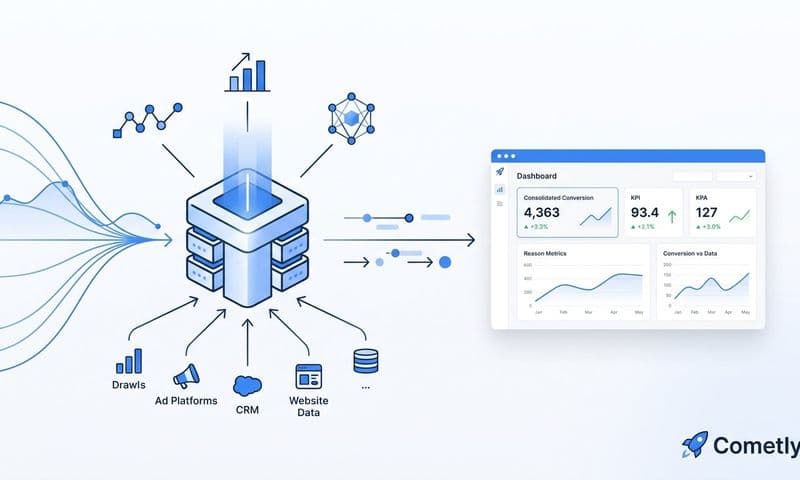
The starting point is creating a single source of truth. This means connecting your ad platforms, CRM, and website analytics into one unified system where every team member is working from the same data set and the same conversion definitions. When different teams are pulling reports from different tools with different settings, you end up with the same conflicting numbers problem you started with, just with more dashboards involved. A unified data layer eliminates that fragmentation and gives everyone a consistent foundation for decision-making.
Once your data is unified, AI-powered analysis becomes significantly more valuable. Manually reviewing performance across multiple channels, campaigns, and attribution models is time-consuming and prone to the kind of cognitive bias that leads to missed insights. AI can surface patterns across large data sets in seconds, identifying which ads and audiences are generating the highest-quality conversions, where budget is being wasted, and where there's untapped opportunity to scale. Cometly's AI-driven recommendations are designed to do exactly this, helping marketers act on insights faster and scale what's working with confidence rather than guesswork.
The third element is ongoing data validation. Tracking setups drift over time. Platforms change their APIs. New campaigns introduce new variables. Without a regular cadence of validation, small tracking errors accumulate into significant blind spots. A practical approach is to compare attributed revenue in your marketing system against actual revenue in your CRM on a weekly or monthly basis. Adopting best practices for using data in marketing decisions ensures this kind of discipline becomes part of your workflow. If those numbers are consistently diverging, something in your tracking chain needs attention. This kind of discipline transforms data quality from a one-time setup task into an ongoing operational standard.
Building this foundation takes investment, but the alternative is continuing to make significant budget decisions based on data you can't trust. The marketers and teams who get this right don't just report better numbers. They make better decisions, run better campaigns, and build the kind of organizational credibility that earns them more resources to work with.
Putting It All Together
Unreliable marketing data is not an unsolvable problem. It's a predictable symptom of tracking methods that were built for a different era and systems that were never designed to work together. The good news is that each of the root causes has a clear solution, and the tools to implement those solutions are available right now.
The path forward involves three core shifts. First, move away from relying solely on platform-reported metrics and toward independent attribution that gives you an unbiased view of what's actually driving conversions. Second, adopt server-side tracking to recapture the conversion signals that privacy changes and browser restrictions are currently hiding from you. Third, unify your data across the full customer journey so you can see how channels work together rather than evaluating each one in isolation.
When these pieces come together, something important happens: you stop managing campaigns based on which platform tells the most convincing story and start making decisions based on what the data actually shows. That shift, from reactive reporting to proactive optimization, is what separates marketing teams that grow their budgets from those that struggle to justify them.
If your current setup leaves you reconciling conflicting reports and second-guessing every budget decision, it's time to change the foundation. Get your free demo of Cometly today and see how AI-driven attribution can help your team replace guesswork with accurate, real-time marketing data you can actually trust.