You're running campaigns across Meta, Google, TikTok, and your CRM is tracking leads. Your analytics dashboard shows conversions. Everything seems connected—until you try to answer the simplest question: which ad actually drove that $10,000 sale?
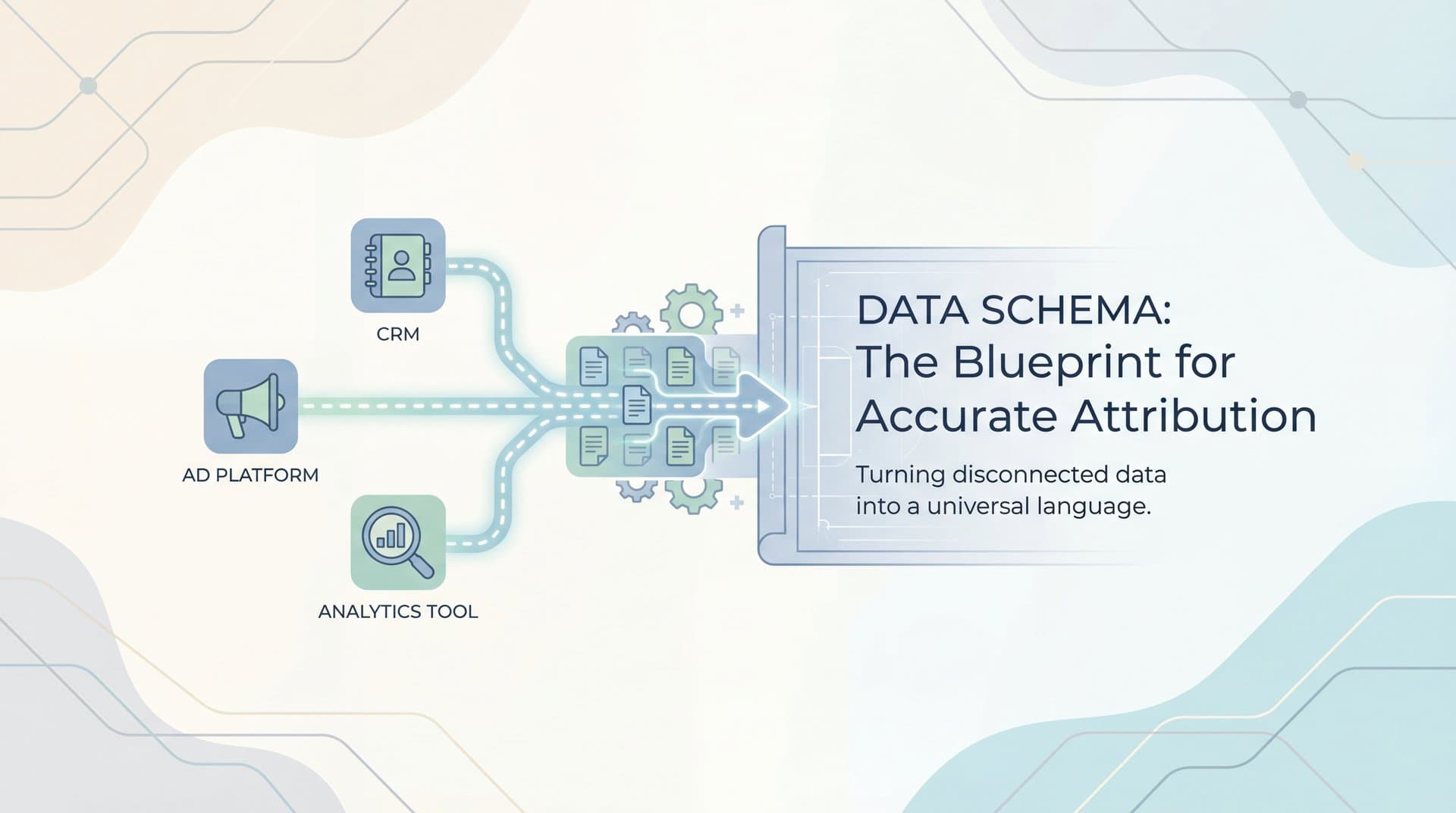
The data exists somewhere. But your ad platform calls it "purchase_complete," your CRM logs it as "deal_closed," and your analytics tool records it as "transaction." Three systems, three names, same event. No way to connect them.
This is the hidden crisis in modern marketing: disconnected data that makes attribution impossible. And at the root of this chaos sits a concept most marketers have never heard of but desperately need to understand—the marketing event data schema.
Think of it as the universal translator for your marketing stack. It's the structured blueprint that defines how every interaction gets captured, named, and organized so your tools can actually talk to each other. Without it, you're flying blind. With it, you can trace every touchpoint from first click to final conversion.
The Foundation: How Event Data Schemas Structure Your Marketing Intelligence
A marketing event data schema is a standardized format that defines exactly how marketing interactions are captured, named, and organized across your entire tech stack. It's not the data itself—it's the structure that makes the data meaningful.
Picture it like architectural blueprints for a building. The blueprint doesn't construct the building, but it ensures every contractor knows where the walls go, how the plumbing connects, and which materials to use. Your event schema does the same thing for marketing data: it ensures that when someone clicks an ad, submits a form, or makes a purchase, that action gets recorded the same way everywhere.
Every schema contains five core components. First, event names—the labels that identify what happened (like "add_to_cart" or "form_submit"). Second, properties or parameters—the details about that event (product name, form type, page URL). Third, timestamps—when exactly the action occurred. Fourth, user identifiers—who took the action (email, user ID, device ID). Fifth, contextual metadata—where it happened (traffic source, campaign ID, device type).
Here's where it gets critical: raw tracking data without a schema is just noise. Imagine your website fires a tracking pixel every time someone does something. Without a schema, you get a stream of unstructured signals: "User clicked something. User submitted something. User bought something." That's chaos.
A schema transforms that chaos into intelligence: "User 12345 clicked ad campaign 'spring_sale' at 2:47 PM, then submitted lead form 'demo_request' with property 'company_size: 50-100' at 3:12 PM, then completed purchase event with property 'revenue: $2,400' at 4:05 PM." Now you can actually trace the journey. This is the foundation of data analytics in marketing—and it starts with defining the blueprint before you capture a single event.
The difference is structure versus randomness. Without a schema, you're collecting data points that can't connect. With a schema, you're building a complete map of how customers move through your funnel. That's the foundation of accurate attribution—and it starts with defining the blueprint before you capture a single event.
Anatomy of a Well-Designed Event Schema
Not all events matter equally, and a well-designed schema reflects that reality. Start with essential event types that map directly to revenue outcomes.
Page View Events: The baseline. These track when users land on key pages—product pages, pricing, checkout. Properties should include page URL, referrer, and session ID. Simple, but critical for understanding navigation patterns.
Click Events: When users interact with buttons, CTAs, or ads. Properties must include click target (what they clicked), destination URL, and campaign source. This is where you connect ad engagement to downstream behavior.
Form Submission Events: Lead capture moments. Properties should include form type (demo request, newsletter signup, contact), fields submitted, and lead source. These events bridge awareness and conversion.
Purchase Events: The revenue moment. Properties must include transaction ID, product details, revenue amount, currency, and order value. This is your north star—everything else exists to predict and optimize toward this event.
Custom Conversion Events: High-intent signals unique to your business. Maybe it's "pricing_calculator_completed" or "trial_activated" or "video_watched_75_percent." These events capture buying intent that standard schemas miss.
Now here's where most teams fail: they don't distinguish between required and optional properties. Required properties are non-negotiable—every instance of that event must include them. For a purchase event, revenue amount and transaction ID are required. Optional properties add context but aren't essential for basic tracking.
Why does this matter? Because incomplete required properties break attribution. If some purchase events include user IDs and others don't, you can't connect those conversions to ad touchpoints. Your data becomes partially useful at best, completely misleading at worst. Understanding marketing data accuracy improvement methods becomes essential when building reliable schemas.
Naming conventions are equally critical. Choose a format and enforce it religiously. Many teams use snake_case (form_submit, add_to_cart) because it's readable and consistent across systems. Others prefer camelCase (formSubmit, addToCart). The format matters less than consistency.
Create hierarchies in your naming: "page_view_product," "page_view_pricing," "page_view_checkout." This structure lets you filter and analyze at different levels. You can look at all page views, or drill into specific page types. Without hierarchy, you end up with flat, disconnected event names that can't roll up into meaningful categories.
The goal is a schema that any team member can understand and implement correctly. If your schema requires a decoder ring, it will fail. Clarity and consistency prevent the data fragmentation that kills attribution accuracy.
Why Schema Consistency Makes or Breaks Attribution Accuracy
Inconsistent schemas don't just create messy data—they make accurate attribution mathematically impossible.
Here's the problem: attribution requires connecting events across platforms. User clicks Meta ad, visits your site (tracked by Google Analytics), submits a form (captured by your CRM), and completes a purchase (recorded by your e-commerce platform). To attribute that sale to the Meta ad, you need to connect four separate events across four systems.
That connection only works if each system uses consistent identifiers and event structures. If Meta tracks the user as "fb_user_12345," your website uses "session_abc789," your CRM logs "lead_contact_xyz," and your e-commerce platform records "customer_456"—you have four disconnected data points. The attribution chain breaks. This is the core of the marketing data silos problem that plagues most organizations.
The downstream effects are brutal. Misattributed conversions mean you're scaling campaigns that don't actually drive revenue while cutting budgets from channels that do. Your Meta dashboard might show 50 conversions, but if those events aren't properly structured with matching user identifiers, you can't verify which ads actually generated sales.
Flawed optimization decisions follow naturally. Ad platforms use conversion data to train their algorithms. If your conversion events are inconsistently structured—sometimes including revenue amounts, sometimes not; sometimes firing immediately, sometimes delayed—the platform receives noisy signals. The algorithm optimizes toward garbage data, and your campaigns suffer.
This is why schema consistency directly impacts your ability to track complete customer journeys. Modern buyers touch 7-10 channels before converting. They see a Meta ad, search your brand on Google, read a blog post, download a guide, attend a webinar, and finally purchase. Each touchpoint must be captured with the same user identifier and consistent event structure, or the journey fragments into disconnected pieces. Implementing proper attribution marketing tracking depends entirely on this consistency.
Think of it like trying to watch a movie where every scene was filmed by a different director using different actors. The plot exists, but you can't follow it. That's what inconsistent schemas do to your attribution—they turn a coherent customer journey into incomprehensible fragments.
Building Your Schema: Practical Implementation Steps
Start with business goals, not tracking capabilities. Most teams build schemas backward—they look at what their tools can track and build from there. That's a mistake. Begin by mapping which events actually indicate purchase intent and revenue potential.
Ask: what actions consistently predict conversions? For SaaS companies, it might be "trial_started" and "feature_activated." For e-commerce, "cart_add" and "checkout_initiated." For service businesses, "consultation_booked" and "proposal_viewed." Identify the 5-10 events that matter most for revenue, and build your schema around those first.
Next, create a documentation system that serves as your single source of truth. This should include three components: an event dictionary, property definitions, and validation rules.
Your event dictionary lists every event name, what it represents, when it should fire, and which properties it requires. Example: "purchase_complete - Fires when user completes checkout. Required properties: transaction_id (string), revenue (number), currency (string). Optional properties: product_name (string), category (string)."
Property definitions specify data types, allowed values, and formatting rules. If you have a property called "campaign_source," define exactly what values are acceptable: "meta," "google," "tiktok"—not "Facebook," "Google Ads," "TikTok Ads." Inconsistent values fragment your data just as badly as inconsistent event names.
Validation rules ensure data quality. Set requirements: revenue must be a positive number, timestamps must use ISO 8601 format, user IDs must be alphanumeric strings of specific length. These rules catch errors before bad data pollutes your attribution.
Now plan for scalability. Your schema will evolve as your business grows. You'll add new products, launch new campaigns, track new conversion types. Design your schema to accommodate expansion without breaking existing tracking. A solid marketing data management strategy ensures your schema remains maintainable over time.
Use versioning: when you modify an event structure, create a new version rather than changing the old one. This prevents historical data from becoming incompatible with current data. If you need to change "purchase_complete" to include a new required property, create "purchase_complete_v2" instead of modifying the original.
Establish a review process before adding new events. Not every action needs tracking. Teams often over-track, creating hundreds of low-value events that clutter dashboards and slow down analysis. Before adding an event, ask: will this event help us make better marketing decisions? If not, don't add it.
Finally, implement governance. Assign ownership—someone must be responsible for maintaining schema documentation and approving changes. Without clear ownership, schemas decay into chaos as different team members implement tracking their own way.
Connecting Schema to Ad Platform Optimization
Clean event data doesn't just help you understand attribution—it directly improves your ad platform performance. Here's why: Meta, Google, and other platforms use your conversion data to train their optimization algorithms. Better data inputs create better algorithmic decisions.
When you send a conversion event to Meta's Conversions API, you're not just recording what happened—you're teaching Meta's algorithm what a valuable user looks like. The algorithm analyzes the characteristics of users who convert (demographics, interests, behaviors) and finds more people like them. If your conversion events are properly structured with rich property data, the algorithm has more signals to work with.
Consider two scenarios. In the first, you send basic purchase events: just "purchase_complete" with no additional properties. The algorithm knows someone converted, but that's it. In the second, you send enriched events: "purchase_complete" with properties including revenue amount, product category, customer lifetime value prediction, and margin data. Now the algorithm can optimize not just for any purchase, but for high-value purchases in profitable categories.
This is where server-side tracking becomes essential. Browser-based tracking (pixels) is increasingly unreliable due to iOS restrictions, ad blockers, and cookie limitations. Server-side tracking sends events directly from your server to ad platforms, bypassing browser limitations entirely.
But server-side tracking requires explicit schema definition. With pixels, you could be sloppy—the pixel would fire and capture whatever data was available. With server-side events, you must explicitly define every property you're sending. This forces schema discipline, which paradoxically makes your data more reliable.
The benefits compound: more reliable data transmission means ad platforms receive consistent signals even when browser tracking fails. iOS users who opt out of tracking can still be attributed server-side if you're matching on email addresses or phone numbers. Your conversion data becomes more complete, and platform algorithms optimize more effectively. This is why marketing data integration across your tech stack is so critical for campaign performance.
Enriched conversion events also improve targeting precision. When you send detailed property data with each conversion—like purchase amount, product type, or customer segment—ad platforms can create more sophisticated lookalike audiences. Instead of "find people like purchasers," you can effectively say "find people like high-value purchasers of premium products." The targeting becomes sharper, and your acquisition costs drop.
Common Schema Mistakes and How to Avoid Them
Inconsistent Event Naming Across Team Members: This is the most common failure point. Developer A implements "form_submit," Developer B uses "formSubmit," and Marketer C creates "Form Submission" in the CRM. Now you have three events that should be identical but can't be connected. Solution: Create a centralized event dictionary that everyone must reference before implementing any tracking. Make it a required step in your development workflow.
Missing User Identifiers: Events fire, data gets collected, but there's no consistent way to connect events to individual users across platforms. You can't build attribution without persistent user identification. Solution: Implement a universal user ID strategy. Hash email addresses to create consistent identifiers that work across your website, CRM, and ad platforms. Ensure every event includes this identifier as a required property.
Over-Tracking Low-Value Events: Teams get excited about tracking everything—every scroll, every hover, every micro-interaction. This creates data bloat that obscures meaningful signals. Your dashboards become cluttered with noise, and analysis takes longer because you're wading through irrelevant events. Solution: Be ruthlessly selective. Only track events that directly inform marketing decisions or predict revenue outcomes. If you can't explain how an event will improve your campaigns, don't track it. Focus on capturing actionable marketing data that drives real decisions.
Failing to Version Schema Changes: You modify an event structure to add new properties, and suddenly historical data becomes incompatible with current data. Your year-over-year comparisons break because the event definition changed. Solution: Never modify existing events in place. Create new versions when you need to change structure, and maintain backward compatibility for historical analysis.
No Validation or Quality Checks: Events fire with missing required properties, incorrect data types, or impossible values (negative revenue, future timestamps). Bad data flows into your attribution system, and you make decisions based on garbage. Solution: Implement server-side validation that rejects malformed events before they reach your analytics platforms. Set up alerts when validation failures spike, indicating implementation problems. These are among the most significant attribution challenges in marketing analytics that teams face.
Putting It All Together
A well-designed marketing event data schema is the invisible infrastructure behind accurate attribution. Most marketers never see it, but it's the foundation that makes everything else work. Without it, you're collecting disconnected data points that can't tell you which channels actually drive revenue. With it, you gain complete visibility into the customer journey from first touchpoint to final conversion.
The marketers who invest in proper schema design gain a decisive advantage. They know exactly which ads generate qualified leads, which content moves prospects through the funnel, and which channels deliver the highest-value customers. They optimize with confidence because their data actually reflects reality. Implementing data driven marketing strategies becomes possible only when your schema provides reliable insights.
This isn't theoretical infrastructure work—it directly impacts your bottom line. Clean schemas feed better signals to ad platform algorithms, improving targeting and reducing acquisition costs. They enable accurate multi-touch attribution, so you can allocate budget to channels that actually work. They create the data foundation for AI-powered optimization that scales your campaigns intelligently.
The gap between marketers with strong schema foundations and those without is widening. As attribution becomes more complex—more channels, more touchpoints, more data sources—the teams with structured, consistent event data will dominate. They'll scale faster, optimize smarter, and waste less budget on campaigns that don't deliver.
Ready to elevate your marketing game with precision and confidence? Discover how Cometly's AI-driven recommendations can transform your ad strategy—Get your free demo today and start capturing every touchpoint to maximize your conversions.