

You're sitting in the quarterly review meeting when the CFO leans forward and asks: "We spent $50,000 on marketing last month. What exactly did we get for that money?" Your stomach drops. You have reports showing thousands of clicks, hundreds of leads, and impressive engagement rates—but you can't confidently draw a straight line from that spend to closed revenue. Sound familiar?
This moment of uncomfortable silence happens in conference rooms across the country every day. Marketing spend accountability isn't about defending your existence or proving you're busy. It's about demonstrating that every dollar invested in marketing generates measurable business outcomes. When you can confidently answer "what we got" with revenue numbers, customer acquisition costs, and pipeline contribution, something powerful happens: you earn bigger budgets and more strategic influence.
The reality is that most marketing teams operate with fragmented data scattered across multiple platforms. Facebook says you drove 50 conversions. Google claims 40. Your CRM shows 25 actual customers. Which number do you trust? This disconnect between platform reporting and business reality creates the accountability gap that undermines marketing's credibility with leadership.
This guide provides a practical framework for building true marketing spend accountability. You'll learn how to connect every marketing dollar to revenue outcomes, establish tracking systems that reveal what actually drives conversions, and communicate results that position marketing as a revenue driver rather than a cost center. Let's close that accountability gap.
The Real Cost of Flying Blind With Your Budget
Marketing spend accountability is the practice of connecting every marketing dollar to measurable business outcomes—not just activity metrics, but actual revenue, pipeline contribution, and customer acquisition. It's the difference between saying "our ads generated 10,000 impressions" and saying "our ads generated $75,000 in revenue at a 3:1 ROAS."
The problem? Most marketing teams still operate in the world of vanity metrics. Impressions, clicks, engagement rates, and follower counts make for impressive-looking reports, but they don't answer the fundamental question leadership cares about: Did this marketing investment generate more money than it cost?
This creates what we call the accountability gap—the chasm between what marketers measure and what executives need to know. When your CMO asks about ROI and you respond with click-through rates, you're speaking different languages. CFOs don't care that your campaign had a 2% CTR. They care whether that campaign contributed to the $500K deal that just closed.
The consequences of poor accountability extend far beyond awkward meetings. Budget cuts hit first. When leadership can't see clear ROI, marketing becomes an easy target when it's time to trim expenses. Trust erodes second. If you can't prove what's working, decision-makers stop believing your recommendations about where to invest next. Scaling becomes impossible third. Even when you have a winning campaign, you can't confidently argue for more budget without data showing it drives revenue.
Think about the opportunity cost. Imagine you're running five different ad campaigns across Meta, Google, and LinkedIn. One of them is generating a 5:1 return while another is losing money. Without proper accountability systems, you might keep funding the loser while underfunding the winner simply because you're looking at surface-level metrics that don't reveal true performance. Understanding how to measure marketing campaign effectiveness becomes critical in these situations.
The shift toward accountability isn't optional anymore. Boards are demanding that every department justify its budget with business outcomes. Sales has quotas and revenue targets. Product has user adoption and retention metrics. Marketing needs to speak the same language of revenue contribution and customer acquisition efficiency.
Here's the thing: accountability isn't about restricting your creativity or micromanaging every dollar. It's about gaining the confidence to make bold moves because you know what works. When you can prove that a specific campaign type consistently delivers 4:1 ROAS, you can confidently request triple the budget for it. That's the power of real accountability.
Building Your Accountability Framework From the Ground Up
True accountability starts with measuring what actually matters to your business. Forget vanity metrics. Your framework needs to center on KPIs that directly connect to revenue and business growth.
Start with Customer Acquisition Cost (CAC). This tells you exactly how much you're spending to acquire each new customer. Calculate it by dividing your total marketing spend by the number of new customers acquired in that period. If you spent $20,000 and acquired 40 customers, your CAC is $500. This number becomes your baseline for evaluating every marketing decision.
Next, establish Return on Ad Spend (ROAS). This measures how much revenue you generate for every dollar spent on advertising. A 3:1 ROAS means every $1 spent returns $3 in revenue. Unlike CAC which focuses on customers, ROAS shows immediate campaign efficiency. Both metrics matter because they reveal different aspects of performance.
Pipeline contribution is your third critical metric. This connects marketing activity to sales pipeline value. Track how much qualified pipeline your marketing efforts generate each month and what percentage of that pipeline converts to closed deals. This bridges the gap between marketing activity and revenue reality.
Now comes the hard part: creating a unified tracking system. Most marketing teams have data trapped in silos. Facebook Ads Manager shows one set of conversions. Google Analytics shows another. Your CRM shows actual customers. These numbers rarely match, creating confusion and undermining accountability.
Your unified system needs to connect three critical data sources. First, your ad platforms (Meta, Google, LinkedIn, etc.) where you're spending money. Second, your website where conversions happen. Third, your CRM where deals close and revenue gets recorded. When these three systems talk to each other, you can finally trace a customer's journey from first ad click to closed deal. The right marketing campaign tracking software makes this integration seamless.
This is where server-side tracking becomes essential. Traditional pixel-based tracking relies on browser cookies, which are increasingly blocked by privacy features and ad blockers. Server-side tracking captures conversion data directly from your servers, creating a more complete and accurate picture of what's actually driving results. Without it, you're flying blind with incomplete data.
Attribution models form the final piece of your framework. These determine how you assign credit for conversions across the customer journey. Did the first ad they clicked deserve credit? The last one before purchase? Every touchpoint along the way? Your attribution model should reflect your actual buying cycle.
For businesses with short sales cycles (e-commerce, low-ticket offers), last-click attribution might work fine. For complex B2B sales with long buying cycles involving multiple touchpoints, multi-touch attribution reveals which channels truly contribute to conversions versus which just happen to be present. Learning about different attribution models in digital marketing helps you choose the right approach for your business.
The key is consistency. Choose an attribution model that makes sense for your business and stick with it. Changing models constantly makes it impossible to compare performance over time or identify trends. Your framework should provide stable, reliable data you can trust for decision-making.
Set up your baseline metrics now, before you start optimizing. Record your current CAC, ROAS, and pipeline contribution. These numbers might not look great initially, but they give you a starting point to measure improvement against. Accountability isn't about having perfect numbers—it's about knowing your numbers and making them better over time.
Connecting Ad Spend to Revenue: The Attribution Challenge
Here's a scenario that plays out constantly: You check Facebook Ads Manager and see 100 conversions. Google Ads reports 75 conversions. Your Google Analytics shows 60. Your CRM has 40 actual customers. Which number do you report to leadership?
This is the attribution challenge in its raw form. Each platform wants to take credit for conversions, often counting the same customer multiple times. Facebook uses a 7-day click and 1-day view attribution window by default. Google uses different windows. They're measuring different things, which creates inflated and conflicting numbers that don't match business reality.
The problem gets worse when you realize that platforms are incentivized to overcount. They want to show you strong results so you keep spending. A customer who clicked your Facebook ad, then later searched on Google and clicked that ad, then visited directly before purchasing might get counted as a conversion by both Facebook and Google—even though only one customer actually converted. These are the attribution challenges in marketing analytics that every team must navigate.
Multi-touch attribution solves this by distributing credit across the actual customer journey. Instead of giving 100% credit to one touchpoint, it recognizes that customers typically interact with multiple channels before converting. Someone might discover you through a Facebook ad, research you via Google search, read your email nurture sequence, and then convert through a retargeting ad. Each touchpoint played a role.
Different multi-touch models distribute credit differently. Linear attribution gives equal credit to every touchpoint. Time-decay gives more credit to touchpoints closer to conversion. Position-based gives more credit to first and last touch while acknowledging middle touches. The right model depends on your buying cycle and how customers actually move through your funnel.
Understanding which channels actually drive conversions versus which just assist changes everything about budget allocation. You might discover that LinkedIn ads rarely close deals directly but play a crucial role in initial awareness for high-value prospects. Or that email marketing deserves more credit than you thought because it consistently appears in winning customer journeys. This insight is impossible without proper attribution.
The iOS privacy changes that started rolling out in 2021 fundamentally broke traditional attribution. Apple's App Tracking Transparency framework lets users opt out of tracking, which means Facebook and other platforms lost visibility into a huge portion of mobile conversions. Cookie deprecation in browsers creates similar blind spots for web tracking.
This is why server-side tracking has become essential rather than optional. Traditional pixel-based tracking happens in the user's browser, where it can be blocked by privacy settings, ad blockers, or browser restrictions. Server-side tracking captures conversion data directly from your server to the ad platform's server, bypassing browser limitations.
Think of it this way: pixel tracking is like trying to follow someone through a crowded mall where they can disappear into stores and you lose sight of them. Server-side tracking is like having a GPS tracker that shows their complete path regardless of where they go. You get a complete, accurate picture of the customer journey. The best performance marketing tracking software includes robust server-side capabilities.
Server-side tracking also enables you to send richer conversion data back to ad platforms. Instead of just telling Facebook "a conversion happened," you can send the actual revenue value, customer lifetime value, and other contextual data that helps the platform's algorithm optimize better. This feedback loop improves targeting and campaign performance over time.
The attribution challenge isn't just technical—it's strategic. When you can accurately attribute revenue to specific campaigns and channels, you gain the confidence to make bold budget decisions. You know which campaigns to scale, which to pause, and where to test new approaches. Without accurate attribution, you're guessing. With it, you're making data-driven decisions that compound over time.
Turning Data Into Decisions: Practical Optimization Tactics
Having accurate data means nothing if you don't act on it. The real power of marketing spend accountability comes from using insights to optimize performance continuously. Let's break down how to turn attribution data into decisions that improve ROI.
Start by identifying your underperformers. Look at campaigns that have run for at least two weeks with sufficient spend to generate meaningful data. Calculate the ROAS or CAC for each campaign. Any campaign consistently performing below your target threshold is a candidate for either optimization or elimination.
But here's where most marketers make a mistake: they pause underperforming campaigns immediately without understanding why they're underperforming. Dig deeper first. Is the targeting wrong? Is the creative weak? Is the landing page converting poorly? Sometimes a campaign targeting the right audience with the wrong message just needs creative refresh, not elimination.
Use the 80/20 rule for budget reallocation. Typically, 20% of your campaigns drive 80% of your results. Once you identify your top performers, shift budget from mediocre campaigns to proven winners. This isn't about killing experimentation—it's about ensuring your core budget goes to what's working while you test new approaches with smaller allocations. Mastering marketing spend optimization requires this disciplined approach.
The feedback loop between your conversion data and ad platforms is where optimization gets powerful. Platforms like Meta and Google use machine learning algorithms to optimize ad delivery. These algorithms learn from conversion signals—when you tell them which users converted, they find more users like those converters.
Here's the key: the quality of your conversion data directly impacts how well these algorithms perform. If you're only sending basic conversion events, the algorithm has limited information to optimize with. But when you send enriched conversion data—including revenue values, customer lifetime value predictions, and custom parameters—the algorithm can optimize for high-value conversions, not just any conversion.
This is called Conversion API or server-side event tracking, and it's become critical for campaign performance. By feeding platforms complete, accurate conversion data, you help their algorithms target better prospects and optimize delivery more effectively. Your campaigns perform better without you manually adjusting targeting.
Real-time accountability enables faster testing and scaling. Traditional marketing reporting happens weekly or monthly, which means you might run underperforming campaigns for weeks before catching them. With real-time dashboards showing campaign performance against your KPIs, you can spot winners and losers within days.
Set up automated alerts for significant performance changes. If a campaign's ROAS drops below your threshold or CAC spikes above acceptable levels, you want to know immediately, not when you check your dashboard next week. Quick responses to performance changes protect your budget and maximize results.
Scaling winners requires confidence in your data. When you find a campaign consistently delivering 4:1 ROAS, the natural move is to increase budget. But scaling isn't linear—doubling budget doesn't automatically double results. Scale gradually, monitoring whether performance holds as you increase spend. If ROAS stays strong, keep scaling. If it degrades, you've found the campaign's effective ceiling. Strategies for improving marketing campaign performance should always include systematic scaling protocols.
Create a testing framework with clear success criteria. Before launching any new campaign, define what success looks like. What ROAS or CAC would make this campaign worth scaling? How long will you test before making a decision? Having predefined criteria prevents emotional decision-making and ensures you're optimizing based on data, not hunches.
Communicating Results That Earn Executive Buy-In
You can have perfect data and optimized campaigns, but if you can't communicate results effectively to leadership, you won't get the budget and support you need. The way you present marketing performance determines whether executives see you as a cost center or a revenue driver.
Start every report with business outcomes, not marketing metrics. Your opening line should be something like: "Marketing generated $250,000 in revenue last month at a 3.5:1 ROAS" rather than "We achieved 2 million impressions and a 2.1% CTR." Lead with what leadership cares about—revenue, pipeline, and customer acquisition—then provide supporting details.
Structure your reports around the metrics that matter to different stakeholders. CFOs care about ROI and budget efficiency. CEOs care about growth and market position. Sales leaders care about pipeline quality and lead volume. Tailor your reporting to address each stakeholder's priorities while maintaining consistent underlying data.
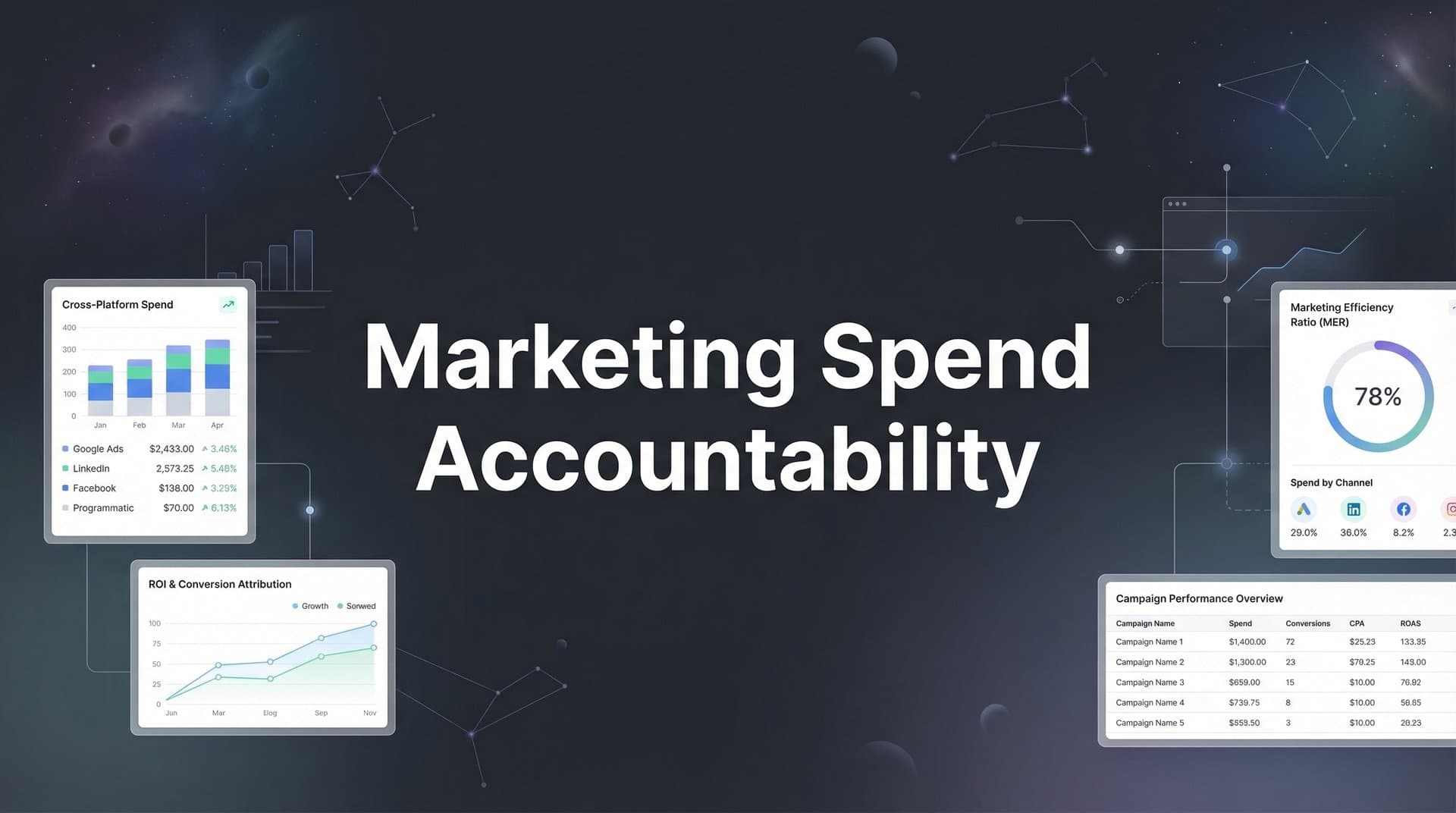
Create dashboards that show the direct line from spend to closed deals. Your ideal dashboard should let executives see: total marketing spend for the period, revenue generated from that spend, ROAS or ROI, customer acquisition cost, pipeline contribution, and how these metrics trend over time. Everything on one screen, updated in real time. A well-designed marketing dashboard for multiple campaigns makes this visibility possible.
Avoid the temptation to bury bad news or only highlight wins. Credibility comes from honesty. If a campaign underperformed, acknowledge it and explain what you learned and how you're adjusting. Leaders respect marketers who can identify failures quickly and pivot, not those who pretend everything is always working.
Tell stories with your data. Numbers alone don't stick in people's minds. Frame your results as narratives: "We discovered that our LinkedIn campaign wasn't closing deals directly, but 60% of our highest-value customers had interacted with those ads early in their journey. So we shifted our LinkedIn strategy to focus on awareness for enterprise prospects while using retargeting to close them, which improved our overall CAC by 25%."
Compare performance against clear benchmarks. Saying "we achieved a 3:1 ROAS" means more when you add context: "which is 50% better than our target of 2:1 and represents a 30% improvement from last quarter." Benchmarks help stakeholders understand whether performance is good, improving, or needs attention. Reviewing SaaS marketing spend benchmarks can provide valuable context for your industry.
Build a narrative that positions marketing as a revenue driver. Instead of asking for budget, present investment opportunities: "We've identified that our retargeting campaigns consistently deliver 5:1 ROAS. For every additional $10,000 we invest here, we can expect to generate $50,000 in revenue. I'm recommending we increase this budget by $30,000 next quarter to capture this proven opportunity."
This reframing changes the conversation from "marketing wants more money" to "here's a proven way to grow revenue." When you can demonstrate that marketing spend generates predictable returns, budget conversations become investment discussions. You're not defending costs—you're presenting growth opportunities backed by data.
Schedule regular reporting cadences with leadership. Monthly business reviews work well for most organizations. Consistent reporting builds trust and keeps marketing top of mind as a strategic function. It also creates accountability for you—when you know you're presenting results monthly, you stay focused on driving the metrics that matter.
Your 30-Day Accountability Roadmap
Theory is valuable, but implementation is what drives results. Here's a practical 30-day roadmap for building marketing spend accountability into your operations, starting from wherever you are today.
Week 1: Audit Your Current State
Begin by documenting every place you're currently tracking marketing data. List all ad platforms you're running campaigns on. Note which analytics tools you're using. Identify where conversion data lives—your website, CRM, e-commerce platform. Create a complete inventory of your current tracking infrastructure.
Next, identify data gaps and inconsistencies. Compare conversion numbers across platforms. Check whether your CRM conversions match your ad platform reports. Document discrepancies. These gaps represent blind spots in your accountability—areas where you can't confidently connect spend to outcomes.
Calculate your baseline metrics using whatever data you currently have. Even if it's imperfect, establish your current CAC, ROAS, and pipeline contribution. These numbers give you a starting point to measure improvement against. Don't worry if they're not great—the goal is visibility, not perfection.
Interview stakeholders about their reporting needs. Talk to your CFO, CEO, and sales leadership. Ask what metrics they care about most and how they currently evaluate marketing's contribution. Understanding their perspective helps you build accountability systems that address their actual concerns.
Week 2: Design Your Unified Tracking System
Map out your ideal customer journey from first touchpoint to closed deal. Identify every conversion point that matters: ad clicks, landing page visits, form submissions, demo requests, trial signups, purchases, or closed deals. Your tracking system needs to capture each of these events and connect them to individual customers. Learning how to track marketing campaigns properly is foundational to this process.
Choose your attribution model based on your buying cycle. For short cycles with few touchpoints, last-click might work. For complex B2B sales, multi-touch attribution provides better insights. Document your choice and the reasoning behind it—consistency matters more than picking the "perfect" model.
Evaluate tracking solutions that can unify your data sources. Look for platforms that integrate with your ad channels, website, and CRM to create a single source of truth. Server-side tracking capability is essential for accurate data in today's privacy-focused environment. Exploring marketing spend optimization tools can help you identify the right solution for your needs.
We compare the leading options in our ad spend optimization tools roundup.
Week 3-4: Implement and Establish Baselines
Set up your unified tracking system. This typically involves installing tracking code on your website, connecting your ad platforms, and integrating your CRM. Server-side implementations may require developer support, so allocate time accordingly.
Test your tracking thoroughly before relying on it for decisions. Submit test conversions and verify they appear correctly across all systems. Check that attribution is working as expected. Confirm that revenue data flows properly from your CRM to your reporting dashboard.
Run your old and new tracking systems in parallel for at least one week. This lets you compare data and build confidence in your new system before fully transitioning. Document any discrepancies and understand what's causing them.
Create your executive dashboard with the metrics that matter: total spend, revenue generated, ROAS, CAC, pipeline contribution, and trend lines. Make it accessible to stakeholders and set expectations for how often it updates.
Ongoing: Build Your Optimization Process
Establish a weekly optimization routine. Every week, review campaign performance against your KPIs. Identify top performers and underperformers. Make budget reallocation decisions based on data, not intuition. Document your changes and the reasoning behind them.
Schedule monthly reporting with leadership. Present results using the framework we discussed: lead with business outcomes, tell stories with your data, and position marketing as a revenue driver. Use these meetings to secure support for scaling what works.
Continuously refine your tracking and attribution. As you learn more about your customer journey, adjust your models and tracking to capture more nuanced insights. Marketing spend accountability isn't a one-time project—it's an ongoing practice that improves over time.
Moving Forward With Confidence
Marketing spend accountability isn't about justifying your existence or proving you're busy. It's about gaining the confidence and data to scale what works and eliminate what doesn't. When you can trace every marketing dollar to revenue outcomes, you transform from a cost center defending budget to a revenue driver requesting investment in proven opportunities.
The marketers who build strong accountability systems earn bigger budgets, more strategic influence, and seat at the executive table. They make faster decisions because they know what's working. They scale campaigns confidently because they have data proving performance. They communicate with leadership in the language of business outcomes rather than marketing metrics.
The framework we've covered—establishing revenue-focused KPIs, building unified tracking systems, implementing proper attribution, optimizing based on data, and communicating results effectively—provides everything you need to build accountability into your marketing operations. Start with the 30-day roadmap. Audit your current state, design your system, implement tracking, and establish your optimization process.
Remember that accountability improves over time. Your first month of unified tracking will reveal gaps and inconsistencies. Your attribution model might need refinement as you learn more about your customer journey. Your reporting will evolve as you understand what stakeholders care about most. That's normal and expected. The goal isn't perfection on day one—it's continuous improvement toward better data and smarter decisions.
The marketing landscape continues to evolve with privacy changes, new platforms, and shifting consumer behavior. But the fundamental principle remains constant: marketers who can prove ROI earn the resources to drive growth. Build your accountability foundation now, and you'll be positioned to adapt to whatever changes come next.
Ready to elevate your marketing game with precision and confidence? Cometly captures every touchpoint across your customer journey, connects ad spend directly to revenue, and provides AI-driven recommendations that help you scale winning campaigns with confidence. Discover how our unified attribution platform can transform your marketing accountability—Get your free demo today and start proving the ROI that earns bigger budgets.


