You've spent thousands on ads this month. Your dashboard shows clicks, impressions, and engagement metrics that look promising. But when your CEO asks which campaigns actually drove revenue, you hesitate. You know your marketing is working, but proving it with confidence? That's a different story.
This disconnect between marketing spend and measurable business outcomes frustrates marketers everywhere. The problem isn't effort or strategy. It's measurement. Most teams track activity instead of impact, watching metrics that feel productive but don't answer the question that actually matters: what's driving revenue?
Accurate marketing measurement goes far beyond counting clicks and impressions. It means connecting every touchpoint in the customer journey to actual business results. It means knowing with certainty which channels deserve more budget and which ones are burning money. This guide shows you how to build that clarity into your marketing operations, transforming guesswork into data-driven confidence.
The Problem With Surface-Level Metrics
Most marketing dashboards are filled with numbers that look impressive but tell you almost nothing about what's actually working. Impressions hit six figures. Click-through rates trend upward. Engagement metrics climb. Yet revenue attribution remains a mystery.
These vanity metrics create a dangerous illusion of success. They measure activity, not outcomes. A campaign can generate thousands of clicks while contributing zero revenue. Another might show modest engagement numbers but drive your highest-value customers. Without connecting these metrics to revenue, you're flying blind.
The situation gets worse when you realize that platform-reported data often inflates results through overlapping attribution. Meta claims credit for a conversion. Google Ads claims the same conversion. LinkedIn reports it too. Add up what each platform says it delivered, and you've somehow generated 300% of your actual revenue. Every platform uses attribution windows and models that favor showing their own impact, creating a marketing channel overlap measurement mess that makes budget allocation nearly impossible.
Privacy changes have amplified these challenges dramatically. iOS App Tracking Transparency restrictions mean many conversions happen outside the view of traditional tracking pixels. Third-party cookies are disappearing across browsers. The tracking methods that marketers relied on for years are becoming less reliable by the day.
This isn't just a technical inconvenience. It's a fundamental shift that requires rethinking how you measure marketing impact. The old approach of dropping a pixel on your website and trusting platform dashboards no longer captures the full picture. Marketers who don't adapt find themselves making million-dollar decisions based on incomplete, conflicting data.
Building Your Measurement Foundation
Accurate marketing measurement starts with first-party data collection. This means capturing information directly from your customers and prospects through your own systems, not relying on third-party cookies or platform pixels that privacy restrictions can block.
Server-side tracking has become essential in this new landscape. Instead of relying solely on browser-based tracking that ad blockers can prevent, server-side tracking captures conversion events on your server and sends them to ad platforms and analytics tools. This approach captures conversions that client-side tracking misses, giving you a more complete view of campaign performance.
Think of it like this: client-side tracking is like trying to count customers by watching who walks through your front door, but some people come in through side entrances you can't see. Server-side tracking puts counters at every entrance, capturing the full traffic picture regardless of which door people use.
Understanding attribution models is equally critical. Each model distributes credit for conversions differently across the customer journey. Last-click attribution gives all credit to the final touchpoint before conversion. First-click credits the initial interaction. Linear attribution spreads credit evenly across all touchpoints. Multi-touch models use more sophisticated logic to assign appropriate weight to each interaction based on its role in the journey.
No single attribution model is universally correct. The right choice depends on your business model, sales cycle, and what questions you're trying to answer. A company with a short sales cycle might find last-click attribution sufficient. A business with a complex, multi-month buying process needs multi-touch attribution to understand which early-stage touchpoints initiate valuable customer relationships.
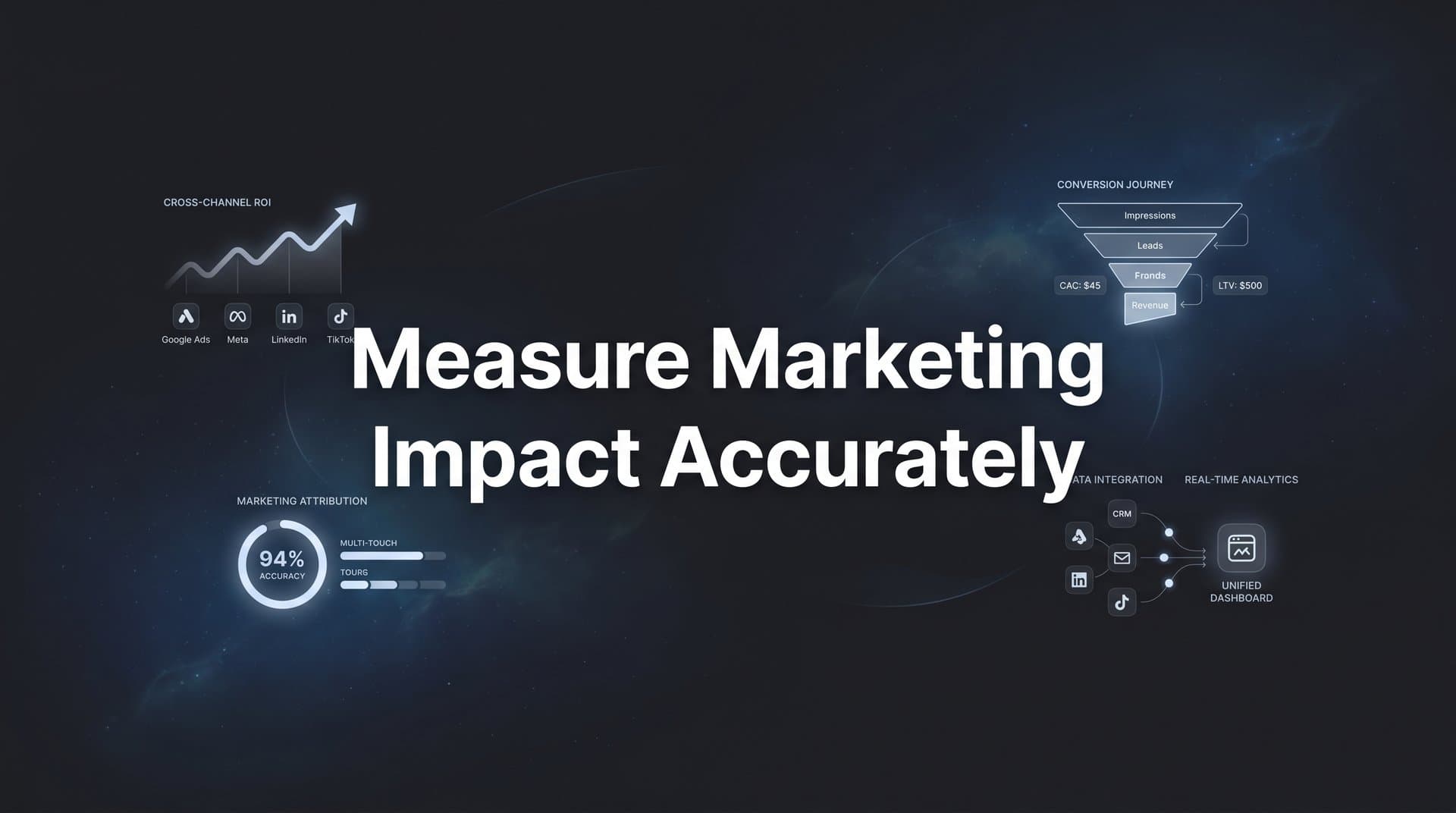
The real power comes from connecting all your data sources into a unified view. Your ad platforms show one piece of the puzzle. Your website analytics reveal another. Your CRM holds the final conversion data. When these systems operate in silos, you're making decisions with fragmented information. Bringing them together creates a complete picture of how marketing activity translates to business outcomes.
This unified approach means connecting Meta Ads, Google Ads, LinkedIn, your website tracking, email marketing platforms, and your CRM into a single source of truth. Only then can you see the full customer journey and understand which marketing investments actually drive revenue.
Understanding the Complete Customer Journey
Customers rarely convert on their first interaction with your brand. They see an ad, visit your website, leave, see another ad, read a blog post, sign up for your email list, receive nurture emails, and eventually convert. Each touchpoint plays a role, but traditional single-touch attribution only credits one.
Multi-touch attribution solves this by acknowledging that conversions happen through accumulated influence, not single moments. A customer might discover your product through a Facebook ad, research it via organic search, compare options after seeing a retargeting ad, and finally convert after reading a case study in your email newsletter. Which touchpoint deserves credit? All of them, in appropriate measure.
This journey-based view reveals patterns that single-touch models hide. You might discover that customers who interact with both paid social and organic search convert at three times the rate of those who only touch one channel. Or that webinar attendees who also engage with retargeting ads have significantly higher lifetime value. These insights are invisible when you only credit the last click.
The real value emerges when you identify which combinations of channels drive your best results. Perhaps paid search alone generates leads, but those leads convert to customers at low rates. Add content marketing touchpoints into the journey, and conversion rates double. This understanding marketing channel impact transforms budget allocation from guesswork into strategy.
Multi-touch attribution also reveals the role of touchpoints that never get credit in last-click models. That initial brand awareness campaign might not directly drive conversions, but it starts journeys that eventually generate significant revenue. Without seeing the full path, you might cut a campaign that's actually essential to your customer acquisition engine.
The challenge is capturing and analyzing this journey data accurately. It requires tracking individual users across sessions and devices, connecting anonymous website visitors to known leads in your CRM, and maintaining that connection through the entire lifecycle. This technical complexity is why many marketers default to simpler, less accurate attribution models, even though those models lead to poor decisions.
Turning Data Into Marketing Intelligence
Collecting data is pointless without the infrastructure to transform it into actionable insights. This starts with proper tracking setup across every marketing channel you use. Each platform needs to send conversion events that include not just whether a conversion happened, but valuable context about the customer, their journey, and the business value they represent.
Your tracking setup should capture more than basic conversion events. Tag conversions with customer attributes like deal size, product interest, and lead quality scores from your CRM. This enriched data reveals which campaigns drive high-value customers versus low-quality leads. A campaign might generate 100 conversions while another generates 50, but if the second campaign's customers have twice the lifetime value, it's the better investment.
Creating dashboards that connect marketing activity to revenue outcomes requires bringing together data from multiple sources. Your ideal dashboard shows not just how many clicks each campaign generated, but how many of those clicks turned into leads, how many leads became customers, and what revenue those customers generated. This end-to-end view makes the impact of marketing and analytics on business success crystal clear.
The dashboard should also reveal time-lag patterns. If customers typically convert 30 days after their first touchpoint, you need to account for that delay when evaluating campaign performance. A campaign launched three weeks ago hasn't had time to show its full impact yet. Understanding these conversion timelines prevents premature optimization decisions based on incomplete data.
AI-powered analysis takes this further by automatically surfacing optimization opportunities that manual analysis might miss. Modern attribution platforms can identify patterns like "customers who interact with video ads and then visit your pricing page within 48 hours convert at 5x the average rate" and recommend scaling that specific combination.
This automated insight generation is particularly valuable for teams managing complex campaigns across multiple platforms. A human analyst might spot obvious patterns, but AI can process thousands of customer journeys simultaneously to find subtle correlations that drive significant results. Understanding the impact of machine learning on marketing analytics helps teams leverage these capabilities effectively.
The key is setting up systems that make these insights accessible to your team without requiring advanced analytics skills. Marketers should be able to answer questions like "which channel drives our highest-value customers?" or "what's the typical journey for customers who spend over $10,000?" without writing SQL queries or building custom reports.
Optimizing Ad Platform Performance Through Better Data
Ad platforms like Meta and Google use machine learning algorithms to optimize your campaigns. They identify patterns in who converts and automatically show your ads to similar audiences. The quality of conversion data you send these platforms directly affects how well their algorithms can optimize.
When you only track basic conversion events, ad platforms have limited information to work with. They know someone converted, but not whether that person became a high-value customer or a one-time buyer who never returned. This limitation means algorithms optimize for conversion volume, not conversion quality.
Server-side event tracking captures conversions that client-side pixels miss due to ad blockers, browser restrictions, and iOS limitations. This more complete conversion data gives ad platform algorithms a clearer picture of campaign performance. Instead of optimizing based on 60% of actual conversions, they can optimize based on 95%, leading to significantly better targeting and results.
The feedback loop works like this: you send enriched conversion data back to ad platforms, including not just that a conversion happened but valuable context about customer quality and revenue potential. The algorithm uses this information to identify your most valuable audience segments and automatically shift budget toward reaching more people like them. Better data leads to better optimization, which leads to better results, which generates more data to further improve performance.
This is particularly important for businesses with varying customer lifetime values. If your customers range from $100 lifetime value to $10,000 lifetime value, you want algorithms optimizing for the high-value segment, not just maximizing total conversion count. Sending value-based conversion data enables this optimization.
Many marketers don't realize that ad platform performance directly correlates with data quality. Two companies in the same industry with similar budgets can see vastly different results based solely on how much conversion signal they're feeding the algorithms. The company sending rich, accurate conversion data will outperform the one sending basic conversion events, even with identical creative and targeting settings. Learning how to track marketing campaigns properly is essential for maximizing this performance advantage.
Setting up this conversion sync requires technical integration between your attribution system and ad platforms, but the performance improvement makes it worth the effort. You're essentially giving ad platform AI better instructions about what success looks like, enabling it to find more of what actually drives your business forward.
Your Path to Measurement Clarity
Improving your marketing measurement starts with auditing your current setup. Ask yourself: Can you trace a specific conversion back to every touchpoint that influenced it? Do you know the typical customer journey for your highest-value customers? Can you confidently say which marketing channels drive the most revenue, not just the most clicks?
If the answer to any of these questions is no, you have measurement gaps that are costing you money. The next step is identifying where those gaps exist. Map out your current tracking infrastructure. Document what each platform measures, how conversion events are defined, and where data might be missing or duplicated.
When evaluating attribution solutions, focus on these key capabilities: Does it connect all your marketing platforms and your CRM into a unified view? Does it support multiple attribution models so you can analyze your data from different perspectives? Does it capture server-side events to overcome browser and privacy restrictions? Can it send enriched conversion data back to ad platforms to improve their optimization? Exploring best marketing measurement tools helps you identify solutions that meet these requirements.
The solution should also make insights accessible without requiring a data science degree. Your marketing team needs to answer performance questions quickly, not wait for analysts to build custom reports. Look for platforms that surface optimization opportunities automatically and present data in ways that drive clear action.
Implementation typically follows this sequence: First, establish proper tracking across all channels with server-side event capture. Second, connect your ad platforms, analytics tools, and CRM into a unified marketing measurement platform. Third, set up dashboards that show the metrics that matter for your business. Fourth, use journey data and AI-powered insights to identify optimization opportunities. Fifth, implement conversion sync to feed better data back to ad platforms.
This transition from guessing to knowing transforms how you make marketing decisions. Instead of debating which channels deserve more budget based on incomplete platform data, you can see exactly which investments drive revenue. Instead of cutting campaigns that look ineffective in isolation but actually play crucial roles in customer journeys, you understand their true contribution.
Making Marketing Measurement Your Competitive Advantage
Accurate marketing measurement is no longer optional for teams that want to scale efficiently. The marketers who connect every touchpoint to revenue outcomes make better decisions, waste less budget, and prove their impact with confidence. Those who rely on incomplete platform data and vanity metrics struggle to justify their spend and miss opportunities hiding in their own customer journey data.
The good news is that the tools and techniques for precise measurement are more accessible than ever. Server-side tracking, multi-touch attribution, and AI-powered insights have moved from enterprise-only capabilities to solutions that teams of any size can implement. The technical barriers that once made accurate measurement difficult have largely disappeared.
What remains is the choice to prioritize measurement accuracy or continue making decisions based on incomplete information. Every day you operate without clear attribution is a day you're allocating budget suboptimally, missing optimization opportunities, and leaving revenue on the table.
The path forward is clear: establish first-party data collection, implement server-side tracking, connect your marketing platforms and CRM into a unified view, and use multi-touch attribution to understand the full customer journey. These steps transform marketing from a cost center you hope is working into a growth driver you can prove is working.
Ready to elevate your marketing game with precision and confidence? Discover how Cometly's AI-driven recommendations can transform your ad strategy. Get your free demo today and start capturing every touchpoint to maximize your conversions.