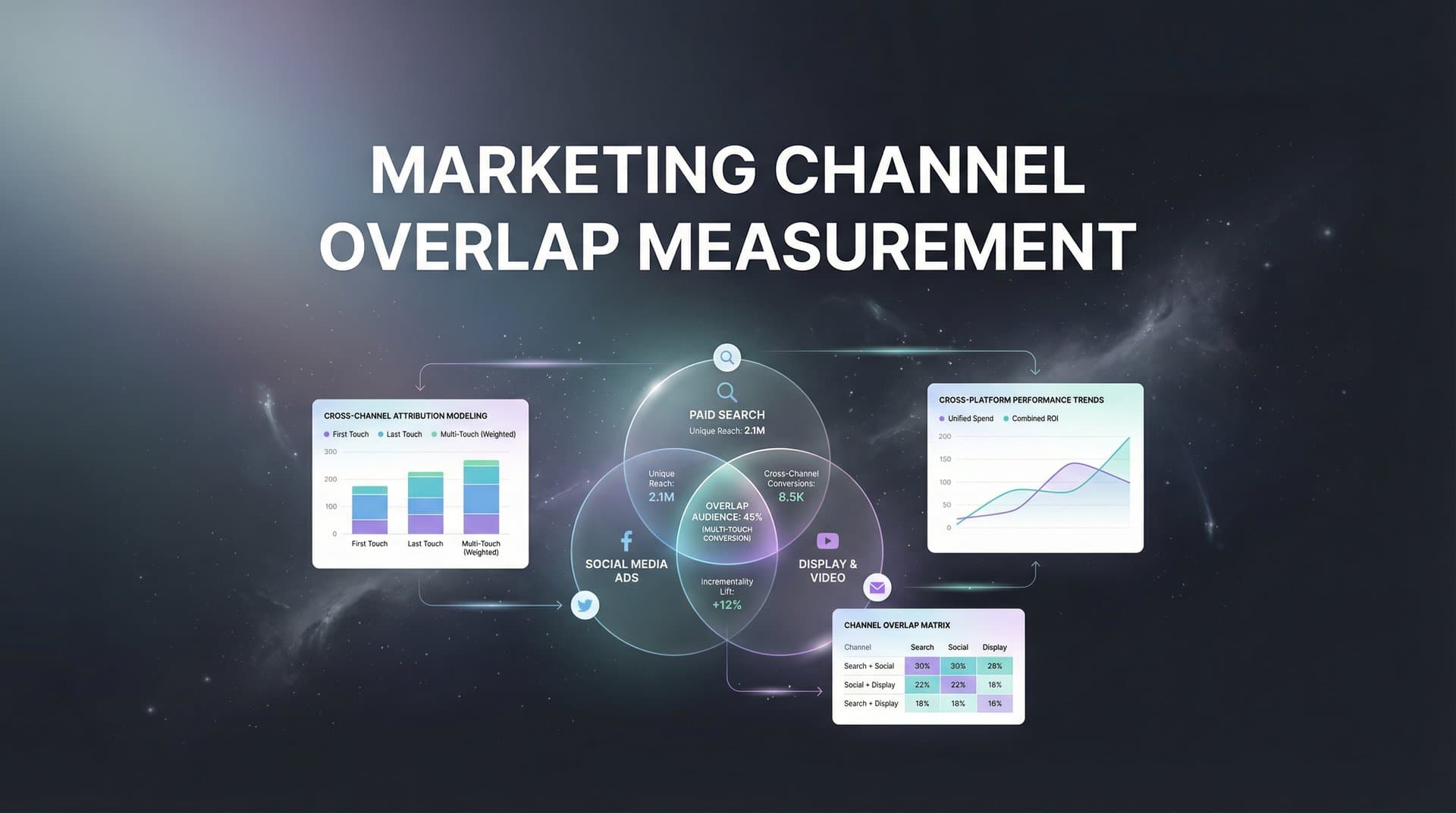
You're running Facebook ads, Google search campaigns, and email nurtures. Each platform's dashboard shows conversions. You add them up and realize something's wrong—the total is 40% higher than your actual sales. Welcome to the world of marketing channel overlap, where every platform claims credit for the same customer, inflating your metrics and hiding the truth about what's actually working.
This isn't just a reporting headache. It's costing you real money. When you can't see which channels truly drive conversions versus which ones just happen to be present in the journey, you end up over-investing in assisters while starving your real revenue drivers.
The solution? Measuring channel overlap accurately. This means understanding how your marketing channels interact in the customer journey, identifying where credit is being double-counted, and using that insight to make smarter budget decisions.
This guide walks you through the exact process for measuring marketing channel overlap. You'll learn how to map your current ecosystem, implement unified tracking, analyze multi-touch journeys, calculate overlap percentages, compare attribution models, and optimize your budget based on real insights. By the end, you'll have a clear framework for understanding which channels work together and which ones are simply inflating each other's numbers.
Step 1: Map Your Current Channel Ecosystem and Data Sources
Before you can measure overlap, you need to know what you're measuring. Start by creating a complete inventory of every marketing channel you're currently running. This includes the obvious ones—paid social, Google Ads, email marketing—but also the channels that often get overlooked like organic search, direct traffic, referral sources, and offline touchpoints.
List each channel with its current monthly spend and where you're currently tracking its performance. Most marketers discover they're looking at data in five or six different places: the Facebook Ads Manager, Google Ads dashboard, email platform analytics, Google Analytics, and maybe a CRM. Each tool is showing you conversions, but they're not talking to each other.
Next, document your current tracking methods. How are you tagging campaigns? Are you using UTM parameters consistently? Do you have different naming conventions across platforms? Write down the exact tracking setup for each channel, including any pixels, tags, or tracking codes you've implemented.
Now comes the critical part: identify your blind spots. Where are you missing data? Common gaps include conversions that happen offline or over the phone, mobile app events that aren't connected to your web tracking, and conversions from users who block cookies or use privacy-focused browsers.
Create a simple spreadsheet with columns for channel name, current spend, where data lives, tracking method, and known gaps. A well-structured marketing campaign tracking spreadsheet becomes your baseline—a clear picture of your current state before you start measuring overlap.
Success indicator: You have a complete written inventory showing all active channels, where their data currently lives, how they're tracked, and specific gaps in your current measurement setup. If you can't explain exactly how each channel reports conversions, you're not ready for the next step.
Step 2: Implement Unified Tracking Across All Touchpoints
Channel overlap becomes measurable only when all your channels feed data into a single source of truth. This step is about connecting your fragmented data sources into one unified system that can track the entire customer journey.
Start with consistent UTM parameters. Create a standardized naming convention for your campaigns across all channels. Your UTM structure should include source (where the traffic comes from), medium (the channel type), campaign name, and any additional parameters that matter to your business. The key word is consistent—Facebook ads and Google ads should follow the same naming logic.
Document this naming convention and share it with everyone who creates campaigns. A simple mistake like one person using "facebook" and another using "fb" breaks your ability to track channel overlap accurately.
Next, connect your ad platforms to a central attribution system. You need a platform that can ingest conversion data from Facebook, Google, your CRM, your email tool, and your website—then deduplicate it to show actual unique conversions. This is where tools like Cometly come in, capturing every touchpoint from ad clicks to CRM events and providing a complete view of each customer journey.
Implement server-side tracking alongside your existing client-side tracking. Browser-based tracking misses conversions from users with ad blockers, strict privacy settings, or those who convert on different devices. Server-side tracking captures these events by sending data directly from your server to your attribution platform, bypassing browser limitations entirely.
Connect your CRM to your attribution system. Many conversions happen days or weeks after the initial touchpoint, and your CRM holds that revenue data. Without this connection, you're only seeing part of the story—the click, but not the eventual sale. Implementing proper attribution marketing tracking ensures you capture the full customer journey.
Set up conversion events that matter to your business. Don't just track purchases. Track form submissions, demo requests, qualified leads, and any other meaningful action. Each event should pass through your unified tracking system with consistent identifiers that allow you to connect touchpoints to the same customer.
Success indicator: All your marketing channels are sending data to one central system. You can pull a report showing a single customer's journey across multiple channels, with every touchpoint visible in chronological order. If you still need to log into multiple platforms to see conversion data, your tracking isn't unified yet.
Step 3: Analyze Multi-Touch Customer Journeys
Now that your tracking is unified, you can finally see what's actually happening in your customer journeys. This step is about pulling back the curtain on how your channels interact before someone converts.
Start by running a multi-touch journey report. This shows all touchpoints that occurred before each conversion, not just the last click. You're looking for patterns—do customers typically see a Facebook ad, then search for your brand, then convert through an email? Or do they bounce between paid search and organic content before finally purchasing?
Pull a report showing the number of touchpoints per conversion. Calculate the average. Many businesses discover their customers touch 3-5 channels before converting, yet they've been optimizing based on last-click data that only shows the final touchpoint. This immediately reveals why your channels appear to be performing better in their native dashboards than they actually are.
Identify your most common channel sequences. Look for patterns like paid social followed by organic search, or email followed by direct traffic. These sequences tell you how channels work together. If you consistently see paid social leading to branded search conversions, that's not overlap—that's paid social doing its job of creating awareness that drives branded searches.
Calculate what percentage of your conversions involve multiple channels. If 70% of conversions touch two or more channels, you have significant overlap to measure. Understanding multi-channel attribution in digital marketing becomes essential when the majority of your conversions span multiple touchpoints.
Look at time between touchpoints. Are customers converting within hours of their first interaction, or does the journey span days or weeks? Longer journeys mean more opportunities for overlap and more complexity in attribution.
Segment your analysis by conversion value. High-value customers often have different journey patterns than low-value ones. You might discover that your biggest deals always involve multiple touchpoints across paid and organic channels, while smaller purchases happen quickly through a single channel.
Success indicator: You can describe your typical customer journey with specific data. You know the average number of touchpoints, the most common channel sequences, and what percentage of conversions involve multiple channels. This visibility is the foundation for measuring overlap accurately.
Step 4: Calculate Channel Overlap Percentages
This is where you quantify the problem. You're going to compare what your channels claim they're delivering versus what they're actually delivering after removing duplicates.
Start by pulling conversion numbers from each platform's native reporting. Facebook says it drove 500 conversions. Google Ads says 400. Email claims 200. Add them up and you get 1,100 conversions. Now check your actual deduplicated conversions in your unified tracking system. Let's say it shows 750 actual unique conversions. The difference—350 conversions—represents your total overlap.
Calculate your overall overlap rate: (Platform-Reported Conversions - Actual Conversions) / Platform-Reported Conversions. In this example, that's 350 / 1,100 = 32% overlap. Nearly a third of your reported conversions are duplicates being claimed by multiple channels.
Now break it down by channel pairs. Which combinations overlap most frequently? Pull a report showing conversions where both Facebook and Google touched the customer. Then Facebook and email. Then Google and email. You're looking for the channel pairs that most often appear together in the same customer journey.
Calculate overlap percentages for each pair. If 300 conversions involved both Facebook and Google, and Facebook reported 500 conversions total, then 60% of Facebook's conversions also involved Google. This tells you that Facebook is often working alongside Google rather than driving conversions independently. Proper cross-channel attribution helps you understand these relationships and their impact on marketing ROI.
Compare each channel's reported ROAS to its deduplicated ROAS. When you remove duplicate credit, ROAS numbers usually drop—sometimes dramatically. A channel showing 4x ROAS in its native dashboard might actually be delivering 2.5x when you account for overlap. This is the real number you should use for optimization decisions.
Identify which channels are the biggest overlap offenders. Often, remarketing campaigns and branded search have the highest overlap rates because they target customers who are already engaged through other channels. They're valuable for closing deals, but they're not initiating customer journeys—they're catching customers that other channels already warmed up.
Document your findings in a clear format: Channel name, native reported conversions, deduplicated conversions, overlap percentage, native ROAS, and deduplicated ROAS. This becomes your overlap scorecard.
Success indicator: You have specific percentages showing how much overlap exists between your major channel pairs. You know which channels are most frequently claiming credit for the same conversions and how much their ROAS numbers are inflated by overlap. These numbers are your guide for the next steps.
Step 5: Compare Attribution Models to Reveal True Channel Value
Different attribution models tell different stories about channel value. This step is about running your data through multiple models to understand how each channel contributes at different stages of the customer journey.
Start with last-touch attribution—the model most platforms use by default. This gives all credit to the final touchpoint before conversion. Pull a report showing channel performance under last-touch. You'll typically see direct traffic, branded search, and email performing well because they often close deals.
Now run the same data through first-touch attribution, which gives all credit to the channel that initiated the customer journey. This usually reveals that channels like paid social, display ads, and content marketing drive more value than last-touch suggests. They're not getting credit for conversions because they happen early in the journey, but they're creating the awareness that makes later conversions possible.
Apply a multi-touch attribution model that distributes credit across all touchpoints. Linear attribution splits credit evenly. Time-decay gives more credit to touchpoints closer to conversion. Position-based gives more credit to the first and last touchpoints. Understanding marketing channel attribution modeling helps you choose the model that best reflects how your customers actually buy.
Create a comparison table showing how each channel's conversion credit changes across models. You'll see patterns emerge. Channels that gain credit when you switch from last-touch to first-touch are your awareness drivers. Channels that lose credit are your closers. Both are valuable, but they serve different roles.
Look at how overlap changes under different models. With last-touch, overlap appears lower because only the final channel gets credit. With multi-touch, overlap becomes more visible because multiple channels share credit for the same conversion. This is actually more accurate—it reflects the reality that multiple channels influenced the decision.
Identify your initiators versus your closers. Initiators like paid social and content marketing might show lower ROAS under last-touch attribution but higher value under first-touch. Closers like remarketing and branded search show the opposite pattern. Understanding these roles helps you optimize each channel for its actual job in the customer journey.
Success indicator: You understand how each channel's apparent value changes under different attribution models. You can explain which channels are best at starting customer journeys versus closing them. This insight guides how you evaluate channel performance and make budget decisions.
Step 6: Optimize Budget Allocation Based on Overlap Insights
Now you can make smarter budget decisions based on actual channel performance, not inflated platform metrics. This step is about translating your overlap insights into action.
Start by identifying channels with excessive overlap and low independent conversion rates. If a channel shows 80% overlap and rarely converts customers on its own, it's primarily an assist channel. These channels are valuable for supporting the customer journey but probably don't deserve the same budget as channels that drive independent conversions.
Look at your high-value customer journeys. Which channels appear most frequently at the start of these journeys? These are your growth drivers. Even if their last-touch ROAS looks mediocre, they're initiating the journeys that lead to your best customers. Consider increasing investment here.
Test budget shifts based on your overlap data. If paid social and paid search heavily overlap, try reducing one while maintaining the other. Monitor total conversion volume, not just individual channel performance. If reducing paid search by 30% only drops total conversions by 10%, you've found inefficiency caused by overlap.
Adjust your channel mix to reduce redundant overlap. If remarketing and email are both targeting the same already-engaged customers, you might be over-investing in the closing phase while under-investing in awareness. Implementing effective multi-channel marketing strategies means balancing your investment across the entire funnel.
Use your deduplicated ROAS numbers for optimization decisions, not native platform ROAS. A channel showing 5x ROAS in its dashboard but only 2x after accounting for overlap needs different optimization than you thought. Learning how to measure ROI from multiple marketing channels accurately ensures you set target ROAS goals based on real numbers, and pause or adjust campaigns that don't meet them.
Monitor the impact of your changes on overall business metrics, not just channel metrics. The goal isn't to make each channel look better in isolation—it's to drive more revenue efficiently. Track total conversions, total revenue, and blended CAC as you optimize based on overlap insights.
Success indicator: You've made budget allocation changes based on overlap data and measured the impact on overall conversion volume and efficiency. Your ROAS improved without sacrificing total conversions, or you maintained ROAS while increasing total revenue. Either outcome proves you're optimizing based on reality rather than inflated metrics.
Putting It All Together
Measuring marketing channel overlap transforms how you understand and optimize your marketing performance. When you can see which channels truly drive conversions versus which ones simply assist or claim credit for work done by other channels, you make fundamentally different budget decisions.
Here's your quick implementation checklist: Map your current channel ecosystem and identify data gaps. Implement unified tracking that captures every touchpoint in one system. Analyze multi-touch customer journeys to understand how channels interact. Calculate specific overlap percentages between your major channel pairs. Compare attribution models to reveal each channel's true role in the customer journey. Optimize your budget allocation based on deduplicated performance data, not inflated platform metrics.
The key shift is moving from siloed platform reporting to a unified view of the customer journey. Every platform wants to claim maximum credit for conversions—that's how they justify their value. But when you measure overlap accurately, you see the real story: some channels initiate valuable journeys, some nurture consideration, and some close deals. All are important, but they deserve different levels of investment based on their actual contribution.
Start with your biggest spending channels and measure their overlap first. Even understanding overlap between your top two or three channels creates immediate optimization opportunities. As you expand measurement across your full channel mix, you'll discover patterns that fundamentally change how you allocate budget.
The businesses that master channel overlap measurement gain a massive competitive advantage. While competitors optimize based on inflated metrics and gut feelings, you're making decisions based on actual customer journey data. You know which channels work together, which ones compete for the same customers, and where to invest for maximum impact.
Ready to elevate your marketing game with precision and confidence? Discover how Cometly's AI-driven recommendations can transform your ad strategy—Get your free demo today and start capturing every touchpoint to maximize your conversions.