You're staring at your campaign dashboard, and the numbers look good. Google Search shows 150 conversions this month. Your attribution report tells a different story, though—and it's one that could be costing you thousands in misallocated ad spend.
Here's what actually happened: A customer first discovered your brand through a Facebook ad that caught their attention during their morning scroll. Two days later, they clicked an email you sent with a case study. A week after that, they searched your brand name on Google and converted. Google Analytics credits that final search click with the entire conversion. Facebook claims credit for the same conversion in Ads Manager. Your email platform also counts it as an email-driven sale.
Which channel actually deserves credit for that revenue?
This is the question marketing channel attribution modeling answers—and it's the difference between scaling campaigns that actually drive growth versus throwing money at channels that just happen to be present at the finish line. With customers now interacting with brands across 6-8 touchpoints before converting, understanding the complete journey isn't optional anymore. It's the foundation of profitable campaign scaling.
The Credit Assignment Problem Every Marketer Faces
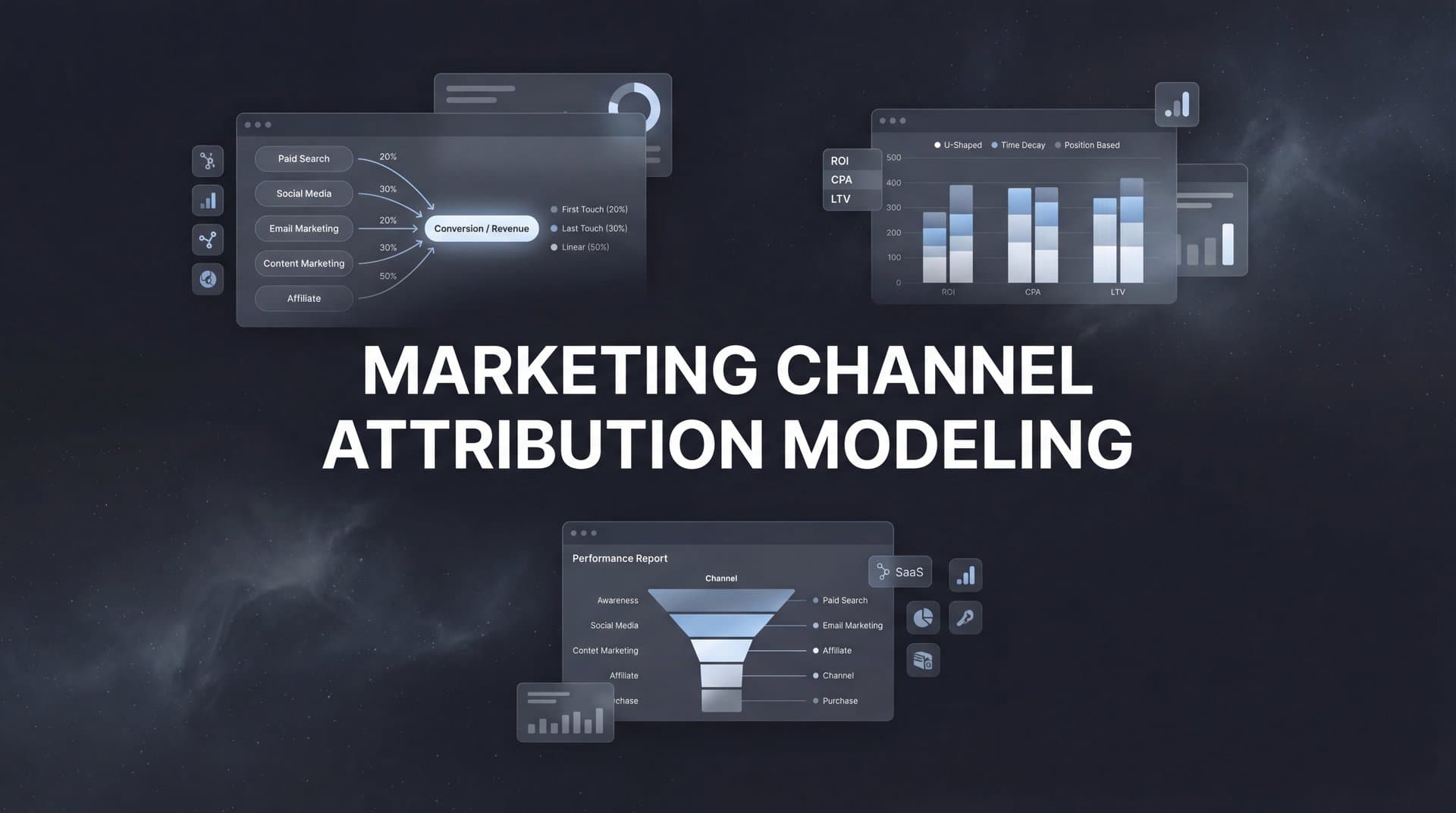
Marketing channel attribution modeling is the methodology for assigning conversion credit across every touchpoint in your customer journey. It's how you determine which ads, emails, social posts, and search clicks actually contributed to revenue—not just which one happened to be last.
Without it, you're making budget decisions based on a fundamentally distorted view of reality.
Here's the problem: every advertising platform operates in its own silo. Facebook Ads Manager uses a default 7-day click and 1-day view attribution window. Google Ads uses last-click attribution. Your email platform credits any conversion that happens within 30 days of an email click. Each platform is designed to make its own performance look as good as possible—which means they all claim full credit for the same conversions.
The math breaks immediately. If you add up the conversions reported across all your platforms, you'll often find you've somehow generated 150-200% of your actual conversions. This isn't a bug—it's the natural result of overlapping attribution windows and platform-specific reporting logic.
The real cost shows up in your budget allocation. Without proper attribution, you might see Google Search delivering a 5X return and decide to triple your budget there. What you don't see is that 80% of those "Google conversions" started with a Facebook ad that introduced your brand to cold traffic. You scale search, your cost per click increases, and suddenly your returns drop because you're not feeding the top of the funnel anymore.
Or you cut your email budget because it shows weak last-click performance—not realizing those emails are the critical middle touchpoint that moves prospects from awareness to consideration. Three months later, your conversion rates drop across all channels, and you can't figure out why.
This is why attribution modeling exists. It creates a unified view of your customer journey that shows which channels initiate relationships, which ones nurture prospects, and which ones close deals. With that clarity, you can allocate budget based on actual contribution to revenue rather than which platform happened to get the last click. Understanding what a marketing attribution model is becomes essential for any marketer serious about optimizing spend.
Single-Touch vs. Multi-Touch: Choosing Your Attribution Approach
Attribution models fall into two categories: single-touch models that assign all credit to one interaction, and multi-touch models that distribute credit across multiple touchpoints. Each serves different purposes, and understanding when to use which approach is critical.
First-Click Attribution: This model gives 100% of the credit to the first touchpoint in the customer journey. If someone discovered you through a Facebook ad, engaged with three emails, and converted via Google Search, Facebook gets all the credit. This model is valuable when you need to understand which channels are most effective at generating awareness and bringing new prospects into your ecosystem. It's particularly useful for top-of-funnel optimization and when evaluating brand awareness campaigns.
The limitation? It completely ignores everything that happened after that first interaction—all the nurturing, retargeting, and consideration-stage content that actually moved the prospect toward a purchase decision.
Last-Click Attribution: The opposite approach—100% of credit goes to the final touchpoint before conversion. This is Google Analytics' default model, which is why so many marketers overvalue bottom-funnel channels like branded search and retargeting. Last-click attribution works when you have a short sales cycle with minimal touchpoints, or when you specifically want to understand what's closing deals.
The problem becomes obvious with longer sales cycles. That branded search click that gets full credit? It only happened because a Facebook ad, two emails, and a retargeting campaign built enough interest for someone to search your brand name. Last-click attribution makes your bottom-funnel channels look like heroes while starving the top-of-funnel campaigns that feed them.
Linear Attribution: This multi-touch model distributes credit equally across all touchpoints. If a customer journey included five interactions, each gets 20% of the credit. Linear attribution provides a more complete picture than single-touch models and works well when every touchpoint genuinely contributes equally to the conversion—though in practice, that's rarely the case. Marketers exploring linear model marketing attribution software often find it useful as a starting point for multi-touch analysis.
Time-Decay Attribution: This model recognizes that touchpoints closer to conversion typically have more influence on the final decision. It assigns incrementally more credit to interactions as they get closer to the conversion event. Time-decay works well for considered purchases where recent interactions matter most, and it's particularly effective for B2B or high-ticket items where the final stages of the journey involve heavy evaluation.
Position-Based (U-Shaped) Attribution: This model typically assigns 40% of credit to the first touchpoint, 40% to the last touchpoint, and distributes the remaining 20% among all middle interactions. It acknowledges that both discovery and closing matter most, while still recognizing the role of nurturing touchpoints. Position-based attribution works well when you want to optimize both awareness and conversion channels simultaneously.
Data-Driven Attribution: The most sophisticated approach uses machine learning to analyze your actual conversion patterns and assign credit based on which touchpoints statistically increase the likelihood of conversion. Instead of using a predetermined formula, data-driven models learn from your specific customer journeys and adapt over time. This approach requires significant conversion volume to be effective—generally hundreds of conversions per month—but provides the most accurate view of channel contribution when you have the data to support it. Understanding how machine learning can be used in marketing attribution helps marketers leverage these advanced capabilities.
So which model should you use? Here's a practical framework: If you're running simple campaigns with short sales cycles and limited channels, start with last-click to understand what's closing deals. If you're running multi-channel campaigns with longer consideration periods, implement position-based attribution to balance awareness and conversion optimization. If you have substantial conversion volume and analytical resources, move toward data-driven attribution for the most accurate insights.
The smartest approach? Don't pick just one. Compare multiple attribution models side by side to understand the full picture of how your channels work together. A thorough comparison of attribution modeling vs marketing mix modeling can help you determine which methodology fits your specific business needs.
Building Your Attribution Foundation: Data Requirements and Setup
Attribution modeling only works if you're capturing accurate data across every touchpoint in your customer journey. This requires three foundational data pillars working together: ad platform data, website and app tracking, and conversion or CRM data.
Ad Platform Data: You need to capture click and impression data from every advertising channel you use—Facebook, Google, LinkedIn, TikTok, display networks, and any other paid channels. This includes not just whether someone clicked, but the specific campaign, ad set, ad creative, and timestamp of each interaction. Most attribution platforms connect directly to ad platform APIs to pull this data automatically, but you need to ensure those connections are properly configured and refreshing regularly.
Website and App Tracking: This is where many attribution setups break down. You need to track every meaningful interaction on your website or app—page views, form submissions, button clicks, video views, and any other engagement signals that indicate progression through your funnel. Standard tools like Google Analytics provide basic tracking, but they're limited by client-side tracking that relies on browser cookies and JavaScript.
Here's where it gets complicated: iOS 14.5 and subsequent privacy updates fundamentally broke client-side tracking. When users opt out of tracking on iOS devices, your website tracking pixel can't follow them across sessions or connect their ad clicks to eventual conversions. Cookie restrictions in browsers like Safari and Firefox create similar gaps. The result is that traditional pixel-based tracking now misses 30-50% of actual conversions, making your attribution data incomplete from the start.
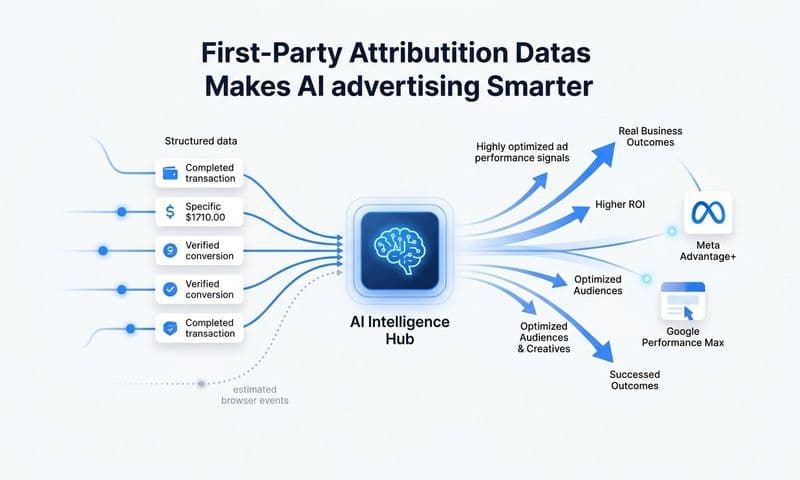
Server-side tracking solves this problem by capturing event data on your server rather than relying on browser-based tracking. When someone submits a form or completes a purchase, your server logs that event directly and can match it back to ad clicks using first-party data like email addresses or customer IDs. This approach isn't blocked by iOS restrictions or browser privacy settings, which means you capture a complete picture of customer behavior even in a privacy-first world. A comprehensive attribution marketing tracking guide can walk you through implementing these solutions effectively.
CRM and Conversion Data: The final pillar connects your marketing touchpoints to actual business outcomes. You need to know not just that someone converted, but the revenue value of that conversion, whether they became a qualified lead, and what happened after the initial conversion. For e-commerce, this means order values and customer lifetime value. For B2B, it means lead status, opportunity value, and closed-won revenue.
Integration with your CRM (Salesforce, HubSpot, Pipedrive) or e-commerce platform (Shopify, WooCommerce) enables you to track the complete journey from first ad click through to revenue. This is critical because not all conversions are equal—a $50 customer and a $5,000 customer shouldn't receive the same attribution weight, and a marketing-qualified lead that never converts to sales shouldn't be valued the same as one that closes. Platforms focused on marketing attribution and revenue tracking make this connection seamless.
The technical challenge is connecting these three data sources into a unified view. You need a way to identify that the person who clicked your Facebook ad, visited your website three times, opened two emails, and eventually converted is the same individual across all those touchpoints. This requires identity resolution—matching anonymous website visitors to known users through email addresses, phone numbers, or customer IDs.
Most businesses implement this through a combination of UTM parameters (to track ad clicks), website tracking pixels or server-side tracking (to capture behavior), and form submissions or account creation (to connect anonymous visitors to known identities). The key is ensuring every touchpoint includes enough data to be matched back to the same customer journey.
Without this foundation, attribution modeling becomes guesswork. You might assign credit to channels based on incomplete data, missing the touchpoints that actually drove conversions. Get the data infrastructure right first, and the attribution insights follow naturally.
Turning Attribution Data Into Budget Decisions
Having attribution data is one thing. Using it to make smarter budget decisions is where the real value emerges. The goal isn't just to understand which channels get credit—it's to identify where your next dollar of ad spend will generate the highest return.
Start by learning to read attribution reports through two lenses: channels that initiate customer journeys versus channels that close them. In a position-based attribution model, you might see that Facebook and LinkedIn drive 60% of first-touch interactions—they're your awareness engines, introducing new prospects to your brand. Meanwhile, Google Search and retargeting campaigns capture 70% of last-touch credit—they're your closers, converting prospects who are already familiar with your offering.
This distinction matters enormously for budget allocation. If you only looked at last-click attribution, you'd conclude that Google Search is your highest-performing channel and shift more budget there. But if you cut your Facebook spend to fund that Google expansion, you'd be starving the top of your funnel. Three months later, your Google Search volume would drop because fewer people know your brand exists to search for it.
The smarter move is to recognize that these channels work together. Facebook creates the awareness that makes branded search possible. Your budget allocation should reflect this relationship—maintaining healthy investment in awareness channels while optimizing your conversion channels for efficiency. Mastering cross-channel attribution for marketing ROI is essential for understanding these interdependencies.
Understanding Assisted Conversions: This is where attribution modeling reveals its greatest value. Assisted conversions are touchpoints that contributed to a customer journey but didn't receive last-click credit. A channel might have a low last-click conversion count but a high assisted conversion rate—meaning it plays a critical role in moving prospects through your funnel even though it rarely closes deals directly.
Email marketing often falls into this category. It might show weak last-click performance, but when you examine assisted conversions, you discover it's present in 70% of all customer journeys. Those emails aren't closing deals, but they're nurturing prospects and keeping your brand top-of-mind during the consideration phase. Cut your email budget based on last-click data, and you'll damage conversion rates across all channels.
The same pattern appears with content marketing, social media engagement, and display advertising. These channels often look underwhelming in last-click reports but prove essential when you examine their role in the complete customer journey. Exploring content marketing attribution modeling with machine learning can reveal these hidden contributions.
Making Data-Driven Reallocation Decisions: Once you understand which channels initiate journeys, which ones assist, and which ones close, you can make informed budget decisions. Look for these patterns in your attribution data:
High first-touch, low last-touch: These channels are effective at generating awareness but weak at direct conversion. Don't judge them on conversion metrics alone. Evaluate them based on cost per new prospect introduced to your ecosystem, and ensure you have strong nurturing mechanisms to move those prospects through the funnel.
Low first-touch, high last-touch: These channels capture existing demand but don't create new opportunities. They're important for efficiency, but scaling them won't drive incremental growth unless you're also feeding the top of your funnel. These are typically branded search, retargeting, and direct traffic.
High assisted conversions, low direct credit: These are your undervalued channels. They're contributing significantly to revenue but don't show up in simple last-click reports. Protect these budgets—cutting them will hurt overall performance even if their direct conversion numbers look weak.
Low contribution across all attribution models: These are your true underperformers. If a channel shows weak first-touch, last-touch, and assisted conversion metrics across multiple attribution models, it's genuinely not pulling its weight. These are your candidates for budget cuts or strategic pivots.
The most effective approach is to run attribution analysis monthly and make incremental budget adjustments based on what you learn. Shift 10-15% of budget from underperforming channels to those showing strong contribution but limited scale. Monitor the results for 30 days, then make your next adjustment. This iterative approach lets you optimize without making dramatic changes that could destabilize your entire funnel.
Common Attribution Pitfalls and How to Avoid Them
Even with solid attribution infrastructure, marketers fall into predictable traps that distort their data and lead to poor decisions. Here are the three most common pitfalls and how to avoid them.
Pitfall 1: Over-Relying on a Single Attribution Model. No single attribution model tells the complete story. Last-click attribution makes bottom-funnel channels look like heroes while ignoring awareness efforts. First-click attribution overvalues top-of-funnel channels while dismissing the nurturing required to close deals. Even data-driven models have limitations—they can only optimize based on trackable interactions, missing offline conversations and word-of-mouth referrals.
The solution is to compare multiple attribution views simultaneously. Run last-click, first-click, and position-based attribution in parallel. When you see a channel performing strongly across all three models, you can be confident it's genuinely valuable. When a channel only looks good in one model, you understand its specific role in your funnel rather than mistaking it for your top performer overall. Understanding the attribution challenges in marketing analytics helps you navigate these complexities more effectively.
Think of attribution models like different camera angles filming the same event. One angle shows you the wide shot, another focuses on key players, a third captures the details. You need all three perspectives to understand what actually happened.
Pitfall 2: Ignoring Offline and Dark Social Touchpoints. Your attribution data only captures trackable interactions—ad clicks, website visits, email opens. It misses the podcast your prospect listened to during their commute, the conversation they had with a colleague who recommended your product, the LinkedIn post they saw but didn't click, and the word-of-mouth referral that prompted them to search your brand.
These "dark social" touchpoints are invisible to attribution systems but can be the most influential moments in a customer journey. Someone might see your Facebook ad five times without clicking, building familiarity and trust, then finally search your brand name and convert. Your attribution system credits that branded search, missing the Facebook ads that created the awareness.
You can't track everything, but you can account for the gap. Survey new customers about how they first heard about you and what influenced their decision. Compare survey responses to your attribution data. If 40% of customers mention podcast advertising but your attribution shows zero podcast conversions, you know there's a significant dark social effect you need to factor into your budget decisions.
Similarly, if you're running offline marketing—events, direct mail, TV, radio—implement tracking mechanisms like unique promo codes or dedicated landing pages to capture at least some of that impact. Accept that your attribution data is incomplete and use qualitative feedback to fill the gaps.
Pitfall 3: Setting and Forgetting Your Attribution Model. Customer behavior changes. New channels emerge. Your marketing mix evolves. An attribution model that accurately reflected your business six months ago might be completely wrong today.
If you launched a new awareness channel, your attribution windows might need adjustment to capture longer customer journeys. If you shifted from B2C to B2B customers, your sales cycle probably lengthened, requiring different attribution logic. If iOS privacy changes reduced your tracking accuracy, you might need to implement server-side tracking or adjust how you weight different data sources.
Schedule quarterly attribution audits. Compare your attribution data to actual closed revenue. Interview your sales team about what they're hearing from prospects regarding how they discovered your company. Test different attribution windows and models to see if they reveal new insights. Attribution modeling isn't a one-time setup—it's an ongoing process of refinement as your business and market evolve.
Putting Attribution Into Practice: Your 30-Day Action Plan
Theory is valuable, but implementation is where attribution modeling creates real business impact. Here's a practical 30-day plan to move from basic tracking to actionable attribution insights.
Week 1-2: Audit Your Current Tracking Setup. Start by mapping every marketing channel you're running and documenting what tracking is currently in place. Check that UTM parameters are consistently applied to all paid campaigns. Verify that your website tracking is firing correctly on key conversion pages. Test form submissions to ensure they're being captured in your analytics platform.
Identify the gaps. Are there channels running without proper tracking? Do you have visibility into assisted conversions, or just last-click data? Is your tracking capturing cross-device journeys, or losing customers when they switch from mobile to desktop? Can you connect website visitors to CRM records for closed-loop attribution? Reviewing the features of marketing attribution software can help you identify what capabilities you need.
This audit will reveal where you're blind. Document every gap, prioritize them by potential impact, and create a remediation plan. The most critical fixes are usually implementing server-side tracking to address iOS limitations and connecting your CRM to your marketing data to track conversions through to revenue.
Week 3: Implement Multi-Touch Attribution and Run Comparisons. Set up at least three attribution models—last-click, first-click, and position-based—and run them in parallel against the same data set. Most analytics platforms and attribution tools allow you to view the same conversion data through multiple attribution lenses simultaneously. A dedicated multi-touch marketing attribution platform can simplify this process significantly.
Generate reports showing how each channel performs under each model. You'll immediately see which channels are overvalued by last-click attribution and which are undervalued. Calculate the difference between each model's channel valuations to understand how sensitive your budget decisions are to attribution methodology.
This comparison phase is critical. It prevents you from making dramatic budget changes based on a single attribution view that might be misleading. When you see consistent patterns across multiple models, you can move forward with confidence.
Week 4: Make Your First Data-Driven Budget Reallocation. Based on your multi-model attribution analysis, identify one clear budget optimization opportunity. This might be increasing spend on a channel that shows strong first-touch and assisted conversion performance but has been underfunded. Or it might be reducing spend on a channel that only looks good in last-click attribution but contributes little to the overall customer journey.
Make a 10-15% budget shift. This is large enough to generate measurable results but small enough that you won't destabilize your entire marketing operation if your analysis was slightly off. Document your hypothesis, implement the change, and establish clear success metrics you'll evaluate after 30 days.
Set up a monthly review cadence where you examine attribution data, compare it to actual revenue results, and make incremental optimizations. Attribution modeling isn't a one-time project—it's an ongoing process of learning what drives results and continuously refining your approach based on data.
Your Path to Attribution-Driven Growth
Marketing channel attribution modeling isn't just a reporting upgrade or an analytics nice-to-have. It's the fundamental difference between guessing which campaigns drive revenue and actually knowing. It's what separates marketers who scale profitably from those who burn budget on channels that look good in platform dashboards but don't contribute to the bottom line.
The core principle is straightforward: start with a clear attribution model that matches your sales cycle and channel complexity. Ensure your data infrastructure captures the complete customer journey—from first touchpoint through conversion to revenue. Then use those insights to continuously optimize how you allocate budget across channels.
The marketers who win in the next decade won't be those with the biggest budgets. They'll be those who understand exactly which channels drive incremental revenue and can prove it with data. They'll know which campaigns to scale, which to optimize, and which to cut—not based on platform-reported metrics that overcount conversions, but based on unified attribution data that shows the complete picture.
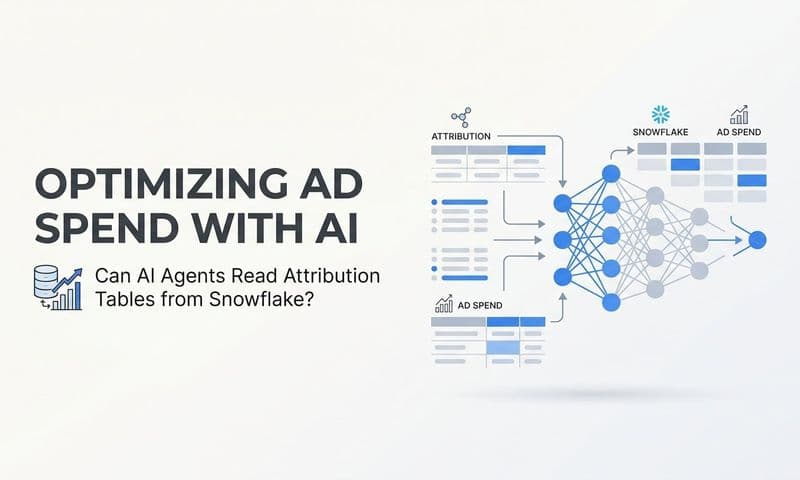
AI-powered attribution tools are making this process faster and more accurate than ever before. Instead of manually comparing attribution models and calculating channel contribution, modern platforms use machine learning to analyze customer journeys, identify patterns, and provide optimization recommendations automatically. They can process millions of touchpoints, account for complex interactions between channels, and surface insights that would take weeks to uncover manually.
The opportunity is clear. Customers are using more touchpoints than ever before making purchase decisions. Privacy changes have made simple tracking less reliable. Competition for ad inventory is driving costs up across every platform. In this environment, the marketers who understand attribution and use it to guide budget decisions will capture market share while their competitors waste spend on channels that don't drive real results.
Ready to elevate your marketing game with precision and confidence? Discover how Cometly's AI-driven recommendations can transform your ad strategy—Get your free demo today and start capturing every touchpoint to maximize your conversions.