

You've just spent $50,000 on Facebook ads promoting your mobile app. A user sees your ad on their laptop during lunch, clicks through on their phone during their commute, and finally installs your app three days later on their tablet. Two weeks after that, they make their first purchase. Which campaign gets credit? Which device? Which touchpoint actually mattered?
This is the reality of modern app marketing. Users don't follow neat, linear paths anymore. They bounce between devices, platforms, and channels before converting. Without proper attribution, you're essentially flying blind—making budget decisions based on incomplete data while your competitors who've figured out attribution are scaling confidently.
Mobile app conversion attribution solves this puzzle by connecting every touchpoint in the customer journey, from that first ad impression to the final revenue event. As app marketing budgets continue to grow and privacy regulations reshape how we track users, accurate attribution has shifted from "nice to have" to absolutely essential. Let's break down exactly how it works and why it matters for your bottom line.
The Technical Journey from Ad Click to Revenue Event
Mobile app attribution isn't magic. It's a sophisticated system of tracking, matching, and crediting that happens behind the scenes every time someone interacts with your ads and eventually converts in your app.
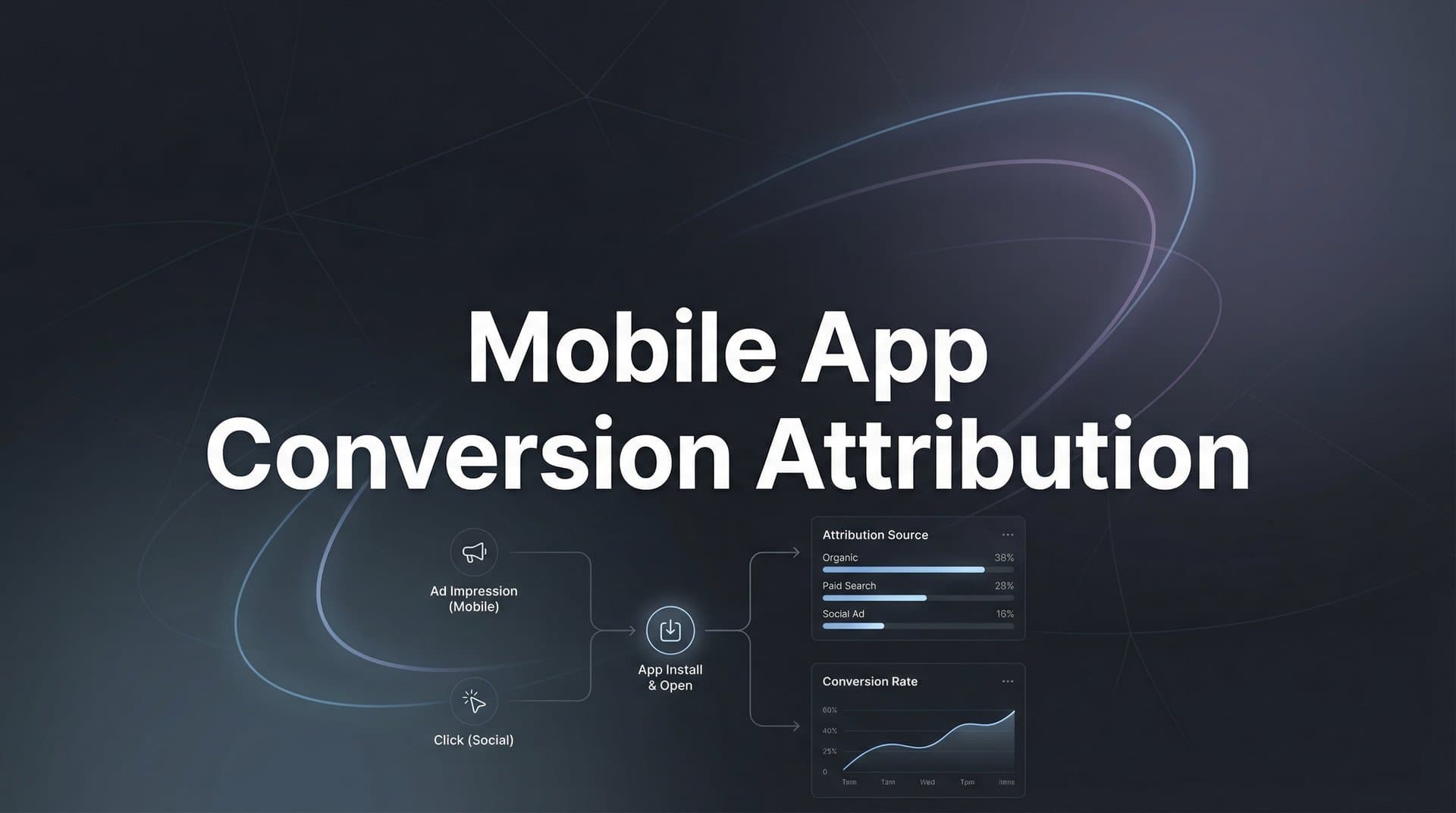
Here's what actually happens: When a user clicks your ad, the ad platform passes specific information to a Mobile Measurement Partner (MMP) or attribution platform. This includes details like the campaign ID, creative variation, timestamp, and most importantly, device identifiers. The attribution platform stores this "click event" and waits.
When that same user installs your app, the app sends an "install event" to the attribution platform. Now comes the crucial matching process. The platform compares the device information from the install against its database of recent ad clicks. If it finds a match within your defined attribution window, it credits that specific ad click with driving the install. Understanding how app marketing attribution works is essential for optimizing your campaigns.
But installation is just the beginning. The real value comes from tracking what happens next. When users complete meaningful actions—creating an account, making a purchase, subscribing—your app sends these conversion events to the attribution platform. This creates a complete picture: which ad drove the install, and which installs led to actual revenue.
Device identifiers make this matching possible. On iOS devices, that's the Identifier for Advertisers (IDFA). On Android, it's the Google Advertising ID (GAID). These unique identifiers allow attribution platforms to say with certainty: "This is the same person who clicked the ad and later installed the app."
At least, that's how it used to work. Privacy changes have complicated this process significantly, which we'll explore shortly.
The matching itself happens through two methods. Deterministic matching uses exact device identifiers to create perfect matches between ad clicks and app installs. This is the gold standard—you know with certainty that the person who clicked is the person who installed.
Probabilistic matching, sometimes called fingerprinting, takes a different approach. When device IDs aren't available, attribution platforms look at other signals: IP address, device type, operating system version, screen resolution, language settings, and timing. By comparing these data points, they make educated guesses about whether an ad click and an app install came from the same user.
Think of deterministic matching as facial recognition and probabilistic matching as identifying someone by their height, build, and clothing. One is definitive, the other is probabilistic but still useful when the definitive method isn't available.
Attribution Models: How You Decide Who Gets Credit
Choosing an attribution model is like choosing which story to tell about your marketing performance. The same data can tell very different stories depending on which touchpoints you decide to credit.
Last-click attribution is the simplest model. It gives 100% of the credit to the final touchpoint before conversion. If a user saw five of your ads across different platforms but clicked the last one before installing, that final click gets all the glory. This model is popular because it's straightforward and focuses on the touchpoint that directly preceded the conversion. To understand what attribution model approach is mainly used in marketing, you need to consider your specific business goals.
For app install campaigns with short consideration cycles, last-click often makes sense. If someone searches for "meditation app," clicks your Google ad, and installs immediately, that last click probably did drive the decision. But what about longer journeys?
Multi-touch attribution distributes credit across multiple touchpoints. A user might see your YouTube ad (first touch), click a Facebook retargeting ad (middle touch), and finally click a Google search ad before installing (last touch). Multi-touch models recognize that each of these interactions played a role in the conversion.
Different multi-touch models weight these touchpoints differently. Linear attribution splits credit evenly. Time-decay gives more credit to recent touchpoints. Position-based (also called U-shaped) gives extra weight to the first and last touches while distributing the remainder across middle interactions.
Here's where it gets interesting for app marketers: view-through attribution. Not everyone who sees your ad clicks immediately. Many users see an ad, don't engage, but later search for your app in the app store and install. Should that initial ad impression get any credit?
View-through attribution says yes, as long as the install happens within a specific window (typically 24 hours to 7 days after the ad impression). This model is particularly valuable for awareness-focused campaigns where you're building familiarity rather than driving immediate clicks. Without view-through attribution, these campaigns would appear completely ineffective even though they're influencing behavior.
Attribution windows dramatically change which channels get credit. A 1-day click window only credits ad clicks if the install happens within 24 hours. A 7-day window extends that grace period to a week. A 30-day window captures conversions that happen up to a month later. Learning what is conversion window attribution helps you set appropriate timeframes for your campaigns.
Shorter windows favor lower-funnel channels like search ads where intent is high and conversions happen quickly. Longer windows favor upper-funnel channels like social media where users need more time to decide. There's no universally correct window—it depends on your typical customer journey length and which behaviors you want to encourage.
The Privacy Revolution That Changed Everything
If you've been doing app marketing for more than a few years, you remember the before times. Attribution was granular, user-level, and relatively straightforward. Then Apple dropped a bomb that reshaped the entire industry.
iOS 14.5 introduced App Tracking Transparency (ATT) in April 2021. Suddenly, apps had to explicitly ask users for permission to track them across other companies' apps and websites. That permission request is what unlocks access to the IDFA—the device identifier that made deterministic attribution possible.
The result? Most users declined. Industry observations suggest opt-in rates typically fall well below 50%, meaning the majority of iOS users are now invisible to traditional attribution methods. For app marketers who relied on granular, user-level data to optimize campaigns, this was devastating. Many marketers found themselves unable to track mobile app conversions with their existing tools.
Apple's solution was SKAdNetwork, a privacy-preserving attribution framework that provides conversion data without revealing individual user identities. Instead of seeing "User A clicked Ad B and made a $50 purchase," you see aggregated data like "Campaign X drove 100 installs with a total conversion value of $5,000."
SKAdNetwork comes with significant limitations. Data is delayed by 24-72 hours. You can only pass limited conversion information. You can't track users across multiple campaigns or see their complete journey. It's attribution with blinders on—you get directional insights but lose the granular visibility that powered sophisticated optimization.
Google is following a similar path with Privacy Sandbox for Android. While not as restrictive as Apple's approach yet, the direction is clear: the industry is moving away from individual user tracking toward privacy-preserving alternatives. The GAID will eventually become less accessible, just like the IDFA.
This is where server-side tracking becomes critical. Instead of relying entirely on client-side cookies and device IDs that users can block, server-side tracking captures first-party data directly from your app and sends conversion events to ad platforms from your own servers.
When a user completes a purchase in your app, your server sends that conversion event directly to Facebook, Google, and other platforms. This happens regardless of whether the user opted into tracking, because you're sharing aggregated conversion data, not tracking individual users across apps. The ad platforms receive the conversion signals they need to optimize campaigns without violating user privacy.
Server-side tracking has become the new standard for maintaining attribution quality in a privacy-first world. It's not a workaround—it's a fundamental shift in how conversion data flows between your app and your advertising platforms.
Building an Attribution System That Reveals What Actually Works
Accurate attribution requires more than just installing a tracking SDK. You need a comprehensive system that connects every piece of your marketing technology stack into a unified view of performance.
Start by connecting your ad platforms to your attribution solution. Facebook, Google, TikTok, Snapchat—wherever you're running app install campaigns, those platforms need to communicate with your attribution system. This connection allows the attribution platform to receive click and impression data from your ads and later match them to app installs and conversion events. Implementing proper mobile app attribution tracking is the foundation of this process.
Next, integrate your app analytics. Tools like Firebase, Amplitude, or Mixpanel track user behavior inside your app, but they need to share data with your attribution platform to complete the picture. When someone makes a purchase, upgrades to premium, or completes another valuable action, that event needs to flow back to your attribution system so it can credit the right marketing touchpoint.
Revenue data integration is where many app marketers fall short. You're tracking installs and maybe some basic events, but are you connecting actual revenue back to specific campaigns? If your app generates revenue through in-app purchases, subscriptions, or advertising, that financial data needs to feed into your attribution platform. This is how you move from vanity metrics like install counts to actual ROI analysis.
Event tracking setup determines whether your attribution system provides meaningful insights or just surface-level data. Installing an app is one event, but what happens next? You need to define and track the conversion events that actually matter for your business.
For a gaming app, that might be completing the tutorial, reaching level 5, and making the first in-app purchase. For a subscription app, it's completing onboarding, starting a trial, and converting to paid. For an e-commerce app, it's viewing products, adding to cart, and completing checkout. Each of these events should be tracked separately so you can see which campaigns drive not just installs, but engaged, valuable users. Proper conversion tracking for app installs goes far beyond the initial download.
The real power of attribution comes from closing the optimization loop. Once you know which campaigns drive valuable conversions, you can feed that data back to ad platforms to improve their targeting algorithms. This is conversion sync in action.
When you send high-quality conversion events back to Facebook or Google, their machine learning systems learn what a valuable user looks like. They start finding more people similar to your best converters. Your cost per acquisition drops because the platforms are optimizing for actual value, not just installs.
This feedback loop is why server-side tracking matters so much. The more accurate conversion data you can send to ad platforms, the better they perform. It's not just about measuring what happened—it's about using attribution data to actively improve future performance.
The Attribution Blind Spots Burning Your Budget
Even with a solid attribution system in place, there are common gaps that cause marketers to misallocate budgets and miss optimization opportunities.
Cross-device journeys break traditional attribution chains. A user sees your ad on their desktop computer at work, but later installs your app on their phone. Without cross-device tracking, these touchpoints appear disconnected. The desktop ad impression looks ineffective because it didn't lead to an install on that device, even though it influenced the decision. Investing in cross platform attribution tracking helps solve this challenge.
Some attribution platforms attempt cross-device matching using probabilistic methods or by tracking logged-in users across devices. But many journeys remain invisible, particularly when users aren't logged in during their initial ad exposure. This gap means upper-funnel desktop campaigns often appear less effective than they actually are.
The organic versus paid attribution conflict creates another major blind spot. A user clicks your paid ad, doesn't install immediately, but later searches for your app in the app store and installs organically. Should the paid ad get credit, or is this a truly organic install that would have happened anyway?
Different attribution platforms handle this differently. Some credit the last paid touchpoint within the attribution window, even if the actual install came through organic search. Others only credit paid campaigns if the install happens directly from the ad. This inconsistency makes it difficult to assess whether your paid campaigns are driving incremental installs or just taking credit for users who would have found you anyway.
Cannibalization issues compound this problem. You might be running both brand search campaigns and non-brand campaigns. Users who click your brand ad were probably already aware of your app and might have installed organically. Are you paying for installs you would have gotten for free?
Self-reported ad platform data creates perhaps the biggest attribution gap. When you look at Facebook Ads Manager or Google Ads, the conversion numbers often look better than what your independent attribution platform reports. Why the discrepancy? Understanding the difference between Google Analytics vs attribution software clarifies why these numbers rarely match.
Ad platforms use their own attribution windows and methodologies that tend to be more generous in giving themselves credit. Facebook might claim credit for a conversion that happened 28 days after someone viewed your ad, while your attribution platform uses a 7-day window. Google might credit an install to a display ad impression, while your attribution platform credits the search ad that came later.
Neither is necessarily wrong—they're just measuring differently. But this gap means you can't rely solely on ad platform reporting to make budget decisions. You need an independent attribution solution that applies consistent methodology across all channels so you can compare apples to apples.
The temptation is to believe the higher numbers from ad platforms because they make your campaigns look more successful. Resist this. Accurate attribution might show lower conversion counts, but it reveals which campaigns truly drive incremental value. That's the data you need to scale efficiently.
Your Path to Attribution-Driven Growth
Mobile app conversion attribution isn't optional anymore. It's the foundation that separates app marketers who scale profitably from those who burn budgets on campaigns that look good on paper but don't drive real results.
The competitive advantage goes to marketers who can see the complete customer journey. Who understand which touchpoints actually influence installs and which campaigns drive users who stick around and generate revenue. Who can feed accurate conversion data back to ad platforms to improve targeting and reduce acquisition costs.
Privacy changes have made attribution more complex, but they've also created an opportunity. While some marketers struggle with limited data and fragmented tracking, those who invest in proper attribution infrastructure—with server-side tracking, multi-touch models, and unified data connections—are gaining clearer insights than ever before.
The path forward is clear: connect your ad platforms, app analytics, and revenue data into a single source of truth. Track meaningful conversion events beyond just installs. Use attribution data not just to measure what happened, but to actively optimize what happens next. Close the loop by sending conversion signals back to ad platforms so their algorithms learn what success looks like for your business.
Ready to elevate your marketing game with precision and confidence? Discover how Cometly's AI-driven recommendations can transform your ad strategy—Get your free demo today and start capturing every touchpoint to maximize your conversions.



