

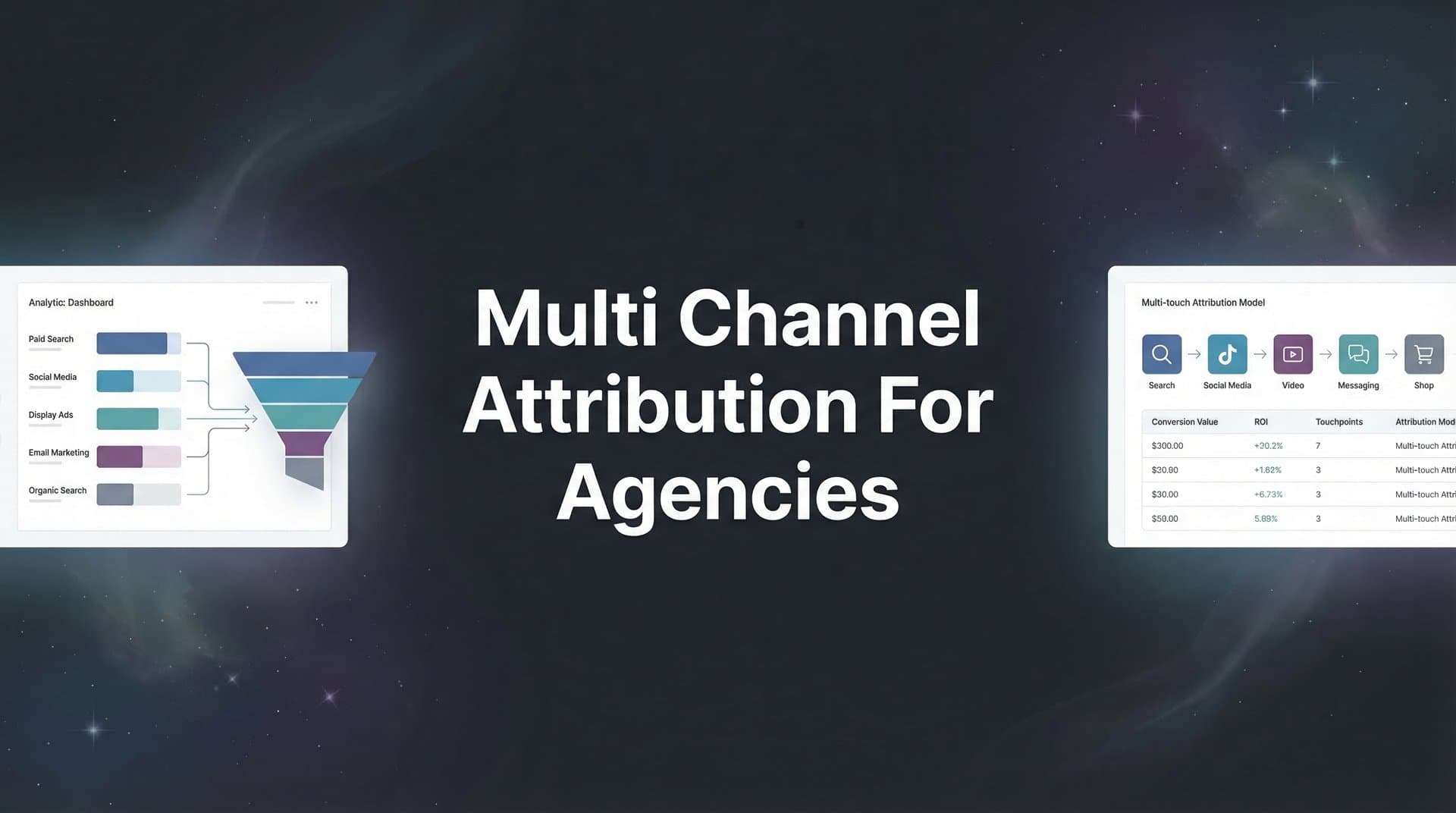
Agencies managing client campaigns across Meta, Google, TikTok, and LinkedIn face a fundamental challenge: proving which channels actually drive revenue. When clients ask "Where should we spend more?" and platform data tells conflicting stories, attribution becomes the difference between confident recommendations and educated guesses.
The problem isn't just about tracking clicks or impressions. It's about connecting every touchpoint—from that first TikTok video view to the final form submission—to actual conversions and revenue. Without this visibility, agencies are forced to rely on platform-reported metrics that each claim credit for the same conversion, making it nearly impossible to optimize budgets with confidence.
Multi-channel attribution solves this by creating a unified view of the customer journey across all platforms. It shows which channels work together to drive results, which touchpoints matter most at different stages, and where budget shifts will have the biggest impact. For agencies, this transforms client relationships from "Here's what we spent" to "Here's exactly what's working and why."
This guide covers seven battle-tested strategies that help agencies implement attribution systems that scale across client portfolios. These aren't theoretical concepts—they're practical frameworks that address the real challenges agencies face when managing attribution for multiple clients with different business models, sales cycles, and channel strategies.
1. Unify Tracking Infrastructure Before Adding Channels
The Challenge It Solves
Agencies often inherit clients with fragmented tracking setups: some pixels fire correctly, others don't, UTM parameters follow different conventions across campaigns, and conversion definitions vary by platform. When you try to layer attribution on top of inconsistent tracking, you're building on a foundation that can't support accurate analysis. The result? Data you can't trust and recommendations you can't make with confidence.
The Strategy Explained
Before implementing any attribution model, establish a unified tracking infrastructure that captures consistent data across all channels. This means implementing server-side tracking to bypass browser-based limitations, creating standardized UTM parameter conventions that work across all clients, and ensuring conversion events fire reliably regardless of platform.
Server-side tracking has become particularly important as browser restrictions and privacy regulations limit traditional pixel-based tracking. By processing conversion data on your server before sending it to ad platforms, you capture more complete data and maintain control over what gets tracked and how.
Think of this as building the foundation before constructing the house. You can't accurately attribute conversions to channels if you're not reliably tracking those conversions in the first place. This foundational work prevents the "garbage in, garbage out" problem that undermines attribution efforts.
Implementation Steps
1. Audit existing tracking across all client accounts to identify gaps, inconsistencies, and reliability issues in current conversion tracking.
2. Implement server-side tracking solutions that capture conversion data independently of browser-based pixels and cookies.
3. Create standardized UTM parameter templates that include campaign source, medium, campaign name, ad group, and creative ID across all platforms.
4. Document conversion event definitions clearly—what constitutes a lead, qualified lead, and sale—and ensure these fire consistently across all platforms.
5. Test tracking infrastructure thoroughly before launching new campaigns, verifying that conversion data flows correctly from ad click through to final conversion event.
Pro Tips
Build tracking infrastructure templates you can deploy quickly across new client accounts. Create a standardized onboarding checklist that covers server-side tracking setup, UTM conventions, and conversion event definitions. This consistency makes it easier to scale attribution practices across your client portfolio and reduces setup time for new accounts.
2. Match Attribution Models to Client Business Cycles
The Challenge It Solves
Not all attribution models work equally well for all businesses. A last-click model might work fine for ecommerce clients with short sales cycles, but it completely misses the value of top-of-funnel touchpoints for B2B clients with six-month sales processes. When agencies apply the same attribution model across all clients, they optimize for the wrong metrics and miss opportunities to demonstrate the full value of their work.
The Strategy Explained
Different clients need different attribution approaches based on their sales cycle length, customer journey complexity, and business model. Ecommerce brands with impulse purchases benefit from models that emphasize recent touchpoints. B2B companies with long sales cycles need models that credit early awareness-building activities. SaaS businesses with free trials need attribution that connects initial signup through to paid conversion.
The key is understanding each client's typical customer journey before selecting an attribution model. How long does it take from first touch to conversion? How many touchpoints do customers typically have? Which channels play awareness roles versus conversion roles? These questions should guide your model selection.
Many agencies find success using multiple attribution models simultaneously—comparing first-touch, last-touch, linear, and time-decay models to understand how different perspectives reveal different insights about channel performance. Understanding multi-channel attribution models explained in detail helps teams make more informed decisions about which approach fits each client.
Implementation Steps
1. Analyze each client's historical conversion data to understand typical sales cycle length and average number of touchpoints before conversion.
2. Map the customer journey for each client, identifying which channels typically appear at awareness, consideration, and decision stages.
3. Select primary attribution models that align with business reality: time-decay for longer sales cycles, position-based for businesses that value both awareness and conversion touches, linear for balanced credit distribution.
4. Implement side-by-side model comparison so you can view the same data through multiple attribution lenses and understand how different models tell different stories.
5. Set review cycles to reassess model fit as client businesses evolve—what works for a new product launch might not work once the business matures.
Pro Tips
Don't just pick one attribution model and stick with it forever. Review model performance quarterly and be willing to adjust as client business models evolve. A client who starts with direct-response campaigns might shift to brand-building as they mature, requiring a different attribution approach that values early-stage touchpoints more heavily.
3. Connect Ad Platform Data to CRM Revenue Events
The Challenge It Solves
Platform-reported conversions tell you how many form submissions or purchases happened, but they don't tell you which leads actually closed or what revenue they generated. For B2B clients especially, this disconnect means you're optimizing for lead volume when you should be optimizing for revenue quality. Agencies that can't connect ad spend to actual revenue struggle to justify budgets and demonstrate true ROI.
The Strategy Explained
True attribution requires connecting the full journey from ad click through to closed revenue. This means integrating your attribution platform with client CRM systems so you can track which leads became opportunities, which opportunities closed, and what revenue each deal generated. Then you work backward to identify which ad touchpoints influenced those high-value conversions.
This integration transforms your optimization approach. Instead of bidding up on campaigns that generate lots of leads, you can identify campaigns that generate leads that actually close. You might discover that one campaign generates fewer leads but those leads close at 3x the rate and 2x the deal size—making it far more valuable than higher-volume campaigns.
For agencies, this capability elevates client conversations from tactical campaign metrics to strategic business impact. Implementing marketing attribution platforms with revenue tracking capabilities allows you to report on cost per closed deal and return on ad spend based on actual revenue rather than just lead volume.
Implementation Steps
1. Set up CRM integrations that pass deal stage changes and revenue data back to your attribution platform in real time or near-real time.
2. Implement lead tracking that maintains connection between the original ad touchpoint and the CRM record throughout the sales process.
3. Create revenue-based conversion events that fire when deals reach specific milestones: qualified opportunity, closed-won, revenue recognized.
4. Build reporting that shows campaign performance based on revenue metrics, not just lead volume—cost per closed deal, revenue per dollar spent, average deal size by channel.
5. Establish feedback loops with client sales teams to validate that attribution data matches their understanding of lead quality and close rates.
Pro Tips
Start with closed-won revenue attribution before trying to attribute pipeline or opportunity value. Closed deals provide the clearest signal for optimization. Once that's working reliably, you can expand to earlier-stage attribution that values qualified opportunities. This progressive approach builds confidence in the data before making it more complex.
4. Build Channel-Agnostic Reporting Dashboards
The Challenge It Solves
When agencies pull reporting from individual platforms—Meta Ads Manager, Google Ads, LinkedIn Campaign Manager—each platform uses different metrics, attribution windows, and conversion definitions. Comparing channel performance becomes an apples-to-oranges exercise. Clients see conflicting numbers and lose confidence in the data, making it difficult to make clear budget allocation decisions.
For a deeper dive into this space, see our ecommerce Meta ad tool guide.
The Strategy Explained
Channel-agnostic reporting means creating a unified dashboard where all channels are measured using the same metrics, attribution methodology, and conversion definitions. Instead of comparing Meta's reported conversions to Google's reported conversions, you're comparing how Meta and Google each contributed to the same set of conversions tracked in your attribution system.
This approach requires routing all conversion data through a single source of truth—your attribution platform—rather than relying on platform-reported metrics. Each platform still provides ad spend, impressions, and click data, but conversion attribution comes from your unified tracking system. Addressing multiple ad platforms attribution confusion is essential for agencies that want to provide clear, actionable insights to clients.
The result is reporting that answers questions like "Which channel drives the most revenue?" with confidence, because you're measuring revenue the same way across all channels. You can make budget recommendations based on comparative performance without worrying that different attribution methodologies are skewing the analysis.
Implementation Steps
1. Define core metrics that apply across all channels: cost per acquisition, return on ad spend, customer acquisition cost, revenue per channel, contribution to pipeline.
2. Build dashboards that pull conversion data from your attribution system rather than individual platform reports, ensuring consistent measurement methodology.
3. Create standardized views that show all channels side-by-side with the same metrics, making performance comparison straightforward and actionable.
4. Include attribution model comparisons in reporting so clients understand how different perspectives affect channel performance evaluation.
5. Supplement unified metrics with platform-specific insights where relevant—Meta's frequency data, Google's search term reports—but keep these separate from core performance comparison.
Pro Tips
Educate clients on why your unified reporting numbers differ from what they see in individual platform dashboards. Create a simple explainer document that covers attribution methodology, why platform numbers conflict, and why your unified approach provides more accurate guidance for budget decisions. This builds trust and prevents confusion when clients compare reports.
5. Implement Conversion Feedback Loops to Platform Algorithms
The Challenge It Solves
Ad platform algorithms optimize based on the conversion data they receive. When platforms only see browser-based pixel fires—which miss conversions due to tracking limitations—they're optimizing with incomplete information. This leads to suboptimal targeting, wasted spend on audiences that actually convert but platforms can't see, and missed opportunities to improve campaign performance through better data.
The Strategy Explained
Conversion feedback loops send enriched, server-side conversion data back to ad platforms through their Conversion APIs. This gives platform algorithms a more complete view of which users actually convert, allowing them to optimize targeting and bidding more effectively. The platforms can then find more users who look like your actual converters, not just the subset their pixels managed to track.
This strategy is particularly powerful for overcoming iOS tracking limitations and cookie restrictions. When browser-based tracking misses conversions, your server-side data fills those gaps. Implementing conversion tracking for multiple ad platforms ensures platforms receive conversion signals they wouldn't otherwise see, improving their ability to optimize campaigns and find high-intent audiences.
Think of it as training platform algorithms with better data. The more accurate and complete your conversion data, the better platforms become at identifying which users to target and how much to bid. This creates a virtuous cycle where better data leads to better optimization, which leads to better results.
Implementation Steps
1. Implement Conversion API integrations for Meta, Google, TikTok, and other platforms you use, sending server-side conversion events that supplement or replace pixel-based tracking.
2. Send enriched conversion data that includes customer value, product categories, and other signals that help platforms understand conversion quality, not just quantity.
3. Match conversion events to user identifiers so platforms can connect conversions to specific users and improve lookalike modeling and targeting.
4. Monitor conversion matching rates to ensure platforms successfully match your conversion data to user profiles—higher match rates mean better optimization.
5. Test the impact by comparing campaign performance before and after implementing conversion feedback loops, watching for improvements in cost per acquisition and conversion rates.
Pro Tips
Don't just send basic conversion events—send value-based conversions with purchase amounts, lead quality scores, or other signals that help platforms distinguish high-value conversions from low-value ones. Platforms like Meta and Google can optimize specifically for high-value conversions when you provide this data, driving better overall return on ad spend.
6. Create Standardized Attribution Playbooks Across Client Accounts
The Challenge It Solves
When every client has a different attribution setup, agencies struggle to scale their practices efficiently. Team members spend time reinventing solutions for each account, knowledge doesn't transfer between clients, and new team members face steep learning curves. This inconsistency also makes it difficult to compare performance across clients or identify agency-wide optimization opportunities.
The Strategy Explained
Standardized attribution playbooks document repeatable frameworks for implementing attribution across client accounts. These playbooks cover tracking setup, attribution model selection criteria, reporting templates, optimization workflows, and troubleshooting procedures. The goal isn't to make every client identical—it's to create consistent foundations that can be customized based on specific client needs.
Think of playbooks as your agency's attribution operating system. They capture best practices, lessons learned, and proven processes in documentation that any team member can follow. Following multi-channel attribution best practices dramatically reduces setup time for new clients, ensures consistent quality across accounts, and makes it easier to onboard new team members who can reference playbooks instead of learning through trial and error.
Effective playbooks also include decision trees that guide attribution model selection, troubleshooting guides for common tracking issues, and templates for client communication about attribution methodology. This comprehensive approach turns attribution from specialized knowledge held by a few team members into standardized practice across your agency.
Implementation Steps
1. Document your current attribution processes across successful client implementations, identifying common patterns and reusable frameworks.
2. Create setup checklists that cover tracking infrastructure, UTM conventions, conversion event definitions, and platform integrations for standard client scenarios.
3. Build attribution model selection guides that help team members choose appropriate models based on client business type, sales cycle length, and channel mix.
4. Develop reporting templates that can be quickly customized for new clients while maintaining consistent core metrics and presentation format.
5. Establish regular playbook review cycles where team members contribute updates based on new learnings, platform changes, and client feedback.
Pro Tips
Include real examples in your playbooks—anonymized client scenarios, specific tracking challenges and solutions, before-and-after results from attribution implementations. These concrete examples make playbooks more actionable and help team members understand not just what to do, but why specific approaches work in different situations. Update playbooks quarterly as platforms evolve and you learn from new implementations.
7. Use Attribution Data to Drive Proactive Budget Recommendations
The Challenge It Solves
Many agencies take a reactive approach to client relationships: clients ask for reports, agencies deliver them, and budget decisions happen in response to client questions. This positions agencies as order-takers rather than strategic advisors. Without proactive recommendations backed by attribution data, agencies miss opportunities to demonstrate value and risk losing clients to competitors who take a more strategic approach.
The Strategy Explained
Attribution data enables proactive strategic advisory by revealing optimization opportunities before clients ask about them. When you see that one channel consistently drives higher-value conversions at lower cost, you can recommend budget shifts before performance declines. When attribution shows certain campaigns working together synergistically, you can propose integrated strategies that maximize that effect.
This approach transforms client relationships from tactical execution to strategic partnership. Instead of waiting for monthly review meetings to discuss what happened, you're reaching out mid-month with data-driven recommendations: "Attribution data shows your LinkedIn campaigns are generating leads that close at 2x the rate of other channels—I recommend shifting budget from Display to LinkedIn to capitalize on this."
The key is establishing regular cadences for proactive outreach based on attribution insights. Weekly quick-win recommendations, monthly strategic reviews, and quarterly planning sessions all driven by what attribution data reveals about performance and opportunities. Leveraging multi-channel attribution for ROI optimization positions your agency as the expert who's constantly monitoring data and identifying ways to improve results.
Implementation Steps
1. Set up automated alerts that flag significant performance changes, attribution shifts, or optimization opportunities requiring attention.
2. Create weekly review processes where team members analyze attribution data specifically looking for actionable recommendations, not just reporting what happened.
3. Develop recommendation frameworks that translate attribution insights into specific budget actions—shift X dollars from Channel A to Channel B, test new audience based on high-converting user profiles, pause campaigns with poor revenue attribution.
4. Establish proactive communication cadences with clients: weekly optimization emails with quick wins, monthly strategic reviews with bigger recommendations, quarterly planning sessions for major budget decisions.
5. Track recommendation implementation and results to demonstrate the value of your proactive approach and build case studies for other clients.
Pro Tips
Frame recommendations in terms of client business outcomes, not marketing metrics. Instead of "Your Meta ROAS is 4.2x," say "Attribution shows Meta campaigns are generating $4.20 in revenue for every dollar spent—significantly higher than your target of 3x. I recommend increasing Meta budget by 20% to capitalize on this performance." This outcome-focused framing makes recommendations more compelling and actionable.
Putting It All Together
Implementing multi-channel attribution transforms agencies from execution partners into strategic advisors. The difference isn't just better reporting—it's the ability to make confident, data-driven recommendations that improve client results and strengthen relationships.
Start with strategy one: unified tracking infrastructure. This foundation is non-negotiable. Without reliable, consistent tracking across all channels, everything else falls apart. Get this right first, even if it takes a few weeks to implement properly. The time invested here pays dividends across every other strategy.
Then prioritize based on your client mix. B2B clients with longer sales cycles benefit most from CRM integration (strategy three), as connecting ad touchpoints to closed revenue dramatically changes how you optimize campaigns. Ecommerce clients see faster wins from conversion feedback loops (strategy five), as improved platform optimization shows up quickly in cost per acquisition and conversion rates.
For agencies managing multiple clients, standardized playbooks (strategy six) become increasingly valuable as you scale. Selecting the right attribution software for agencies creates efficiency gains from repeatable processes that compound over time, freeing up team capacity to focus on strategic work rather than reinventing attribution setups for each new client.
The ultimate goal is reaching strategy seven: using attribution data to drive proactive recommendations. This is where attribution delivers its full value. You're not just tracking what happened—you're identifying what should happen next. This proactive approach is what retains clients and wins new business, as it demonstrates the strategic value agencies provide beyond campaign execution.
Remember that attribution isn't a one-time implementation—it's an ongoing practice that evolves as platforms change, client businesses grow, and new channels emerge. The agencies that master attribution treat it as a core competency, investing in infrastructure, training, and continuous improvement.
Ready to elevate your agency's attribution capabilities with precision and confidence? Discover how Cometly's AI-driven recommendations can transform your client strategies—from capturing every touchpoint to feeding better data back to ad platforms. Get your free demo today and start delivering the strategic insights that make you indispensable to your clients.


