
You're running ads on Meta, Google, TikTok, and LinkedIn. Each platform tells you it's driving conversions. Meta's dashboard shows 150 purchases this month. Google Ads reports 120. TikTok claims 80. Add them up and you should have 350 sales, right?
But your Shopify dashboard shows only 200 actual orders.
This isn't a tracking glitch. It's the reality of running multi-platform campaigns without unified attribution. Each platform sees a slice of the customer journey and claims full credit for the conversion. The same customer who saw your Meta ad, clicked your Google search ad, and watched your TikTok video gets counted three times. Meanwhile, you're making budget decisions based on inflated data, potentially pouring money into channels that aren't pulling their weight.
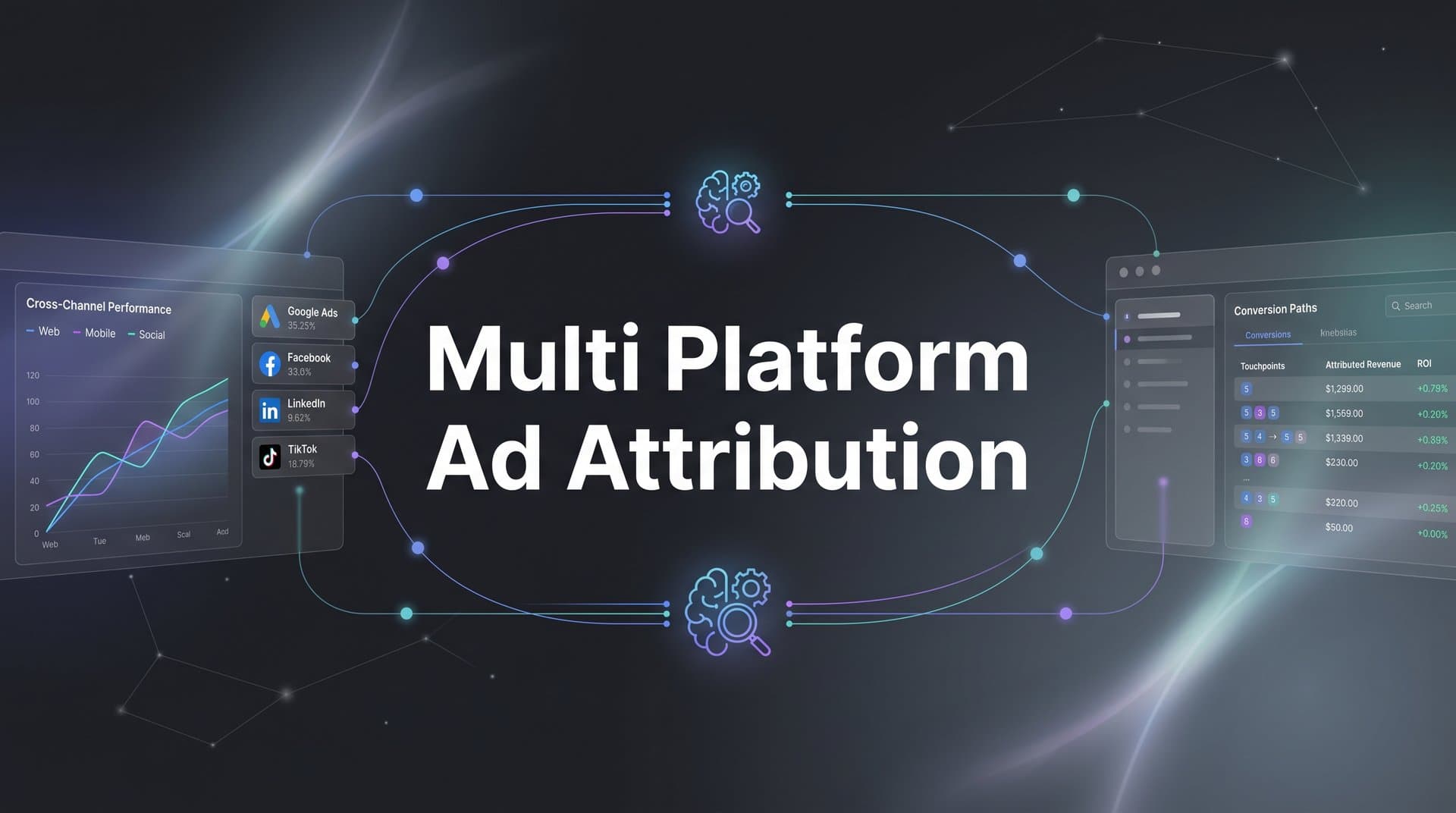
Multi platform ad attribution solves this by connecting every touchpoint across your marketing ecosystem. Instead of fragmented reports that contradict each other, you get a unified view of which ads, channels, and campaigns actually drive revenue. This clarity transforms how you allocate budget, optimize campaigns, and scale with confidence.
Why Platform Dashboards Tell Different Stories
Every ad platform operates in its own world. Meta has its pixel. Google has its tag. TikTok has its tracker. Each one monitors user behavior independently, applying its own attribution rules and conversion windows.
When a customer interacts with multiple platforms before converting, each platform sees only its own touchpoints. Meta knows the user clicked an ad three days ago. Google knows they searched your brand name yesterday. Neither platform sees the full picture, so both claim the conversion. This duplication inflates your reported results and makes it nearly impossible to understand true performance.
The attribution window problem makes this worse. Meta might use a seven-day click window. Google might use a 30-day window. TikTok defaults to a one-day view window. These different timeframes mean platforms attribute the same conversion using completely different logic, creating reports that can't be reconciled.
Privacy changes have turned platform reporting from unreliable to borderline unusable for many marketers. iOS App Tracking Transparency restrictions mean Meta and other platforms can't track iOS users who opt out of tracking. Third-party cookie deprecation is eliminating another major tracking mechanism. The result? Platform dashboards show fewer conversions than actually happened, but they still double-count the ones they do see. Understanding ad platform attribution bias is essential for interpreting these conflicting reports.
Without a unified attribution system, you're flying blind. You might be scaling a channel that's getting credit for conversions driven by other platforms. You might be cutting budget from channels that play crucial supporting roles in the customer journey. Every decision is based on partial, conflicting information.
The Foundation: How Cross-Channel Attribution Actually Works
Multi platform ad attribution starts with first-party data collection. Instead of relying on each platform's pixel firing in the user's browser, you capture conversion events at the server level. This server-side tracking approach records every meaningful action—ad clicks, page views, form submissions, purchases—regardless of whether the user has cookies enabled or tracking blocked.
Think of it like having a central ledger that records every interaction. When someone clicks your Meta ad, that event gets logged with a unique identifier. When they later search on Google and click that ad, it's logged with the same identifier. When they convert, you can trace the entire path they took.
Customer journey mapping connects these touchpoints into coherent stories. A single conversion might involve five or more interactions: seeing a Meta ad, clicking a Google search ad, reading a blog post, watching a YouTube video, and finally purchasing through a retargeting ad. Traditional platform reporting would show this as five separate conversions. Unified attribution shows it as one customer journey with multiple influences.
This is where attribution models come into play. These models are rules for distributing credit across touchpoints. No single model is universally correct—they serve different strategic purposes and answer different questions about your marketing performance. For a deeper dive, explore the difference between single source attribution and multi-touch attribution models.
First-touch attribution gives 100% credit to whichever channel introduced the customer to your brand. If someone first discovered you through a TikTok ad, then later clicked Google and Meta ads before converting, TikTok gets full credit. This model helps you understand which channels are best at generating awareness and bringing new audiences into your funnel.
Last-touch attribution does the opposite, crediting whichever touchpoint happened immediately before conversion. If that same customer converted after clicking a Meta retargeting ad, Meta gets full credit. This model shows which channels are most effective at closing deals, but it completely ignores the journey that got the customer there.
Multi-touch models distribute credit more fairly. Linear attribution splits credit equally across all touchpoints. Position-based (or U-shaped) attribution gives 40% credit to the first touch, 40% to the last touch, and distributes the remaining 20% among middle interactions. Time-decay models give progressively more credit to recent touchpoints, reflecting the idea that interactions closer to conversion had more influence.
The key insight is that you need multiple attribution models to understand your marketing fully. First-touch shows you where customers come from. Last-touch shows you what closes them. Multi-touch models reveal the supporting role each channel plays throughout the journey.
Matching Attribution Models to Your Marketing Strategy
Choosing the right attribution model isn't about finding the "most accurate" option. It's about asking the right questions for your business goals.
First-touch attribution makes sense when you're investing heavily in brand awareness and top-of-funnel campaigns. If you're running display ads, sponsoring podcasts, or testing new channels like TikTok or Pinterest, first-touch shows you which efforts are successfully introducing new audiences to your brand. This model helps you evaluate whether your awareness spend is bringing in the right people, even if those people don't convert immediately.
For example, if you notice that TikTok has a high first-touch attribution rate but low last-touch, that tells you TikTok is great for discovery but not for closing. You might keep TikTok budget focused on creative, engaging content that builds awareness, while relying on other channels to convert those prospects later.
Last-touch attribution works best for evaluating bottom-funnel conversion campaigns. If you're running Google search ads targeting high-intent keywords, retargeting campaigns, or promotional email sequences, last-touch shows you which efforts are most effective at turning warm prospects into customers. This model helps you optimize for immediate conversion efficiency.
But last-touch has a major blind spot: it gives zero credit to the channels that did the hard work of generating interest and nurturing the prospect. A customer might discover you through a Meta ad, engage with your content over weeks, and finally convert after a Google search. Last-touch gives Google all the credit, potentially leading you to cut Meta budget even though Meta was essential to the conversion. This is one of the most common ad attribution problems across multiple platforms.
Multi-touch models provide the balanced view most marketers need. Linear attribution is the simplest multi-touch approach—it treats every touchpoint as equally important. This works well when you have a relatively short sales cycle and want to understand the full mix of channels contributing to conversions.
Position-based attribution makes sense for businesses with longer, more complex buying journeys. By emphasizing first and last touch while still crediting middle interactions, this model recognizes that introduction and closing matter most, but the nurturing touchpoints in between still play a role. Many B2B companies and high-ticket ecommerce brands find this model aligns well with their reality.
The strategic move is to review multiple models side by side. When you compare first-touch, last-touch, and position-based attribution for the same conversion data, patterns emerge. You might discover that LinkedIn drives excellent first-touch attribution but poor last-touch, suggesting it's a powerful awareness channel that needs support from other platforms to close deals. Or you might find that Google search has strong last-touch attribution across all customer segments, confirming its role as a reliable conversion driver.
This multi-model view prevents you from making budget decisions based on a single perspective. Instead of asking "which channel is best," you start asking more nuanced questions: "Which channels are best for awareness? Which are best for closing? Which combinations work together most effectively?"
Building a Tracking System That Captures Everything
Setting up multi platform attribution that actually works requires connecting three core pieces: your ad platforms, your website and analytics, and your CRM or sales system. Each piece contributes essential data, and the connections between them create the complete picture.
Start by integrating all your ad platforms into a unified attribution system. This means connecting Meta Ads, Google Ads, TikTok Ads, LinkedIn Ads, and any other platforms you use. The integration should capture not just conversion data but also campaign structure, ad creative details, audience targeting, and spend information. A robust conversion tracking software for multiple ad platforms makes this process seamless.
Your website and analytics layer provides the middle of the funnel. This is where you track page views, content engagement, form submissions, and other on-site behavior that happens between the initial ad click and the final conversion. Connecting this layer lets you see patterns like which blog posts or product pages appear most often in converting customer journeys.
Your CRM or sales system holds the final conversion data and, crucially, the revenue data. This is where attribution shifts from tracking conversions to tracking actual business outcomes. Not all conversions are equal—some customers spend more, some have higher lifetime value, some churn faster. By connecting CRM data to your attribution system, you can identify which channels drive high-value customers versus which channels drive low-margin conversions.
Server-side tracking is the technical foundation that makes this all work reliably. Instead of relying on JavaScript pixels firing in users' browsers—which can be blocked by ad blockers, privacy settings, or browser restrictions—server-side tracking captures events at the server level. When a conversion happens, your server sends that data directly to your attribution platform, bypassing browser-based limitations.
This approach has become essential as privacy restrictions have increased. iOS users who opt out of tracking won't fire Meta's browser pixel, but a server-side implementation can still capture their conversion and send it to Meta through the Conversions API. The result is more complete data and more accurate attribution.
Conversion sync takes this a step further by feeding enriched conversion data back to your ad platforms. Here's why this matters: when you send conversion data back to Meta or Google, their machine learning algorithms use it to optimize ad delivery. If you only send basic conversion events, the algorithm optimizes for any conversion. But if you send enriched data that includes conversion value, customer lifetime value predictions, or customer quality scores, the algorithm can optimize for better conversions.
For example, you might discover through your attribution analysis that customers who engage with three or more touchpoints before converting have 2x higher lifetime value than single-touch converters. By sending this insight back to your ad platforms as part of conversion sync, you help their algorithms identify and target similar high-value prospects.
The technical setup requires some initial effort, but the ongoing benefit is massive. Once your tracking infrastructure is in place, data flows automatically. Every ad click, every website visit, every conversion gets captured and connected. You're no longer piecing together reports from five different dashboards—you're looking at one unified view of your marketing performance.
From Data to Decisions: Optimizing Budget Allocation
Having accurate attribution data is only valuable if you use it to make better decisions. The real power of multi platform ad attribution comes when you shift budget based on what's actually driving revenue, not what platform dashboards claim is working.
Start by identifying which channels drive high-value customers. Look beyond simple conversion counts and examine revenue per conversion, average order value, and customer lifetime value by channel. You might discover that TikTok drives a high volume of conversions but with lower average order values, while LinkedIn drives fewer conversions but with customers who spend 3x more. This insight should fundamentally change how you allocate budget between these channels.
Customer quality matters as much as customer quantity. Some channels attract bargain hunters who convert once and never return. Other channels bring in customers who become loyal repeat buyers. By connecting attribution data to your CRM, you can track which channels have the best retention rates, highest repeat purchase rates, and lowest churn. These metrics often reveal that your most expensive channels are actually your most profitable when you account for lifetime value. Platforms focused on marketing attribution with revenue tracking make this analysis straightforward.
AI-powered recommendations accelerate this optimization process. Instead of manually analyzing attribution reports to spot patterns, AI can identify scaling opportunities and underperforming campaigns automatically. It might notice that a specific Meta ad creative performs exceptionally well when it appears as the first touchpoint in customer journeys, suggesting you should increase its budget and use it more in cold audience campaigns.
Or AI might detect that Google search campaigns have started showing declining performance in multi-touch journeys while maintaining strong last-touch attribution. This pattern could indicate that Google is getting credit for conversions driven primarily by other channels, suggesting you should test reducing Google budget and reallocating it to the channels doing the heavy lifting earlier in the funnel. A marketing attribution platform with AI can surface these insights automatically.
Dynamic budget shifting based on real revenue data prevents the common mistake of optimizing for vanity metrics. When you're working only with platform-reported data, you might increase budget on a campaign showing a low cost per conversion. But unified attribution might reveal that those "cheap" conversions have low order values and high return rates. The campaign looks efficient in isolation but actually loses money when you account for the full picture.
The weekly review cadence matters more than most marketers realize. Attribution patterns shift as you adjust campaigns, as competitors change their strategies, and as customer behavior evolves. Reviewing attribution data weekly lets you catch trends early—before they waste significant budget. You might notice that a channel's performance is declining, giving you time to investigate and adjust before burning through thousands in inefficient spend.
Look for channel interaction effects in your attribution data. Some channel combinations work synergistically—customers who see both Meta ads and Google search ads convert at higher rates than those who see only one. Other combinations show diminishing returns—adding a third or fourth touchpoint doesn't increase conversion likelihood. Understanding these patterns helps you design smarter campaign strategies that leverage channel strengths.
Budget decisions should account for the role each channel plays in the customer journey. A channel with low last-touch attribution but high first-touch attribution deserves budget because it's generating the awareness that other channels capitalize on later. Cutting that channel might boost short-term efficiency metrics but damage long-term growth by reducing the pool of aware prospects entering your funnel.
Your Attribution Strategy Blueprint
Building an effective multi platform attribution strategy starts with defining clear conversion goals. Not all conversions deserve equal weight. Distinguish between micro-conversions like email signups or content downloads and macro-conversions like purchases or qualified leads. Ensure your tracking captures both, but prioritize optimization around the conversions that actually drive revenue.
Map out your typical customer journey before you start tracking. How many touchpoints do customers usually experience before converting? Which channels tend to appear early versus late in the journey? This upfront mapping helps you set realistic expectations and choose attribution models that match your actual sales process. A business with a two-day sales cycle needs different attribution than one with a 90-day enterprise sales process.
Implement tracking that captures every meaningful touchpoint from first click to final revenue. This means going beyond just tracking ad clicks and purchases. Capture content engagement, email opens, sales calls, demo requests, and any other interaction that influences buying decisions. The more complete your data, the more accurate your attribution and the better your optimization decisions. Explore the multi-touch marketing attribution platform complete guide for implementation details.
Review attribution data weekly to stay ahead of performance trends. Set up dashboards that show key metrics across different attribution models. Look for changes in channel performance, shifts in customer journey patterns, and opportunities to reallocate budget. The weekly cadence keeps you responsive without creating the noise of daily overreaction to normal variance.
Test attribution insights with controlled experiments. If your data suggests that LinkedIn plays a valuable first-touch role, test increasing LinkedIn budget while monitoring downstream conversion rates. If attribution indicates a channel is underperforming, test reducing its budget and measuring the impact on overall conversions. These experiments validate your attribution insights and build confidence in data-driven decisions.
Use a dedicated attribution platform rather than trying to build your own system. The technical complexity of capturing cross-platform data, maintaining tracking accuracy through privacy changes, and analyzing multi-touch journeys is substantial. Purpose-built multi-touch attribution platforms handle this complexity and provide interfaces designed for making marketing decisions, not just viewing data.
The platform should offer real-time data updates so you can react quickly to campaign performance changes. It should support multiple attribution models so you can view performance from different angles. And it should integrate with all your ad platforms and business systems to create that unified view you need for confident decision-making.
Making Attribution Your Competitive Advantage
Multi platform ad attribution transforms scattered, conflicting data into a clear picture of what's actually driving revenue. When you know which ads, channels, and campaigns are pulling their weight—and which are getting credit they don't deserve—every budget decision becomes smarter. You stop wasting money on channels that look good in isolation but don't contribute to the full customer journey. You start investing more in the combinations and sequences that actually convert.
But accurate attribution delivers another crucial advantage that many marketers overlook: it makes your ad platforms smarter. When you feed enriched conversion data back to Meta, Google, and other platforms through conversion sync, you're training their algorithms on what success really looks like for your business. Instead of optimizing for any conversion, they optimize for the high-value conversions that drive profit. This feedback loop compounds over time, improving your ad targeting and efficiency automatically.
The marketers who win in today's multi-platform environment aren't the ones with the biggest budgets. They're the ones with the clearest data. They know which touchpoints matter, which journeys convert, and which investments deliver real returns. They make decisions based on revenue, not vanity metrics. And they use that clarity to scale confidently while competitors guess.
Ready to elevate your marketing game with precision and confidence? Discover how Cometly's AI-driven recommendations can transform your ad strategy—Get your free demo today and start capturing every touchpoint to maximize your conversions.