You open your Meta Ads Manager and see 47 conversions from yesterday's campaign. Great news. Then you check Google Ads: 31 conversions from the same day. Still solid. But when you pull up your CRM to verify actual sales, there are only 22 new customers. The numbers don't match. They never do.
This isn't a tracking error or a technical glitch. It's the reality of running ads across multiple platforms in 2026. Every channel reports success differently, attributes conversions using different rules, and operates in its own data silo. The result? You're making budget decisions based on inflated numbers that tell three different versions of the same story.
Understanding why multi platform ad tracking challenges exist is the first step to solving them. The second step is building a tracking approach that gives you one source of truth—accurate data that shows what's really driving revenue, not just what each platform wants to claim credit for. Let's break down exactly why your numbers don't match and what you can do about it.
The Data Fragmentation Problem Explained
Every advertising platform operates in its own ecosystem with proprietary tracking methods. Meta uses the Meta Pixel. Google uses Google Ads conversion tracking and Google Analytics. LinkedIn has the LinkedIn Insight Tag. TikTok has its own pixel. Each of these tracking systems collects data independently, stores it on separate servers, and reports it through different dashboards.
This fragmentation creates a fundamental problem: no single platform can see the complete customer journey. When someone clicks your Meta ad on Monday, searches for your brand on Google on Wednesday, and converts on Friday, both platforms may claim that conversion as their own. Meta sees the click and the eventual purchase. Google sees the search and the purchase. Neither platform knows about the other's touchpoint.
The situation gets worse when you factor in different attribution windows. Meta's default attribution window is 7-day click and 1-day view. Google Ads defaults to 30-day click attribution. If a customer clicks your Meta ad on day 8 before converting, Meta won't count it. But if they clicked a Google ad within 30 days, Google will claim full credit.
These different counting rules mean the same conversion can be attributed differently depending on which dashboard you're looking at. It's not that one platform is lying—they're just measuring with different rulers. Understanding these multiple ad platforms tracking problems is essential for any marketer running cross-channel campaigns.
Attribution models add another layer of complexity. Last-click attribution gives all credit to the final touchpoint before conversion. First-click attribution credits the initial interaction. Each platform defaults to different models, and many marketers don't even realize they're comparing apples to oranges when they look at cross-platform performance.
The customer journey itself spans multiple touchpoints that no single platform can capture completely. A typical B2B customer might see a LinkedIn ad, click a Google search result, read your blog, return via organic search, and finally convert after receiving an email. That's five touchpoints across multiple channels, and each advertising platform only sees the piece they were involved in.
This fragmentation isn't just a reporting inconvenience. It directly impacts your ability to make smart budget allocation decisions. When you can't see which channels actually drive revenue versus which ones just touch customers late in the journey, you risk overspending on bottom-of-funnel tactics while underfunding the awareness channels that start the customer relationship.
Privacy Changes That Broke Traditional Tracking
If multi platform tracking was challenging before, privacy changes over the past few years have made it exponentially harder. Apple's iOS 14.5 update in 2021 introduced App Tracking Transparency, requiring apps to ask users for permission before tracking their activity across other apps and websites. Most users declined.
This fundamentally changed mobile attribution. Before iOS 14.5, advertising platforms could track users across apps and websites to build detailed profiles and measure ad effectiveness. After the update, that visibility disappeared for the majority of iOS users. Meta, in particular, publicly discussed how this impacted their ability to measure and optimize campaigns.
The loss of tracking visibility didn't just affect reporting—it broke the feedback loop that ad platforms rely on to optimize delivery. When Meta or Google can't see which users converted after clicking an ad, their algorithms can't learn which audiences are most likely to convert. This leads to less efficient targeting and higher costs per acquisition.
Browser privacy features have compounded the problem. Safari's Intelligent Tracking Prevention limits how long cookies can persist and blocks many third-party cookies entirely. Firefox has similar protections. Even Chrome, which has delayed its third-party cookie deprecation multiple times, continues moving toward a privacy-first approach that will eventually eliminate traditional cross-site tracking.
These changes create data gaps that compound across multiple platforms. When a customer clicks your Meta ad on their iPhone, then later converts on their laptop via a Google search, the connection between those two events may be completely invisible. Meta can't track what happened after the click due to iOS restrictions. Google sees the conversion but has no visibility into the Meta touchpoint. Many marketers are now exploring cookieless tracking platforms to address these challenges.
The result is that your actual customer journeys are happening in the dark. You're running ads, people are converting, but the tracking infrastructure that used to connect those dots has been systematically dismantled in the name of privacy. This isn't a temporary issue—it's the new normal that every marketer must adapt to.
Server-side tracking has emerged as one solution because it moves data collection from the browser to your server, bypassing many browser-based privacy restrictions. But implementing server-side tracking across multiple platforms requires technical expertise and a unified approach to data collection that most marketing teams haven't built yet.
Why Platform-Reported Conversions Inflate Results
Here's an uncomfortable truth: when you add up the conversions reported by Meta, Google, LinkedIn, and TikTok, you'll almost always get a number higher than your actual sales. This isn't a coincidence. It's self-attribution bias in action.
Each advertising platform is incentivized to show strong performance. They're not maliciously inflating numbers, but their attribution models are designed to capture every possible conversion they might have influenced. This means when multiple platforms touch the same customer journey, they all claim credit for the final conversion.
Think about it this way: a customer sees your Meta ad on Monday but doesn't click. On Tuesday, they see your Google Display ad and still don't click. On Wednesday, they search your brand name, click your Google Search ad, and convert. In this scenario, Meta may claim a view-through conversion. Google Display may also claim a view-through conversion. And Google Search will definitely claim a click-through conversion. That's one actual sale being counted as three conversions across your ad platforms.
View-through conversions are particularly problematic. These occur when someone sees your ad but doesn't click, then later converts through another channel. The challenge is that people see hundreds of ads every day. Just because someone saw your ad before converting doesn't mean the ad caused the conversion. They might have been planning to buy from you anyway. This is one of the core ad platform tracking issues that marketers struggle with daily.
When view-through attribution overlaps across multiple channels, the inflation becomes significant. If someone sees ads on Meta, Google, and LinkedIn before converting, all three platforms may claim view-through credit. Your dashboards show three conversions, but you only made one sale.
The real cost of making budget decisions on inflated data is substantial. If you're scaling campaigns based on platform-reported conversions without verifying actual revenue, you're likely overspending on channels that are claiming credit they don't deserve. You might cut a profitable channel because it doesn't get last-click credit, while doubling down on a bottom-funnel channel that's just harvesting demand created elsewhere.
This creates a vicious cycle. You allocate more budget to channels with inflated conversion counts. Those channels continue to claim credit for conversions they didn't drive. Your overall marketing efficiency decreases even as your dashboard metrics look better. Eventually, you're spending more to generate the same revenue, but the platform-level data doesn't reveal the problem.
The only way to break this cycle is to stop relying on platform-reported conversions as your source of truth. You need a unified tracking system that connects ad clicks to actual revenue in your CRM or analytics platform, giving credit based on the real customer journey rather than each platform's self-interested attribution model.
Cross-Device and Cross-Channel Blind Spots
The modern customer journey is rarely linear. People discover your brand on their phone during their morning commute, research on their work laptop during lunch, and convert on their home computer in the evening. This cross-device behavior creates massive blind spots in traditional ad tracking.
When a user switches devices, the tracking chain breaks. The cookie or device ID that tracked them on mobile doesn't carry over to desktop. Unless they log in to your website on both devices, there's no way to connect those sessions. From your ad platform's perspective, these look like two different people. These multi-device customer tracking challenges affect virtually every business running digital ads.
This means a customer journey that actually went "mobile ad click → desktop research → desktop conversion" might be tracked as "mobile ad click with no conversion" plus "desktop direct visit conversion." The ad platform sees the click but no conversion, so it reports poor performance. Meanwhile, the conversion gets attributed to direct traffic in your analytics, making it look like the customer found you organically.
Cross-channel blind spots are equally problematic. Offline conversions and phone calls often never connect back to the original ad click. If someone clicks your Google ad, then calls your sales team and buys over the phone, Google has no way to know that conversion happened unless you manually feed that data back into the platform.
For businesses with longer sales cycles, attribution windows create another blind spot. If your average customer takes 45 days from first touch to purchase, but your ad platforms only track conversions within 30 days, you're missing a significant portion of your actual results. The customer journey is longer than the measurement window, so conversions fall outside the tracking period and get attributed to direct traffic or marked as organic.
B2B companies face this challenge constantly. A prospect might click a LinkedIn ad in January, attend a webinar in February, request a demo in March, and close in April. By the time the deal closes, it's far beyond LinkedIn's attribution window. The conversion never gets connected back to that initial ad click, making the campaign look ineffective even if it was the critical first touchpoint.
Email marketing adds another layer of complexity. When someone clicks your ad, joins your email list, and later converts after clicking an email, where should the credit go? The ad platform that drove the initial click? The email platform that sent the converting message? Your analytics platform might show the conversion coming from email, while your ad platform claims it based on the earlier click.
These blind spots aren't edge cases. They're the norm for most businesses. The majority of customer journeys involve multiple devices, multiple channels, and touchpoints that span weeks or months. If your tracking infrastructure can't connect these dots, you're making decisions based on incomplete data that systematically undervalues awareness and consideration-stage marketing.
Building a Unified Tracking Approach
The solution to multi platform ad tracking challenges isn't trying to fix each platform's tracking individually. It's building a unified system that sits above all your ad platforms and connects the complete customer journey in one place.
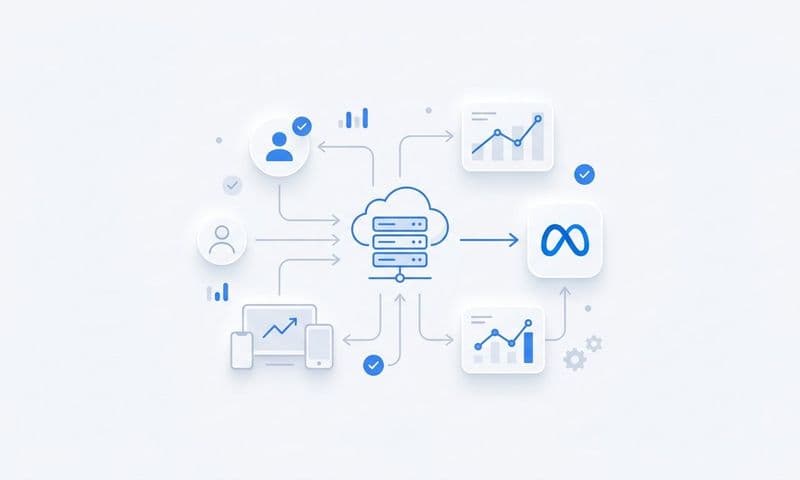
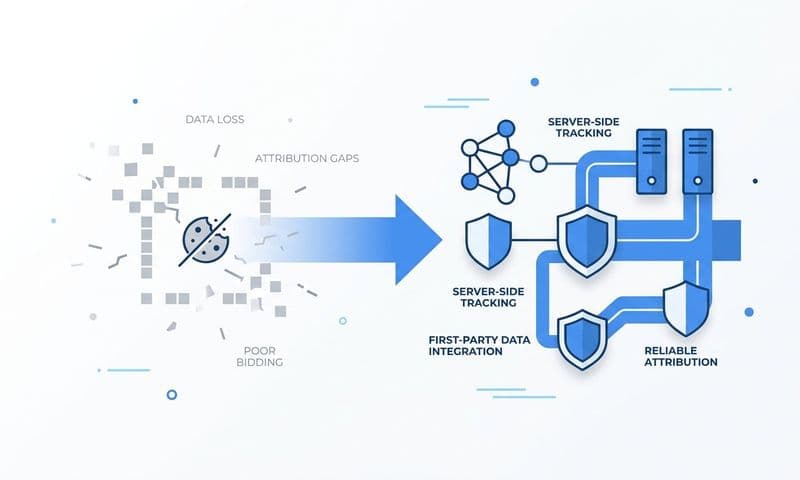
Server-side tracking forms the foundation of this approach. Instead of relying on browser-based pixels that get blocked by privacy features and can't track across devices, server-side tracking collects data on your server and sends it to your ad platforms and analytics tools. This bypasses browser restrictions, improves data accuracy, and gives you control over what data gets sent where. A robust first-party data tracking platform makes this implementation much more manageable.
With server-side tracking, when someone clicks your Meta ad on mobile and later converts on desktop, your server can connect those two events using first-party identifiers like email addresses or customer IDs. You're not dependent on third-party cookies or device IDs that break across devices. The data flows through your infrastructure, where you can match sessions and attribute conversions accurately.
Connecting your ad platforms to your CRM creates full-funnel visibility. When your CRM knows which ad click led to which lead, which lead became an opportunity, and which opportunity closed as revenue, you can track marketing performance all the way to actual dollars earned. This is the only way to see true ROI rather than just conversion counts.
This integration also enables you to feed offline conversions back to your ad platforms. When someone calls your sales team after clicking a Google ad, you can send that conversion back to Google so their algorithm knows the ad worked. This improves optimization and gives you credit for conversions that would otherwise be invisible.
Multi-touch attribution models help you see the complete customer journey across all touchpoints. Instead of giving all credit to the last click, multi-touch attribution distributes credit across every interaction. A comprehensive multi-touch marketing attribution platform reveals which channels are driving awareness, which are nurturing consideration, and which are closing deals.
The key is choosing an attribution model that matches your business reality. Linear attribution gives equal credit to every touchpoint. Time-decay attribution gives more credit to recent interactions. Position-based attribution credits the first and last touches more heavily. There's no perfect model, but any multi-touch approach is better than last-click attribution that ignores most of the customer journey.
A unified tracking platform brings all this together. Instead of logging into five different dashboards to piece together your marketing performance, you have one source of truth that shows conversions, revenue, and customer journeys across all channels. You can compare the true performance of Meta versus Google versus LinkedIn based on actual revenue attribution, not self-reported conversions.
This approach requires investment in the right tools and some technical implementation, but the payoff is substantial. When you can see which channels actually drive revenue, you can reallocate budget with confidence. When you can feed accurate conversion data back to ad platforms, their algorithms optimize better. When you can track the full customer journey, you can build marketing strategies that work with how customers actually buy rather than how platforms want to measure success.
Turning Accurate Data Into Better Ad Performance
Clean, accurate data isn't just about better reporting. It directly improves your ad performance by feeding better signals back to platform algorithms. Meta's algorithm, Google's machine learning, LinkedIn's targeting—they all depend on conversion data to optimize delivery. When you send them accurate, complete conversion information, they get better at finding customers who will actually buy.
Think about how ad platform optimization works. When you run a conversion campaign, the platform's algorithm learns from every conversion signal it receives. It analyzes which users converted, what they have in common, and finds more people like them. But if the conversion data is incomplete or inaccurate, the algorithm learns from bad information and optimizes toward the wrong audience.
With server-side tracking and proper conversion sync, you can send enriched conversion events back to your ad platforms. Instead of just telling Meta that someone converted, you can send the conversion value, the product purchased, and whether this was a first-time or repeat customer. This gives the algorithm much richer signals to optimize against, leading to better targeting and lower acquisition costs. Implementing tracking conversions across multiple ad platforms correctly is the foundation of this optimization strategy.
Making confident budget allocation decisions becomes possible when you have accurate attribution. Instead of wondering whether to increase your Meta budget or shift dollars to Google, you can see which channels drive the highest revenue per dollar spent. You can identify which campaigns generate cheap clicks that never convert versus which ones drive valuable customers worth the higher cost per click.
This clarity is especially valuable when testing new channels. If you launch a LinkedIn campaign and your unified tracking shows it's driving high-value leads that close at 40% rate, you can confidently scale that channel even if LinkedIn's platform-reported conversions look modest. Conversely, if a channel shows great conversion numbers in-platform but your CRM data reveals those leads never close, you can cut spending before wasting more budget.
Scaling campaigns based on true revenue attribution rather than platform vanity metrics transforms your growth trajectory. Many marketers hit a scaling wall because they optimize for metrics that don't correlate with revenue. They increase spend on campaigns with great click-through rates or low cost-per-conversion, but revenue doesn't grow proportionally because those metrics don't capture actual business value.
When you optimize for revenue attribution instead, you can scale with confidence. You know exactly which campaigns generate profitable customers, which channels have room to grow, and where you're reaching saturation. This lets you push budgets higher on what works while quickly cutting what doesn't, leading to more efficient growth.
Moving Forward With Unified Attribution
Multi platform ad tracking challenges are real, but they're not insurmountable. The fragmentation, privacy restrictions, self-attribution bias, and cross-device blind spots create serious obstacles—but understanding these challenges is the first step to solving them.
The solution isn't trying to make each platform's tracking perfect. It's building a unified approach that sits above your ad platforms and connects the complete customer journey. Server-side tracking, CRM integration, and multi-touch attribution give you the infrastructure to see what's really driving revenue across all your marketing channels.
This matters because accurate attribution is about more than just reporting. It's about feeding better data back to ad platforms so their algorithms can optimize effectively. It's about making confident budget decisions based on revenue, not vanity metrics. It's about building a marketing strategy that works with how customers actually buy rather than how platforms want to measure success.
The marketers who solve multi platform tracking challenges gain a massive competitive advantage. While their competitors make decisions based on inflated, fragmented data, they can see the truth. They know which channels drive real revenue. They can scale profitably while others waste budget on misattributed conversions. They turn accurate data into better ad performance and sustainable growth.
Ready to elevate your marketing game with precision and confidence? Discover how Cometly's AI-driven recommendations can transform your ad strategy—Get your free demo today and start capturing every touchpoint to maximize your conversions.