You check your Meta Ads dashboard and see 150 conversions this month. Your Google Analytics shows 112. Your CRM logged 89 actual sales. Your finance team counted 94 closed deals. Four different systems, four different versions of reality—and somewhere in that gap, you're burning budget on ads that don't actually work.
This isn't a technical glitch you can refresh away. It's not a tracking pixel that fired incorrectly or a tag that needs debugging. What you're experiencing is the new reality of digital advertising: ad platform tracking issues have become the norm, not the exception.
The problem goes deeper than mismatched numbers. When your tracking data is fundamentally broken, every decision you make—which campaigns to scale, which audiences to target, where to allocate next quarter's budget—is built on a foundation of inaccuracy. You're essentially flying blind while your competitors figure out how to see clearly.
Since 2021, a perfect storm of privacy changes, browser updates, and platform limitations has systematically dismantled the tracking infrastructure that digital marketing was built on. The tools that worked reliably for years suddenly produce estimates instead of facts, models instead of measurements, and guesses instead of certainty.
Here's what's actually happening behind those discrepant numbers, why every major ad platform struggles with accuracy in different ways, and—most importantly—what you can do to build a tracking system that actually reflects reality.
The Perfect Storm: Why Ad Tracking Fell Apart
April 2021 marked the moment everything changed. Apple released iOS 14.5 with App Tracking Transparency, a feature that sounds innocuous but fundamentally rewired how data flows across the internet.
Before ATT, apps could freely share data about user behavior across different platforms. When someone saw your Meta ad, clicked through to your website, and later made a purchase, that entire journey was trackable. The connection between impression, click, and conversion was clear and deterministic.
After ATT, every app had to explicitly ask users for permission to track their activity across other apps and websites. That simple pop-up—"Allow [App] to track your activity across other companies' apps and websites?"—became a death sentence for traditional mobile tracking. Industry observers consistently note that opt-in rates have remained low, with many users declining to be tracked. When users say no, ad platforms lose visibility into what happens after someone leaves their app. Understanding how to fix iOS 14 tracking issues has become essential for marketers navigating this landscape.
The impact was immediate and severe. Meta couldn't see what happened after someone clicked an Instagram ad and landed on your mobile website. Google couldn't track users who moved between apps. TikTok lost visibility into post-click behavior. Every platform that relied on cross-app data suddenly went partially blind.
But iOS 14.5 was just the opening act. Browser makers were simultaneously tightening their own restrictions, creating a multi-front war against traditional tracking methods.
Safari's Intelligent Tracking Prevention has been progressively limiting how long cookies persist and how they can be used for cross-site tracking. Firefox's Enhanced Tracking Protection blocks third-party cookies by default. Even Chrome, which has delayed its timeline multiple times, is moving toward restricting third-party cookies through its Privacy Sandbox initiative.
Each browser handles these restrictions differently, which means your tracking accuracy varies depending on which browser your customers use. A customer journey that's fully visible in one browser might be completely invisible in another.
Then there's the human factor: users themselves are increasingly privacy-conscious. Ad blocker adoption continues to grow. Privacy-focused browsers like Brave are gaining market share. VPNs that mask user location and behavior are mainstream tools now, not niche products for tech enthusiasts.
The result? Your tracking infrastructure is under siege from multiple directions simultaneously. Platform restrictions, browser limitations, and user behavior have converged to create an environment where traditional pixel-based tracking simply cannot capture the complete picture anymore.
How Each Major Platform Handles (and Misreports) Conversions
When ad platforms lost access to deterministic tracking data, they didn't just shrug and accept defeat. They adapted—but their adaptations introduced new problems that many marketers don't fully understand.
Meta's response was Aggregated Event Measurement and modeled conversions. Instead of tracking individual user journeys, Meta now groups conversions into aggregated buckets and uses statistical modeling to estimate what probably happened. This sounds reasonable in theory, but in practice it means you're often looking at educated guesses rather than actual measurements. Many marketers struggle with Facebook Ads tracking pixel issues that stem from these fundamental platform changes.
The modeling works like this: Meta sees that 100 people clicked your ad, and later your website reports 10 conversions. But due to tracking limitations, Meta can only directly connect 4 of those conversions to specific ad clicks. For the other 6, Meta uses statistical models to estimate which clicks probably led to those conversions based on historical patterns and user behavior signals.
This creates several problems. First, your conversion data now appears in aggregated form with a delay, making real-time optimization difficult. Second, the estimates can be wrong—sometimes significantly. Third, you can't drill down into individual user journeys anymore because that granular data simply doesn't exist in the system.
Meta also prioritizes certain conversion events over others through its event priority system. If multiple events fire, only the highest-priority event gets reported. This means you might be optimizing for conversions that aren't actually your most valuable actions.
Google Ads faces different but equally challenging limitations. Google's conversion modeling attempts to fill tracking gaps using machine learning, but it operates within constraints that affect accuracy. Cross-device attribution—tracking a user who clicks an ad on mobile but converts on desktop—remains imperfect despite Google's attempts to connect devices through signed-in accounts.
Google's attribution window limitations compound the problem. If a customer clicks your ad but takes longer than your attribution window to convert, that conversion simply vanishes from your Google Ads reporting. It happened, it drove revenue, but as far as Google Ads is concerned, it never existed.
The platform also struggles with assisted conversions—touches that contributed to a conversion but weren't the final click. Google Ads will show you assisted conversion data, but its default reporting focuses on last-click attribution, which systematically undervalues upper-funnel campaigns and brand awareness efforts. Addressing view through conversion tracking issues requires understanding these attribution limitations.
TikTok's tracking challenges are particularly acute because the platform is newer and hasn't had years to build sophisticated tracking infrastructure. TikTok's pixel faces the same browser and iOS limitations as other platforms, but with less historical data to power accurate modeling. The platform's younger user base also tends to be more privacy-conscious and more likely to use ad blockers or privacy settings. Marketers need specialized tools for tracking TikTok ads to overcome these challenges.
LinkedIn operates in a B2B environment where the customer journey is inherently longer and more complex. Someone might see your LinkedIn ad at work, research your solution over several days, discuss it with colleagues, and then convert weeks later from a different device. LinkedIn's tracking simply cannot maintain visibility across that extended, multi-device, multi-stakeholder journey.
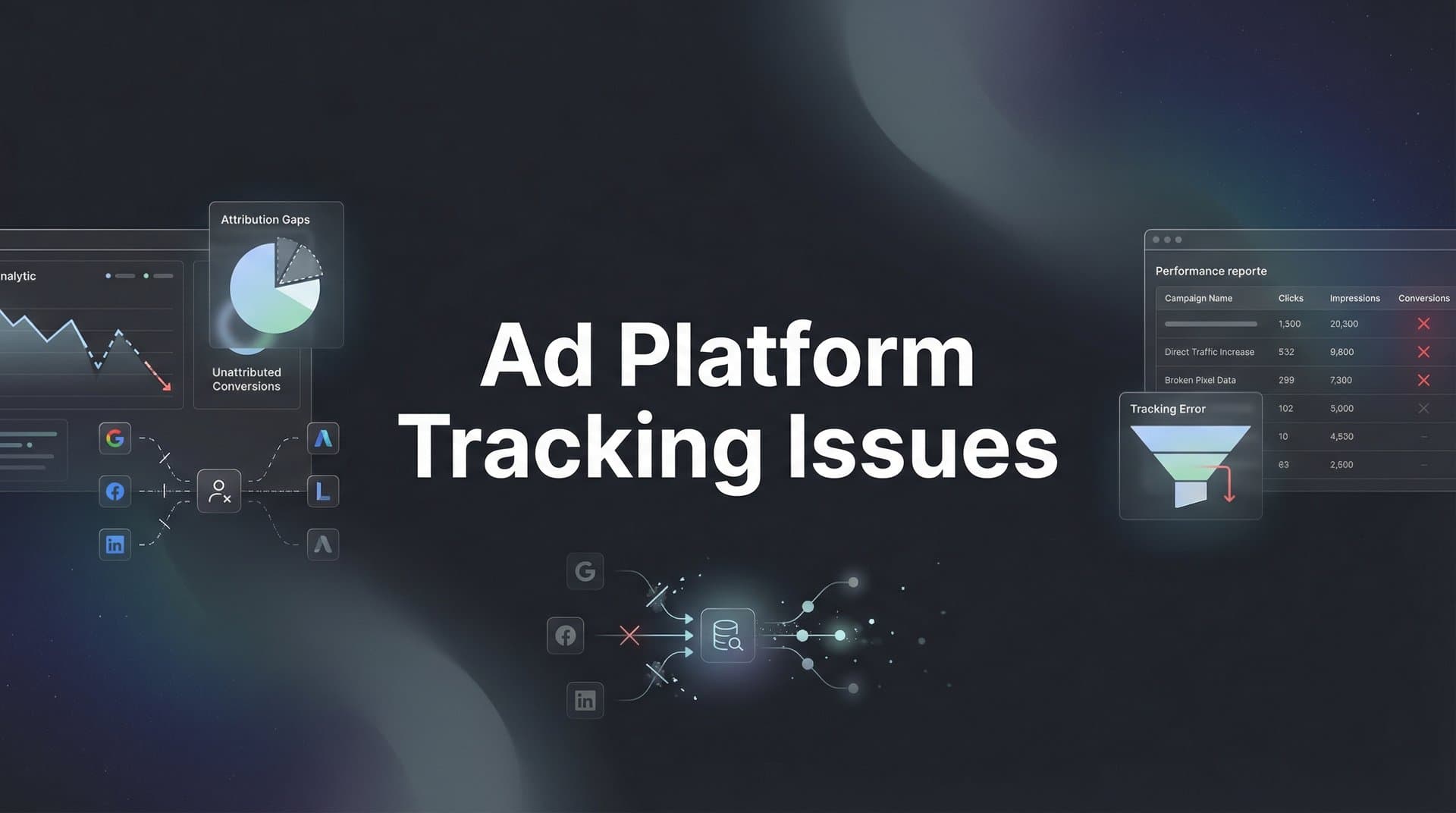
When you run campaigns across multiple platforms simultaneously—which most marketers do—these platform-specific limitations multiply. Each platform sees only its slice of the customer journey and tends to over-claim credit for conversions. A customer who sees your Meta ad, clicks your Google ad, and then converts after opening your LinkedIn message will generate conversion claims from all three platforms. Your reporting shows 3 conversions, but you actually got 1. This is the core multiple ad platforms tracking problem that plagues modern marketing teams.
The Hidden Costs of Inaccurate Attribution
Broken tracking isn't just an annoying reporting problem. It's actively costing you money in ways that compound over time.
The most obvious cost is budget misallocation. When your tracking shows that Campaign A drove 50 conversions and Campaign B drove 20, you naturally shift more budget to Campaign A. But what if those numbers are wrong? What if Campaign A's conversions are being over-reported due to platform modeling errors, while Campaign B's true impact is being systematically undercounted because it operates higher in the funnel with longer attribution windows?
You're now spending more on the campaign that looks better in the data but actually performs worse in reality. That misallocation doesn't just waste the money you're putting into the wrong campaign—it also represents the opportunity cost of underfunding the campaign that actually works.
Then there's algorithm degradation, a problem that creates a negative feedback loop. Ad platform algorithms optimize toward the conversion data they receive. When that data is incomplete or inaccurate, the algorithms learn the wrong lessons.
Picture this: Your server-side tracking shows that customers who add items to cart and then view your pricing page are highly likely to convert. But your Meta pixel, limited by browser restrictions, only captures the add-to-cart event reliably. Meta's algorithm learns to optimize for add-to-cart actions, missing the crucial pricing page signal that actually predicts conversion.
The algorithm now drives traffic that adds to cart but doesn't progress further. Your add-to-cart rate looks great in Meta's reporting, but your actual conversion rate declines. The algorithm is optimizing for the wrong thing because it's working with incomplete information.
Perhaps the most insidious cost is strategic blind spots—the insights you never discover because your data can't surface them. When you can't see the full customer journey, you can't identify patterns that matter. Implementing proper customer journey tracking tools helps eliminate these blind spots.
Many high-value customers follow non-linear paths. They might see your brand awareness campaign on TikTok, ignore it, later search for your product category on Google, click a competitor's ad, return to Google a week later and click your retargeting ad, then finally convert after receiving your email newsletter. That journey involves five touchpoints across four channels over multiple days.
If your tracking can't capture that complete sequence, you'll never understand that your TikTok brand campaign is actually driving bottom-funnel conversions—it just takes time and multiple touches. You might cut that campaign because it doesn't show direct conversions, eliminating a crucial top-of-funnel driver that feeds your entire acquisition system.
These costs accumulate silently. You don't get an alert saying "You just misallocated $10,000 based on bad data." You just gradually lose competitive advantage as your decisions drift further from reality.
Server-Side Tracking: The Foundation of Accurate Data
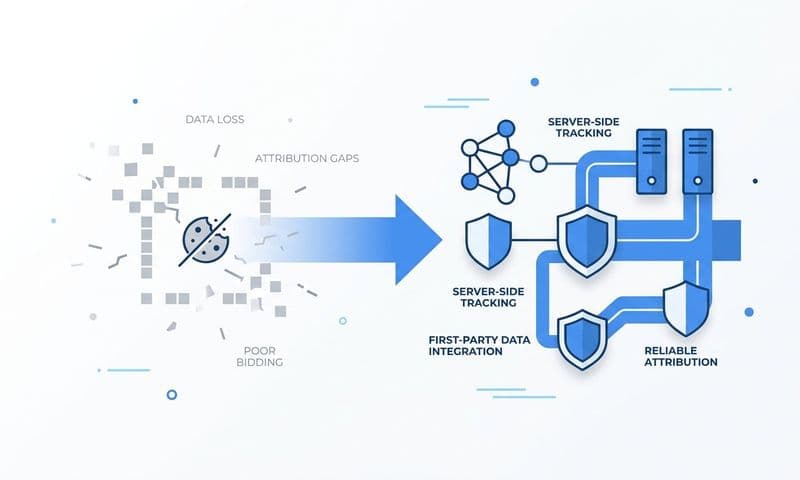
While browser-based tracking crumbles under privacy restrictions, server-side tracking operates in a completely different environment—one that's largely immune to the changes that broke traditional pixels.
Here's the fundamental difference: Client-side tracking relies on code that runs in your customer's browser. When someone visits your website, your Meta pixel fires in their browser, attempting to send data to Meta's servers. But that browser is now a hostile environment. Safari might block the request. An ad blocker might prevent the pixel from firing. iOS restrictions might limit what data can be transmitted. The user's privacy settings might interfere with cookie storage.
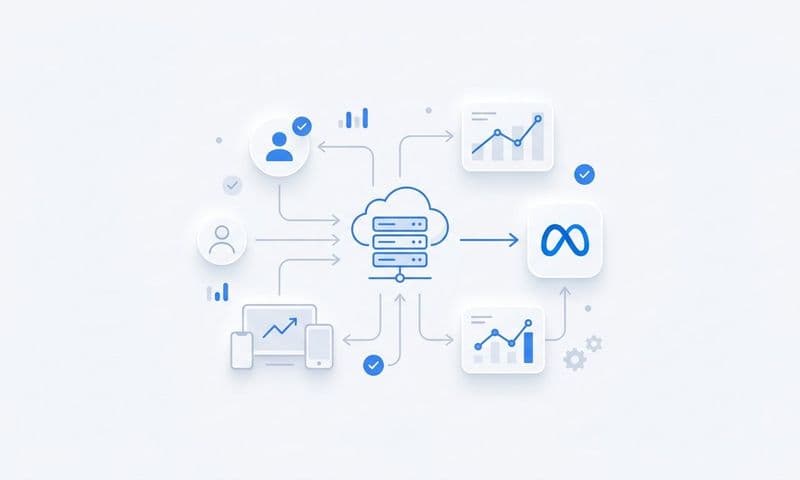
Server-side tracking bypasses all of that. Instead of relying on the customer's browser to send data to ad platforms, your server sends the data directly. The customer visits your website, your server logs that visit and any actions they take, and then your server transmits that information directly to Meta, Google, TikTok, or wherever else you need it to go. Finding the best server-side tracking platform is crucial for implementing this approach effectively.
This architecture is resilient because it doesn't depend on browser cooperation. There's no pixel for an ad blocker to block. There's no third-party cookie for Safari to restrict. There's no iOS permission to decline. The data flows from your server to the ad platform's server through a direct connection that privacy restrictions don't touch.
Meta calls this the Conversions API. Google calls it Enhanced Conversions. TikTok has its Events API. The names differ, but the concept is the same: server-to-server data transmission that maintains tracking accuracy despite privacy changes.
The quality of data you can send through server-side tracking is also superior. Browser-based pixels can only capture what happens on your website. Server-side tracking can incorporate data from your entire system—your CRM, your subscription platform, your customer support system, your billing infrastructure.
This means you can send ad platforms information about customer lifetime value, subscription renewals, support ticket volume, or any other business metric that matters. The ad platforms can then optimize not just for conversions, but for high-value conversions, long-term customers, or whatever metric actually drives your business.
Implementation does require more technical sophistication than dropping a pixel on your website. You need to collect data on your server, typically through first-party cookies or authenticated user sessions. You need to structure that data in the format each ad platform expects. You need to handle user privacy correctly, ensuring you're only transmitting data you have permission to share.
Many businesses implement server-side tracking through their CRM or a dedicated attribution platform that handles the technical complexity. The platform sits between your website, your CRM, and your ad platforms, collecting data from the first two and transmitting it to the third in the proper format. You can explore server-side tracking tools compared to find the right solution for your needs.
The key requirement is having a system that can reliably identify users across sessions and devices, match their actions to your business outcomes, and transmit that complete picture to ad platforms. When you do this right, you're feeding ad platforms far more accurate and complete data than their native pixels could ever capture.
Building a Tracking System That Actually Works
Accurate tracking in the current environment requires moving beyond any single platform's reporting and building an independent system that captures the complete truth.
The foundation is establishing a single source of truth—a central system that receives data from all your marketing touchpoints and business systems. This means connecting your ad platforms, your website analytics, your CRM, your email platform, and any other system that touches customers. Implementing cross-platform ad tracking is essential for achieving this unified view.
When someone clicks your Meta ad, that click gets logged in your central system. When they land on your website, that session connects to the same user profile. When they fill out a form, that lead connects to the same profile. When your sales team closes the deal, that conversion connects back to the original ad click. You now have a complete, deterministic record of the journey from impression to revenue.
This approach requires user identity resolution—the ability to recognize the same person across different touchpoints even when they're not logged in or using different devices. First-party data collection through cookies, email addresses, and account logins provides the foundation. Probabilistic matching techniques can fill gaps where deterministic identification isn't possible.
Once you have complete journey data, multi-touch attribution becomes possible. Instead of relying on Meta's claim that it drove the conversion or Google's claim that it deserves the credit, you can see exactly which touchpoints were involved and apply attribution models that reflect your business reality. Our multi-touch marketing attribution platform complete guide explains these concepts in depth.
Linear attribution gives equal credit to all touchpoints. Time-decay attribution gives more credit to recent touches. Position-based attribution emphasizes first and last touch. The right model depends on your sales cycle and customer behavior, but the key is that you're making the decision based on complete data rather than accepting whatever attribution model each platform uses by default.
Multi-touch attribution also reveals patterns that single-platform reporting cannot. You might discover that customers who see both Meta and Google ads before converting have a 40% higher lifetime value than those who only interact with one platform. That insight changes how you allocate budget—it's not about which platform drives more conversions in isolation, but which combination of platforms drives the most valuable customers.
The final piece is feeding this enriched data back to ad platforms to improve their optimization. This is where server-side tracking becomes crucial. Once you know which ad clicks led to high-value customers, you can send that information back to Meta, Google, and other platforms through their server-side APIs. Proper ad platform data synchronization ensures this feedback loop operates smoothly.
The platforms' algorithms can then optimize for the outcomes that actually matter to your business rather than optimizing for whatever incomplete data their native tracking captured. You're essentially teaching the ad platforms what success looks like using your complete business data instead of letting them guess based on their limited visibility.
This creates a virtuous cycle: Better tracking leads to better data, which leads to better algorithmic optimization, which leads to better results, which generates more data to further improve the system. Your tracking accuracy and campaign performance compound over time rather than degrading.
Putting It All Together: From Broken Data to Confident Decisions
Start with a quick audit to identify where your current tracking is failing. Compare conversion numbers across your ad platforms, website analytics, and CRM. If the discrepancies exceed 10-15%, you have a tracking accuracy problem that's affecting your decision-making.
Check whether you're using server-side tracking or still relying entirely on browser pixels. If you're pixel-only, that's your biggest vulnerability. Review your attribution windows—are they long enough to capture your actual customer journey, or are you losing conversions that happen outside the window?
Look at your multi-channel campaigns and check whether you're seeing the same conversion claimed by multiple platforms. If a customer journey touches three platforms and all three claim the conversion, you're over-counting by 200%. That inflation is distorting every budget allocation decision you make.
For prioritization, implement server-side tracking first. This single change addresses the majority of tracking accuracy issues by bypassing browser and platform limitations. Focus on your highest-volume conversion events initially—get those tracking accurately before expanding to every micro-conversion.
Next, establish independent attribution tracking that sits outside any single ad platform. This gives you a neutral view of which channels and campaigns actually drive results. Investing in the right attribution tracking tools makes this process significantly easier.
Finally, create feedback loops that send enriched conversion data back to ad platforms. This step amplifies the value of your improved tracking by helping platform algorithms optimize more effectively.
Remember that tracking accuracy requires ongoing maintenance. Privacy regulations evolve. Platform APIs change. Browser restrictions tighten. What works today might degrade tomorrow. Build monitoring into your process—regularly audit your tracking accuracy and adjust your implementation as the landscape shifts.
The marketers who treat tracking as a one-time setup project will find their data quality gradually declining. Those who treat it as an ongoing system that needs continuous attention will maintain accuracy and competitive advantage.
The Path Forward: Building on Solid Ground
Ad platform tracking issues aren't a temporary problem waiting for a solution. They're the permanent new reality of digital marketing. Privacy restrictions will continue tightening, not loosening. Browser limitations will expand, not contract. User privacy consciousness will grow, not diminish.
The question isn't whether you'll face tracking challenges—it's whether you'll build infrastructure that thrives despite them. The marketers who continue relying on native platform pixels and single-platform attribution will make progressively worse decisions as their data quality degrades. Those who invest in server-side tracking, independent attribution, and complete journey visibility will make better decisions and compound that advantage over time.
This isn't about perfect data—that's never been achievable and never will be. It's about building a tracking system that's accurate enough to make confident decisions, resilient enough to withstand ongoing privacy changes, and comprehensive enough to reveal insights that single-platform reporting cannot surface.
The gap between marketers with accurate attribution and those flying blind is widening. Every budget cycle that passes based on broken data pushes you further from optimal allocation. Every campaign optimization based on incomplete information trains algorithms toward the wrong outcomes.
Start with one improvement. Implement server-side tracking for your primary conversion event. Connect one additional data source to create a more complete picture. Feed one enriched conversion signal back to your ad platforms. Each step builds on the previous one, progressively improving your data quality and decision-making confidence.
Ready to elevate your marketing game with precision and confidence? Discover how Cometly's AI-driven recommendations can transform your ad strategy—Get your free demo today and start capturing every touchpoint to maximize your conversions.