You're staring at your paid search dashboard, conversions are coming in, and your boss wants to know which campaigns deserve more budget. The problem? You cannot confidently answer that question. Was it the branded keyword that closed the deal, or the broad discovery campaign that introduced the prospect three weeks ago? Maybe it was the retargeting ad they clicked two days before converting. The truth is, without a clear paid search attribution model, you are essentially guessing.
This is not a niche problem. It affects every marketer running paid search campaigns across Google, Bing, or any other platform. As customer journeys grow longer and more complex, with prospects bouncing between multiple searches, devices, and touchpoints before converting, the question of "which click gets credit?" becomes increasingly difficult to answer. And the way you answer it has real consequences for how you allocate budget, which campaigns you scale, and which ones you quietly pause.
A paid search attribution model is the framework that determines how conversion credit is distributed across the clicks and interactions in a customer's journey. Choose the wrong one and you will over-reward the easy wins while starving the campaigns that actually start conversations. Choose the right one and you get a clearer map of what is actually driving revenue. This guide walks you through everything you need to know: the core models, their trade-offs, the pitfalls of relying on platform-reported data, and how to choose and implement the approach that fits your business.
Why Giving Credit to the Right Click Changes Everything
At its core, a paid search attribution model is a set of rules or algorithms that determines how conversion credit is assigned across the paid search touchpoints a customer encounters before completing a goal. That goal might be a purchase, a form submission, a phone call, or a trial signup. The model decides whether one click gets all the credit, or whether credit is spread across multiple interactions.
This might sound like an accounting exercise, but the downstream effects are significant. When you misattribute conversions, you make budget decisions based on a distorted picture of reality. One of the most common examples is over-investing in branded keywords. Because branded terms sit at the bottom of the funnel and capture people who are already ready to buy, they tend to look like conversion machines under last-click attribution. The result? Marketers pour budget into branded campaigns while cutting the top-of-funnel discovery keywords that actually generated the interest in the first place. Understanding the importance of attribution models is critical to avoiding these costly mistakes.
The reverse problem is equally damaging. Campaigns that assist conversions without directly closing them often appear underperforming in platform dashboards. A marketer might pause an awareness campaign because it "isn't converting," not realizing it was responsible for initiating dozens of journeys that later converted through a different touchpoint. That is misattribution in action, and it quietly erodes campaign performance over time.
There is also an important distinction worth understanding early: platform-native attribution and independent attribution are not the same thing. When Google Ads reports a conversion, it is using its own attribution model, its own lookback window, and data from within its own ecosystem. It does not know what happened on Microsoft Ads, or how a social ad influenced the journey before the first search. Independent attribution tools track the full journey across platforms and channels, giving you a unified view that no single ad platform can provide on its own.
This distinction matters more as your campaigns grow in complexity. If you are running paid search alongside social, display, and email, relying solely on platform-reported data means you are always looking at a partial picture. Accurate attribution is not just about knowing which keyword to credit. It is about understanding the full architecture of your customer's path to conversion so you can build smarter campaigns at every stage of the funnel.
Breaking Down the Core Attribution Models for Paid Search
Understanding how each model works in the context of paid search helps you see not just what the model does, but what kind of strategy it naturally rewards and where it introduces blind spots.
Last Click Attribution: This model gives 100% of the conversion credit to the final keyword or ad clicked before the conversion. It is the simplest model and was Google Ads' default for years. In practice, it heavily favors branded keywords, navigational queries, and bottom-funnel terms because those are typically the last clicks before a purchase or signup. If you are optimizing purely for last-click, you will likely over-invest in the keywords that capture demand rather than the ones that create it.
First Click Attribution: The mirror image of last click, this model gives all the credit to the first paid search interaction in the journey. It is useful for understanding which keywords are generating initial awareness and bringing new prospects into the funnel. Broad match and discovery-oriented keywords tend to shine here. The downside is that it ignores everything that happens after that first touch, including the retargeting and nurturing that ultimately drives conversion. For a deeper comparison, explore the difference between single source attribution and multi-touch attribution models.
Linear Attribution: Linear models distribute conversion credit equally across every touchpoint in the journey. If a prospect clicked four different ads before converting, each gets 25% of the credit. This approach is more democratic but can feel overly simplistic. It treats a casual awareness click the same as the final conversion click, which does not always reflect how much each interaction actually influenced the decision. You can learn more about how the linear attribution model works in practice.
Time Decay Attribution: This model assigns more credit to touchpoints that occurred closer to the conversion, with earlier interactions receiving progressively less. It is a natural fit for retargeting campaigns and situations where recency matters, such as promotional offers with a deadline. However, it can undervalue the upper-funnel campaigns that first introduced the prospect to your brand or product.
Position-Based (U-Shaped) Attribution: This model gives the most credit to the first and last touchpoints, typically 40% each, with the remaining 20% distributed across the middle interactions. It acknowledges both the importance of initial discovery and the final conversion moment. For paid search, this means branded and discovery keywords both get recognized, which is often a more balanced reflection of how search funnels actually work.
Data-Driven Attribution: Google's data-driven model uses machine learning to assign credit based on actual conversion path data from your specific account. It analyzes which touchpoints are most likely to lead to conversions and weights them accordingly. This is a more sophisticated approach, but it comes with a critical limitation: it only considers interactions within the Google ecosystem. If your prospects also engaged with Microsoft Ads, social campaigns, or organic search, that data is invisible to Google's model. For marketers running cross-platform campaigns, data-driven attribution within a single platform is still an incomplete picture.
Single-Touch vs. Multi-Touch: Which Approach Fits Your Funnel?
Single-touch models like first click and last click are appealing because they are easy to understand and implement. There is no ambiguity about where the credit goes. For simple campaigns with short sales cycles, a single product, or a highly transactional audience, this simplicity can work in your favor. If someone searches for a specific product, clicks your ad, and buys immediately, the last-click model captures that journey accurately because the journey itself is a single step.
But most paid search funnels are not that clean. A prospect might search a broad informational query, click your ad, leave without converting, then return a week later via a retargeting ad, then search your brand name and convert. That journey involved three distinct paid search interactions, each playing a different role. A single-touch model will either credit the first broad click or the final branded click, ignoring the middle touchpoint entirely. That is a significant distortion when you are trying to understand what actually drove the conversion. A robust multi-touch attribution model helps you see the full picture.
Multi-touch attribution distributes credit across the entire journey. This gives marketers a more complete picture of how awareness keywords, consideration keywords, and conversion keywords work together as a system rather than as isolated events. When you can see that a broad discovery campaign consistently appears early in converting journeys, you have a data-backed reason to protect that budget even if the campaign looks weak under last-click reporting.
The right approach depends on your specific situation. Single-touch models still make sense when your sales cycle is short, your campaigns are simple, and most conversions happen in a single session. Multi-touch attribution becomes essential when you are running long B2B sales cycles, high-ticket purchases where prospects research extensively before buying, or multi-campaign strategies where different ad groups serve different funnel stages. In those scenarios, a single-touch model will almost certainly lead you to make decisions that hurt performance over time.
The natural question becomes: how do you know which stage you are in? Start by looking at your average path length. If most conversions involve only one or two touchpoints, single-touch may be adequate. If your conversion paths regularly span multiple sessions, days, or campaigns, multi-touch is worth the additional setup investment.
How Platform-Reported Data Can Mislead Your Paid Search Strategy
Here is something every performance marketer eventually discovers: Google Ads, Microsoft Ads, and Meta each count conversions using their own rules. They each have their own default attribution models, their own lookback windows, and their own definitions of what counts as a conversion. When you run campaigns across multiple platforms simultaneously, you will almost always see more total conversions reported across platforms than actually occurred. This is double-counting, and it is a well-documented challenge in the industry.
The scenario plays out like this. A prospect sees a Google ad, does not convert. Later they see a Microsoft Ads result, click it, and convert. Google claims the conversion because the prospect was within its lookback window. Microsoft claims the conversion because the final click was on their platform. Your spreadsheet shows two conversions. Your CRM shows one customer. The gap between those numbers is where budget decisions go wrong. Understanding why attribution data doesn't match across platforms is essential for avoiding these pitfalls.
Platform-native attribution also struggles with the reality of modern browsing behavior. Apple's App Tracking Transparency framework, introduced with iOS 14.5, significantly reduced the ability of ad platforms to track user behavior across apps and websites. Browser-level restrictions from Safari's Intelligent Tracking Prevention and Firefox's Enhanced Tracking Protection further limit what traditional pixel-based tracking can capture. The result is that a meaningful portion of conversion activity simply goes untracked by standard platform pixels, and the conversions that do get attributed may be misassigned because the full journey is invisible.
Cross-device behavior compounds this further. A prospect might research on their phone, compare on a tablet, and convert on a desktop. Each device looks like a separate user to most platform tracking systems. The journey that looks like three separate sessions to your analytics tool is actually one person moving through a single decision process.
Server-side tracking addresses many of these challenges. Instead of relying on browser-based pixels that can be blocked or degraded by privacy tools, server-side tracking sends conversion data directly from your server to the ad platforms. This approach is more reliable, more privacy-resilient, and captures a more complete picture of what is actually happening. When combined with independent attribution software that tracks across all platforms, you get a unified view of paid search performance that no single ad platform can provide on its own. Comparing UTM tracking vs attribution software can help you understand which approach best fits your tracking needs. This is where tools like Cometly become valuable: connecting your ad platforms, CRM, and website tracking into a single system so conversion data flows consistently and accurately.
Choosing and Implementing the Right Model for Your Campaigns
Selecting the right paid search attribution model is not about finding the most sophisticated option. It is about matching your model to your business reality. A few key factors should guide your decision.
Sales Cycle Length: Short sales cycles with quick purchase decisions are well-served by simpler models. Longer cycles with multiple research phases benefit from multi-touch approaches that can capture the full journey. If you are unsure about timing, our guide on when to switch attribution models can help you evaluate your current setup.
Number of Paid Search Channels: If you are running campaigns on a single platform with a relatively simple structure, platform-native attribution may be sufficient. If you are running across Google, Microsoft, and other channels simultaneously, independent attribution becomes essential to avoid double-counting and to see the cross-platform journey clearly.
Primary Optimization Goal: Are you optimizing for volume of conversions or quality of revenue? If you are focused on revenue, you need attribution that connects ad spend to actual customer value, not just conversion events. Integrating your CRM data into your attribution system allows you to see which keywords and campaigns drive not just conversions but high-value customers. Exploring revenue attribution models can provide a framework for connecting spend to actual business outcomes.
Funnel Complexity: If your paid search strategy includes campaigns targeting different funnel stages, from broad awareness to branded capture, a model that only credits one end of the funnel will create systematic blind spots.
Once you have chosen a model, implementation involves three practical steps. First, connect all your ad platforms to a single attribution system so data flows into one place rather than living in isolated platform dashboards. Second, integrate your CRM so that offline conversions, lead quality data, and revenue figures can be matched back to the paid search touchpoints that initiated those journeys. Third, ensure your website tracking is configured to capture every meaningful interaction, whether through server-side tracking or a robust first-party data strategy.
One of the most valuable practices is comparing multiple attribution models side by side rather than committing to a single view. When you run a linear model alongside a last-click model and see dramatically different credit distributions, that gap reveals where your current model might be over- or under-crediting specific campaigns. Those discrepancies are where the most actionable insights live.
Turning Attribution Insights Into Smarter Budget Decisions
Accurate attribution is not the end goal. The end goal is better decisions. Once you have a clearer picture of how credit is distributed across your paid search campaigns, the most immediate application is budget reallocation.
A common pattern that emerges when marketers switch from last-click to multi-touch attribution is the discovery that branded campaigns were consuming a disproportionate share of budget relative to their actual contribution to new demand. Meanwhile, broad match and discovery campaigns that consistently appear at the start of converting journeys were underfunded because they looked weak under last-click reporting. Shifting budget toward those upper-funnel campaigns often improves overall conversion volume because you are investing in the part of the funnel that generates demand, not just captures it. Implementing sales funnel attribution tracking helps you see exactly where each campaign contributes across your funnel stages.
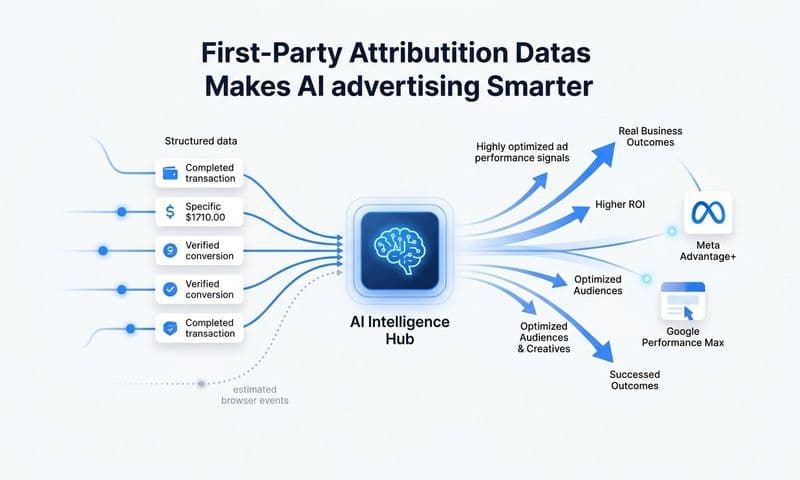
Beyond manual reallocation, accurate conversion data also improves the performance of ad platform algorithms. Automated bidding strategies like Target CPA and Target ROAS rely on conversion signals to make bidding decisions. When those signals are incomplete or inaccurate because of pixel-based tracking gaps, the algorithm is optimizing toward a distorted version of reality. Sending enriched, server-side conversion data back to platforms through a process called conversion sync helps the algorithm understand which clicks are actually driving valuable outcomes. Over time, this improves targeting, reduces wasted spend, and makes automated bidding more effective.
AI-powered attribution tools take this a step further. Rather than waiting for a human analyst to spot patterns in attribution data, AI can surface optimization opportunities proactively. Cometly's AI-powered recommendations, for example, can identify high-performing campaigns across channels and flag underperforming segments before they drain budget. Reviewing the top attribution tools for paid ads can help you evaluate which solution best fits your needs. This kind of continuous analysis would take a human analyst significant time to replicate manually, and by the time the analysis is complete, the opportunity may have passed.
The combination of accurate attribution, conversion sync, and AI-driven recommendations creates a feedback loop where better data leads to better algorithm performance, which leads to better campaign results, which generates more reliable data. That compounding effect is what separates teams that scale confidently from those that are always chasing last month's performance.
Putting It All Together
The paid search attribution model you choose is not a technical detail. It is a strategic decision that shapes how you understand your campaigns, where you invest your budget, and how confidently you can defend those decisions. A model that misrepresents your funnel will lead to misallocated spend, paused campaigns that were actually working, and missed opportunities to scale what is genuinely driving revenue.
The goal is not to find a perfect model because no single model captures every nuance of every customer journey. The goal is to move from guesswork to data-backed confidence. That means understanding the trade-offs of each model, recognizing the limitations of platform-reported data, and building a tracking infrastructure that gives you a unified, accurate view of how your paid search campaigns work together.
Cometly is built exactly for this challenge. It connects your ad platforms, CRM, and website to track the full customer journey in real time, lets you compare attribution models side by side, and uses AI-powered insights to surface the optimization opportunities that matter most. Whether you are trying to understand which keywords actually initiate conversions or looking to feed better data back to Google and Meta's bidding algorithms, Cometly gives you the clarity to act with confidence.
Ready to elevate your marketing game with precision and confidence? Discover how Cometly's AI-driven recommendations can transform your ad strategy. Get your free demo today and start capturing every touchpoint to maximize your conversions.