
Your Pinterest ads are driving traffic. Pins are being saved. Engagement looks healthy. But when you pull up your analytics dashboard, you're left with the same nagging question: which of these clicks and saves actually turned into revenue?
Pinterest has become a powerful advertising platform, especially for brands in visual-heavy industries like home decor, fashion, food, and lifestyle. The platform's discovery-focused environment creates unique opportunities to reach high-intent audiences actively seeking inspiration and solutions. Yet many marketers struggle to connect their Pinterest ad spend to actual business outcomes.
The challenge isn't just about installing a tracking pixel and calling it done. Pinterest users behave differently than audiences on other platforms. They save pins to boards, return days or weeks later, switch devices, and take winding paths to conversion. Standard tracking setups miss these nuances, leading to incomplete data, undervalued campaigns, and budget decisions based on guesswork rather than reality.
This guide walks you through the essential principles of Pinterest ads performance tracking—from understanding why Pinterest requires a different measurement approach to implementing tracking infrastructure that captures the full customer journey. You'll learn which metrics actually predict revenue, how to set up accurate conversion tracking, and how to connect Pinterest data to your broader marketing picture so you can optimize with confidence.
Why Pinterest Demands a Different Tracking Approach
Pinterest isn't a social network in the traditional sense. Users don't scroll to catch up with friends or consume entertainment. They arrive with intent, searching for ideas, planning projects, and discovering products they'll purchase later. This discovery mindset fundamentally changes how you need to measure ad performance.
When someone clicks your Facebook ad, they typically convert within hours or days. Pinterest operates on a completely different timeline. A user might save your pin on Monday while planning a kitchen renovation, research options throughout the week, compare prices on Saturday, and finally make a purchase two weeks later on a different device. If your attribution window only captures seven days, you've just missed crediting Pinterest for a conversion it directly influenced.
This save-and-return behavior creates tracking complexity that most marketers underestimate. Pinterest reports that many conversions happen days or even weeks after the initial interaction. Someone saves a pin to their "Dream Home Office" board, switches from their phone to their laptop, clears cookies multiple times, and eventually purchases through a Google search. Standard last-click attribution gives Google all the credit, even though Pinterest sparked the entire journey.
Native Pinterest Analytics shows you surface-level engagement: impressions, saves, outbound clicks, and basic conversion events if you've installed the Pinterest Tag. These metrics provide visibility into immediate response, but they don't reveal the full story. You can see that a pin generated 500 saves and 200 outbound clicks, but Pinterest Analytics won't tell you which of those users became paying customers three weeks later or what their lifetime value turned out to be.
The platform's longer consideration cycles mean you need tracking infrastructure that maintains identity across devices and time. You need attribution models that account for Pinterest's role in multi-touch journeys. And you need reporting that connects Pinterest engagement to downstream revenue, not just to clicks that happened within a narrow window. Understanding Pinterest ads conversion tracking fundamentals is essential for capturing this complete picture.
Many marketers treat Pinterest like any other paid channel, applying the same tracking approach they use for Meta or Google. They install the pixel, set up conversion events, and assume the platform's reporting tells the complete story. Then they wonder why Pinterest appears to underperform compared to other channels, even though their sales increased after launching Pinterest campaigns. The issue isn't Pinterest's effectiveness. It's the measurement framework that fails to capture how Pinterest actually drives revenue.
Essential Metrics That Actually Reveal Pinterest Ad Performance
Impressions and reach feel important, but they don't pay the bills. When evaluating Pinterest ad performance, you need metrics that connect directly to business outcomes and provide early signals about which campaigns will drive revenue.
Outbound clicks represent one of the most valuable leading indicators for Pinterest campaigns. Unlike engagement metrics that keep users on the platform, outbound clicks show that someone found your pin compelling enough to leave Pinterest and visit your website. This metric reveals intent and interest that correlates strongly with future conversions. Track outbound click rate alongside total clicks to understand which creative formats and targeting approaches drive qualified traffic.
Saves deserve special attention in Pinterest performance tracking. When someone saves your pin to their board, they're signaling strong interest and creating a reminder to return later. Pins with high save rates often generate conversions weeks after the initial save, making this metric a powerful predictor of long-term campaign value. Products with longer consideration cycles typically see higher save-to-conversion ratios, so don't dismiss campaigns with strong save performance even if immediate conversions appear low.
Engagement rate provides context for how your creative resonates with your target audience. This metric combines clicks, saves, and other interactions to show overall pin performance. High engagement rates indicate that your creative and messaging align with what users want to see, which typically leads to better algorithm performance and lower costs over time as Pinterest rewards engaging content with increased distribution.
Now we move beyond leading indicators to the metrics that directly measure business impact. Return on ad spend remains the ultimate measure of Pinterest campaign effectiveness. Calculate ROAS by dividing total revenue attributed to Pinterest by your total ad spend. The key word here is "attributed"—you need tracking infrastructure that accurately connects Pinterest interactions to revenue, including conversions that happen days or weeks later. Implementing robust tracking paid ads performance systems ensures you capture this data accurately.
Cost per acquisition reveals the efficiency of your Pinterest campaigns at driving desired actions. Whether you're measuring cost per purchase, cost per lead, or cost per signup, this metric helps you understand the true price of customer acquisition through Pinterest. Compare CPA across different campaign types, audience segments, and creative formats to identify your most efficient approaches.
Customer lifetime value from Pinterest traffic often reveals the platform's true value. Pinterest users frequently have higher purchase intent and better long-term retention than audiences from other channels. A customer acquired through Pinterest might have a higher initial CPA but generate significantly more revenue over time through repeat purchases. Track CLV by acquisition channel to understand whether Pinterest customers justify higher acquisition costs.
View-through attribution deserves special consideration for Pinterest campaigns. Unlike click-through conversions where someone directly clicks your ad and converts, view-through conversions happen when someone sees your pin, doesn't click immediately, but converts later after exposure to your brand. Pinterest's visual nature and save-focused behavior mean view-through attribution captures significant value that pure click tracking misses.
The challenge with view-through attribution is setting appropriate windows and weighting. Someone who saw your pin three days ago and then converted likely received meaningful influence from that exposure. Someone who glimpsed your pin six weeks ago probably didn't. Most marketers find that 7-14 day view-through windows balance capturing Pinterest's influence without overcrediting the channel.
Click-through attribution remains important, but don't rely on it exclusively for Pinterest measurement. Users who click your pin and convert within a standard attribution window represent only part of Pinterest's impact. The platform's strength lies in discovery and inspiration, which often manifests as view-through conversions or assisted conversions where Pinterest played an early-stage role in a multi-touch journey.
Balancing Short-Term and Long-Term Performance Indicators
The most effective Pinterest tracking strategies combine immediate response metrics with longer-term outcome measures. Monitor outbound clicks and saves to gauge campaign momentum and creative effectiveness in real time. Use these leading indicators to make quick optimizations without waiting weeks for conversion data.
Simultaneously track attributed revenue, ROAS, and customer lifetime value to understand true campaign performance. These lagging indicators reveal which campaigns actually drive business results, even if they don't show immediate conversion spikes. The combination gives you both the agility to optimize quickly and the insight to make sound strategic decisions about Pinterest's role in your marketing mix.
Setting Up Accurate Pinterest Conversion Tracking
Accurate conversion tracking starts with proper Pinterest Tag implementation. The Pinterest Tag is a piece of JavaScript code that you install on your website to track visitor actions and conversions. When implemented correctly, it captures events like page views, add to cart actions, and purchases, then sends this data back to Pinterest to measure ad performance and optimize delivery.
Install the base Pinterest Tag code in the header section of every page on your website. This base code loads the tracking infrastructure and automatically captures page view events. Then implement event codes on specific pages or actions you want to track: add the checkout event on your checkout page, the add to cart event when someone adds a product, and the purchase event on your order confirmation page.
Common setup mistakes undermine tracking accuracy from day one. Installing the Pinterest Tag only on landing pages means you'll miss conversions that happen after users navigate deeper into your site. Failing to pass dynamic values like order total or product IDs limits your ability to calculate accurate ROAS or optimize for high-value purchases. Implementing multiple instances of the same event code creates duplicate tracking that inflates your metrics.
Test your Pinterest Tag implementation before scaling ad spend. Use the Pinterest Tag Helper browser extension to verify that the base code loads on every page and that event codes fire correctly when users take desired actions. Check that dynamic values populate properly—your purchase event should capture the actual order total, not a static placeholder value.
Enhanced match significantly improves conversion tracking accuracy by sending hashed customer information to Pinterest alongside conversion events. When you enable enhanced match, the Pinterest Tag captures email addresses, phone numbers, and other identifiers from your website forms, then hashes this data before sending it to Pinterest. This allows Pinterest to match website conversions to specific Pinterest users, even when cookies are blocked or users switch devices. This approach leverages first party data tracking for ads to maintain accuracy despite privacy restrictions.
Implement enhanced match by modifying your Pinterest Tag code to include customer information fields. Most e-commerce platforms and tag management systems offer built-in support for enhanced match, making implementation straightforward. The key is ensuring you're capturing customer data at the right moments—typically during checkout or account creation—and passing it to the Pinterest Tag in the correct format.
Server-side tracking represents the next evolution in conversion measurement, addressing the growing limitations of client-side pixels. Browser restrictions, ad blockers, and privacy changes increasingly prevent client-side JavaScript tags from firing or transmitting data. Understanding what is server side tracking for ads helps you implement solutions that bypass browser-based blocking entirely.
With server-side tracking, when a customer completes a purchase on your website, your server sends the conversion event directly to Pinterest's API rather than relying on JavaScript code in the customer's browser. This approach captures conversions that client-side pixels miss, providing more complete and accurate data. Many businesses see 20-30% more tracked conversions after implementing server-side tracking alongside their client-side pixel.
The technical implementation requires API integration between your website or e-commerce platform and Pinterest's Conversions API. You'll send conversion events from your server, including relevant details like conversion value, customer identifiers, and event metadata. Pinterest uses this server-side data alongside client-side pixel data to build a more complete picture of conversion activity.
Validating Your Tracking Before Scaling
Never scale Pinterest ad spend without first validating that your tracking accurately captures conversions. Run test transactions through your website while monitoring Pinterest's Events Manager to confirm that events fire correctly and values populate accurately. Compare conversion counts in Pinterest Analytics against your actual sales data to identify any tracking gaps.
Create a validation checklist: verify the base tag loads on all pages, confirm event codes fire at the right moments, check that dynamic values capture correctly, test enhanced match implementation, and validate that conversion counts align with your source of truth. Address any discrepancies before increasing budgets, because scaling campaigns with broken tracking means making optimization decisions based on incomplete or inaccurate data.
Connecting Pinterest Data to Your Full Marketing Picture
Pinterest performance data sitting in isolation tells an incomplete story. You need to connect Pinterest interactions to your CRM, revenue data, and other marketing channels to understand the platform's true impact on your business.
Integration with your CRM reveals which Pinterest campaigns drive qualified leads and high-value customers. When you connect Pinterest ad data to your CRM, you can track individual customer journeys from initial pin interaction through lead capture, sales conversations, and closed deals. This connection shows you not just that Pinterest generated 50 leads this month, but that 15 of those leads came from a specific campaign targeting home renovation keywords, and 8 of them converted to customers worth a combined $47,000 in revenue.
The integration process typically involves passing unique identifiers from Pinterest through to your CRM. When someone clicks a Pinterest ad and fills out a lead form on your website, you capture both their information and data about which Pinterest campaign, ad group, and pin drove the visit. This campaign data flows into your CRM alongside the lead record, allowing you to analyze lead quality and conversion rates by Pinterest campaign.
For e-commerce businesses, connecting Pinterest data to your order management system provides similar insights. You can see which Pinterest campaigns drive customers who make repeat purchases, have higher average order values, or show better long-term retention. This level of analysis often reveals that Pinterest customers behave differently than those from other channels, justifying different CPA targets or budget allocation strategies.
Multi-touch attribution models become essential when Pinterest is part of a broader marketing mix. Last-click attribution systematically undercredits Pinterest because the platform often plays an early-stage discovery role rather than a final-click conversion driver. Someone might discover your brand through a Pinterest ad, research your products over several days, and finally convert after clicking a retargeting ad on Meta. Last-click attribution gives Meta all the credit, even though Pinterest initiated the entire journey. Implementing cross platform marketing performance tracking helps you see the complete picture.
Time-decay attribution models give more credit to touchpoints closer to conversion while still acknowledging earlier interactions. This approach better captures Pinterest's contribution when it plays a discovery role early in the customer journey. Position-based attribution assigns significant credit to both first and last touches, with remaining credit distributed among middle interactions. This model works well when you want to value both Pinterest's discovery impact and the channels that drive final conversions.
Linear attribution distributes credit equally across all touchpoints in the customer journey. While this approach lacks the sophistication of weighted models, it provides a straightforward way to ensure Pinterest receives credit for its role in multi-touch conversions. The best attribution model depends on your business, sales cycle length, and how different channels typically interact in customer journeys.
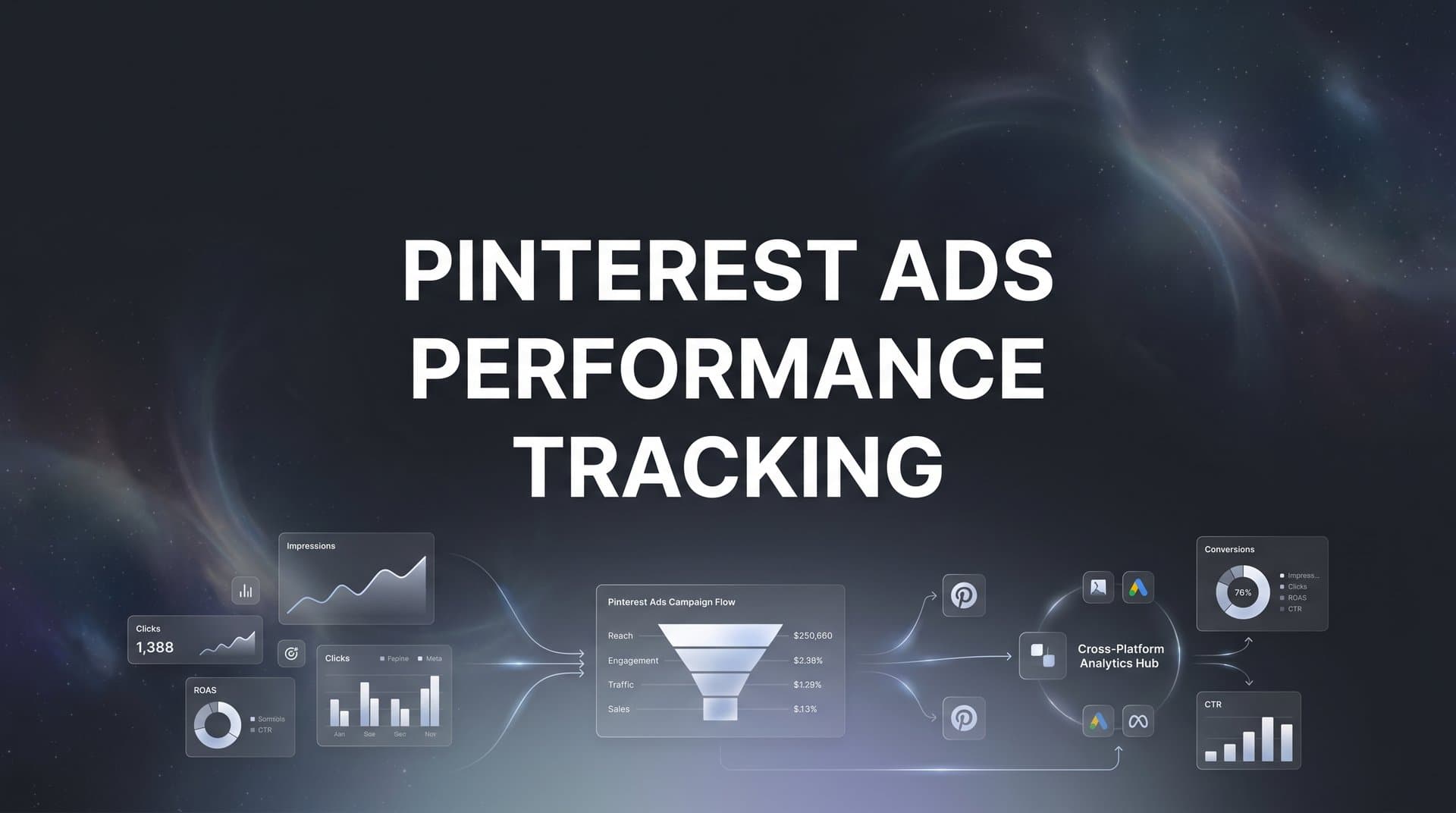
Building unified dashboards that display Pinterest performance alongside other paid channels enables true comparison and informed budget allocation. When Pinterest data lives in Pinterest Analytics, Meta data lives in Ads Manager, and Google data lives in Google Ads, you're forced to jump between platforms and manually compare metrics that may be calculated differently. Using a dedicated marketing performance tracking platform solves this fragmentation problem.
A unified dashboard pulls data from all your advertising platforms into a single view, standardizing metrics and enabling direct comparison. You can see that Pinterest delivered a 4.2x ROAS last month compared to Meta's 3.8x and Google's 5.1x, all calculated using the same attribution model and conversion definition. This clarity makes budget allocation decisions straightforward rather than speculative.
Creating a Single Source of Truth
The most sophisticated marketers build a centralized data infrastructure that becomes their single source of truth for all marketing performance. This system ingests data from Pinterest, Meta, Google, your CRM, your e-commerce platform, and any other relevant sources, then applies consistent attribution logic to determine each channel's contribution to revenue.
With this foundation in place, you can confidently answer questions like "What's my true ROAS from Pinterest?" and "How does Pinterest performance compare to other channels?" without worrying about inconsistent tracking, different attribution windows, or platform-specific reporting quirks. You're making decisions based on unified, accurate data rather than fragmented platform metrics that each tell a different story.
Turning Tracking Data Into Optimization Decisions
Collecting accurate Pinterest performance data is only valuable if you actually use it to improve campaign results. The goal of sophisticated tracking isn't reporting for its own sake—it's generating insights that drive better creative, targeting, and budget decisions.
Start by analyzing which creative formats, pin types, and messaging approaches drive the best performance. Break down your conversion data by creative variables to identify patterns. You might discover that carousel pins showing product details drive 60% higher conversion rates than static image pins, or that pins featuring lifestyle imagery outperform product-only shots by 40%. These insights should directly inform your creative production priorities.
Look beyond immediate click-through performance when evaluating creative effectiveness. A pin with modest click rates but exceptional save rates might drive significant long-term value as users return to their saved pins over weeks and months. Conversely, pins with high click rates but low conversion rates might attract curiosity clicks from unqualified audiences. Use your full-funnel tracking data to understand which creative truly drives revenue, not just engagement. Leveraging ad tracking tools to scale ads using accurate data makes this analysis far more effective.
Audience analysis reveals which targeting approaches deliver qualified traffic and profitable conversions. Compare performance across different audience segments: interest-based targeting, keyword targeting, actalike audiences, and retargeting. You might find that interest-based targeting drives high volume but lower conversion rates, while actalike audiences based on your customer list deliver fewer clicks but significantly higher ROAS.
Dig into demographic and behavioral patterns within your converting audience. If your tracking data shows that Pinterest users aged 35-44 have 3x higher lifetime value than younger segments, you can adjust your targeting and creative strategy accordingly. If certain interest combinations consistently drive better results, expand your campaigns around those proven audiences.
Budget allocation becomes strategic rather than speculative when you have accurate attribution data. Instead of distributing budget based on platform-reported metrics that may overstate or understate true performance, you can allocate spend based on actual attributed revenue. If your unified tracking shows Pinterest delivering a 4.5x ROAS while another channel delivers 2.8x, you have clear direction for where additional budget will generate the best returns.
Consider the full customer journey when making budget decisions. A channel that appears less efficient on a last-click basis might play a crucial discovery role that makes other channels more effective. Pinterest often functions this way—introducing customers to your brand and warming them up for conversion through other channels. Attribution models that capture this dynamic help you avoid cutting budgets from channels that drive significant assisted value.
The feedback loop between tracking data and platform optimization creates compounding returns over time. When you feed accurate conversion data back to Pinterest's algorithm, the platform gets better at identifying which users are likely to convert. Pinterest uses this signal to optimize ad delivery, showing your ads to more people who resemble your converters and fewer people who don't.
This optimization happens automatically when your Pinterest Tag accurately tracks conversions, but the quality of optimization depends entirely on the quality of your conversion data. If your tracking only captures 60% of actual conversions due to browser restrictions or implementation issues, Pinterest's algorithm optimizes based on incomplete information. When you implement server side tracking for ads and enhanced match to capture 90%+ of conversions, the algorithm has much better data to work with, leading to improved targeting and lower costs.
Create regular optimization cycles where you review performance data, identify insights, implement changes, and measure results. Monthly reviews work well for most businesses, giving you enough data to spot meaningful patterns without waiting so long that you miss optimization opportunities. During these reviews, look for campaigns that have scaled successfully and deserve more budget, underperforming elements that need adjustment or pausing, and new opportunities based on what's working.
Testing Your Way to Better Performance
Use your tracking infrastructure to run structured tests that improve performance over time. Test different creative approaches, audience combinations, and bidding strategies, then let your attribution data reveal which variations drive better results. Start with high-impact variables like creative format and core messaging, then move to more granular tests around specific images, headlines, or targeting refinements.
The key to effective testing is isolating variables and giving tests enough time and budget to generate statistically meaningful results. Don't change five things at once and wonder which drove the improvement. Test one variable at a time, run tests until you have sufficient conversion data, and use your attribution system to measure impact on actual revenue rather than just platform-reported metrics.
Making Pinterest Tracking Work for Your Business
Accurate Pinterest ads performance tracking requires looking beyond native analytics to capture the full customer journey. The platform's discovery-focused user behavior and longer consideration cycles mean you need tracking infrastructure that maintains identity across devices and time, attribution models that credit Pinterest for its role in multi-touch journeys, and reporting that connects Pinterest engagement to actual revenue outcomes.
Start with solid foundational tracking: implement the Pinterest Tag correctly, enable enhanced match, and consider server-side tracking to capture conversions that client-side pixels miss. Focus on metrics that predict and measure real business impact—outbound clicks, saves, attributed revenue, ROAS, and customer lifetime value—rather than vanity metrics that look good but don't correlate with growth.
Connect Pinterest data to your broader marketing infrastructure. Integrate with your CRM to see which campaigns drive qualified leads and high-value customers. Implement multi-touch attribution to ensure Pinterest receives appropriate credit when it plays a discovery role early in customer journeys. Build unified dashboards that enable direct comparison across all your paid channels using consistent metrics and attribution logic.
Use your tracking data to drive continuous optimization. Analyze which creative formats, audiences, and campaigns deliver the best results, then double down on what works. Allocate budget based on attributed revenue rather than platform-reported metrics. Feed accurate conversion data back to Pinterest's algorithm to improve targeting over time.
The marketers who succeed with Pinterest advertising are those who invest in measurement infrastructure that reveals the platform's true impact. They understand that Pinterest often plays a different role than last-click conversion channels, and they build tracking systems that capture this value. They make optimization decisions based on complete data that connects ad spend to revenue, not fragmented metrics that tell an incomplete story.
Ready to elevate your marketing game with precision and confidence? Discover how Cometly's AI-driven recommendations can transform your ad strategy—Get your free demo today and start capturing every touchpoint to maximize your conversions.