B2B marketing attribution is one of those challenges that keeps marketers up at night. You launch campaigns across LinkedIn, Google Ads, and Meta. You nurture leads through email sequences. Your sales team takes prospects through demos and discovery calls. Then, weeks or months later, a deal closes. But which marketing touchpoint actually started that journey? Which campaign deserves credit for the revenue?
Unlike consumer purchases that happen in minutes, B2B buying decisions involve multiple stakeholders, lengthy evaluation periods, and touchpoints scattered across digital and offline channels. A CFO might click your LinkedIn ad on mobile during their commute, a VP might download your white paper on desktop at the office, and the CEO might attend your webinar before the team finally requests a demo. Connecting these dots requires more than basic analytics.
This guide walks you through building a B2B attribution system that captures every meaningful interaction from first click to signed contract. You will learn how to connect your marketing platforms to your CRM, implement tracking that actually works despite browser limitations, and analyze which campaigns drive real pipeline and revenue. By the end, you will have a clear framework for understanding which marketing investments deserve more budget and which ones are quietly draining resources without delivering results.
Step 1: Map Your B2B Customer Journey and Define Key Conversion Events
Before you can track attribution, you need to know what you are tracking. Start by documenting every touchpoint in your typical sales cycle. Sit down with your sales team and map out how prospects actually move from awareness to closed deal. This is not about creating an idealized customer journey. This is about understanding the messy, real-world path your buyers take.
Identify your micro-conversions first. These are the early signals that someone is interested but not yet ready to buy. Think content downloads, blog subscriptions, webinar registrations, and email engagement. These actions might not generate immediate revenue, but they indicate buying intent and deserve to be tracked. A prospect who downloads three white papers and attends a webinar is showing significantly more interest than someone who bounced after reading one blog post.
Next, define your macro-conversions. These are the high-value actions that move prospects closer to revenue. Demo requests, free trial signups, contact sales form submissions, and consultation bookings all signal serious buying intent. In your CRM, these typically correspond to stages like Marketing Qualified Lead (MQL), Sales Qualified Lead (SQL), and Opportunity Created. Understanding marketing funnel attribution helps you connect these stages to specific campaigns.
Document the typical timeline for each stage. B2B sales cycles vary dramatically by industry and deal size. A $5,000 software subscription might close in two weeks, while an enterprise contract could take six months. Understanding your timeline helps you set realistic expectations for attribution data and prevents you from prematurely judging campaign performance.
Account for multiple stakeholders. In B2B, the person who clicks your ad is rarely the only decision-maker. You might be marketing to a Director of Marketing who influences the VP of Sales who reports to the CMO who needs CFO approval. Your attribution system needs to track multiple contacts from the same company and understand that all their touchpoints contribute to a single revenue event.
Create a visual journey map showing both online and offline interactions. Include website visits, ad clicks, email opens, content downloads, sales calls, product demos, and in-person meetings. This map becomes your blueprint for what needs to be tracked. Every action that influences a purchase decision should have a corresponding trackable event in your attribution system.
Verify success by ensuring every revenue-generating action has a trackable event. Walk through your map and confirm that each touchpoint can be captured and connected to a specific prospect or account. If you discover gaps where important interactions are not being tracked, note them now so you can address them in later steps.
Step 2: Connect Your Ad Platforms and Marketing Channels to a Central Tracking System
Once you know what to track, you need to actually capture that data. This means integrating all your marketing channels into a central attribution platform that can see the complete picture. Scattered data across multiple dashboards will never give you accurate attribution.
Start by connecting your paid advertising platforms. Integrate Google Ads, LinkedIn Campaign Manager, and Meta Ads Manager with your attribution system. Most modern attribution platforms offer native integrations that pull campaign data, spend, and conversion events automatically. This connection allows you to see not just which channel drove a conversion, but which specific campaign, ad set, and creative deserves credit. Explore the best software for tracking marketing attribution to find the right solution for your needs.
Establish a consistent UTM parameter convention across all campaigns. UTM parameters are the tags you add to URLs that tell your analytics system where traffic came from. Create a standardized naming structure and document it for your entire team. For example, you might use utm_source for the platform (linkedin, google, facebook), utm_medium for the channel type (cpc, email, social), and utm_campaign for the specific campaign name.
Consistency matters more than you think. If one team member tags LinkedIn ads as "LinkedIn" and another uses "linkedin" or "LI", your attribution data will be fragmented. Build a shared spreadsheet or use a UTM builder tool that enforces your naming conventions. Every campaign URL should follow the same structure without exception.
Configure tracking for organic channels as well. SEO traffic, email marketing, direct visits, and referral sources all contribute to B2B conversions. Set up proper tracking for email campaigns by including UTM parameters in every link. For SEO, ensure your analytics platform can attribute organic search traffic to specific landing pages and keywords. Direct traffic often includes people who saw your ad, remembered your brand, and typed your URL directly later, so do not dismiss it as unattributable.
Implement first-party cookies and prepare for browser limitations. Browser privacy features and ad blockers increasingly block third-party tracking pixels. First-party cookies, which are set by your own domain rather than an external tracking service, are more reliable and less likely to be blocked. Your attribution platform should use first-party data collection methods to maximize data accuracy.
Set up cross-domain tracking if your customer journey spans multiple websites. If prospects start on your blog subdomain, move to your main website, and then complete a form on a separate landing page domain, you need tracking that follows them across all three. Without proper cross-domain configuration, these will appear as separate sessions from different visitors, breaking your attribution chain.
Test every integration thoroughly. Run test traffic through each channel and verify that the data appears correctly in your attribution platform. Click a LinkedIn ad, fill out a form, and confirm that the conversion is attributed to LinkedIn with the correct campaign and ad details. Do this for every channel you plan to track. Discovering broken tracking after you have spent thousands on campaigns is expensive and frustrating.
Step 3: Integrate Your CRM to Track Leads Through the Sales Pipeline
Marketing attribution is not complete until you connect it to revenue. Your CRM is where leads become opportunities and opportunities become closed deals. Without CRM integration, you can see which campaigns drive form submissions, but you cannot see which campaigns drive actual revenue.
Connect your CRM to your attribution platform through a native integration or API. Most attribution systems support direct connections to Salesforce, HubSpot, Pipedrive, and other major CRM platforms. This integration should be bidirectional, sending marketing touchpoint data into your CRM and pulling sales stage and revenue data back into your attribution platform. A robust B2B marketing attribution platform makes this integration seamless.
Map your CRM stages to attribution events. Every meaningful progression through your sales pipeline should be trackable. When a lead is created in your CRM, that is an event. When they are marked as Marketing Qualified, that is another event. Sales Qualified, Opportunity Created, and Closed-Won are all critical milestones that need to flow into your attribution system.
Configure revenue value tracking so that when deals close, the revenue amount is connected back to the marketing touchpoints that influenced that deal. This is where attribution becomes truly powerful. Instead of just knowing that LinkedIn drove 100 leads, you can see that those 100 leads generated $250,000 in closed revenue, while the 150 leads from Google Ads only generated $80,000. Suddenly, your budget allocation decisions become much clearer.
Set up account-level attribution to handle the reality of B2B buying. Multiple people from the same company will interact with your marketing before a deal closes. Your attribution system needs to recognize that the Director who clicked your ad, the VP who downloaded your case study, and the C-level executive who attended your webinar are all from the same account. Account-based attribution groups all these contacts together and attributes revenue to the collective journey, not just individual leads.
Ensure that lead source data persists through the entire sales cycle. A common attribution failure happens when CRM records are updated or merged, overwriting the original source information. Configure your CRM to preserve initial touchpoint data even as leads progress through sales stages or when duplicate records are merged. The first marketing interaction that created the lead should remain visible even after months of sales activity.
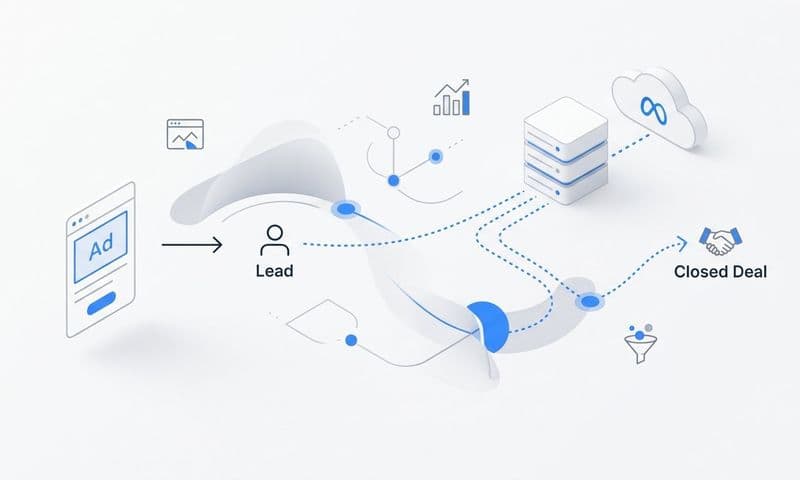
Validate your integration by tracing a test lead from ad click to closed deal. Create a test contact, put them through your entire funnel, mark them as an opportunity, and close them as won with a revenue value. Then check your attribution platform to confirm that the entire journey is visible, from the initial ad click through to the final revenue number. If any stage is missing or the revenue is not connecting back to marketing touchpoints, troubleshoot before going live.
Step 4: Implement Server-Side Tracking for Accurate Data Collection
Browser-based tracking pixels are becoming less reliable every year. iOS privacy features, browser ad blockers, and cookie restrictions mean that traditional client-side tracking misses a significant portion of conversions. For B2B marketers, this gap can be devastating because high-value prospects often use privacy tools or corporate networks that block tracking scripts.
Server-side tracking solves this problem by capturing conversion events on your server rather than relying on browser pixels. When someone fills out a form or completes a purchase, your server sends that conversion data directly to your attribution platform and ad networks. This method bypasses browser limitations entirely, ensuring you capture every conversion regardless of privacy settings or ad blockers.
Set up server-side event tracking through your attribution platform. Modern platforms provide server-side APIs that let you send conversion events directly from your backend systems. When a lead fills out a form, your server processes that submission and simultaneously fires a conversion event to your tracking system. The prospect's browser never needs to load a tracking pixel, so nothing can block the data collection. Learn more about building a complete campaign attribution tracking system that incorporates server-side methods.
Configure conversion sync to feed accurate data back to your ad platforms. When you capture conversions server-side, you can send that data back to Google Ads, Meta, and LinkedIn. This improves their algorithm optimization because they receive accurate conversion signals even when browser tracking fails. Better conversion data means better ad targeting and optimization, which directly improves your campaign performance and ROI.
Handle cross-device tracking for prospects who research on mobile but convert on desktop. B2B buyers often discover your brand on their phone during a commute or lunch break, then return on their work computer to take action. Server-side tracking combined with user identification helps connect these sessions. When someone enters their email address, that becomes the identifier that links their mobile browsing to their desktop conversion.
Implement proper user consent management to stay compliant with privacy regulations while maintaining tracking accuracy. Server-side tracking still requires user consent in many jurisdictions, but it gives you more control over data collection and allows you to honor consent preferences more precisely. Build consent collection into your forms and ensure your server-side tracking respects those preferences.
Monitor data quality by comparing server-side events to CRM records. Regularly audit your tracking to ensure that the conversions captured server-side match what appears in your CRM. Discrepancies indicate configuration issues that need to be fixed. High-quality attribution depends on accurate data, so treat data quality monitoring as an ongoing responsibility, not a one-time setup task.
Step 5: Choose and Configure Your Attribution Model
Attribution models determine how credit is distributed across the touchpoints in a customer journey. The model you choose fundamentally changes how you understand campaign performance and where you allocate budget. There is no universally correct model, but there are models that align better with B2B sales cycles.
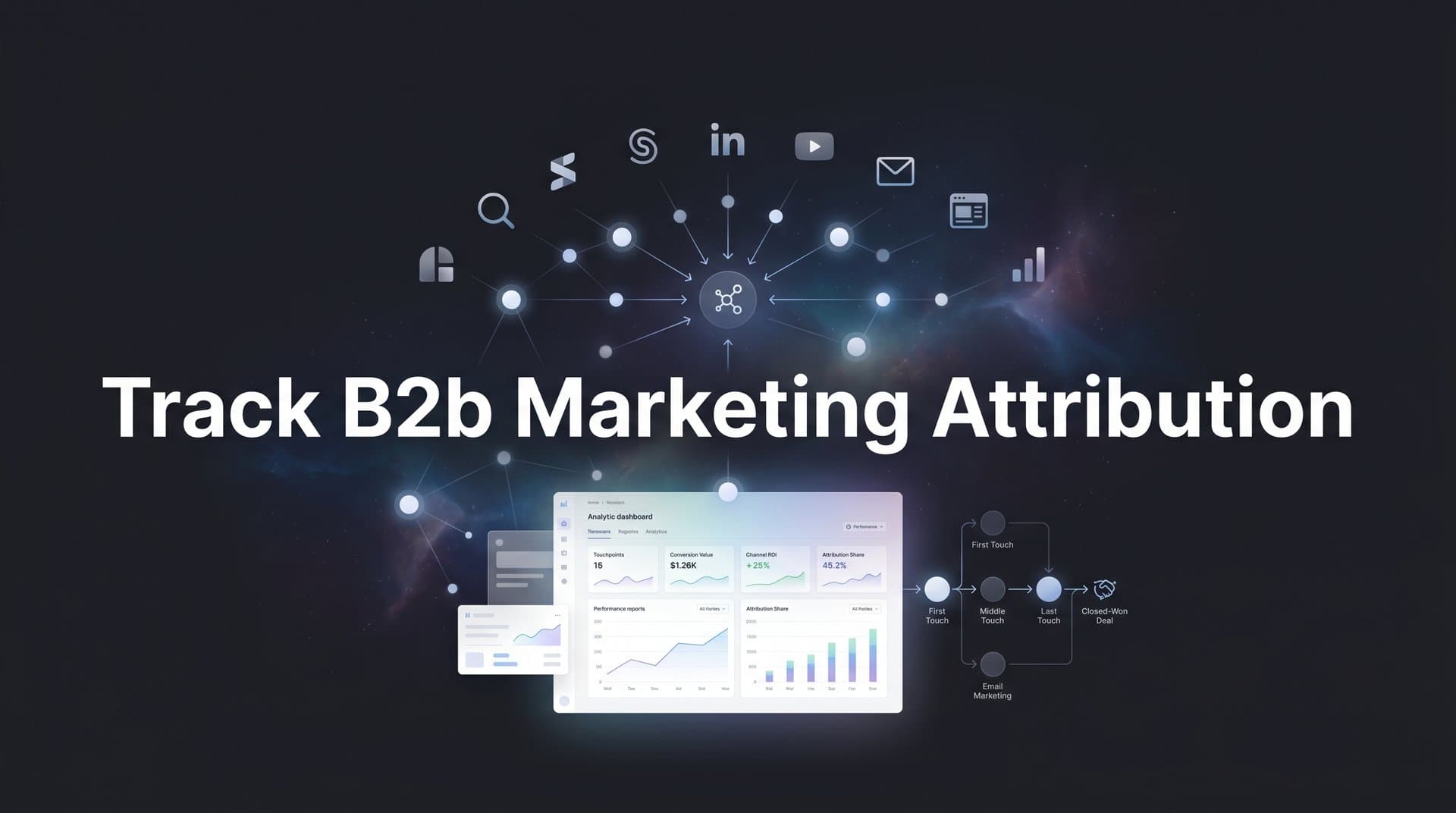
Understand the common attribution models and what they measure. First-touch attribution gives all credit to the initial interaction that brought someone into your ecosystem. Last-touch attribution credits only the final touchpoint before conversion. Linear attribution divides credit equally across all touchpoints. Time-decay attribution gives more weight to recent interactions. Position-based attribution credits the first and last touchpoints more heavily while distributing remaining credit to middle interactions. For a deeper dive, explore our guide on attribution models for B2B marketing.
For most B2B companies, single-touch models like first-touch or last-touch are too simplistic. The campaign that generated initial awareness deserves credit, but so does the nurture email that re-engaged them three weeks later and the retargeting ad that brought them back for a demo. Multi-touch attribution models recognize this complexity and distribute credit more fairly.
Select a model based on your sales cycle length and marketing strategy. If you run short sales cycles with few touchpoints, a simpler model might suffice. For longer enterprise sales with dozens of interactions over months, multi-touch attribution becomes essential. Many B2B marketers start with position-based attribution, which gives 40% credit to the first touch, 40% to the last touch, and distributes the remaining 20% among middle touchpoints.
Configure the ability to compare models side-by-side. Different attribution models will tell different stories about your marketing performance. A channel that looks weak in last-touch attribution might be a powerful awareness driver in first-touch attribution. Set up your attribution platform to show multiple models simultaneously so you can understand performance from different perspectives. This prevents you from optimizing based on a single, potentially misleading view.
Consider custom attribution models if standard models do not fit your business. Some attribution platforms allow you to build custom logic that weights touchpoints based on your specific sales process. You might give extra credit to demo requests or webinar attendance because you know these actions correlate strongly with closed deals. Custom models require more setup but can provide more accurate insights for unique business models.
Document your attribution logic clearly so stakeholders understand how credit is assigned. When you present attribution data to executives or sales teams, they need to know what the numbers mean. Create a simple explanation of your chosen model and why certain campaigns receive the credit they do. This transparency builds trust in your attribution data and prevents confusion when making budget decisions.
Step 6: Analyze Attribution Data and Optimize Campaign Performance
Attribution data is only valuable if you actually use it to make better marketing decisions. Build regular reporting and optimization processes that turn attribution insights into action.
Create reports that show which channels and campaigns drive pipeline and revenue, not just leads. Many marketing teams optimize for lead volume and wonder why revenue does not follow. Attribution reveals the truth. You might discover that LinkedIn generates fewer leads than Google Ads but those LinkedIn leads close at three times the rate and generate twice the average deal size. Understanding channel attribution in digital marketing helps you make these critical distinctions.
Identify high-performing ads and campaigns using AI-powered analysis. Modern attribution platforms can analyze thousands of data points to surface patterns you would never spot manually. AI recommendations might reveal that ads featuring customer testimonials convert 40% better than product feature ads, or that campaigns targeting specific job titles drive significantly higher revenue. Use these insights to inform creative strategy and campaign planning.
Reallocate budget from underperforming channels to proven revenue drivers. Attribution data gives you the confidence to shift spend aggressively. If your data shows that webinar promotion campaigns consistently drive high-value opportunities while generic awareness campaigns generate leads that never close, you have clear justification to move budget. Make these shifts gradually and monitor results, but do not be afraid to act on strong attribution signals.
Set up regular attribution reviews to continuously improve marketing ROI. Schedule monthly or quarterly sessions where you analyze attribution data, identify trends, and plan optimizations. Include both marketing and sales team members in these reviews. Sales can provide context about lead quality and buying signals that pure data might miss, while marketing can explain campaign strategies and timing. Review common attribution challenges in B2B marketing to anticipate and address potential roadblocks.
Use attribution insights to inform content strategy and campaign planning. If attribution shows that prospects who engage with case studies are twice as likely to close, create more case studies and promote them more heavily. If certain topics or industries drive disproportionate revenue, double down on content and campaigns targeting those areas. Let your attribution data guide not just budget allocation but your entire marketing strategy.
Feed conversion data back to ad platforms to improve their optimization algorithms. Platforms like Meta and Google use machine learning to optimize ad delivery, but they can only optimize based on the conversion data you provide. When you send accurate, revenue-connected conversion events back to these platforms through conversion sync, their algorithms learn which audiences and placements actually drive valuable outcomes. This creates a virtuous cycle where better data leads to better targeting, which leads to better results and even more data to optimize with.
Moving Forward with Confidence
Tracking B2B marketing attribution is complex, but it is not optional if you want to scale your marketing effectively. The framework outlined here gives you a systematic approach: map your customer journey and define trackable events, connect all your marketing channels to a central tracking system, integrate your CRM to follow leads through the pipeline, implement server-side tracking for accurate data collection, choose an attribution model that reflects your sales reality, and use your insights to continuously optimize performance.
Start with the foundation. Get your conversion events defined and your integrations connected properly. Data quality matters more than having every advanced feature configured on day one. A simple attribution setup with accurate data beats a sophisticated system built on incomplete or unreliable information.
The payoff is worth the effort. With proper attribution in place, you will know exactly which marketing investments drive real revenue. You will stop wasting budget on campaigns that look good on vanity metrics but never convert. You will confidently scale the channels and campaigns that actually work. Most importantly, you will have the data to prove marketing's impact on revenue and justify the budget you need to grow.
Ready to elevate your marketing game with precision and confidence? Discover how Cometly's AI-driven recommendations can transform your ad strategy. Get your free demo today and start capturing every touchpoint to maximize your conversions.