
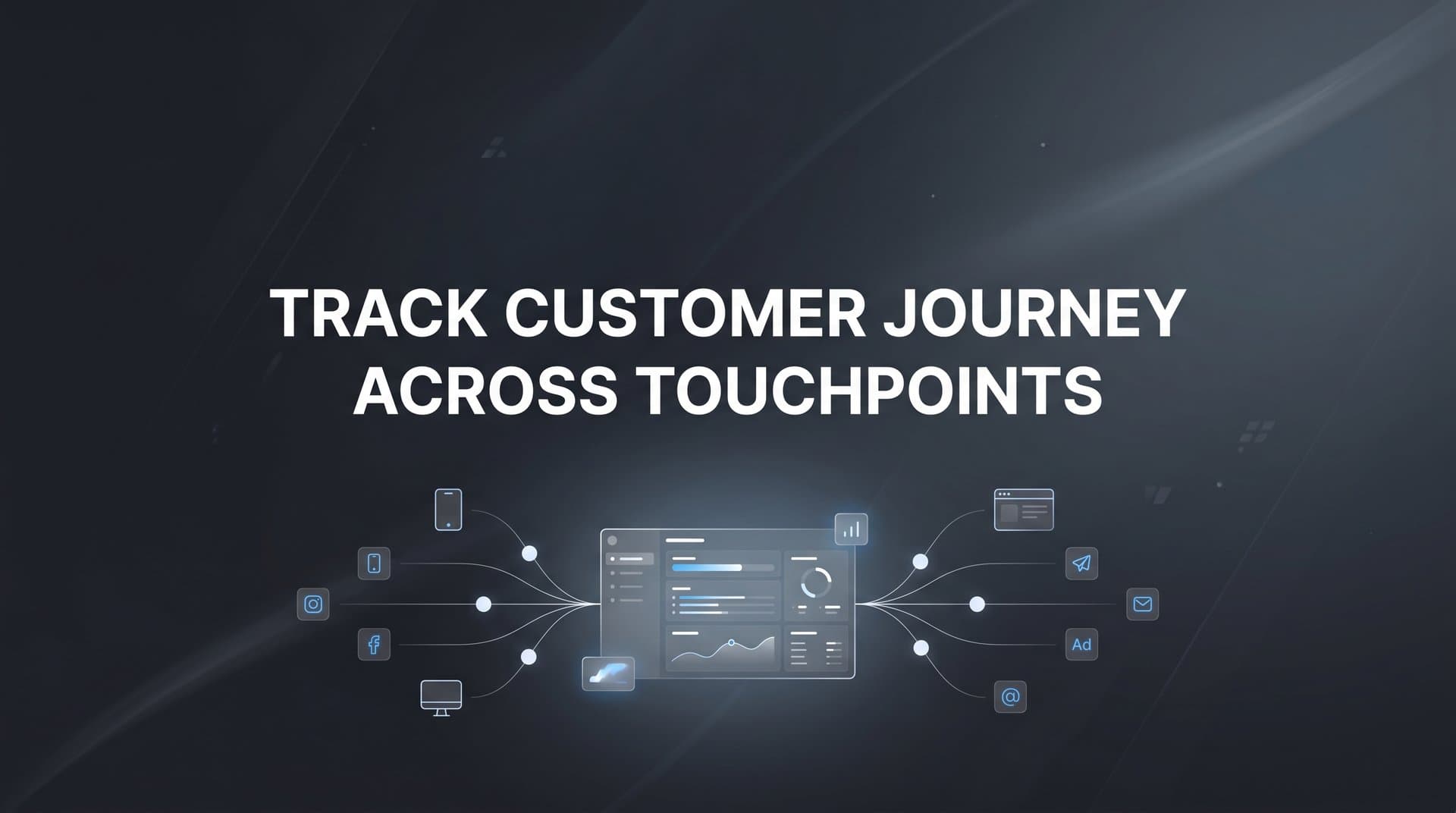
Every customer interaction tells part of a story. The challenge is connecting those fragments into a complete picture that reveals what actually drives conversions. When a prospect clicks your Facebook ad, browses your website, opens three emails, and finally converts after a Google search, which touchpoint deserves credit? More importantly, how do you capture this entire journey without losing data along the way?
This guide walks you through the exact process of setting up comprehensive customer journey tracking across all your marketing touchpoints. You'll learn how to connect your ad platforms, website, and CRM into a unified tracking system that shows the complete path from first click to closed deal.
By the end, you'll have a working framework to attribute revenue accurately and optimize your campaigns based on real customer behavior, not guesswork.
Step 1: Map Your Current Customer Touchpoints and Data Sources
Before you can track customer journeys effectively, you need to know exactly where those journeys happen. Start by auditing every channel where prospects interact with your brand. This includes paid advertising platforms like Meta, Google, TikTok, and LinkedIn, as well as organic channels like search, social media, email marketing, and direct traffic to your website.
Create a spreadsheet that lists each touchpoint and documents what you're currently tracking. For paid ads, note which conversion events you've configured and whether you're capturing view-through conversions alongside clicks. For your website, identify which pages have tracking pixels and which user actions trigger events. For email, determine if you're tracking opens, clicks, and conversions back to specific campaigns.
This audit reveals gaps fast. You might discover that your TikTok ads have no conversion tracking beyond platform-reported clicks. Or that your email platform sits completely disconnected from your website analytics. Maybe your sales team closes deals in a CRM that has zero connection to the marketing campaigns that generated those leads.
Once you've mapped your current state, prioritize based on impact. Which channels drive the most traffic? Which ones have the highest conversion rates? Which platforms represent your largest ad spend? These high-priority touchpoints deserve your immediate attention when building out comprehensive tracking.
Document your customer's typical journey. Do most people discover you through paid ads and convert immediately? Or do they engage with multiple touchpoints over weeks before purchasing? Understanding common patterns helps you design a tracking system that captures the interactions that actually matter for your business.
The goal of this step is simple: know what you have, identify what's missing, and create a roadmap for connecting the dots. Without this foundation, you'll build tracking infrastructure that misses critical pieces of the customer journey.
Step 2: Set Up Server-Side Tracking for Accurate Data Collection
Browser-based tracking has fundamental limitations in 2026. iOS privacy features block third-party cookies, Safari's Intelligent Tracking Prevention restricts tracking windows, and ad blockers eliminate pixels entirely for many users. If you're still relying solely on client-side JavaScript pixels, you're losing significant portions of your conversion data.
Server-side tracking solves this by processing data on your server before sending it to ad platforms and analytics tools. Instead of relying on a user's browser to fire tracking pixels, your server captures the interaction and forwards that data directly to your marketing tools. This approach bypasses browser restrictions and gives you complete control over what data gets collected and shared.
Start by implementing first-party data collection on your website. This means setting up tracking that runs on your own domain rather than loading third-party scripts from external platforms. When someone submits a form, makes a purchase, or completes any valuable action, your server captures that event with all relevant details like user identifier, timestamp, and conversion value.
Configure your tracking to capture user identifiers consistently. This typically means setting a first-party cookie when someone first visits your site and maintaining that identifier throughout their journey. When they convert, you can tie that action back to their original ad click, even if weeks have passed.
Test your implementation thoroughly. Submit test conversions from different devices and browsers. Check that events fire correctly on mobile Safari, which has the strictest tracking limitations. Understanding customer journey tracking across devices is essential for verifying your server receives the data and successfully forwards it to your ad platforms and attribution system.
Server-side tracking requires more technical setup than dropping a pixel on your site, but the data accuracy gains are substantial. You'll capture conversions that browser-based tracking misses entirely, giving you a more complete picture of campaign performance and customer journeys.
Step 3: Connect Your Ad Platforms to a Centralized Attribution System
Each ad platform has its own dashboard, its own metrics, and its own version of reality. Meta claims credit for conversions that Google also counts. TikTok reports results that don't match your website analytics. When data lives in silos, you can't see the complete customer journey or make informed budget decisions.
A centralized attribution system solves this by pulling data from all your ad platforms into one place. This creates a single source of truth where you can see how touchpoints work together rather than evaluating each channel in isolation. Integration typically happens through API connections that automatically sync campaign data, ad spend, clicks, and conversions.
Before connecting platforms, standardize your UTM parameters and naming conventions. Create a consistent structure for campaign names, ad set names, and ad names across all platforms. This makes it possible to compare performance and analyze journeys when data from different sources flows into your attribution system.
For example, use a format like: {platform}_{campaigntype}_{audience}_{objective}. A Facebook campaign might be named "meta_prospecting_lookalike_purchase" while a Google campaign follows the same structure: "google_prospecting_intent_purchase". Consistency enables meaningful analysis when you're looking at multi-platform journeys.
Set up conversion events that sync bidirectionally. Your attribution system should receive conversion data from your website and CRM, then send those conversions back to your ad platforms. Learning how to track conversions across multiple ad platforms ensures this conversion sync feeds better data to platform algorithms, improving their ability to optimize toward actual business outcomes rather than proxy metrics.
Test each integration by running a small campaign and verifying that clicks, impressions, and conversions appear correctly in your attribution dashboard. Check that the data matches what the ad platform reports. Small discrepancies are normal due to different attribution windows and counting methodologies, but large gaps indicate integration problems that need fixing.
With all platforms connected, you gain the ability to see cross-channel journeys. You can identify that a customer clicked a Meta ad, returned through a Google search, and converted after clicking an email. That complete picture is impossible when data stays trapped in separate platform dashboards.
Step 4: Link Your CRM to Capture the Full Revenue Journey
Marketing touchpoints tell half the story. The other half lives in your CRM, where leads become opportunities, opportunities move through sales stages, and deals close with actual revenue attached. Connecting CRM data to marketing touchpoints transforms attribution from tracking clicks to tracking dollars.
Start by integrating your CRM with your attribution platform. Most modern CRMs offer API access that allows bidirectional data sync. When a lead enters your CRM, that event should flow back to your attribution system along with the lead's identifier. As that lead progresses through your sales pipeline, each stage change becomes a trackable event.
Map customer identifiers carefully across systems. The email address someone used to fill out your lead form needs to match the contact record in your CRM. The user ID your website assigns needs to connect to the same person's ad clicks and CRM record. Without consistent identifier mapping, journeys fragment and attribution breaks down.
Configure revenue attribution by sending closed deal values back to your marketing touchpoints. When a $10,000 deal closes in your CRM, your attribution system should connect that revenue to every marketing interaction that influenced the sale. This approach to end to end customer journey tracking lets you see actual ROI for each campaign rather than guessing based on lead volume.
Set up automated data sync to keep everything current. Your CRM should push updates to your attribution platform in real time or near-real time. When a lead converts to an opportunity, that event should appear in your marketing reports immediately. When a deal closes, the revenue should attribute to campaigns within minutes, not days.
This connection reveals which campaigns drive revenue, not just leads. You might discover that your LinkedIn ads generate fewer leads than Facebook but close at three times the rate with twice the deal size. Without CRM integration, you'd optimize toward Facebook because it has higher lead volume, missing the fact that LinkedIn drives more actual revenue.
The full revenue journey shows you everything from first ad impression to closed deal, including all the touchpoints in between. This complete visibility enables smarter budget allocation and more accurate forecasting of marketing's impact on business growth.
Step 5: Configure Multi-Touch Attribution Models
Attribution models determine how credit gets distributed across the touchpoints in a customer journey. The model you choose fundamentally changes which campaigns appear successful and where you allocate budget. Understanding the options and selecting the right approach for your business is critical.
First-touch attribution gives all credit to the initial interaction. If someone clicked a Facebook ad six weeks before converting, that Facebook campaign gets 100% credit even if the customer engaged with five other touchpoints along the way. This model favors top-of-funnel awareness campaigns but ignores everything that happened after the first click.
Last-touch attribution does the opposite, crediting only the final interaction before conversion. If someone converted after clicking a Google search ad, that campaign gets full credit regardless of the Facebook ad, email, and website visits that preceded it. This model favors bottom-of-funnel campaigns but misses the awareness and consideration touchpoints that made the final conversion possible.
Multi-touch attribution distributes credit across multiple touchpoints in the journey. Linear models split credit evenly among all interactions. Time-decay models give more weight to recent touchpoints. Position-based models emphasize the first and last touch while still crediting middle interactions. Understanding tracking conversions across multiple touchpoints helps you evaluate each approach and its different insights into how your marketing channels work together.
Select an attribution model that matches your sales cycle and business goals. If you run a short sales cycle where most customers convert within days, last-touch attribution might reasonably represent reality. If you have a complex B2B sales process spanning months with multiple stakeholder interactions, multi-touch attribution becomes essential for understanding what actually drives deals.
Compare how different models credit the same journeys. Look at a high-value customer who engaged with six touchpoints over two months. See how first-touch, last-touch, and various multi-touch models distribute credit. This comparison reveals which touchpoints get undervalued by simpler models and helps you make informed decisions about budget allocation.
The right attribution model shows you which marketing investments drive results. It helps you identify undervalued touchpoints that assist conversions without getting credit in last-touch models. It reveals whether your awareness campaigns actually contribute to revenue or just generate vanity metrics. Use model comparison as a tool for understanding customer behavior, not as a search for the single "correct" answer.
Step 6: Analyze Customer Journeys and Optimize Your Campaigns
With comprehensive tracking in place and attribution models configured, you can finally see complete customer journeys. The real value comes from analyzing these journeys to identify patterns, spot opportunities, and optimize your marketing based on actual behavior rather than assumptions.
Start by examining common paths to conversion. Which sequences of touchpoints appear most frequently in successful customer journeys? You might discover that customers who engage with both paid social and paid search convert at twice the rate of those who only interact with one channel. Or that email touches in the middle of the journey significantly increase conversion probability.
Identify where prospects drop off. Look at incomplete journeys where people engaged with multiple touchpoints but never converted. Do they consistently disappear after visiting your pricing page? Do they click ads but never return after the first website visit? These drop-off points reveal friction in your funnel that needs addressing.
Analyze which touchpoints accelerate deals. Compare journey lengths for customers who engaged with different combinations of channels. If adding a retargeting campaign reduces time-to-conversion by 40%, that insight drives immediate optimization decisions. If customers who receive a specific email sequence close faster, you can systematize that touchpoint for all prospects.
Use AI-powered recommendations to identify optimization opportunities you might miss manually. Modern attribution platforms analyze thousands of customer journeys to surface patterns like underperforming ad creatives, audiences that engage but don't convert, or budget allocation inefficiencies across channels. Learning how to analyze customer journeys effectively helps you leverage these insights for maximum impact.
Feed enriched conversion data back to your ad platforms. When you send detailed conversion events with accurate values to Meta, Google, and other platforms, their algorithms optimize more effectively. Instead of optimizing toward clicks or basic conversion events, they can optimize toward the specific customer actions and revenue outcomes that matter for your business.
Establish a regular optimization routine. Weekly, review journey reports to spot emerging patterns. Monthly, analyze attribution model comparisons to identify shifts in channel effectiveness. Quarterly, conduct deep dives into high-value customer journeys to understand what differentiates your best customers from average ones.
The goal is continuous improvement driven by real data. Every optimization cycle should make your marketing more efficient, your attribution more accurate, and your understanding of customer behavior more complete. The insights you gain from journey analysis compound over time, creating a sustainable competitive advantage.
Putting It All Together
Tracking customer journeys across touchpoints transforms how you make marketing decisions. Instead of guessing which campaigns work, you see the complete path from first ad click to closed revenue. The framework you've learned gives you everything needed to build comprehensive journey tracking that survives privacy restrictions and data fragmentation.
Start by mapping your current touchpoints and identifying gaps in your tracking infrastructure. Build server-side tracking that captures accurate data regardless of browser limitations or privacy features. Connect all your ad platforms to a centralized attribution system that provides a single source of truth for campaign performance.
Link your CRM to marketing touchpoints so you can attribute actual revenue to campaigns rather than relying on proxy metrics. Configure multi-touch attribution models that match your sales cycle and reveal how channels work together. Use journey analysis to identify optimization opportunities and feed better data back to ad platform algorithms.
Your implementation checklist: audit existing touchpoints, set up server-side tracking, integrate all ad platforms, connect your CRM, choose attribution models, and establish a regular optimization routine. Each step builds on the previous one, creating a comprehensive system that captures every interaction and reveals what actually drives conversions.
With this framework in place, every marketing dollar becomes traceable to real business outcomes. You can confidently scale campaigns that drive revenue and cut spending on channels that only look good in isolated platform dashboards. The complete customer journey becomes visible, measurable, and optimizable.
Ready to elevate your marketing game with precision and confidence? Discover how Cometly's AI-driven recommendations can transform your ad strategy. Get your free demo today and start capturing every touchpoint to maximize your conversions.