

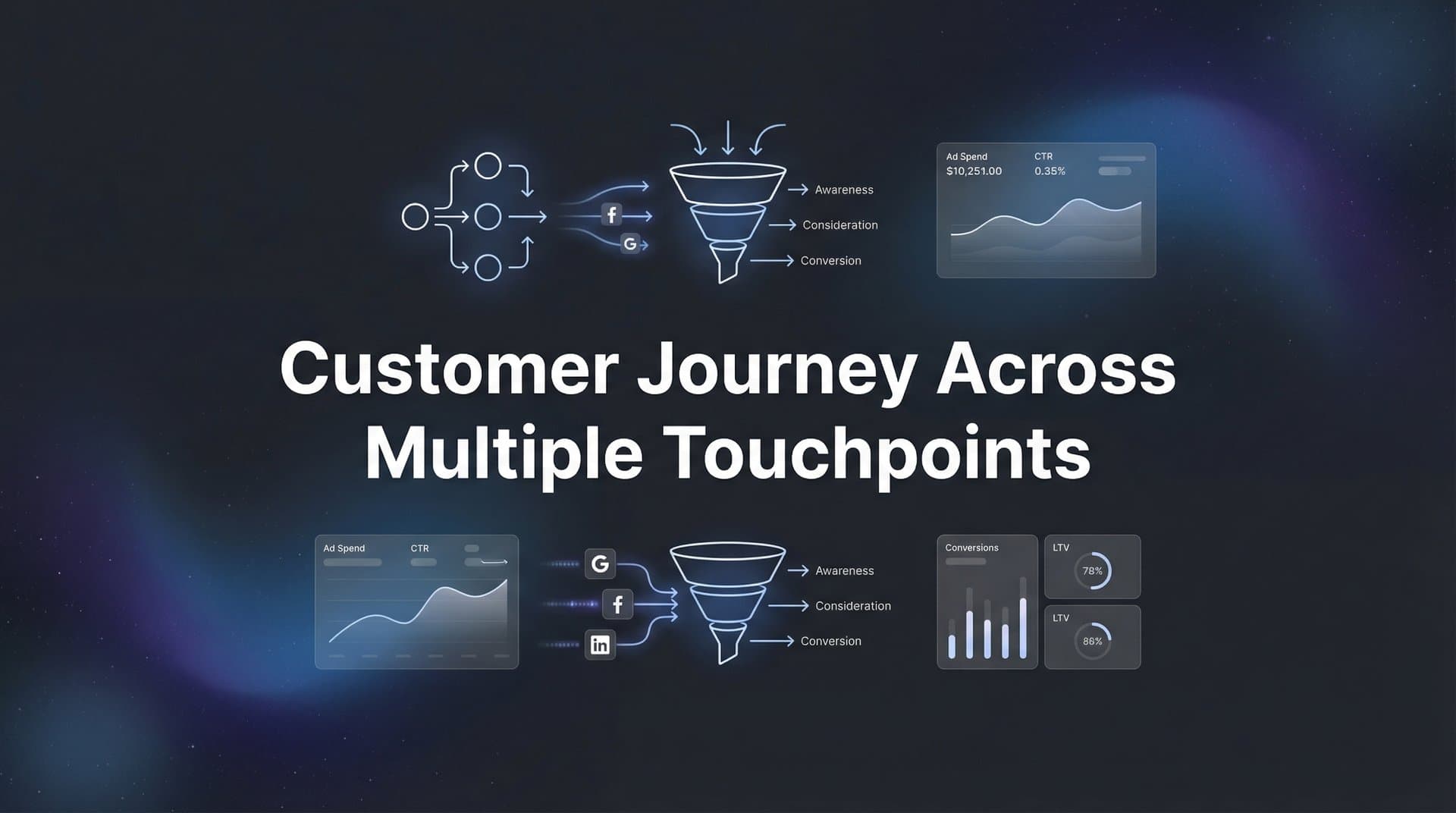
You've launched campaigns on Google, Meta, TikTok, and LinkedIn. Your email sequences are running. Organic content is live. Retargeting pixels are firing. And somewhere in this web of marketing activity, customers are converting.
But here's the question that keeps you up at night: which touchpoints actually drove those conversions?
The truth is, modern buyers don't click one ad and convert. They discover your brand on Instagram, research you on Google three days later, ignore your first email, click a retargeting ad from their phone during lunch, visit your site directly from their laptop that evening, and finally convert after reading a comparison article they found organically. That's seven touchpoints across four devices and five days—and most analytics platforms only show you fragments of this journey.
Understanding the customer journey across multiple touchpoints isn't just about satisfying your curiosity. It's about knowing which marketing investments actually generate revenue, which channels work together to drive conversions, and where to allocate your next dollar for maximum impact. When you can see the complete picture, you stop guessing and start scaling with confidence.
This guide breaks down everything you need to know about tracking, analyzing, and optimizing multi-touchpoint customer journeys. You'll learn why traditional tracking falls short, how to capture every interaction accurately, and how to turn journey data into decisions that improve your marketing ROI.
Why Modern Buyers Never Follow a Straight Line
The linear customer journey is a myth. The idea that someone sees your ad, clicks through, and immediately converts belongs to a simpler era of digital marketing—one that ended years ago.
Today's buyers interact with brands across an average of multiple devices and platforms before making a purchase decision. They might discover you through a Facebook ad while scrolling on their phone during their morning commute. Later that day, they Google your product category from their work computer. That evening, they see your retargeting ad on YouTube, click through, but don't convert. A week later, they receive your email newsletter, click a link, browse your site, leave again, then finally return via direct traffic and complete the purchase.
This fragmentation happens across predictable touchpoint categories. Paid advertising includes your Google Ads, Meta campaigns, LinkedIn sponsored content, and TikTok promotions. Organic search captures people finding you through Google or Bing. Social media encompasses both organic posts and paid social interactions. Email marketing includes newsletters, abandoned cart sequences, and promotional campaigns. Direct visits happen when people type your URL or use a bookmark. Referrals come from partner sites, affiliates, or content mentions.
Each category represents a different moment in the customer's decision-making process. Some touchpoints create awareness. Others build consideration. Some handle objections. And a few trigger the final conversion action. Understanding customer journey touchpoints helps you identify which interactions matter most at each stage.
The hidden cost of missing touchpoints shows up in two damaging ways. First, you over-invest in channels that get credit for conversions they didn't actually drive. Last-click attribution often gives 100% credit to bottom-funnel channels like branded search or retargeting, even though the customer only searched for your brand because they saw your awareness campaign on Meta. You end up pouring budget into channels that capture existing demand rather than channels that create new demand.
Second, you under-invest in channels that are actually working. If your YouTube awareness campaign introduces prospects who later convert through Google search, traditional analytics credits Google and shows YouTube as "not converting." You might cut the YouTube budget, eliminating the very touchpoint that was filling your funnel with qualified prospects.
When you can't see the full journey, you're making budget decisions based on incomplete information. You're essentially flying blind, trusting that the last touchpoint before conversion deserves all the credit—which is rarely true for complex B2B sales or considered purchases.
Mapping the Full Customer Journey: From First Click to Closed Deal
Before you can optimize your customer journey, you need to see it. That means identifying every touchpoint where prospects interact with your brand and understanding how these interactions connect to eventual conversions.
Start by cataloging all touchpoints in your marketing ecosystem. Your ad platforms include every campaign running on Google, Meta, LinkedIn, TikTok, Pinterest, or other paid channels. Your website captures organic search visits, direct traffic, and referrals from other sites. Your CRM events track form submissions, demo requests, sales calls, and closed deals. Email platforms record opens, clicks, and engagement. Social media interactions include profile visits, post engagement, and direct messages.
Each of these touchpoints generates data, but that data lives in isolated silos. Google Ads knows about ad clicks but not what happened after someone left Google. Your website analytics sees visits but can't always connect them back to the original ad source. Your CRM knows which leads closed but doesn't automatically know which marketing touchpoints influenced them. This is why customer journey mapping across channels becomes essential for seeing the complete picture.
The next step is distinguishing between micro-conversions and macro-conversions along the customer path. Macro-conversions are your primary goals: purchases, demo bookings, qualified lead submissions, or subscription sign-ups. Micro-conversions are smaller actions that indicate progress: email sign-ups, content downloads, pricing page views, add-to-cart actions, or video watches.
Understanding this distinction matters because micro-conversions often predict macro-conversions. A prospect who downloads your comparison guide, watches your product demo video, and visits your pricing page three times is showing strong buying intent—even if they haven't converted yet. These micro-conversions are touchpoints worth tracking and optimizing.
Creating a visual journey map reveals your actual customer paths. Start by pulling conversion data from your CRM or analytics platform. For a sample of recent conversions, trace backwards to identify every touchpoint that preceded the conversion. You might discover patterns like this: awareness touchpoint (social media ad) → consideration touchpoint (organic blog visit) → evaluation touchpoint (pricing page view) → decision touchpoint (retargeting ad) → conversion (demo request).
When you map multiple customer journeys, patterns emerge. You might find that customers who engage with educational content convert at higher rates. You might discover that certain channel combinations work better together—like LinkedIn ads followed by Google search. You might learn that your sales cycle typically involves five to seven touchpoints over two to three weeks.
These insights are invisible when you only look at last-click data. The journey map shows you the reality of how prospects actually move through your funnel, which touchpoints appear most frequently in successful conversions, and where prospects typically drop off before converting.
The goal isn't to create a perfect, linear journey that every customer follows. The goal is to understand the common paths, the critical touchpoints that appear repeatedly in successful conversions, and the typical timeline from first interaction to closed deal. This understanding becomes the foundation for smarter tracking and optimization.
The Technical Side: How Multi-Touch Tracking Actually Works
Tracking the customer journey across multiple touchpoints requires connecting data from sources that don't naturally talk to each other. The technical approach you choose determines how complete and accurate your journey data will be.
Traditional browser-based tracking relies on cookies and pixels placed on your website. When someone clicks your ad, the ad platform drops a cookie in their browser. When they convert on your site, your analytics pixel fires and attributes the conversion back to that ad click. This approach worked well for years, but it's increasingly unreliable.
Browser-based tracking breaks down when users switch devices, use privacy-focused browsers, or enable tracking prevention features. If someone clicks your ad on their phone but converts on their laptop, traditional tracking often misses the connection. Many marketers struggle with customer journey tracking across devices because of these technical limitations. If they use Safari with Intelligent Tracking Prevention enabled, cookies expire quickly and attribution breaks. If they clear their browser data regularly, the connection between touchpoints disappears.
Server-side tracking takes a fundamentally different approach. Instead of relying on browser cookies to connect touchpoints, server-side tracking captures events at the server level and uses more durable identifiers to connect customer interactions. When someone converts on your site, the conversion event is sent directly from your server to your analytics platform and back to ad platforms—bypassing browser limitations entirely.
This approach solves several critical problems. First, it's not affected by cookie deletion, ad blockers, or browser privacy features. The data flows server-to-server, making it more reliable. Second, it can connect touchpoints across devices more effectively by using email addresses, phone numbers, or customer IDs that persist across sessions. Third, it captures data that browser-based tracking often misses, like conversions that happen offline or in mobile apps.
Connecting ad platforms, website analytics, and CRM data into a unified view requires integration at multiple levels. Your website tracking captures visits, page views, and on-site conversions. Your ad platforms report clicks, impressions, and platform-reported conversions. Your CRM contains the ultimate source of truth: which leads actually closed and generated revenue.
The challenge is matching these data sources together. When someone clicks your Google ad, visits your site, fills out a form, and eventually closes as a customer in your CRM, you need to connect all four events to the same person. This requires passing identifiers between systems—like click IDs from ad platforms, user IDs from your website, and email addresses or contact IDs from your CRM. Learning how to track conversions across multiple ad platforms is crucial for building this unified view.
Modern attribution platforms handle this matching process automatically. They ingest data from all your marketing sources, use probabilistic and deterministic matching to connect touchpoints to individual users, and build a unified customer journey that spans every interaction. The result is a complete view that shows exactly which ads, emails, content pieces, and other touchpoints contributed to each conversion.
Overcoming iOS privacy changes and cookie limitations requires adapting your tracking strategy. Apple's iOS 14.5 update and subsequent privacy changes limit how long ad platforms can track conversions through browser-based methods. Google's planned cookie deprecation will create similar challenges. These changes don't eliminate tracking—they just require a more sophisticated approach.
Server-side tracking becomes essential in this environment. By capturing conversion data on your server and sending it directly to ad platforms through their APIs, you maintain accurate conversion tracking even when browser-based methods fail. You can also enrich conversion events with additional data—like customer lifetime value, product categories, or lead quality scores—that helps ad platforms optimize more effectively.
Attribution Models That Make Sense of Complex Journeys
Once you're tracking every touchpoint, you need a framework for understanding which interactions actually drove conversions. Attribution models provide that framework by determining how credit gets distributed across the customer journey.
First-touch attribution gives 100% credit to the first touchpoint that introduced a prospect to your brand. If someone discovers you through a Facebook ad, then later converts through five other touchpoints, Facebook gets all the credit. This model makes sense when your primary goal is understanding which channels create awareness and fill the top of your funnel. It answers the question: where do new prospects come from?
Last-touch attribution does the opposite, giving 100% credit to the final touchpoint before conversion. If someone clicks a retargeting ad and immediately converts, that ad gets full credit—even if they previously interacted with your brand through email, organic search, and social media. This model is useful for understanding which channels close deals, but it completely ignores the touchpoints that built awareness and consideration.
Linear attribution distributes credit equally across all touchpoints in the journey. If a customer interacted with five touchpoints before converting, each touchpoint receives 20% of the credit. This approach acknowledges that multiple interactions contributed to the conversion, but it assumes every touchpoint was equally important—which is rarely true. The awareness ad that introduced your brand probably had more impact than the third email they ignored.
Time-decay attribution gives more credit to touchpoints that happened closer to the conversion. The logic is that recent interactions have more influence on the decision to convert. A retargeting ad someone clicked yesterday gets more credit than a blog post they read three weeks ago. This model works well for shorter sales cycles where recency matters, but it can undervalue the awareness touchpoints that started the journey. For a deeper dive into these concepts, explore understanding customer journey attribution.
Position-based attribution (also called U-shaped) gives more credit to the first and last touchpoints, with less credit distributed to middle interactions. Typically, 40% goes to the first touch, 40% to the last touch, and 20% is split among the middle touchpoints. This model acknowledges that both awareness and conversion touchpoints matter more than the touches in between.
Data-driven attribution uses machine learning algorithms to analyze thousands of customer journeys and determine which touchpoints actually influence conversions. Instead of applying a predetermined rule, the algorithm learns from your specific data. It might discover that prospects who watch your demo video are twice as likely to convert, or that email touchpoints in the middle of the journey have more impact than you expected.
Choosing the right attribution model depends on your sales cycle length and touchpoint volume. For businesses with short sales cycles and few touchpoints—like e-commerce purchases that happen within a day or two—last-touch or time-decay models often provide actionable insights. For businesses with longer sales cycles and many touchpoints—like B2B SaaS with 30-day consideration periods—data-driven or position-based models reveal more useful patterns.
The most important principle is this: comparing multiple attribution models reveals insights a single model misses. When you look at first-touch, last-touch, and data-driven models side by side, you see the complete picture. You understand which channels create awareness, which channels assist in the middle of the journey, and which channels close deals. You can then optimize each channel for its actual role in the customer journey rather than expecting every channel to be a last-click converter.
Turning Journey Data Into Smarter Marketing Decisions
Understanding the customer journey across multiple touchpoints only creates value when you use that understanding to make better marketing decisions. The insights you gain should directly inform budget allocation, campaign optimization, and strategic planning.
Start by identifying which touchpoints actually drive conversions versus which just assist. A touchpoint that appears in 80% of successful customer journeys deserves different treatment than one that appears in 10%. Look for patterns in your highest-value conversions. Which channels appear most frequently? Which touchpoints happen early in successful journeys? Which interactions correlate with higher conversion rates or larger deal sizes?
You might discover that prospects who engage with educational content before requesting a demo close at twice the rate of those who don't. That insight suggests investing more in content marketing and ensuring your ad campaigns drive traffic to educational resources rather than pushing for immediate conversions. You might find that LinkedIn ads rarely get last-click credit but appear in 60% of enterprise deal journeys. That insight prevents you from cutting LinkedIn budget based on misleading last-click data. The ability to track customer touchpoints before purchase reveals these hidden patterns.
Reallocating budget based on true revenue contribution requires looking beyond surface-level metrics. A channel that generates 100 conversions at $50 cost per conversion looks efficient. But if those conversions have low lifetime value and high churn rates, the channel isn't actually performing well. Conversely, a channel with $200 cost per conversion might look expensive until you realize those customers have 3x higher lifetime value and come from your ideal customer profile.
Multi-touchpoint journey data reveals these quality differences. When you can see which channels attract high-value customers who engage with multiple touchpoints before converting, you can confidently invest more in those channels—even if their last-click metrics look worse than cheaper alternatives. You're optimizing for revenue and customer quality, not just conversion volume. Understanding how to optimize ad spend across multiple channels becomes much easier with complete journey visibility.
Budget reallocation should happen gradually based on clear patterns. If your data shows that YouTube awareness campaigns appear in 70% of high-value customer journeys but get minimal last-click credit, test increasing YouTube spend by 20% while monitoring the downstream impact on conversions. If prospects who interact with both Google and Meta before converting close at higher rates, consider running coordinated campaigns across both platforms rather than treating them as separate channels competing for budget.
Using journey insights to improve ad platform optimization creates a powerful feedback loop. When you feed enriched conversion data back to ad platforms, their machine learning algorithms get better information about what success looks like. Instead of just knowing that someone converted, the platform learns that someone converted after engaging with three touchpoints, has a high predicted lifetime value, and matches your ideal customer profile.
This enriched data helps platforms optimize more effectively. Meta's algorithm can prioritize finding more people who match the profile of customers who engage with multiple touchpoints before converting. Google's Smart Bidding can adjust bids based on the likelihood that a click will lead to a high-value, multi-touchpoint journey. The platforms become better at finding your best customers, not just your cheapest conversions.
The key is creating feedback loops that continuously improve targeting and optimization. As you gather more journey data, you refine your understanding of what successful customer paths look like. As you feed better conversion data to ad platforms, they find more qualified prospects. As those prospects convert, you gather more journey data. The cycle compounds over time, making your marketing more efficient and effective.
Putting Multi-Touchpoint Tracking Into Practice
Understanding the theory behind multi-touchpoint tracking is one thing. Implementing it effectively is another. The key is starting strategically rather than trying to track everything at once.
Begin with your highest-value conversion paths first. If you're a B2B SaaS company, start by tracking the journey from first website visit to demo request to closed deal. If you're an e-commerce business, focus on the path from ad click to purchase for your best-selling products. Don't try to implement perfect tracking across every possible touchpoint immediately. Start with the journeys that matter most to your revenue. A comprehensive customer journey mapping guide can help you prioritize which paths to track first.
This focused approach lets you prove value quickly. When you can show that implementing better tracking revealed that a specific channel drives 40% more revenue than last-click attribution suggested, you build momentum for expanding tracking to other areas. When you demonstrate that feeding enriched conversion data to Meta improved your cost per acquisition by 25%, you justify the investment in more sophisticated tracking infrastructure.
Building feedback loops that continuously improve targeting and optimization requires connecting your tracking data to your campaign management. Set up regular reviews where you analyze journey data and make specific optimization decisions. Which touchpoints appear most frequently in successful conversions this month? Which channel combinations drive the highest-value customers? Which campaigns are getting last-click credit but rarely appear in the full journey?
Use these insights to adjust your campaigns. If you notice that prospects who engage with video content convert at higher rates, create more video ads and ensure your retargeting campaigns prioritize video viewers. If you see that customers who interact with both organic and paid touchpoints have higher lifetime value, develop strategies that coordinate organic content and paid promotion rather than treating them as separate efforts. The right customer journey analytics tools make this analysis significantly easier.
The feedback loop should be systematic. Track journey data, identify patterns, make optimization decisions, measure the impact, and refine your approach based on results. This process compounds over time as you learn which touchpoints drive value, which channel combinations work best together, and which customer journey patterns predict high-value conversions.
Scaling what works with confidence becomes possible once you see the full picture. When last-click attribution tells you a channel is working, you're never quite sure if it's actually driving new demand or just capturing existing demand. When multi-touchpoint journey data shows you that a channel consistently appears in successful customer journeys, introduces new prospects, and contributes to high-value conversions, you can scale with confidence.
This confidence transforms how you approach growth. Instead of cautiously testing small budget increases and hoping they work, you can identify the channels and campaigns that genuinely drive revenue and scale them aggressively. Instead of cutting budgets based on misleading last-click data, you protect the awareness and consideration touchpoints that fill your funnel with qualified prospects.
The Competitive Advantage of Seeing the Complete Picture
Understanding the customer journey across multiple touchpoints has shifted from a nice-to-have to a competitive necessity. Your competitors are running campaigns on the same platforms, targeting similar audiences, and competing for the same conversions. The businesses that win are the ones that understand which marketing investments actually generate revenue.
When you can see every interaction from first click to closed deal, you make fundamentally different decisions than marketers who only see fragments of the journey. You invest in the channels that create demand, not just the ones that capture it. You optimize for customer quality and lifetime value, not just conversion volume. You coordinate campaigns across platforms instead of treating each channel as an isolated effort.
The technical landscape is evolving rapidly. Privacy changes, cookie deprecation, and platform restrictions are making traditional tracking less reliable. The marketers who adapt by implementing server-side tracking, building unified customer journey views, and feeding enriched data back to ad platforms will maintain accurate attribution while their competitors struggle with incomplete data.
The strategic advantage compounds over time. Every customer journey you track teaches you something about what works. Every optimization you make based on complete journey data improves your efficiency. Every high-value conversion path you identify becomes a template for finding more customers like that. The businesses that start building this capability now will have years of refined understanding while competitors are still figuring out basic attribution.
Marketing attribution isn't just about giving credit to the right channels. It's about understanding how your marketing ecosystem works together to drive business outcomes. It's about knowing which touchpoints create awareness, which build consideration, which handle objections, and which trigger conversions. It's about seeing the patterns that predict success and scaling them with confidence.
The customer journey across multiple touchpoints is complex, but it's not unknowable. With the right tracking infrastructure, attribution models, and analytical approach, you can map every interaction, understand what drives conversions, and make smarter marketing decisions. The question isn't whether you need this visibility. The question is how quickly you can build it before your competitors do.
Ready to elevate your marketing game with precision and confidence? Discover how Cometly's AI-driven recommendations can transform your ad strategy. Get your free demo today and start capturing every touchpoint to maximize your conversions.


