

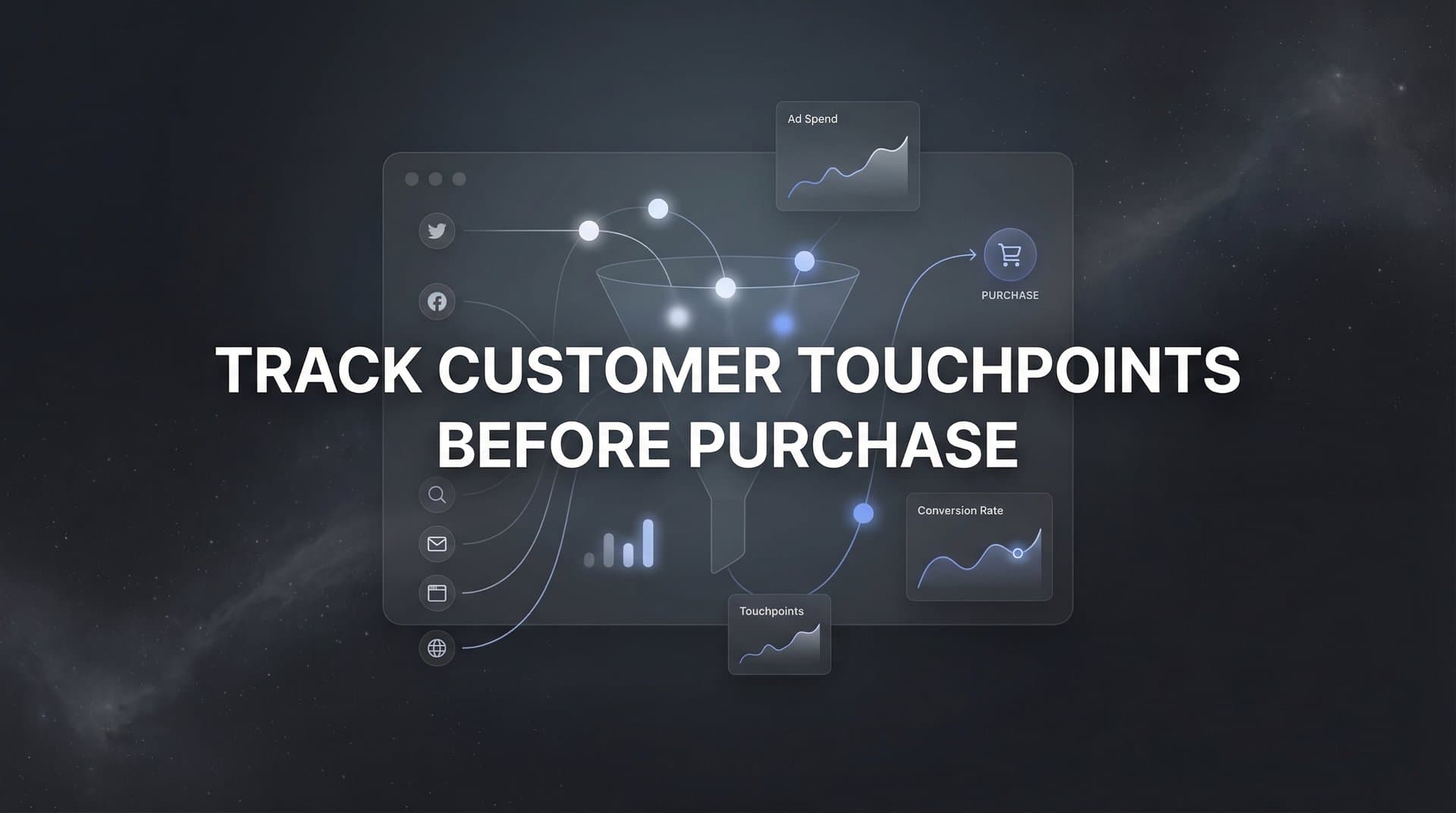
Picture this: A customer clicks your Facebook ad on Monday morning, reads two blog posts that afternoon, opens your email on Wednesday, visits your pricing page twice on Thursday, and finally converts on Friday after clicking a Google search ad. Which channel gets credit for the sale?
Most marketers can't answer that question with confidence. They see the final click in Google Analytics, celebrate the "winning" campaign, and miss the four other touchpoints that actually influenced the decision. Meanwhile, they're scaling the wrong channels and cutting budgets from the ones that truly drive revenue.
The reality is that modern customers rarely convert on first touch. They research, compare, revisit, and evaluate across multiple channels before making a purchase decision. Understanding this journey isn't just nice to have—it's the difference between marketing based on assumptions and marketing based on what actually works.
This guide walks you through exactly how to track customer touchpoints before purchase, from mapping your customer journey to implementing the technical infrastructure that captures every interaction. You'll learn how to connect fragmented data across platforms, attribute revenue to the right sources, and optimize campaigns based on complete customer journey insights rather than incomplete snapshots.
By the end, you'll have a clear system for capturing every touchpoint that influences buying decisions—giving you the confidence to invest in channels that truly drive conversions and cut spending on ones that don't.
Step 1: Map Your Customer Journey and Define Key Touchpoints
Before you can track touchpoints effectively, you need to know what you're looking for. Start by documenting every channel where customers interact with your brand. This includes paid advertising platforms like Meta, Google Ads, TikTok, and LinkedIn, as well as organic channels such as search traffic, social media, email marketing, referral sources, and direct visits.
Think beyond just acquisition channels. Customers also interact with your content—blog posts, case studies, product pages, pricing pages, webinars, and downloadable resources. Each of these represents a touchpoint that can influence purchase decisions. Understanding what customer journey touchpoints are helps you identify which interactions matter most.
Next, organize these touchpoints into customer journey stages. Awareness-stage touchpoints typically include paid social ads, display advertising, organic social posts, and top-of-funnel content. Consideration-stage touchpoints involve comparison content, product pages, email nurture sequences, and retargeting campaigns. Decision-stage touchpoints include pricing page visits, demo requests, sales calls, and bottom-of-funnel offers.
Not all touchpoints carry equal weight. Prioritize based on proximity to conversion and frequency in successful customer journeys. A pricing page visit typically signals higher intent than a blog post view. Multiple email opens suggest growing interest. Return visits to your website indicate active consideration.
Create a visual journey map showing the most common paths customers take from awareness to purchase. You might discover that most B2B customers follow a pattern like: LinkedIn ad click → blog post read → email signup → nurture sequence → pricing page visit → demo request → purchase. Or for e-commerce, you might see: Facebook ad click → product page view → cart abandonment → retargeting ad → email reminder → purchase.
Document these patterns because they'll guide your tracking implementation. You'll know which touchpoints to prioritize, where to focus your technical setup, and which interactions matter most for attribution analysis.
This mapping exercise also reveals gaps in your current tracking. You might realize you're not capturing email engagement properly, or that you can't connect content consumption to eventual conversions. Identifying these blind spots now prevents incomplete data later.
Step 2: Implement Server-Side Tracking for Accurate Data Capture
Traditional browser-based tracking is broken. iOS App Tracking Transparency restrictions, Safari's Intelligent Tracking Prevention, ad blockers, and third-party cookie deprecation have created massive blind spots in customer journey data. If you're relying solely on client-side pixels, you're missing a significant portion of your actual touchpoints.
Server-side tracking solves this by capturing events on your server before they ever reach the customer's browser. Instead of depending on cookies and pixels that can be blocked or deleted, server-side tracking uses first-party data and direct server-to-server connections with ad platforms and analytics tools.
The practical difference is substantial. Browser-based tracking might capture 60-70% of actual conversions due to iOS limitations and ad blockers. Server-side tracking captures close to 100% because it bypasses browser restrictions entirely. This means you see the complete customer journey rather than a fragmented version. For a deeper dive into implementation, explore first-party tracking implementation strategies.
To implement server-side tracking, you'll need a tracking platform that supports this architecture. The setup typically involves installing a tracking script on your website that sends events to your server rather than directly to third-party platforms. Your server then forwards these events to ad platforms, analytics tools, and your attribution system.
Start by setting up tracking for your most critical conversion events—purchases, lead submissions, demo requests, or whatever defines success for your business. Configure your server to capture the original source data for each visitor: which ad they clicked, what campaign they came from, and any UTM parameters attached to their entry point.
Verify your implementation with test conversions. Complete a purchase or lead form yourself, then check that the event appears correctly in your tracking dashboard with proper source attribution. Test from different devices and browsers, including iOS devices where tracking limitations are most severe.
Server-side tracking also enables you to enrich conversion data before sending it to ad platforms. You can attach customer lifetime value, product categories, or CRM data to conversion events—giving ad platform algorithms better signals for optimization. This improved data quality helps platforms like Meta and Google identify and target high-value customers more effectively.
The technical lift is worth it. Accurate data capture is the foundation of everything else in this guide. If you're missing 30-40% of touchpoints due to tracking limitations, no amount of sophisticated attribution modeling will give you reliable insights.
Step 3: Connect Your Ad Platforms and Marketing Channels
Your customer journey data lives in silos—Meta has ad click data, Google has search data, your email platform has engagement data, and your website analytics has session data. To track touchpoints before purchase, you need to consolidate all of this into a unified view.
Start by integrating your paid advertising platforms into a centralized tracking system. Connect Meta Ads, Google Ads, TikTok Ads, LinkedIn Ads, and any other platforms where you run campaigns. Most attribution platforms offer native integrations that pull in ad spend, impressions, clicks, and conversion data automatically.
These integrations do more than just import data—they enable proper attribution by connecting ad clicks to eventual conversions. When someone clicks your Meta ad and converts three days later after multiple touchpoints, your tracking system can attribute that conversion back to the original ad, campaign, and creative. A comprehensive cross-platform tracking setup ensures no touchpoint goes unrecorded.
Next, connect organic marketing channels. Integrate your email marketing platform to capture email opens, clicks, and campaign engagement. Link your social media management tools to track organic social interactions. Connect your content management system to see which blog posts and resources customers consume before converting.
UTM parameter consistency is critical here. If your Meta campaigns use "facebook" as the source while your Google campaigns use "google_ads" but your analytics shows "google-ads" for some traffic, you've created attribution chaos. Establish a clear naming convention and apply it consistently across all campaigns.
A solid UTM structure includes: utm_source for the platform (facebook, google, linkedin), utm_medium for the channel type (cpc, email, organic_social), utm_campaign for the specific campaign name, utm_content for ad variations or email versions, and utm_term for paid search keywords.
Document your UTM conventions and share them with everyone who creates campaigns. Inconsistent tagging is one of the most common reasons marketers can't accurately track customer touchpoints—it's entirely preventable with clear standards and team alignment.
If you operate multiple websites or use separate landing page platforms, implement cross-domain tracking. This ensures that when a customer clicks from your main website to a landing page on a different domain, their session continues unbroken. Without cross-domain tracking, that transition looks like a new visit from a new source, breaking your attribution chain.
Test your integrations thoroughly. Run campaigns across different platforms, interact with them yourself, and verify that all touchpoints appear correctly in your tracking system. Check that source attribution is accurate, that touchpoint timestamps are correct, and that no data is missing.
Step 4: Integrate Your CRM to Track Post-Click Behavior
The customer journey doesn't end at form submission. What happens after someone becomes a lead—the demos they book, the sales calls they take, the opportunities that open in your pipeline—provides crucial context for understanding which marketing touchpoints actually drive revenue.
CRM integration connects marketing touchpoints to sales outcomes. When you can see that leads from LinkedIn ads have a 40% close rate while leads from Facebook ads have a 15% close rate, you make very different budget allocation decisions than if you only looked at cost per lead.
Start by connecting your CRM to your attribution platform. Most modern CRMs like Salesforce, HubSpot, and Pipedrive offer API integrations that sync lead and opportunity data automatically. Configure the integration to capture key events: lead created, opportunity opened, demo completed, proposal sent, deal won, and deal lost. Implementing customer attribution tracking ensures every interaction ties back to revenue.
Map these CRM stages to your customer journey framework. A lead creation event might map to the end of your consideration stage. An opportunity opening signals entry into the decision stage. A closed-won deal represents conversion. This mapping allows you to analyze touchpoints not just by lead generation, but by their influence on actual revenue.
Enable bi-directional data flow where possible. Your CRM should receive marketing touchpoint data so sales teams can see which campaigns influenced each lead. Your attribution platform should receive CRM event data so you can analyze which marketing touchpoints correlate with high-value opportunities and closed deals.
This two-way sync creates powerful insights. You might discover that leads who engage with three or more blog posts before converting have twice the lifetime value of those who don't. Or that prospects who attend a webinar are 60% more likely to close than those who don't. These patterns only emerge when you connect marketing touchpoints to CRM outcomes.
Pay special attention to offline conversions—purchases or deals that happen outside your website. If customers can buy via phone, in-person, or through a sales team, those conversions need to be attributed back to their original marketing touchpoints. Your CRM integration should capture these offline events and link them to the digital journey that preceded them. Learn more about post-purchase attribution tracking solutions to close this loop.
Verify your CRM integration by tracking a test lead through the entire pipeline. Create a lead, move it through your sales stages, and confirm that each event appears correctly in your attribution platform with proper touchpoint history intact. Check that revenue values sync accurately and that closed-won deals are attributed to their originating campaigns.
Step 5: Configure Multi-Touch Attribution Models
Single-touch attribution models—first-touch or last-touch—tell incomplete stories. First-touch gives all credit to the initial interaction, ignoring everything that happened afterward. Last-touch credits only the final touchpoint, dismissing all the awareness and nurturing that made the conversion possible.
Multi-touch attribution distributes credit across all touchpoints in the customer journey, providing a more complete picture of what actually drives conversions. Different models distribute this credit in different ways, and understanding these differences helps you choose the right approach for your business. Our attribution marketing tracking complete guide breaks down each model in detail.
Linear attribution gives equal credit to every touchpoint. If a customer had five interactions before converting, each gets 20% credit. This model works well when you believe all touchpoints contribute equally, though it may overvalue early awareness touches and undervalue decision-stage interactions.
Time-decay attribution gives more credit to touchpoints closer to conversion. The theory is that recent interactions have more influence on purchase decisions than older ones. This model suits businesses with shorter sales cycles where momentum builds quickly toward conversion.
Position-based attribution (also called U-shaped) assigns 40% credit to the first touch, 40% to the last touch, and distributes the remaining 20% evenly among middle touchpoints. This model acknowledges that initial awareness and final conversion moments are particularly important while still valuing the nurturing that happens between them.
Your sales cycle length should influence your model choice. B2B companies with 90-day sales cycles might prefer time-decay or position-based models that account for lengthy consideration periods. E-commerce businesses with same-day purchases might find linear attribution more appropriate since all touchpoints occur in a compressed timeframe.
Most attribution platforms allow you to compare multiple models side-by-side. Take advantage of this feature rather than committing to a single view. You might use position-based attribution for budget allocation decisions while consulting linear attribution to ensure you're not undervaluing mid-funnel content.
Configure your chosen attribution models in your tracking platform. Set appropriate lookback windows—the time period during which touchpoints are included in attribution. A 30-day lookback might suit e-commerce, while B2B often requires 90-day or even 180-day windows to capture the full journey.
Review attribution reports regularly to understand which touchpoints consistently appear in converting journeys. You're looking for patterns: Do customers who engage with comparison content convert at higher rates? Do retargeting campaigns assist conversions even when they don't get last-click credit? Does email nurturing play a bigger role than you realized?
Multi-touch attribution reveals these insights by showing the complete journey rather than just the entry point or exit point. This comprehensive view enables smarter optimization decisions based on actual customer behavior rather than oversimplified attribution logic.
Step 6: Analyze Touchpoint Data and Optimize Your Marketing
With tracking infrastructure in place and data flowing properly, you can now extract insights that transform your marketing strategy. Start by reviewing customer journey reports to identify the most common paths to conversion. You're looking for patterns that repeat across multiple customers.
You might discover that your highest-value customers typically follow a specific sequence: paid ad click → blog post consumption → email signup → nurture sequence → pricing page visit → demo request → purchase. This pattern tells you which touchpoints to prioritize and optimize. Learning how to analyze customer journeys effectively turns raw data into actionable strategy.
Identify high-impact touchpoints that consistently appear in converting journeys. These are your force multipliers—the interactions that significantly increase conversion probability. Maybe prospects who watch your product demo video are three times more likely to convert than those who don't. Or customers who visit your pricing page twice before purchasing have higher lifetime value than single-visit converters.
Look for drop-off points where prospects disengage. If you see many customers reaching your pricing page but not converting, that's a signal to optimize pricing presentation, add social proof, or address common objections more clearly. If email open rates drop sharply after the third message in your sequence, your nurture campaign needs refinement.
Use these insights to reallocate budget toward channels that actually drive revenue. If your multi-touch attribution analysis shows that LinkedIn ads consistently appear in high-value customer journeys—even when they don't get last-click credit—increase LinkedIn spend. If display advertising generates awareness but rarely contributes to conversions, reduce that budget or shift to more effective channels.
Analyze touchpoint performance by customer segment. B2B and enterprise customers might follow different paths than SMB customers. High-ticket purchases likely involve more touchpoints than low-ticket ones. Geographic regions might show varying channel preferences. Segment your analysis to uncover these differences and optimize accordingly.
Test optimization hypotheses based on your touchpoint data. If analysis shows that customers who engage with case studies convert at higher rates, create more case study content and promote it more aggressively. If retargeting campaigns assist many conversions without getting last-click credit, experiment with increased retargeting budgets.
Establish a regular analysis cadence—weekly for fast-moving businesses, monthly for longer sales cycles. Review which touchpoints are trending up or down in effectiveness. Monitor how changes to your marketing mix affect customer journey patterns. Track whether optimizations based on previous insights are delivering expected results.
Share touchpoint insights across your organization. Sales teams benefit from knowing which marketing touchpoints their best leads engaged with. Product teams can use journey data to understand which features customers research most before purchasing. Executive leadership needs visibility into which marketing investments actually drive revenue growth.
Putting It All Together
Tracking customer touchpoints before purchase transforms marketing from guesswork into a data-driven discipline. You're no longer making budget decisions based on last-click attribution or gut feeling—you're optimizing based on complete visibility into what actually influences buying decisions.
The system you've built captures every interaction across all channels, connects those touchpoints to actual revenue outcomes, and reveals which marketing investments drive results. You can now answer questions that most marketers can't: Which channels work together to drive conversions? What's the optimal customer journey? Where should you increase spend and where should you cut?
Quick implementation checklist: Journey map documented with key touchpoints identified and prioritized. Server-side tracking active and verified across all critical conversion events. All ad platforms and marketing channels connected with consistent UTM parameters. CRM integration capturing post-click events and syncing revenue data. Attribution model selected, configured, and compared against alternative models. Regular analysis schedule established for reviewing touchpoint performance and optimizing campaigns.
Start optimizing your campaigns based on real customer journey data rather than incomplete snapshots. Focus budget on touchpoints that consistently appear in high-value customer journeys. Improve or eliminate channels that consume resources without driving conversions. Test new approaches based on patterns you discover in your attribution data.
The competitive advantage is significant. While other marketers optimize based on last-click data or vanity metrics, you're making decisions based on complete customer journey visibility. You know which touchpoints truly matter, which channels work synergistically, and where to invest for maximum return.
Ready to elevate your marketing game with precision and confidence? Discover how Cometly's AI-driven recommendations can transform your ad strategy—Get your free demo today and start capturing every touchpoint to maximize your conversions.


