

You just spent $50,000 on ads last month. Your dashboard shows 200 conversions. Revenue looks solid. But here's the question that keeps you up at night: which ads actually drove those sales?
Most marketing platforms will happily take credit. Facebook says it drove 150 conversions. Google claims 120. Your email platform reports 80. Add them up and you've got 350 conversions for the 200 that actually happened. Someone's lying, but you can't tell who.
This isn't just a reporting headache. It's a strategic blindness that costs you real money. When you can't see the complete path from first click to final purchase, you're making scaling decisions based on incomplete data. You might be doubling down on channels that look good in isolation but barely contribute to actual revenue. Or worse, you might be cutting budget from the touchpoints that set up your best customers, simply because they don't get credit in last-click attribution.
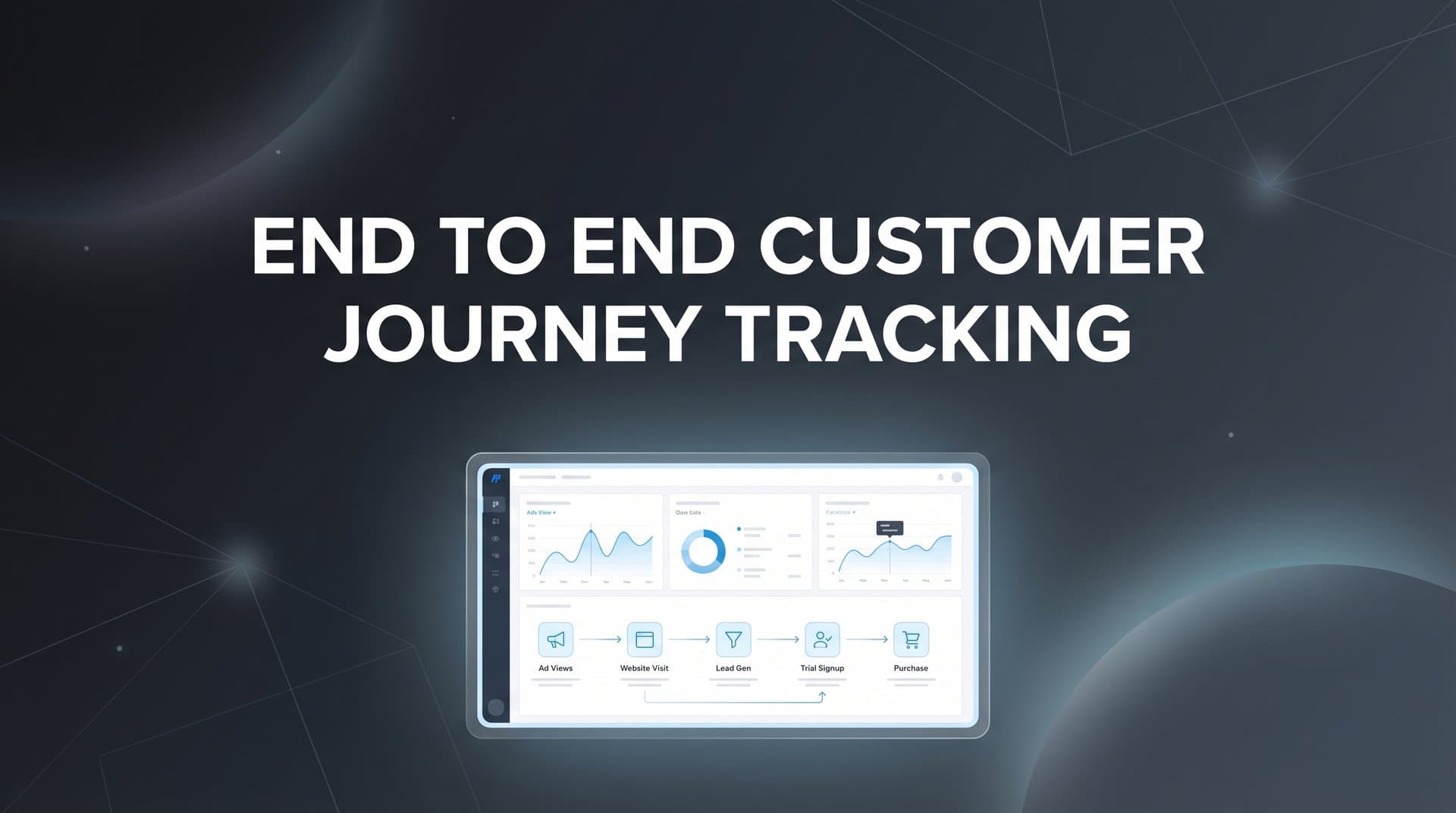
End to end customer journey tracking solves this problem by capturing every interaction a customer has with your brand, from their first anonymous website visit through conversion and beyond. It connects the dots across ad platforms, your website, email campaigns, sales calls, and CRM events to show you the complete story of how customers actually buy.
This guide breaks down what end to end tracking really means, why fragmented data is costing you revenue, and how to implement unified journey tracking that gives you the attribution clarity you need to scale with confidence.
The Complete Path Your Customers Actually Take
End to end customer journey tracking means capturing every single touchpoint a customer encounters with your brand, from initial awareness through purchase and into post-sale engagement. It's the practice of stitching together interactions across channels, devices, and sessions into one continuous timeline that shows exactly how people move through your marketing ecosystem.
Think about how your best customers actually find you. They might see a Facebook ad on their phone during lunch, click through to read a blog post, then close the tab. Three days later, they Google your brand name on their laptop at work, land on your homepage, and browse your pricing page. A week passes. They open your nurture email, click to a case study, and finally book a demo. The sales call happens. They go silent for two weeks, then return directly to your site and convert.
That's seven distinct touchpoints across three devices, four channels, and nearly a month of time. Traditional analytics tools see fragments of this journey. Your Facebook Ads Manager sees the initial click. Google Analytics sees three separate sessions with different traffic sources. Your email platform sees one click. Your CRM sees the demo booking and the closed deal. But none of them see the complete picture.
End to end tracking connects all of these moments into one unified customer record. It captures ad impressions and clicks from every platform you run. It tracks website visits across sessions and devices. It logs email opens, link clicks, and engagement patterns. It records sales calls, demo bookings, and CRM stage changes. Most importantly, it ties all of this activity to actual revenue outcomes. Understanding what customer journey tracking entails is the first step toward implementing it effectively.
This differs fundamentally from partial tracking approaches that only monitor specific channels in isolation. Session-based analytics like standard Google Analytics treats each visit as a separate event. Ad platform reporting only shows what happens within that platform's ecosystem. CRM systems track sales activity but rarely connect it back to the marketing touchpoints that generated the lead.
The result is a fragmented view where you can see that things happened, but you cannot understand the relationships between them. You know someone converted, but you cannot trace their path backward to see which campaigns influenced their decision. You can see campaign metrics like clicks and impressions, but you cannot connect them forward to revenue.
Complete journey tracking eliminates these gaps. It creates a continuous timeline that shows not just what happened, but the sequence and relationships between events. This visibility transforms how you understand campaign performance, because you can finally see which touchpoints actually contribute to conversions versus which ones just happen to be present in the data.
The Hidden Cost of Data Silos
When your marketing data lives in separate platforms that don't talk to each other, you're not just missing context. You're actively making decisions based on distorted information that leads you to waste budget and miss growth opportunities.
Here's what happens in practice. Your Facebook Ads Manager uses last-click attribution by default, crediting conversions to the final Facebook interaction before purchase. Google Ads does the same thing within its ecosystem. So does every other ad platform. Each one operates in its own silo, claiming credit for conversions without visibility into what else influenced the customer.
The math breaks down immediately. If you add up the conversions each platform reports, you get 150% to 200% of your actual conversion total. This isn't a rounding error. It's systematic overcounting where multiple platforms claim the same conversion because they each see only their piece of the journey. This is one of the most common customer journey tracking problems that marketers face.
This creates real consequences for budget allocation. Let's say your bottom-of-funnel retargeting campaigns on Facebook show a strong return because they get last-click credit for conversions. Meanwhile, your top-of-funnel prospecting campaigns on Google look mediocre because they rarely get final-click credit, even though they're introducing most of your eventual customers to your brand.
Based on platform-level reporting, you'd logically shift more budget to the Facebook retargeting that shows better numbers. But in reality, those retargeting campaigns only work because the Google prospecting campaigns are feeding them qualified traffic. Cut the prospecting budget and your retargeting performance collapses, because you've starved the top of your funnel.
Siloed data also prevents you from understanding cross-channel synergies. Maybe your email campaigns don't drive many direct conversions, but they consistently warm up leads who then convert through paid search. Maybe your LinkedIn ads generate expensive clicks that look inefficient, but they reach decision-makers who later convert at twice the average order value. When you can't see the full customer journey across channels, you cannot identify these patterns.
The problem has intensified dramatically with iOS privacy changes and the deprecation of third-party cookies. Apple's App Tracking Transparency framework and Intelligent Tracking Prevention have made browser-based tracking increasingly unreliable. Many platforms now report only a fraction of actual conversions because they cannot track users across domains or match website activity back to ad clicks.
When your tracking breaks down, your attribution becomes even more fragmented. You might see 60% fewer conversions reported in Facebook Ads Manager than actually occurred. Google Analytics might show traffic from "direct" or "unattributed" sources that really came from your paid campaigns. Your reported return on ad spend looks worse than reality, but you have no way to know by how much.
This uncertainty makes scaling decisions nearly impossible. You cannot confidently increase budget on campaigns when you're not sure if they're actually performing well or if the data is just incomplete. You cannot cut underperforming channels without wondering if they're contributing more than the fragmented data suggests. You're flying blind with expensive consequences.
Building Blocks of Complete Journey Visibility
Capturing the full customer journey requires infrastructure that goes beyond standard analytics implementations. You need systems that can track users reliably across sessions and devices, connect anonymous website visitors to known customer records, and integrate data from every platform in your marketing stack.
Server-side tracking forms the foundation of accurate journey capture in the current privacy landscape. Unlike browser-based tracking that relies on cookies and client-side scripts that can be blocked, server-side tracking sends data directly from your server to analytics platforms. This bypasses browser restrictions, ad blockers, and privacy tools that interfere with traditional tracking methods.
When someone clicks your ad and lands on your website, server-side tracking captures that event on your server before sending the page to their browser. The data flows through your infrastructure where you control it completely, then gets forwarded to your analytics platforms and ad networks through secure server-to-server connections. This approach maintains tracking accuracy even as browsers restrict third-party cookies and limit client-side tracking capabilities. Understanding cookieless tracking future trends helps you prepare for continued privacy changes.
Cross-platform identity resolution connects the dots between anonymous visitors and known customers. Someone might visit your site five times as an anonymous user before they fill out a form and become a known lead. Identity resolution retroactively connects those earlier anonymous sessions to the customer record once they identify themselves, revealing the complete journey from first touch onward.
This requires sophisticated matching logic that can recognize the same person across devices and sessions using multiple signals. IP addresses, device fingerprints, email addresses, and customer IDs all contribute to building a unified profile. When someone clicks an email on their phone, visits your site on their laptop, and converts on their tablet, identity resolution stitches these activities together into one customer timeline. Solving multi-device customer tracking challenges is essential for accurate attribution.
The technical challenge lies in maintaining accuracy while respecting privacy. You need to match user activity reliably enough to track journeys, but you cannot rely on invasive tracking methods that violate privacy regulations or user expectations. First-party data collection where users voluntarily provide information through forms, accounts, and authenticated sessions provides the most reliable and compliant foundation.
Integration between your ad platforms, website analytics, and CRM closes the loop between marketing activity and business outcomes. Your ad platforms need to send click and impression data to your tracking system. Your website needs to capture behavioral data and conversion events. Your CRM needs to share lead stages, deal values, and revenue data. All of this information must flow into a central system that can connect it together.
Our explainer on what is cost per share covers the fundamentals in more depth.
Modern marketing attribution platforms handle these integrations through native connections with major ad networks, analytics tools, and CRM systems. They pull data from Facebook Ads, Google Ads, LinkedIn, and other platforms automatically. They capture website events through tracking scripts or server-side implementations. They sync with Salesforce, HubSpot, and other CRMs to import sales data.
The result is a unified data layer that contains every touchpoint from every system, all connected to individual customer records. This becomes your source of truth for understanding how marketing drives revenue, because it's the only place where you can see the complete journey from first impression through closed deal.
How Data Flows From Click to Conversion
Understanding the technical flow of data through your tracking infrastructure helps you implement end to end journey tracking effectively. The process starts the moment someone encounters your marketing and continues through every interaction until conversion and beyond.
When someone clicks your Facebook ad, Facebook's system generates a click ID and forwards them to your landing page with that identifier in the URL. Your tracking system captures this click ID when they land, associating it with the visitor's session. At the same time, your server-side tracking implementation sends the click event back to Facebook's Conversion API, confirming that the click resulted in a website visit.
As the visitor browses your site, your tracking system captures their behavior: pages viewed, time spent, content engaged with, forms started. If they leave without converting, this session data gets stored with their visitor profile, waiting to be connected to future activity. The visitor might be anonymous at this point, identified only by device signals and session data.
Three days later, the same person Googles your brand name and clicks your search ad. Google's click ID gets captured when they land. Your tracking system recognizes signals that suggest this might be the same visitor who came from Facebook, but it cannot confirm the match yet. This second session adds more behavioral data to their emerging profile. Building a robust customer journey data model ensures all these touchpoints connect properly.
A week later, they open your nurture email and click through to a case study. The email click includes a unique identifier that your tracking system captures. When they land on your site, you can now definitively connect this visit to the email recipient's known email address. This identification event triggers retroactive matching that connects the previous two anonymous sessions to this now-known contact.
Suddenly, you can see their complete journey: Facebook ad click, initial website visit, Google search ad click, return visit, email click, case study view. All of these events get written to their unified customer record with timestamps and source attribution.
They fill out a demo request form. This conversion event gets captured by your tracking system and sent to your CRM, creating a new lead record. It also gets sent back to Facebook and Google through their respective conversion APIs, informing those platforms that this user converted. The ad platforms can now optimize their algorithms based on actual conversion data rather than just clicks.
Your sales team has the demo call. The CRM records this as a completed activity on the lead record. Your tracking system imports this CRM event and adds it to the customer journey timeline. Two weeks later, the deal closes. The CRM marks it as won with a deal value. This revenue data flows back to your tracking system, completing the loop from initial ad impression to final revenue outcome.
Now you can trace that revenue backward through every touchpoint: which ad they first clicked, which search terms they used, which email they engaged with, which content they consumed. You know the complete path and the value it generated. This visibility enables accurate attribution because you're working with complete data rather than fragments.
First-party data collection makes this entire flow possible. When you capture data directly through your own systems rather than relying on third-party cookies, you maintain control and accuracy. Your server sees every interaction. Your forms capture identifying information with user consent. Your CRM holds the business outcomes. You own the complete dataset.
Attribution Models That Match Your Business Reality
Once you have complete journey data, you need to decide how to distribute credit for conversions across the touchpoints that influenced them. Different attribution models answer this question in different ways, and the right choice depends on your sales cycle and channel strategy.
First-touch attribution gives all credit to the initial touchpoint that introduced the customer to your brand. If someone clicked a Facebook ad, then later converted through five other touchpoints, Facebook gets 100% of the credit. This model makes sense if you care most about understanding which channels are best at generating new awareness and starting customer relationships.
Last-touch attribution does the opposite, crediting only the final interaction before conversion. If that same customer's last touchpoint was a Google search ad, Google gets all the credit. This model reflects which channels are best at closing deals, but it ignores everything that happened earlier in the journey. Many businesses struggle with customer journey attribution problems when relying solely on last-touch models.
Linear attribution distributes credit equally across all touchpoints. If the customer had five interactions before converting, each one gets 20% of the credit. This approach acknowledges that multiple touchpoints contributed, but it assumes they all mattered equally, which is rarely true in practice.
Time-decay attribution gives more credit to touchpoints closer to the conversion, based on the logic that recent interactions matter more than older ones. A touchpoint from yesterday gets more credit than one from last month. This can make sense for businesses where recency indicates intent, but it may undervalue the awareness-building that happened earlier.
Position-based attribution, sometimes called U-shaped, gives the most credit to the first and last touchpoints, with the remaining credit distributed among middle interactions. This recognizes that introducing someone to your brand and closing the deal are particularly valuable moments, while still acknowledging the nurturing that happened between them.
Data-driven attribution uses machine learning to analyze your actual conversion patterns and assign credit based on statistical analysis of which touchpoints most strongly correlate with conversions. Instead of using a predetermined formula, it learns from your data which touchpoints actually matter most for driving conversions in your specific business.
End to end tracking enables multi-touch attribution by providing the complete journey data these models need to function. Without visibility into all touchpoints, you're stuck with last-click attribution by default because it's the only model that works with incomplete data. With complete journey tracking, you can choose the model that best reflects your business reality. A dedicated customer journey attribution software can help you implement and compare different models.
For businesses with long sales cycles and multiple stakeholders, position-based or data-driven models often provide the most useful insights. They acknowledge that the customer journey involves many influences, and they help you understand which channels work together to drive conversions. You can see that LinkedIn ads are great at starting conversations with enterprise buyers, while retargeting and email nurture campaigns are essential for closing those deals over time.
For businesses with shorter, more transactional sales cycles, simpler models might suffice. If most customers convert within a day or two of first discovering you, there aren't many touchpoints to distribute credit across. First-touch and last-touch might tell similar stories because they're often the same interaction.
The key is matching your attribution model to how customers actually buy from you. Analyze journey lengths, touchpoint counts, and conversion patterns in your data. Test different models to see which one produces insights that align with your business knowledge and help you make better decisions.
From Journey Insights to Revenue Growth
Complete journey visibility transforms from interesting data into competitive advantage when you use it to make smarter scaling decisions. The goal isn't just to understand what happened, but to identify which campaigns and channels actually drive revenue so you can invest more in what works.
Start by analyzing which campaigns generate customers with the highest lifetime value, not just the most conversions. You might discover that LinkedIn ads produce fewer leads than Facebook, but those leads convert at twice the rate and spend 50% more over time. The campaign that looks less efficient by cost per lead becomes your most profitable channel when you connect it to actual revenue outcomes. Learning how to optimize ad spend with data is essential for maximizing these insights.
Journey data reveals these patterns because it connects initial touchpoints to final revenue numbers. You can segment customers by their first interaction and compare average order values, conversion rates, and retention metrics. This shows you which acquisition channels bring in your best customers, even if they don't bring the most volume.
Look for high-performing ad creatives and audiences by analyzing complete journeys rather than just click-through rates. An ad might generate fewer clicks but start journeys that convert at higher rates. Another ad might drive lots of traffic that bounces immediately. Journey analysis shows you which creatives attract genuinely interested prospects versus which ones just get attention without driving quality engagement.
You can identify these winners by tracking cohorts of users who first encountered specific ads, then measuring their conversion rates and revenue contribution over time. The ads that start the most valuable customer journeys deserve more budget, even if their immediate metrics look average. Proper ad spend ROI tracking makes these patterns visible.
Cross-channel synergies become visible when you can see complete journeys. You might notice that customers who interact with both your Facebook ads and your email campaigns convert at three times the rate of single-channel customers. This insight suggests that running coordinated campaigns across channels creates compounding effects that single-channel strategies miss.
Use journey data to optimize budget allocation in real time based on actual performance rather than platform-reported metrics. When you know which campaigns drive revenue and which ones just drive clicks, you can shift budget toward the real performers with confidence. You can also identify campaigns that contribute value as assist touchpoints even if they rarely get last-click credit, protecting them from budget cuts that would hurt overall performance.
The process becomes iterative. Launch campaigns, capture complete journey data, analyze which touchpoints drive the best outcomes, reallocate budget accordingly, and repeat. Each cycle refines your understanding of what works and compounds your results as you concentrate resources on proven winners.
Putting It All Together
End to end customer journey tracking transforms marketing from guesswork into a data-driven discipline where every decision is grounded in complete information about how customers actually buy. When you can see the full path from first impression through final purchase, you stop making budget decisions based on fragmented platform reports and start investing based on real revenue outcomes.
The difference shows up in your results. You scale the campaigns that genuinely drive your best customers rather than the ones that just look good in isolation. You protect valuable assist touchpoints that set up conversions even when they don't get last-click credit. You identify cross-channel synergies that multiply your impact. You feed better data back to ad platforms so their algorithms optimize for actual business outcomes.
Most importantly, you gain the confidence to make bold scaling decisions because you're working with accurate data instead of assumptions. You know which ads work, which audiences convert, and which channels deliver the highest lifetime value. This clarity eliminates the hesitation that keeps most marketers stuck making small, cautious optimizations instead of aggressive, data-backed growth moves.
The technical implementation requires server-side tracking infrastructure, cross-platform identity resolution, and integration between your ad platforms, website, and CRM. But the strategic impact is straightforward: complete visibility into how marketing drives revenue, enabling you to invest in what works and cut what doesn't with precision.
Ready to elevate your marketing game with precision and confidence? Discover how Cometly's AI-driven recommendations can transform your ad strategy. Get your free demo today and start capturing every touchpoint to maximize your conversions.



