

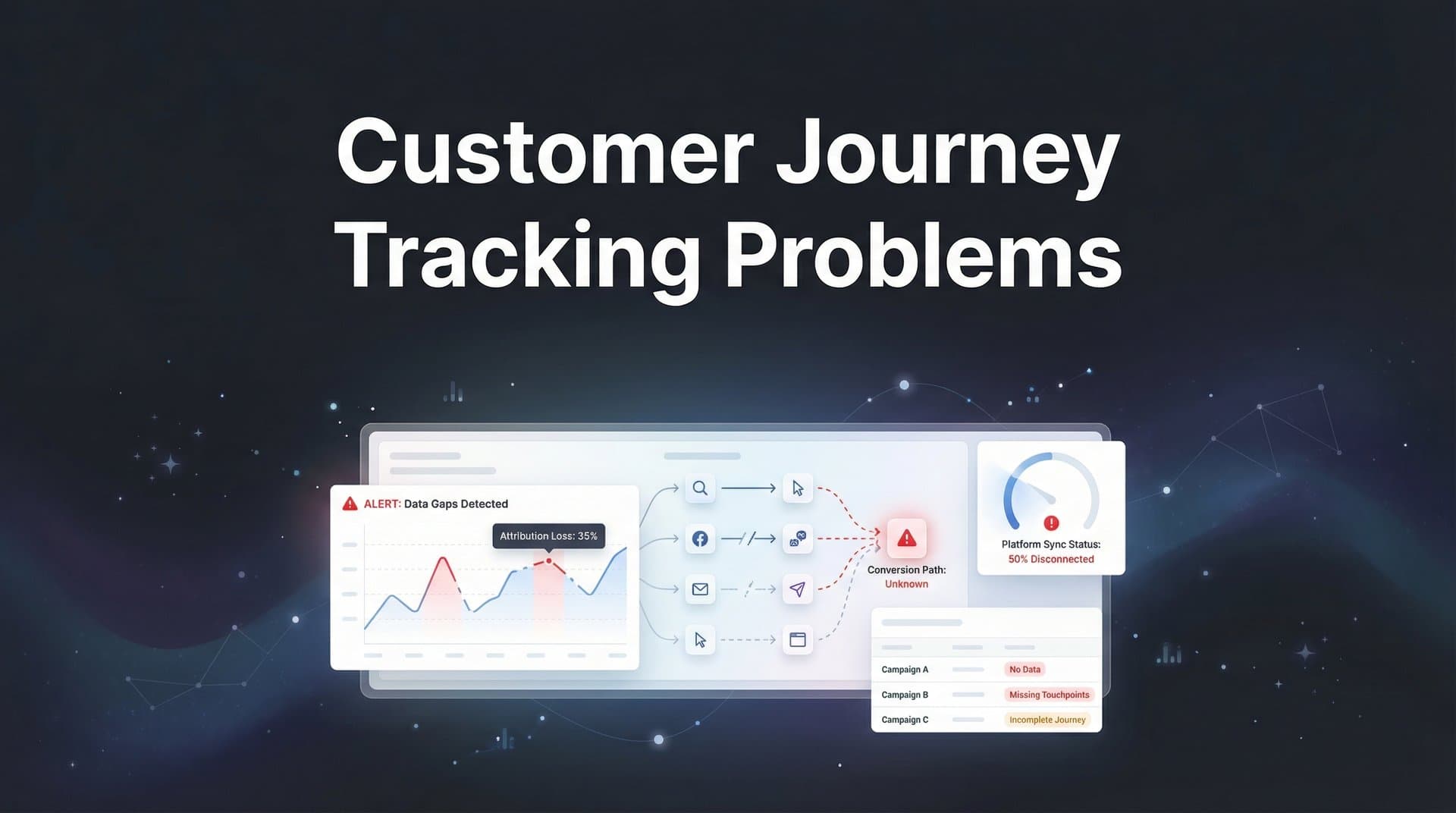
You check your Facebook Ads dashboard and see 47 conversions. Google Ads reports 32. Your CRM shows 28 new customers. And your actual revenue? It matches only 19 sales.
Sound familiar?
You're not alone. Every day, marketers make scaling decisions based on platform dashboards that tell wildly different stories about the same customer journeys. You increase budget on campaigns that "look profitable" only to watch your actual margins shrink. You pause campaigns that appear underperforming, unknowingly cutting off a significant revenue source.
The uncomfortable truth: your marketing data is lying to you. Not because of malicious intent, but because the customer journey tracking infrastructure most businesses rely on is fundamentally broken. Privacy changes, technical limitations, and platform-specific attribution models have created a fragmented landscape where accurate tracking has become nearly impossible using traditional methods.
This guide will help you diagnose the specific tracking problems affecting your data, understand why they're happening, and recognize the warning signs in your own analytics. By the end, you'll know exactly where your tracking is failing and what modern solutions can fix it.
The Hidden Cost of Broken Customer Journey Data
When your tracking is broken, you're not just missing data points in a spreadsheet. You're making expensive decisions based on fiction.
Consider what happens when Facebook takes credit for a conversion that actually came from a Google search three weeks after the initial Facebook click. Your Facebook ROAS looks stellar, so you scale. Meanwhile, your Google campaigns appear to underperform, so you reduce budget. In reality, you just shifted money away from the channel driving actual revenue toward one that merely touched the customer early in their journey.
This misattribution creates a cascading failure across your entire marketing operation. Your cost per acquisition calculations become meaningless when you're attributing customers to the wrong sources. Your lifetime value analysis falls apart when you can't accurately segment customers by their true acquisition channel. And your ROAS reporting becomes a creative fiction exercise where the numbers look good but your bank account tells a different story.
The compounding effect is even more insidious. When you feed incomplete or incorrect conversion data back to ad platform algorithms, they optimize toward the wrong audiences. Facebook's algorithm thinks it's crushing your goals and finds more people like those "converters," many of whom never actually bought. Google's smart bidding adjusts based on partial data, systematically undervaluing high-intent searches that don't get proper attribution credit.
Here's the business reality: companies often discover they're spending 30-40% of their ad budget on channels and campaigns that appear profitable in platform dashboards but generate minimal actual revenue. At the same time, they're underinvesting in channels that drive real sales but don't get attribution credit because the tracking chain breaks somewhere between click and purchase.
The financial impact compounds over time. Each month you operate with broken tracking, you're essentially flying blind with a budget that could be six or seven figures. You're making strategic decisions about which channels to prioritize, which audiences to target, and which campaigns to scale based on data that fundamentally misrepresents reality.
Privacy Changes That Shattered Traditional Tracking
The tracking methods that worked reliably for a decade stopped working almost overnight, and they're never coming back.
Apple's iOS 14.5 update in 2021 introduced App Tracking Transparency, fundamentally changing how advertisers could track iPhone users. Before ATT, Facebook and other platforms could track user behavior across apps and websites by default. After ATT, users had to explicitly opt in. The result? Opt-in rates hover around 25%, meaning roughly 75% of iOS users became effectively invisible to traditional tracking methods.
This wasn't just a minor inconvenience. iOS users represent a significant portion of high-value customers in most markets, particularly in developed economies. When you can't track three-quarters of iPhone users across their journey from ad click to purchase, your attribution data develops massive blind spots. A customer might click your Facebook ad on their iPhone, research on their laptop, and purchase on their iPad. Traditional tracking sees three separate, unconnected sessions.
Chrome's third-party cookie deprecation, which accelerated through 2024 and into 2025, delivered another devastating blow. For years, cookies allowed advertisers to track users across different websites, building comprehensive profiles of behavior and intent. As Chrome joined Safari and Firefox in blocking third-party cookies by default, that cookie tracking capability vanished.
The practical impact: you can no longer reliably track a customer who clicks your Google ad, visits your site, leaves, reads reviews on another site, returns directly to your site, and then purchases. Each of those touchpoints might appear as separate, unconnected visitors in your analytics.
Consent management requirements under GDPR, CCPA, and similar regulations added another layer of complexity. Before users accept your cookie banner, you can't track their behavior. Many users never accept, or accept only essential cookies. Others clear their cookies regularly. Each of these scenarios creates gaps in the customer journey data you're collecting.
The shift from permissive to restrictive tracking happened fast, but most marketing infrastructures adapted slowly or not at all. Companies still running pixel-based tracking are operating with incomplete data by default. The question isn't whether you have tracking gaps but how severe they are and whether you're aware of them.
What makes this particularly challenging: these privacy changes are permanent and expanding. Regulations are getting stricter, not looser. Browser restrictions are increasing, not decreasing. Any tracking strategy built on the old permissive environment is fundamentally obsolete.
Cross-Platform Attribution Blind Spots
Every ad platform wants credit for your conversions. The problem? They're all claiming credit for the same sales.
Here's how the double-counting problem works in practice. A customer sees your Facebook ad on Monday, clicks but doesn't purchase. On Wednesday, they see your Google search ad, click, and still don't buy. On Friday, they click a retargeting ad on LinkedIn, visit your site, and finally purchase.
Facebook's attribution window says: "That's our conversion. They clicked our ad within the 7-day window." Google says: "We drove that sale. They clicked our ad and converted within our attribution window." LinkedIn claims: "Obviously our retargeting ad closed the deal."
Add up the conversions each platform reports, and you might see 3 conversions. Check your actual sales data, and there's 1 purchase. This isn't a hypothetical scenario. It's the default state of multi-platform advertising.
The disconnect becomes even more pronounced when you compare ad platform data against your CRM and revenue systems. Your ad platforms report conversions the moment someone completes a form or makes a purchase. Your CRM tracks what happens next: did that lead qualify, did they become an opportunity, did they actually close and generate revenue?
For businesses with longer sales cycles, this disconnect can be catastrophic. You might have campaigns generating hundreds of "conversions" according to Facebook, but when you trace those leads through your CRM, you discover most never engaged with sales, many were unqualified, and only a handful became customers. Meanwhile, campaigns that generated fewer platform-reported conversions might have delivered higher-quality leads that closed at much better rates.
Multi-touch journeys that span weeks or months expose another critical failure point. Traditional tracking excels at capturing immediate conversions but struggles with complex B2B journeys or considered purchases. A customer might interact with your brand across a dozen touchpoints over 60 days: organic search, paid social, email, webinar, sales call, retargeting, direct visit, and finally purchase. Understanding customer journey touchpoints becomes essential for accurate attribution.
Most attribution systems either use last-click attribution, which gives all credit to the final touchpoint, or first-click attribution, which credits only the initial interaction. Both models ignore the reality that every touchpoint contributed to the conversion. The webinar might have been the moment they decided to buy, even though a retargeting ad got the final click.
Without a unified view that connects all these touchpoints to a single customer journey, you're making decisions based on fragments. You see individual interactions but miss the pattern. You optimize for platform-reported conversions but lose sight of actual revenue generation.
Technical Gaps That Break Your Tracking Chain
Even when privacy settings allow tracking, technical failures silently destroy your data accuracy.
Client-side tracking depends on JavaScript executing properly in the user's browser. Sounds simple, but countless factors can prevent that from happening. Ad blockers, used by 25-30% of internet users in many markets, actively prevent tracking scripts from loading. Browser privacy features increasingly block or limit tracking by default. Slow page loads can cause users to navigate away before tracking scripts fire. JavaScript errors on your site can prevent conversion tracking from working at all.
The result: a significant percentage of your actual conversions never get tracked. A customer completes a purchase, you get the revenue, but your analytics never records the conversion because the tracking pixel was blocked or failed to load. Your ad platforms think the campaign isn't working, so their algorithms optimize away from audiences that are actually converting. These client-side tracking accuracy problems affect nearly every advertiser.
UTM parameter inconsistencies create another layer of tracking chaos. Marketing teams often lack standardized naming conventions across campaigns, channels, and team members. One person uses "utm_source=facebook" while another uses "utm_source=fb" or "utm_source=Facebook" or "utm_source=meta". Your analytics treats these as four different sources, fragmenting your data and making accurate attribution impossible.
The problem compounds when UTM parameters get stripped during the customer journey. Email clients remove them. Redirects drop them. Payment processors strip them. A customer clicks your perfectly tagged ad, but by the time they reach your thank-you page, all the attribution data has vanished. These UTM parameter tracking problems are more common than most marketers realize.
CRM integration failures represent perhaps the most costly technical gap. Marketing generates leads with proper attribution data, but when those leads sync to your CRM, the source information gets lost or overwritten. Sales updates lead status, creates opportunities, and closes deals, but none of that revenue data flows back to your marketing analytics.
You end up with marketing data that shows conversions but no revenue, and sales data that shows revenue but no attribution. The two systems exist in silos, making it impossible to calculate true customer acquisition costs or accurately measure campaign ROI.
Form tracking presents its own technical challenges. Multi-step forms can lose tracking data between steps. Forms that submit via AJAX might not trigger conversion tracking properly. Forms embedded in iframes often can't access the attribution data stored in cookies on the parent page.
Each of these technical gaps might seem minor in isolation, but they stack. A customer journey that encounters ad blockers, UTM parameter stripping, and CRM integration failures might generate revenue for your business while leaving zero trace in your attribution data. You literally can't see what's working.
Diagnosing Tracking Problems in Your Own Data
The first warning sign is usually the most obvious: your platform-reported conversions don't match your actual revenue numbers.
Start with a simple audit. Pull conversion data from each of your ad platforms for the last 30 days. Add them together. Now check your actual sales or lead numbers from your CRM or e-commerce platform for the same period. If the platform total significantly exceeds your actual conversions, you're seeing the double-counting problem in action. If your actual conversions exceed platform-reported numbers, you have tracking gaps preventing proper attribution.
Look for inconsistencies in conversion values. If Facebook reports $50,000 in conversion value but your actual revenue from Facebook-attributed customers is $35,000, something is broken. Either the tracking is attributing revenue incorrectly, or the conversion value tracking isn't properly implemented.
Check your attribution window settings across platforms. Are you using 7-day click, 1-day view on Facebook but 30-day click on Google? Inconsistent attribution windows guarantee conflicting data and make cross-platform comparison meaningless. Learning how to track customer journey across channels requires standardized measurement approaches.
Audit your UTM parameter implementation. Export your analytics data and examine the actual utm_source, utm_medium, and utm_campaign values being recorded. Look for inconsistencies, typos, and variations that should be the same source. If you see "facebook," "Facebook," "fb," and "meta" all appearing as separate sources, you've found a problem.
Test your conversion tracking directly. Complete a conversion on your own site using a tagged URL. Check whether that conversion appears in your ad platform, your analytics, and your CRM with proper attribution. If it doesn't show up everywhere with consistent source data, your tracking chain is broken.
Ask these critical questions about your current setup: Can you trace a single customer from their first ad click through every touchpoint to closed revenue? Do you have visibility into which campaigns drive not just conversions but actual revenue and profit? Can you see multi-touch journeys that span weeks or months? Does your data match when you compare platform reports against CRM data?
If you're answering no to these questions, you're operating with incomplete information. The decisions you're making about budget allocation, campaign optimization, and channel strategy are based on partial data that likely misrepresents reality.
One particularly revealing test: identify customers who purchased in the last 30 days and trace their journey backward. Can you see every touchpoint that led to their purchase? If you can only see the last click or the first click, you're missing the full story. If you can't connect their ad interactions to their CRM record, you have integration gaps.
Modern Solutions for Accurate Journey Tracking
The solution to broken customer journey tracking isn't better pixels or more sophisticated cookies. It's a fundamental architectural shift to server-side tracking and unified attribution.
Server-side tracking bypasses the limitations that plague client-side methods. Instead of relying on JavaScript in the user's browser, your server sends conversion data directly to ad platforms and analytics tools. Ad blockers can't interfere because the data never touches the user's browser. Privacy restrictions don't apply the same way because you're sending data from your own server using your own customer data.
The technical implementation requires proper infrastructure, but the benefits are substantial. You capture conversions that would otherwise be lost to ad blockers and browser restrictions. You maintain more consistent tracking across different devices and sessions. And you have complete control over what data gets sent and when. Implementing first-party data tracking has become essential for modern advertisers.
However, server-side tracking alone doesn't solve attribution. You still need a unified platform that connects all the pieces: ad platform data showing which ads were clicked, website behavior data showing how visitors engaged with your content, CRM data showing which leads qualified and closed, and revenue data showing actual business outcomes.
This is where platforms like Cometly become essential. Instead of trying to piece together data from Facebook's dashboard, Google's interface, your analytics tool, and your CRM, you need a single source of truth that captures every touchpoint and connects them to real revenue outcomes.
The key capabilities to look for: comprehensive tracking that captures ad clicks, website visits, form submissions, and CRM events in a unified system; multi-touch attribution that shows you every touchpoint in the customer journey, not just first or last click; revenue tracking that connects conversions back to actual sales data, letting you measure true ROI; and conversion sync that feeds enriched data back to ad platforms. A robust customer journey attribution software should provide all these capabilities.
That last point is particularly powerful. When you send accurate, complete conversion data back to Facebook, Google, and other platforms, their algorithms can optimize more effectively. Instead of optimizing based on partial data about who clicked, they can optimize based on complete data about who actually bought and generated revenue.
The business impact of accurate attribution extends beyond better reporting. When you know which campaigns truly drive revenue, you can scale with confidence. When you understand the full customer journey, you can optimize each touchpoint. When you feed better data to ad platform algorithms, they find better customers.
Modern attribution also enables more sophisticated analysis. You can compare different attribution models to understand how credit shifts between touchpoints. You can analyze customer journeys by segment to see how different audiences interact with your marketing. You can identify the most common paths to purchase and optimize for those patterns.
Moving Forward with Confidence
Customer journey tracking problems aren't a minor inconvenience to work around. They're a fundamental threat to your ability to make informed marketing decisions and scale profitably.
The good news: these problems are solvable. The shift from fragmented, platform-native tracking to unified, server-side attribution is happening across the industry. Companies that make this transition gain a massive competitive advantage because they can see what's actually working while competitors operate on incomplete data and platform-reported fiction.
The bad news: continuing to rely on broken tracking gets more expensive every day. Every budget decision based on inaccurate attribution moves money away from what's working toward what merely appears to work. Every optimization based on platform-reported conversions that don't match reality trains algorithms to find the wrong customers.
Start by acknowledging the scope of the problem in your own data. Run the diagnostic tests outlined in this guide. Compare platform reports against actual revenue. Trace customer journeys from first touch to closed deal. Identify where your tracking chain breaks.
Then evaluate solutions that provide what traditional tracking can't: a complete view of every customer touchpoint connected to real business outcomes. Look for platforms that combine server-side tracking, unified attribution, CRM integration, and conversion sync capabilities.
The marketers winning in 2026 aren't the ones with the biggest budgets or the most creative ads. They're the ones with accurate data who can confidently scale what's working because they actually know what's working. They feed better data to ad platforms and get better results. They optimize based on revenue, not vanity metrics.
Your tracking infrastructure is either a competitive advantage or a costly liability. There's no middle ground anymore. The question isn't whether to fix your customer journey tracking but how quickly you can implement solutions that capture the full picture.
Ready to elevate your marketing game with precision and confidence? Discover how Cometly's AI-driven recommendations can transform your ad strategy. Get your free demo today and start capturing every touchpoint to maximize your conversions.


