

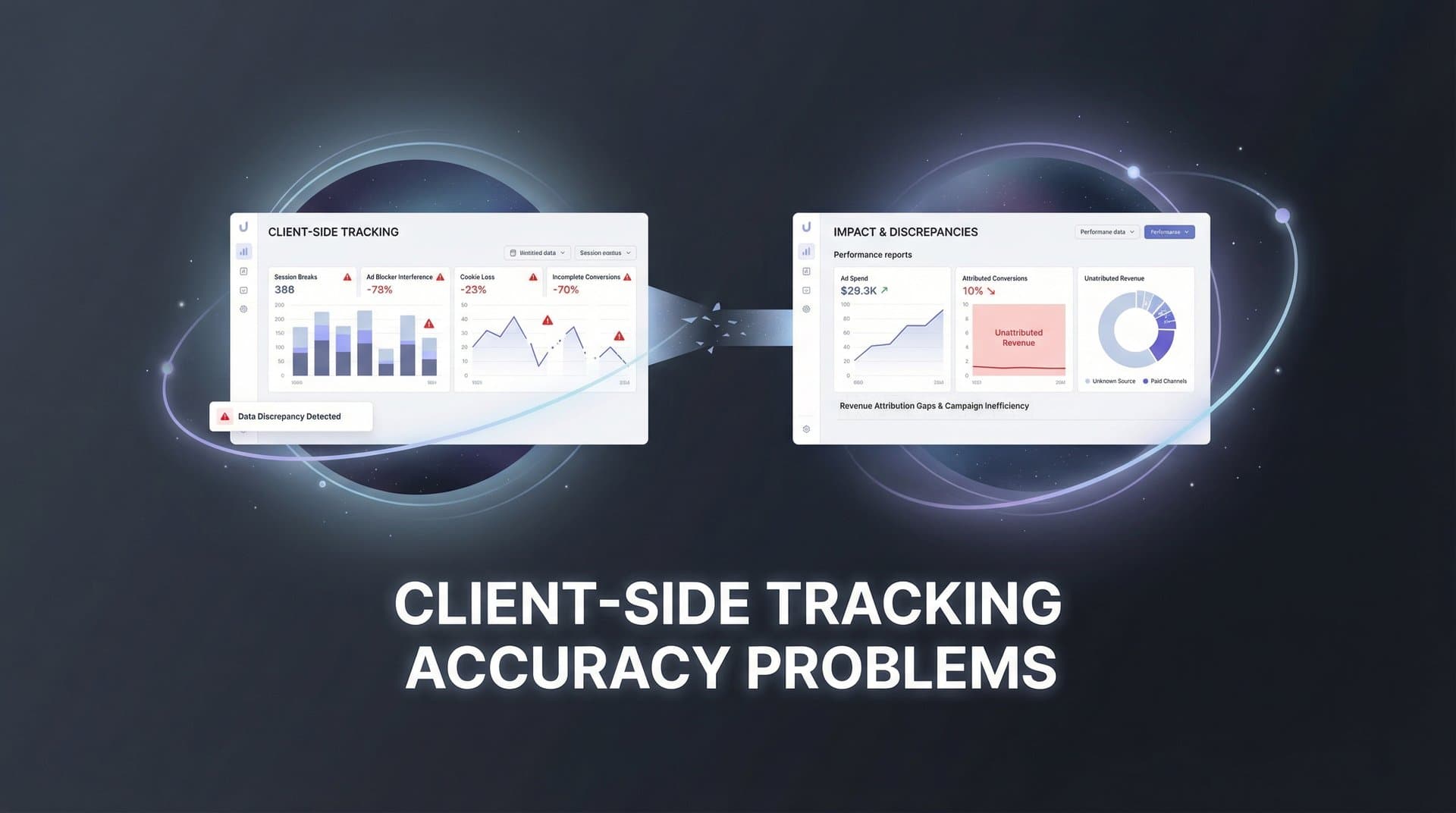
You've triple-checked your ad campaigns. Meta Ads Manager shows 150 conversions. Google Analytics reports 112. Your CRM says 89 actual sales came through. Which number do you trust? Which one do you use to decide whether to scale your budget or kill the campaign?
This isn't a minor reporting glitch. It's a fundamental crisis in how marketing data gets captured, and it's costing you real money every single day. The culprit? Client-side tracking, the browser-based system that most marketers still rely on without realizing how broken it has become.
Your marketing decisions are only as good as the data behind them. When that data is incomplete, blocked, or simply missing, you're not optimizing campaigns. You're guessing with a bigger budget. This article breaks down exactly what's going wrong with client-side tracking, why the problem keeps getting worse, and what modern attribution systems do differently to give you data you can actually trust.
How Browser-Based Tracking Actually Works (And Where It Breaks Down)
Client-side tracking sounds technical, but the concept is straightforward. When someone visits your website, a small piece of JavaScript code loads in their browser. This script fires tracking pixels, sets cookies to remember the visitor, and sends data about their actions back to your analytics platforms and ad networks.
Think of it like dropping a tracking device on every visitor's phone. As they move through your site, the device reports back: "They clicked this ad, viewed that product page, added something to cart, maybe converted." Your ad platforms use these signals to measure performance and optimize who sees your ads next.
The entire system depends on one critical assumption: the visitor's browser will cooperate. The JavaScript needs to load. The cookies need to be stored and readable. The tracking requests need to reach their destination. For years, this worked reasonably well.
But here's where it breaks down. That assumption no longer holds true. Modern browsers actively work against tracking. Privacy tools block the scripts before they load. Mobile operating systems require permission that users increasingly deny. The tracking device you're trying to drop? It gets confiscated at the door for a growing percentage of your traffic.
When tracking fails, the data simply disappears. The conversion happened in reality, but your analytics never recorded it. The customer journey that led to a sale? You only see fragments of it. The ad platform thinks the campaign underperformed, so it stops showing your ads to similar audiences. Meanwhile, you're looking at incomplete reports trying to figure out what's working.
The gap between attempted tracking and actual data capture has grown into a chasm. What used to be a minor discrepancy between platforms has become a major attribution crisis. You're not just dealing with different counting methodologies anymore. You're dealing with fundamental data loss that makes accurate marketing decisions nearly impossible. Understanding the difference between server side vs client side tracking is essential to solving this problem.
The Five Forces Destroying Your Tracking Accuracy
Understanding why client-side tracking fails requires looking at the multiple forces working against it. These aren't theoretical privacy concerns. They're active technologies that millions of users employ right now, silently blocking your tracking scripts and creating the data gaps you see in your reports.
Ad Blockers and Privacy Extensions: Browser extensions like uBlock Origin, Privacy Badger, and Ghostery have become mainstream tools. These extensions identify and block tracking scripts before they ever load on the page. When a user with an ad blocker visits your site, your Meta pixel never fires. Your Google Analytics tag never executes. From your analytics perspective, that visitor doesn't exist. They may browse your entire site, add products to cart, even complete a purchase, but you'll never connect that conversion back to the ad that brought them.
Browser Privacy Features: Safari's Intelligent Tracking Prevention has been steadily tightening restrictions since 2017. It caps first-party cookie lifetimes at seven days, meaning return visitors beyond that window appear as new traffic. It blocks third-party cookies entirely, breaking cross-site tracking. Firefox Enhanced Tracking Protection follows similar principles, blocking known tracking domains by default. Even Chrome, long the most permissive browser for advertisers, is phasing out third-party cookies as part of its Privacy Sandbox initiative. These cookie tracking problems in advertising continue to multiply.
These aren't niche browsers. Safari dominates mobile browsing. Firefox maintains a loyal user base. Together, they represent a substantial portion of web traffic where traditional tracking methods face severe limitations.
iOS App Tracking Transparency: Apple's ATT framework, introduced in iOS 14.5, fundamentally changed mobile tracking. Apps must now ask permission before tracking users across other apps and websites. Most users decline. When they do, the advertiser identifier that linked ad clicks to app installs and in-app events disappears. Facebook famously projected this change would cost them billions in revenue, not because fewer ads would run, but because accurate measurement became dramatically harder.
The impact extends beyond apps. Mobile web browsing on iOS faces similar restrictions. Cross-site tracking that used to connect a user's journey from ad click through multiple website visits no longer works reliably. You see fragments of the journey, not the complete path to conversion.
Network-Level Blocking: VPNs strip tracking parameters from URLs before they reach your website. Corporate firewalls block requests to known tracking domains. DNS-level ad blockers like Pi-hole prevent tracking scripts from loading across every device on a network. These tools operate invisibly to the user but create complete blind spots in your analytics. A visitor using a VPN might appear as direct traffic when they actually clicked your paid ad, making your ad spend look ineffective when it drove the conversion. This contributes to widespread conversion tracking accuracy issues.
Technical Failures: Even when nothing actively blocks tracking, technical issues create data loss. Slow page loads mean users bounce before JavaScript executes. Mobile connections drop mid-session. Users close tabs before tracking requests complete. Single-page applications break traditional pageview tracking. These aren't edge cases. They're everyday occurrences that quietly erode your data quality.
Each of these forces works independently, but they compound. A user on iOS Safari with a VPN and Privacy Badger installed represents a perfect storm of tracking failure. Your carefully implemented analytics sees almost nothing from that visitor's session, yet they're a real potential customer making real decisions about your products.
The Real Cost of Inaccurate Attribution Data
Bad data doesn't just create reporting headaches. It drives bad decisions that waste budget and limit growth. When your attribution is fundamentally broken, every strategic choice you make rests on a faulty foundation.
The most immediate cost is budget misallocation. Your ad platform reports that Campaign A generated 50 conversions while Campaign B only drove 20. Based on that data, you shift budget toward Campaign A. But what if Campaign B's conversions came from users with ad blockers, and the actual conversion count was 45? You just starved a high-performing campaign because your tracking couldn't see its real impact.
This happens constantly. Campaigns targeting privacy-conscious audiences, tech-savvy users, or iOS mobile traffic systematically appear to underperform because those segments have higher rates of tracking failure. You end up optimizing toward audiences where tracking works, not audiences that actually convert best. The irony is brutal: your most valuable customers might be the hardest to track, so your data pushes you away from them. These marketing attribution accuracy problems affect businesses of all sizes.
Algorithm degradation creates a second-order cost that compounds over time. Ad platforms like Meta and Google use machine learning to optimize who sees your ads. These algorithms learn from conversion signals. When you send incomplete or inaccurate conversion data, the algorithms learn the wrong patterns. They optimize toward characteristics that correlate with trackable conversions, not actual conversions.
Feed an algorithm bad data long enough, and it becomes confidently wrong. It finds audiences that look like converters based on the limited signals it receives, while missing the broader patterns that would reveal your true best customers. The longer this continues, the harder it becomes to fix, because the algorithm's learning is built on a foundation of incomplete information.
Strategic blindness might be the most insidious cost because it's the hardest to quantify. When you can't see the complete customer journey, you can't understand what actually drives conversions. Does your content marketing create awareness that leads to paid search clicks that convert? You'll never know if your tracking only captures the final click. Are customers researching on mobile but converting on desktop? That cross-device journey is invisible to client-side tracking. These multiple touchpoint tracking problems obscure your true marketing performance.
Without visibility into the full journey, you make strategic decisions in the dark. You might cut a channel that appears ineffective but actually plays a crucial assist role. You might double down on tactics that capture last-click attribution while ignoring the touchpoints that made that final click possible. Your entire marketing strategy becomes reactive rather than strategic, driven by incomplete data rather than true understanding.
The competitive implications are stark. Companies that solve attribution accuracy gain a decisive advantage. They see opportunities competitors miss. They optimize toward real performance while others optimize toward measurement artifacts. In markets where margins are tight and competition is fierce, better data translates directly to better growth.
Server-Side Tracking: The Architecture That Solves Accuracy Problems
Server-side tracking represents a fundamental shift in how conversion data flows from your business to ad platforms. Instead of relying on JavaScript in the user's browser, data travels directly from your server to ad platform APIs. This architectural change eliminates most of the accuracy problems that plague client-side tracking.
Here's how it works in practice. When a conversion happens on your website or in your CRM, your server captures that event with all its relevant details: which user converted, what they purchased, how much revenue was generated. Your server then sends this information directly to Meta's Conversions API, Google's server-side tagging, or other platform endpoints. The user's browser never enters the equation. For a deeper understanding, explore what server side conversion tracking actually means.
The accuracy advantages are immediate and substantial. Ad blockers can't interfere because there's no script to block. Browser privacy features don't matter because no cookies are being set or read. iOS tracking restrictions are irrelevant because the data flow happens entirely server-to-server. The conversion signal reaches the ad platform regardless of what privacy tools the user employs.
This means you capture conversions that client-side tracking misses entirely. That iOS user with an ad blocker and a VPN who appeared invisible to your Meta pixel? Server-side tracking sees them clearly because the conversion data originates from your server after they complete a purchase, not from a blocked JavaScript tag in their browser. This is why server side tracking is more accurate than traditional methods.
The completeness of data improves ad platform optimization in meaningful ways. When you feed Meta or Google accurate conversion signals, their algorithms can identify the true characteristics of your converters. They find more people like your actual customers, not just people like your trackable customers. Over time, this leads to better targeting, lower acquisition costs, and improved return on ad spend.
Server-side tracking also enables richer conversion data. Client-side tracking is limited to what JavaScript can observe in the browser. Server-side tracking can include CRM data, offline conversions, customer lifetime value, and other business metrics that provide context about conversion quality. You can tell ad platforms not just that a conversion happened, but that it was a high-value customer worth acquiring more of.
The implementation requires technical setup, but modern attribution platforms handle much of the complexity. You connect your data sources, define what events constitute conversions, and configure the platform to send enriched conversion data to your ad platforms. Once configured, the system runs continuously, capturing accurate attribution data regardless of browser restrictions or privacy tools.
The shift from browser-dependent to server-controlled tracking represents more than a technical change. It's a strategic move toward first-party data ownership. Instead of hoping browsers will cooperate with your tracking, you control the data flow from your own infrastructure. This positions you to maintain accurate attribution even as privacy regulations tighten and browser restrictions expand.
Building an Accurate Attribution System That Actually Works
Server-side tracking solves data capture, but accurate attribution requires connecting all your data sources into a unified view. Conversions don't happen in isolation. They're the result of multiple touchpoints across channels, devices, and time periods. Understanding which marketing efforts truly drive revenue requires seeing the complete picture.
The foundation is data integration. Your ad platforms show clicks and impressions. Your website analytics tracks sessions and pageviews. Your CRM records leads and closed deals. Your email platform measures opens and clicks. Each system holds part of the story, but none sees the whole journey. Accurate attribution connects these fragmented data sources into a single customer journey map. A comprehensive attribution marketing tracking guide can help you understand this process.
This means tracking the same user across touchpoints and matching their interactions to eventual outcomes. When someone clicks a Facebook ad, visits your site, submits a lead form, receives nurture emails, and finally converts through a sales call, you need to connect all those dots. Client-side tracking struggles with this because cookies don't persist across devices and privacy tools break the chain. A robust attribution system uses multiple identifiers and probabilistic matching to reconstruct journeys even when tracking signals are incomplete.
Multi-touch attribution reveals which channels and campaigns play different roles in the conversion process. Your Google search ads might capture high-intent users ready to buy, earning last-click credit. But your content marketing might create the awareness that led to that search. Your retargeting might re-engage users who weren't ready on first visit. Single-touch attribution models give all credit to one touchpoint, hiding the contributions of others. Multi-touch models distribute credit across the journey, showing you the true value of each marketing effort.
The sophistication of attribution models matters. Linear models split credit evenly across touchpoints, which treats all interactions as equally important. Time-decay models give more credit to recent touchpoints, recognizing that actions closer to conversion often matter more. Position-based models emphasize first and last touch while acknowledging mid-journey interactions. The right model depends on your business, but having options lets you analyze performance from multiple angles. Understanding attribution model accuracy problems helps you choose wisely.
AI-powered analysis takes attribution beyond static models. Machine learning can identify patterns in successful conversion journeys that human analysis might miss. It can weight touchpoints based on their actual predictive value for conversion, not just their position in the journey. It can surface insights like "users who engage with this content type are 3x more likely to convert within 30 days" or "this ad creative drives lower-quality leads despite high click rates."
The practical outcome is marketing clarity. You stop guessing which campaigns work and start knowing. You can confidently scale spending on channels that drive real revenue, even if they don't capture last-click attribution. You can identify underperforming tactics early and reallocate budget before waste accumulates. You can test new channels with clear measurement of their incremental impact.
This level of attribution accuracy becomes a competitive advantage. While competitors optimize based on incomplete data, you optimize based on reality. Your ad platform algorithms receive accurate signals and improve over time. Your marketing strategy aligns with actual customer behavior rather than measurement artifacts. The compound effect of better data driving better decisions creates sustained performance improvements.
Putting It All Together: From Data Chaos to Marketing Clarity
The evolution from client-side tracking to server-side, first-party data approaches isn't optional anymore. It's essential infrastructure for modern marketing. Browser restrictions will continue tightening. Privacy regulations will expand. The tracking methods that worked five years ago are breaking down in real time, and the trend only accelerates.
Companies that adapt gain a decisive advantage. Accurate attribution becomes a moat that competitors struggle to cross. You see opportunities they miss. You optimize toward real performance while they chase measurement artifacts. Your ad spend works harder because algorithms receive accurate signals. Your strategic decisions rest on solid data rather than fragmented guesses.
The technical shift to server-side tracking solves the immediate problem of data capture. The strategic shift to unified, multi-touch attribution solves the deeper problem of understanding what actually drives revenue. Together, they transform marketing from educated guesswork into data-driven science.
The cost of inaction compounds daily. Every campaign you run with broken attribution wastes some portion of budget. Every strategic decision made with incomplete data carries hidden risk. The gap between your performance and what's possible with accurate attribution grows wider the longer you wait to address it.
Modern attribution platforms make the transition manageable. They handle the technical complexity of server-side implementation, data integration across sources, and sophisticated analysis that reveals true marketing performance. The investment in proper attribution infrastructure pays for itself quickly through better budget allocation and improved campaign performance.
Take Control of Your Marketing Data
Client-side tracking accuracy problems aren't getting better. They're accelerating as privacy becomes a competitive differentiator for browsers and operating systems. The marketers who thrive in this environment are those who stop depending on browser-based tracking and build attribution systems designed for the privacy-first era.
Your marketing deserves data you can trust. Your budget decisions deserve accurate attribution. Your growth strategy deserves complete visibility into what drives real revenue. The technology exists to solve these problems today, not years from now when even more tracking capabilities have degraded.
Cometly's server-side tracking and AI-powered attribution provide the accuracy modern marketers need. Capture every touchpoint across your customer journey. Connect ad platforms, website events, and CRM data into unified attribution. Feed your ad platform algorithms complete conversion signals that improve targeting over time. Make confident budget decisions based on reality, not fragments.
Ready to elevate your marketing game with precision and confidence? Discover how Cometly's AI-driven recommendations can transform your ad strategy. Get your free demo today and start capturing every touchpoint to maximize your conversions.


