

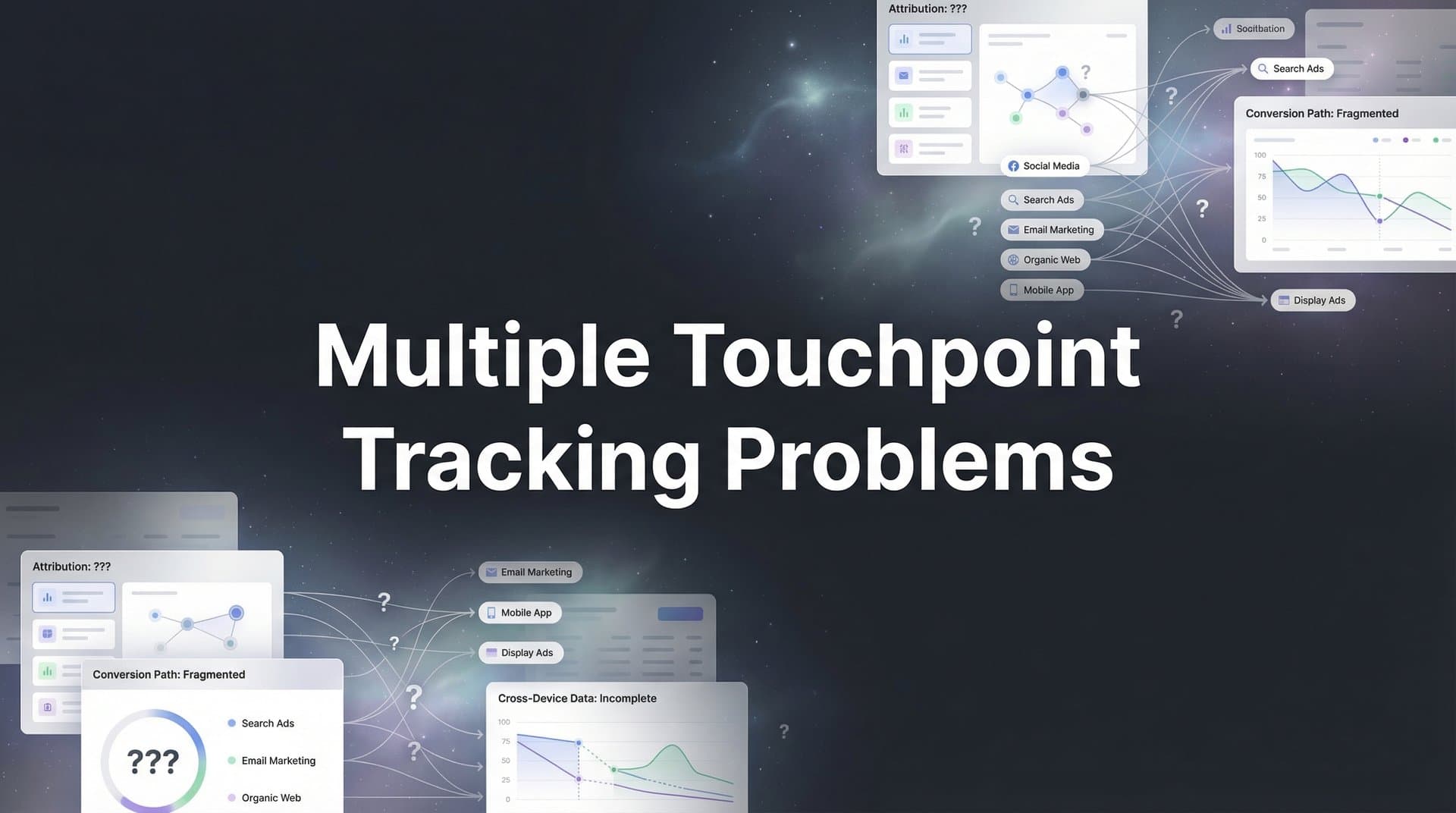
You're running campaigns across Meta, Google, TikTok, and email. The budget is flowing. The ads are live. But when you sit down to figure out what's actually driving conversions, nothing makes sense.
Meta's dashboard claims 150 conversions this month. Google Ads says it drove 120. Your email platform reports 80. Add them all up and you get 350 conversions—except your CRM only shows 200 actual sales.
Every platform is taking credit for the same customers. Your analytics tools tell different stories depending on which one you open. And you're stuck making budget decisions based on data you can't trust.
This isn't a minor reporting glitch. It's a fundamental breakdown in how marketing attribution works in 2026. The problem has a name: multiple touchpoint tracking problems. And it's costing you real money every single day—wasting budget on channels that look good in their own dashboards while starving the campaigns that actually convert.
The stakes are higher than most marketers realize. When your tracking is broken, you're not just looking at messy reports. You're making strategic decisions in the dark. You're feeding ad platform algorithms incomplete data, which makes their optimization worse. You're comparing channels using metrics that can't be compared.
Let's break down exactly why multiple touchpoint tracking falls apart, what it's costing you, and how modern marketers are solving it.
The Hidden Complexity Behind Every Conversion
Here's what most marketing dashboards won't tell you: the average customer doesn't see one ad and buy. They interact with your brand 6-8 times across different devices and channels before converting. Sometimes more.
A typical journey might look like this: someone sees your Meta ad on their phone during their morning commute. They don't click. Three days later, they see a Google search ad on their work laptop and visit your site. They browse but don't buy. A week later, your retargeting ad catches them on Instagram. They click through on mobile but still don't convert. Finally, they receive your email campaign, click through on their home computer, and make a purchase.
That's four touchpoints across three devices. Which channel "caused" the sale?
Traditional tracking methods can't answer that question because they were built for a simpler era. Cookies and platform pixels were designed when most people used one device and one browser. They tracked sessions, not people. They assumed a linear path from ad click to conversion.
That world doesn't exist anymore.
The "black box" problem makes this worse. Between each touchpoint you can track, there are gaps you can't see. Your customer might have seen your billboard. They might have asked a friend about your product. They might have read a review site that didn't have your tracking pixel. They might have visited your site directly by typing your URL after remembering your brand from that first Meta ad weeks ago.
All of that happens in the dark. Your tracking sees disconnected dots—a mobile click here, a desktop session there—but it can't connect them into a coherent journey. So each platform fills in the story with its own logic, usually in a way that makes that platform look as valuable as possible.
The result? You're making budget decisions based on incomplete fragments of the truth, stitched together by systems that weren't designed for how people actually buy in 2026.
Five Core Problems That Break Multi-Touch Tracking
Cross-Device Blindness: This is the most common breakdown. A user sees your ad on mobile during lunch, thinks about it, then converts on their desktop computer at home that evening. To you, that's one customer journey. To your tracking? Those look like two completely different people.
Cookie-based tracking can't follow users across devices because cookies live in browsers, not in people. When someone switches from their iPhone to their MacBook, the connection breaks. The mobile click gets logged. The desktop conversion gets logged. But nothing ties them together. So your mobile campaigns look like they're generating clicks without conversions, while your desktop traffic looks like it's converting out of nowhere. Understanding cross-device attribution tracking is essential for solving this challenge.
Walled Garden Conflicts: Meta, Google, TikTok, and other major platforms operate as closed ecosystems. Each one tracks conversions using its own attribution logic, its own lookback windows, and its own definitions of what counts as an "assisted" conversion versus a "direct" conversion.
Meta might use a 7-day click and 1-day view attribution window. Google might use 30-day click. TikTok might use something different entirely. When the same customer interacts with ads on all three platforms before buying, each platform applies its own rules and often claims full credit.
This creates the infamous "double-counting" problem where total platform-reported conversions exceed your actual sales by 30-50% or more. Every platform is technically correct according to its own methodology. But they can't all be right at the same time. This is why multiple ad platforms tracking issues remain one of the biggest challenges for marketers.
Cookie Deprecation and Privacy Changes: The tracking landscape changed fundamentally when Apple released iOS 14.5 with App Tracking Transparency in April 2021. Suddenly, apps had to ask explicit permission to track users across other apps and websites. Most users said no.
The result? Massive data gaps for mobile-heavy platforms like Meta and TikTok. Marketers who relied on mobile conversion tracking saw their visibility drop overnight. Many reported opt-in rates below 20%, meaning 80% of their mobile traffic became effectively invisible to traditional tracking methods. The ongoing cookie tracking problems in advertising continue to erode data accuracy.
Google's planned deprecation of third-party cookies in Chrome keeps getting delayed, but it's still coming. When it arrives, cross-site tracking will become even harder. The browser-based tracking that powered digital marketing for two decades is dying, and many marketers haven't adapted yet.
Offline and CRM Disconnects: Not every conversion happens on your website. Phone calls driven by ads don't automatically get attributed back to the campaign that caused them. In-person meetings, sales team conversations, and offline purchases create attribution gaps that most tracking systems can't bridge.
Your CRM might show that a lead came from "organic search," but that's only because they typed your company name directly into Google after seeing your Meta ad three times. The CRM sees the search. It doesn't see the ads that built the awareness that led to the search. Implementing proper marketing attribution for phone calls can help close some of these gaps.
For B2B companies with long sales cycles, this problem multiplies. A prospect might download a whitepaper from a LinkedIn ad, attend a webinar promoted via email, have three sales calls, and then convert six months later. Connecting all those dots requires integration between your ad platforms, marketing automation, and CRM—integration that most companies don't have.
Time Decay Confusion: When weeks or months pass between first touch and conversion, attribution becomes a nightmare. Did that initial blog post from an organic search really contribute to a sale that happened 90 days later? What about the retargeting ad they saw in between?
Most platform attribution windows are short—7 to 30 days. If your sales cycle is longer, the first touchpoints fall outside the window and get zero credit. This systematically undervalues top-of-funnel campaigns and overvalues bottom-funnel tactics, leading to budget decisions that starve awareness campaigns and over-invest in retargeting.
The Real Cost of Attribution Blind Spots
Let's talk about what these tracking problems actually cost you.
Budget Misallocation: When you can't see which channels truly drive revenue, you end up spending based on incomplete data. A channel might look incredibly efficient in its own dashboard—great ROAS, lots of conversions—but those conversions might be heavily duplicated with other channels or might be bottom-funnel touches that only work because other channels did the heavy lifting earlier.
The inverse is equally damaging. Top-of-funnel channels that introduce new customers to your brand often look terrible in last-click attribution. They generate awareness and consideration, but someone else gets credit for the conversion. So you cut budget from the channels that are actually filling your pipeline, then wonder why your retargeting performance drops two months later when there aren't enough new prospects to retarget.
Algorithm Starvation: Here's a problem most marketers don't think about: ad platform algorithms need accurate conversion data to optimize effectively. When Meta's algorithm can't see that a mobile ad led to a desktop conversion, it thinks that ad didn't work. So it stops showing similar ads to similar people.
This creates a vicious cycle. Incomplete tracking leads to incomplete conversion data. Incomplete conversion data leads to poor algorithmic optimization. Poor optimization leads to worse campaign performance. And worse performance makes you trust your data even less.
Modern ad platforms are increasingly powered by machine learning that optimizes toward conversion events. When those conversion events are missing or misattributed, you're asking the AI to optimize based on lies. It will do exactly what you tell it to do—it'll just be optimizing toward the wrong thing. This is why conversion tracking for multiple ad platforms needs to be unified and accurate.
Strategic Paralysis: The most insidious cost is what happens to decision-making when you can't trust your data. Teams start making gut-based calls instead of data-driven decisions. Budget planning becomes political instead of analytical. Executives ask "what's our CAC?" and the answer is "well, it depends which platform you ask."
Some companies respond by freezing budgets entirely. They're spending money, but they're not increasing investment in what works because they genuinely don't know what works. Others keep spending but with a constant nagging doubt about whether they're wasting money. Both scenarios leave you vulnerable to competitors who have solved the attribution problem and can scale with confidence.
Why Platform-Native Analytics Fall Short
You might be thinking: "Can't I just use the analytics built into each platform?" You can. But you shouldn't rely on them exclusively.
Every platform's attribution system is designed with a built-in bias: to make that platform look as valuable as possible. This isn't necessarily malicious—it's just how the incentives work. Meta wants you to spend more on Meta ads. Google wants you to spend more on Google ads. Their reporting reflects that.
Meta might count a conversion if someone saw your ad (didn't even click it) and then converted within 24 hours. Google might count it if they clicked an ad within 30 days. TikTok might use different windows entirely. Each platform is technically telling the truth according to its own rules. But when you add them all up, you get nonsense.
The "double-counting" problem is real and significant. Many marketers report that when they sum up all platform-reported conversions, the total exceeds actual sales by 30-50%. Some see even wider gaps. This isn't a rounding error—it's a fundamental conflict in how attribution is calculated across platforms.
Platform-native analytics also suffer from limited lookback windows and last-click bias. Most platforms heavily weight the final touchpoint before conversion because that's easiest to measure and makes their platform look most effective. But this systematically ignores the customer journey that led to that final click.
If someone sees your Meta ad five times over two weeks, clicks a Google search ad, and then converts, Google's last-click attribution gives Google 100% credit. Meta gets nothing, even though those five impressions built the awareness that made someone search for your brand in the first place. Understanding touchpoint attribution tracking helps reveal the full picture.
Platform analytics also can't see outside their own ecosystem. Meta doesn't know what happens on Google. Google doesn't know what happens in your email campaigns. None of them know what your sales team is doing. Each platform is showing you one piece of a puzzle while pretending it's the complete picture.
Building a Tracking System That Actually Works
So how do you fix this? Modern attribution requires moving beyond browser-based, platform-siloed tracking toward a unified system that captures the full customer journey. Here's what that looks like in practice.
Server-Side Tracking: This is the foundation. Instead of relying on cookies and browser pixels that break across devices and get blocked by privacy restrictions, server-side tracking sends conversion data directly from your server to ad platforms.
When someone converts on your website, your server captures that event and sends it to Meta's Conversions API, Google's Enhanced Conversions, and any other platforms you're using. This bypasses browser limitations entirely. It works regardless of cookie settings, ad blockers, or iOS privacy restrictions. Learn more about Google Analytics vs server-side tracking to understand the differences.
Server-side tracking also lets you send richer data. You can include customer lifetime value, order details, and CRM information that wouldn't be available through a browser pixel. This gives ad platforms better data to optimize against and gives you better visibility into which campaigns drive valuable customers, not just any customers.
First-Party Data Unification: The next step is connecting all your data sources into a single source of truth. This means integrating your ad platforms, website analytics, CRM, email marketing, and any other systems that touch the customer journey. A proper first-party data tracking setup is critical for this foundation.
When these systems talk to each other, you can finally see the complete picture. A lead enters through a Meta ad, gets nurtured through email, converts on your website, and closes in your CRM. Instead of seeing those as disconnected events in different dashboards, you see them as one customer journey with multiple touchpoints.
This unification also enables identity resolution—matching the same person across devices and sessions. When someone visits on mobile and later converts on desktop, a unified system can connect those actions to the same individual, solving the cross-device blindness problem.
Multi-Touch Attribution Models: Once you have unified data, you can apply different attribution models to understand how credit should be distributed across touchpoints. There's no single "correct" model—different approaches reveal different insights. Exploring various attribution tracking methods helps you find the right approach for your business.
Linear attribution distributes credit equally across all touchpoints. If someone had five interactions before converting, each gets 20% credit. This is fair but doesn't account for the fact that some touches are more influential than others.
Time-decay attribution gives more weight to recent interactions, based on the logic that touchpoints closer to conversion had more influence on the decision. This works well for shorter sales cycles but can undervalue early awareness-building efforts.
Position-based (or U-shaped) attribution emphasizes the first and last touchpoints, giving them each 40% credit while distributing the remaining 20% across middle touches. This recognizes that introducing someone to your brand and closing the sale are both critical moments.
The key is using multiple models to compare results. If a channel looks great in last-click but terrible in first-click, it's probably a bottom-funnel tactic that relies on other channels to feed it. If a channel looks strong in first-click but weak in last-click, it's building awareness that other channels convert.
Conversion Sync: Here's where it all comes together. Once you have accurate, unified conversion data, you need to feed it back to ad platforms so their algorithms can optimize effectively. This is what Conversion APIs and Enhanced Conversions are designed for.
When you send complete, accurate conversion data back to Meta and Google, their machine learning systems can identify patterns in who converts and optimize toward finding more people like that. This improves targeting, bidding, and creative optimization—all of which directly impact your ROAS.
Conversion sync also helps with the iOS 14.5 data gap. Even when browser-based tracking fails, server-side conversion events still get through. This gives platforms the conversion signals they need to optimize, even when traditional tracking is blocked.
Your Roadmap to Better Attribution
Fixing multiple touchpoint tracking problems doesn't happen overnight, but you can start making progress immediately with a structured approach.
Start with an audit: Before you implement new tracking, understand where your current system breaks down. Compare conversion counts across platforms and your actual sales. Identify the biggest gaps—are you losing visibility on mobile? Across devices? In your CRM handoff? Focus on the problems that cost you the most. If you're experiencing issues, our guide on attribution tracking not working can help diagnose common problems.
Prioritize server-side implementation: Begin with your highest-spend platforms. If you're running significant Meta and Google campaigns, implementing Meta's Conversions API and Google's Enhanced Conversions should be your first priority. These provide immediate benefits in data accuracy and algorithmic optimization.
Server-side tracking requires technical implementation—you'll need developer resources or a platform that handles it for you. But the investment pays off quickly in better attribution visibility and improved campaign performance.
Build toward unified attribution: Once server-side tracking is in place, work on connecting your data sources. Start by integrating your ad platforms with your CRM. This lets you see which campaigns drive leads that actually close, not just which campaigns drive form fills.
Use unified attribution to compare different models and understand which channels deserve more investment. Look for channels that perform well in first-click attribution but get ignored in last-click—these are often your best opportunities to scale top-of-funnel awareness.
The Competitive Advantage of Accurate Attribution
Multiple touchpoint tracking problems aren't going away. Privacy regulations continue tightening. Customer journeys keep getting more complex across devices and channels. The gap between marketers who solve attribution and those who don't will only widen.
Companies that fix their tracking gain a significant competitive advantage. They know exactly which campaigns drive revenue, not just traffic or clicks. They can scale confidently because they trust their data. They stop wasting budget on channels that look good in isolation but don't actually contribute to growth.
Just as importantly, they feed better data to ad platform algorithms, which improves optimization and performance. When Meta and Google can see accurate conversion data across your entire funnel, they get better at finding customers who actually buy. Your ROAS improves not just because you're making better budget decisions, but because the platforms themselves are working more effectively.
The alternative is continuing to make decisions in the dark—comparing channels using incompatible metrics, trusting platform dashboards that systematically overstate their own value, and wondering why your marketing feels like it's getting less efficient every quarter.
Ready to elevate your marketing game with precision and confidence? Discover how Cometly's AI-driven recommendations can transform your ad strategy—Get your free demo today and start capturing every touchpoint to maximize your conversions.


