Your Meta ads dashboard shows 100 conversions. Google Analytics shows 75. Your CRM recorded 60. Which number is real? If you're still relying on tracking methods built for a cookie-based world, the honest answer is: none of them.
The third-party cookie era didn't just fade away—it collapsed. Safari killed them years ago. Firefox followed. And Chrome, after years of delays, finally pulled the trigger on deprecation. For marketers who haven't adapted, this isn't a future problem. It's a current crisis.
Here's what that looks like in practice: attribution gaps that make campaign analysis feel like guesswork. Audience targeting that's a shadow of what it used to be. Ad platform reporting that contradicts itself across every dashboard you check. And the nagging suspicion that you're making budget decisions based on incomplete, inaccurate data.
But here's the twist: this disruption is forcing something better. The cookieless shift is pushing marketers toward approaches that respect privacy while actually improving data quality. Server-side tracking captures what cookies miss. First-party data strategies build direct relationships with customers. AI-powered attribution fills gaps that manual tracking never could. And conversion sync feeds ad platform algorithms the enriched signals they need to optimize effectively.
This article is your practical guide to understanding where cookieless tracking is headed and how to position your marketing stack for what's next. We'll break down the technologies defining the new landscape, the strategies that actually scale, and the infrastructure decisions that separate marketers who thrive from those who struggle. The cookieless future isn't coming—it's here. Let's make sure you're ready for it.
Why the Cookie Crumbled: The Forces Reshaping Digital Tracking
Third-party cookies didn't die from natural causes. They were killed by a perfect storm of regulatory pressure, technical changes, and shifting consumer expectations that made them unsustainable.
Start with privacy regulations. GDPR arrived in 2018 and immediately changed the compliance landscape across Europe. Companies faced real financial consequences for mishandling user data—fines that could reach 4% of global revenue. California followed with CCPA in 2020, and the regulatory momentum hasn't stopped. Virginia, Colorado, Connecticut, and other states have passed their own privacy laws. Each one adds complexity, but they all share a common theme: users must have meaningful control over their data.
Third-party cookies—those small files dropped by advertisers to track you across the web—became the poster child for everything privacy advocates opposed. They enabled tracking that most users didn't understand and couldn't easily control. Regulators took notice.
Then came the browser-level changes that turned regulatory pressure into technical reality. Apple's Safari introduced Intelligent Tracking Prevention (ITP) in 2017, systematically blocking third-party cookies and limiting first-party cookie lifespans. Mozilla's Firefox followed with Enhanced Tracking Protection. These weren't small players—they represented billions of users.
Chrome's decision to deprecate third-party cookies was the final domino. After multiple delays, Google moved forward with Privacy Sandbox—a collection of APIs designed to enable advertising use cases without cross-site tracking. The rollout took years, but by 2026, third-party cookies are effectively gone from the world's most popular browser.
But regulation and browser changes alone don't tell the full story. Consumer expectations shifted fundamentally. Users became aware that they were being tracked everywhere online, often without clear consent or benefit. High-profile data breaches and privacy scandals made headlines regularly. Trust eroded.
Today's consumers expect transparency. They want to know what data you're collecting, why you're collecting it, and what you're doing with it. They expect simple controls to opt out. And increasingly, they expect something in return—personalized experiences, exclusive content, better service—for sharing their information.
This convergence of forces—regulatory mandates, technical restrictions, and consumer demand—didn't just deprecate cookies. It fundamentally changed the rules of digital marketing. Marketers who viewed this as merely a technical problem to solve missed the point. This is a reset that requires rethinking how you collect data, how you measure performance, and how you build relationships with your audience.
The question isn't whether to adapt. It's how quickly you can build a tracking infrastructure that works in this new reality. Understanding what cookieless tracking actually means is the first step toward building that infrastructure.
Server-Side Tracking: The Foundation of Modern Attribution
If cookies are dead, what replaces them? The answer that's emerging across the industry is server-side tracking—a fundamental shift in where and how you collect marketing data.
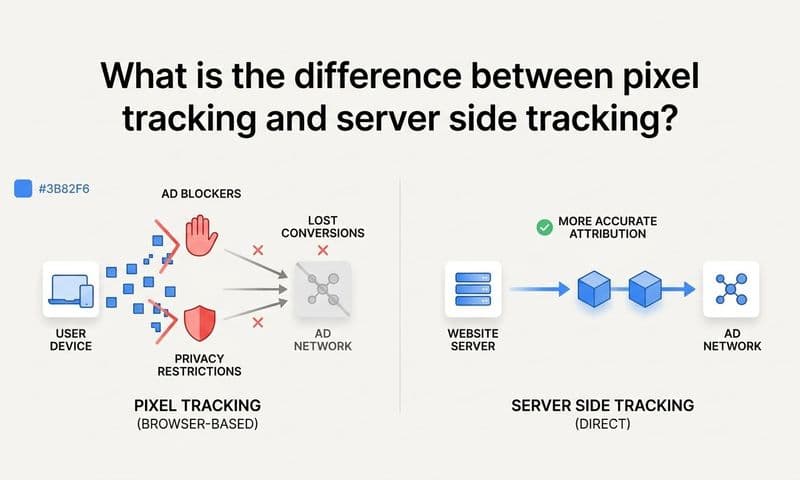
Here's the core concept: instead of relying on JavaScript code running in a user's browser to capture and send data (client-side tracking), you collect that information on your own server before it ever reaches the browser. When someone clicks your ad and lands on your site, your server logs that event, enriches it with additional context, and sends it directly to your analytics platform and ad networks.
Why does this matter? Because browser-based tracking is increasingly unreliable. Ad blockers strip out tracking scripts. Browser privacy features limit cookie lifespans and block cross-site requests. iOS restrictions prevent accurate attribution. By the time data reaches your analytics platform through client-side methods, it's incomplete, degraded, or missing entirely.
Server-side tracking bypasses these limitations entirely. The data collection happens in an environment you control, immune to browser restrictions and ad blocking software. When a conversion occurs, your server captures it with complete accuracy and sends that event directly to Meta's Conversions API, Google's Enhanced Conversions, or TikTok's Events API.
The benefits extend beyond just avoiding browser restrictions. Server-side tracking typically provides better data accuracy because it's not subject to client-side errors, network issues, or users closing their browser before tracking pixels fire. It improves page load speeds because you're removing heavy tracking scripts from the client side. And it gives you complete control over what data gets sent where, making privacy compliance more straightforward.
But here's where it gets interesting for attribution: server-side tracking lets you connect your entire data ecosystem. Your CRM knows when a lead becomes a customer. Your payment processor knows the exact revenue. Your ad platforms need to know which campaigns drove those outcomes. Server-side tracking creates the infrastructure to tie it all together.
Picture this: A user clicks your Meta ad, browses your site, leaves without converting, then returns three days later through a Google search and makes a purchase. With client-side tracking alone, you'd likely miss the initial Meta touchpoint (cookie expired or blocked). With server-side tracking, your server logs that first click with a unique identifier, tracks the journey across sessions, and when the conversion happens, sends complete attribution data back to both Meta and Google.
Implementation requires connecting several pieces. Your website needs server-side tracking infrastructure—many marketers use server-side Google Tag Manager or dedicated attribution platforms. For a detailed walkthrough, our server-side tracking implementation guide covers the technical requirements step by step. Your CRM and payment systems need to feed conversion data to that server. And you need conversion sync set up to send enriched events back to ad platforms.
The technical lift is real, but so is the competitive advantage. While competitors struggle with degraded cookie-based data, you're feeding ad platform algorithms accurate, complete conversion information. That difference compounds over time as their targeting gets better and their optimization becomes more effective.
Server-side tracking isn't just a workaround for cookie deprecation. It's the foundation for attribution that actually works in 2026 and beyond.
First-Party Data Strategies That Actually Scale
When third-party cookies disappeared, they took something valuable with them: the ability to track users across the web without their direct participation. The replacement isn't another tracking trick—it's building direct relationships with your audience through first-party data.
First-party data is information users willingly share with you: email addresses, preferences, purchase history, behavior on your owned properties. It's data you collect directly, with consent, through interactions on your website, app, or other channels you control. And in a cookieless world, it's the most valuable asset in your marketing stack.
But here's the challenge: collecting first-party data at scale requires giving users a compelling reason to share it. This is where value exchange becomes critical. Users won't hand over their email address for nothing. They need something worth the trade.
Gated content works when it's genuinely valuable—comprehensive guides, research reports, tools, or templates that solve real problems. Loyalty programs create ongoing value exchange: users share purchase data and preferences in return for rewards, exclusive access, or personalized experiences. Account creation with progressive profiling lets you gather information over time rather than demanding everything upfront.
The key is making the exchange feel fair. "Sign up for our newsletter" is weak. "Get our 50-page guide to scaling paid ads profitably" creates clear value. "Join our community for early access to new features" gives users something they actually want.
Once you're collecting first-party data, the real power comes from using it to understand the complete customer journey. This is where your CRM becomes central to attribution. When you know that user@example.com clicked your Meta ad last Tuesday, downloaded your guide on Thursday, attended your webinar the following week, and converted into a customer two days later, you have attribution clarity that cookies never provided. Our deep dive into first-party data tracking explains how to build this infrastructure effectively.
Many marketers stop at basic CRM data—contact info and deal stages. But first-party data strategies that scale go deeper. Track content engagement: which blog posts did they read? Which emails did they open? What features did they use in your product trial? Every interaction adds context that helps you understand what drives conversions.
This is where AI becomes a multiplier. Machine learning can analyze patterns across thousands of customer journeys to identify the touchpoints that matter most. It can spot early signals that a lead is likely to convert or churn. It can segment your audience based on behavior patterns that humans would miss.
AI can also enrich your first-party data by connecting dots across different sources. When someone engages with your content anonymously, then later provides their email, AI can probabilistically link those sessions to build a more complete picture of their journey. When conversion happens, you can attribute it accurately across all touchpoints—not just the last click.
Here's what this looks like in practice: Instead of seeing "100 conversions from Meta ads" and wondering which campaigns actually worked, you see that users who engaged with your educational content, attended a webinar, and received three specific nurture emails converted at 10x the rate of cold traffic. That insight lets you double down on what works and cut what doesn't.
The shift to first-party data isn't just about replacing cookies. It's about building a more sustainable, privacy-respecting approach that gives you better data than you ever had before. But it requires infrastructure—CRM systems that integrate with your marketing stack, attribution platforms that can track the full journey, and AI to make sense of it all.
Marketers who invest in robust first-party data strategies now are building competitive moats that compound over time. Every interaction adds data. Every conversion refines your understanding. And every optimization decision gets made with confidence instead of guesswork.
Emerging Technologies Defining the Next Wave
The cookieless transition isn't just about losing old tracking methods. It's spawning entirely new technologies designed to enable advertising while respecting privacy. Understanding these emerging approaches is critical for positioning your marketing stack for the next few years.
Start with Google's Privacy Sandbox—the collection of APIs that replaced third-party cookies in Chrome. The most relevant for marketers is the Topics API, which represents a fundamental shift in how targeting works. Instead of tracking individual users across sites, Topics assigns users to interest categories based on their browsing history. When you visit a site, your browser shares a few relevant topics (like "fitness" or "travel") without revealing your specific browsing history.
For advertisers, this means targeting broad interest cohorts rather than specific individuals. It's less granular than cookie-based targeting, but it preserves user privacy while still enabling relevant advertising. The challenge is adapting campaign strategies that were built for precise audience targeting to work effectively with cohort-based approaches.
Then there's the identity resolution challenge: how do you recognize the same user across devices and platforms when cookies can't follow them? This is where probabilistic and deterministic identity solutions come in.
Deterministic identity matching uses known identifiers—email addresses, phone numbers, logged-in user IDs—to link activity across touchpoints. When a user logs into your site on their phone and later on their laptop, you can definitively connect those sessions. This is highly accurate but requires users to authenticate.
Probabilistic identity matching uses signals like device characteristics, IP addresses, browsing patterns, and timing to estimate when different sessions likely belong to the same person. It's less certain than deterministic matching but works for anonymous traffic. Modern identity solutions combine both approaches, using deterministic matching where possible and probabilistic modeling to fill gaps. For marketers struggling with this challenge, understanding cross-device user tracking challenges and solutions is essential.
These identity graphs become the connective tissue in cookieless attribution. They help you understand that the person who clicked your Instagram ad on their phone is the same person who later converted on desktop through a Google search. Without this cross-device and cross-platform visibility, attribution becomes nearly impossible.
Perhaps the most transformative technology is AI-powered attribution modeling. Traditional attribution relied on direct tracking—you could see exactly which ad someone clicked before converting. But when tracking gaps exist (and they increasingly do), AI can model the likely path based on patterns learned from complete journeys.
Machine learning algorithms analyze thousands of customer journeys where you do have complete data, identify patterns in how different touchpoints contribute to conversions, and then apply those patterns to journeys with missing data. The result is attribution that's often more accurate than last-click or even multi-touch models that only counted directly tracked interactions.
AI attribution can also account for factors that traditional models miss: the impact of brand awareness campaigns that don't generate direct clicks, the influence of organic social mentions, the delayed effect of content marketing. By analyzing conversion patterns across your entire customer base, machine learning identifies the true drivers of revenue—not just the last touchpoint before conversion.
These technologies work best together. Privacy-preserving APIs like Topics provide targeting capabilities. Identity solutions connect cross-device journeys. AI attribution fills tracking gaps and surfaces insights. And server-side infrastructure (covered earlier) captures the data that feeds all of it.
The marketers who thrive in this environment are those who understand that cookieless attribution tracking isn't about finding a single replacement for cookies. It's about orchestrating multiple technologies into a cohesive system that captures customer journeys accurately while respecting privacy.
The learning curve is real. These technologies are newer, more complex, and require more technical sophistication than dropping a tracking pixel on your site. But they're also more powerful, more privacy-compliant, and increasingly, they're not optional. Ad platforms are building their optimization around these approaches. Browsers continue adding privacy protections. The question isn't whether to adopt these technologies—it's how quickly you can integrate them into your stack.
Feeding Ad Platform Algorithms Without Cookies
Here's something many marketers miss: the death of third-party cookies didn't just hurt your attribution visibility. It also degraded the data that Meta, Google, and TikTok use to optimize your campaigns. And that second problem might be more costly than the first.
Ad platform algorithms are only as good as the conversion data you feed them. When someone converts on your site, those platforms need to know about it so they can learn which audience segments, creative approaches, and bidding strategies actually drive results. That feedback loop is how their AI gets better at finding your ideal customers and showing them the right message at the right time.
Cookie-based conversion tracking is increasingly unreliable. Browser restrictions, ad blockers, and iOS privacy features mean many conversions never get reported back to ad platforms. When Meta's pixel fires in the browser and gets blocked, Meta's algorithm thinks that campaign underperformed—even if it actually drove conversions you can see in your CRM.
This creates a vicious cycle. The algorithm receives incomplete data, makes optimization decisions based on that partial picture, and shifts budget away from campaigns that are actually working. Your performance degrades not because your targeting was wrong, but because the platform's AI is optimizing based on bad information.
The solution is sending conversion data directly from your server to ad platforms through their conversion APIs. Meta has Conversions API (CAPI). Google has Enhanced Conversions. TikTok has Events API. These let you bypass browser-based tracking entirely and report conversions with complete accuracy. If you're running campaigns on TikTok specifically, exploring the best tools for tracking TikTok ads can help you maximize that platform's potential.
Here's why this matters so much: when you send server-side conversion data, you're giving ad platforms information they can't get any other way. You can include the actual purchase amount, customer lifetime value, specific products purchased, and whether this is a new customer or repeat purchase. You can match conversions to ad clicks that happened days or weeks earlier, even if cookies expired. And you can ensure every single conversion gets reported, regardless of browser restrictions.
The competitive advantage is significant. While competitors relying on degraded pixel-based tracking are feeding ad algorithms partial data, you're providing complete, enriched conversion information. Their algorithms are optimizing in the dark. Yours are optimizing with clarity.
This difference compounds over time. Better conversion data leads to better targeting, which leads to more efficient spend, which drives better results, which provides more conversion data to further train the algorithm. It's a flywheel that rewards marketers with superior data infrastructure.
But implementation requires more than just turning on an API. You need server-side tracking infrastructure to capture conversions accurately. You need identity resolution to match conversions back to ad clicks across sessions. You need data enrichment to send valuable signals like customer value and product categories. And you need conversion sync working reliably so every event gets reported.
Many marketers set up conversion APIs but send minimal data—just "conversion happened" without context. That's better than nothing, but it misses the opportunity. The more context you provide, the better ad platforms can optimize. Send purchase value so they can optimize for revenue, not just conversions. Send customer type so they can prioritize new customer acquisition. Send product categories so they can learn which creative resonates with which product interests. Following best practices for tracking conversions accurately ensures you're capturing the complete picture.
Think about what this means for campaign performance. When Meta's algorithm knows that users who watch 75% of your video ad are 3x more likely to become high-value customers, it can optimize delivery to find more people like that. When Google knows that conversions from mobile traffic have 2x the lifetime value of desktop, it can adjust bidding accordingly. But they can only learn these patterns if you're sending complete, accurate conversion data.
The marketers winning in 2026 aren't necessarily the ones with bigger budgets or better creative (though those help). They're the ones feeding ad platform algorithms better data than their competitors. That's the new competitive advantage in paid advertising.
Building Your Cookieless-Ready Marketing Stack
Understanding cookieless tracking trends is one thing. Actually building the infrastructure to thrive in this environment is another. Let's talk about what a cookieless-ready marketing stack actually looks like and how to evaluate whether your current tools measure up.
Start with the non-negotiable capabilities. Server-side tracking is foundational—you need infrastructure that captures conversions at the server level, immune to browser restrictions. Multi-touch attribution is essential for understanding the full customer journey across all touchpoints. Conversion sync is critical for feeding ad platforms the data their algorithms need. And AI-powered recommendations help you identify what's actually driving results when direct tracking has gaps.
But capabilities on a feature list don't tell the whole story. You need to evaluate how well these systems actually work together. Can your attribution platform receive conversion data from your CRM and send it to Meta, Google, and TikTok simultaneously? Does it handle identity resolution across devices and sessions? Can it track the complete journey from first ad click through multiple touchpoints to final conversion?
Integration depth matters more than ever. A tool that requires manual CSV uploads or only connects to two ad platforms isn't going to scale. You need native integrations that sync data automatically, in real-time, across your entire marketing ecosystem. Your attribution platform should talk to your CRM, your ad accounts, your payment processor, and your analytics tools without constant manual intervention.
Here are the questions to ask vendors when evaluating attribution and tracking solutions:
Data Accuracy: How do you handle iOS restrictions and browser privacy features? What percentage of conversions do you capture compared to client-side tracking? How do you validate that your data matches what's actually happening in my CRM?
Server-Side Capabilities: Do you offer true server-side tracking, or are you still primarily client-side with server-side as an add-on? How do you handle identity resolution across sessions? Can you track users who never accept cookies?
Attribution Modeling: What attribution models do you support? Can I compare first-click, last-click, linear, time-decay, and AI-powered models side by side? How does your AI attribution work when tracking gaps exist? Our guide to attribution tracking methods breaks down the differences between these approaches.
Conversion Sync: Do you send conversion data back to ad platforms automatically? Which platforms do you support? Can I customize what data gets sent and how events are enriched?
Privacy Compliance: How do you handle GDPR, CCPA, and other privacy regulations? Do you support consent management? How do you ensure data is processed in compliance with regional requirements?
Reporting and Insights: Can I see the complete customer journey from first touch to conversion? Do you provide AI recommendations for optimization? How quickly can I access data—is it real-time or delayed?
Beyond vendor evaluation, think about your internal capabilities. Do you have the technical resources to implement server-side tracking? Can your team manage conversion API setup across multiple platforms? Do you have processes for regularly reviewing attribution data and acting on insights?
The goal isn't just collecting more data. It's capturing the complete customer journey from first touch to revenue, with enough accuracy and context to make confident optimization decisions. That requires tools that work together seamlessly, infrastructure that's resilient to privacy changes, and AI that helps you make sense of increasingly complex customer paths. For a comprehensive overview of available options, our comparison of the best software for tracking marketing attribution in 2026 can help narrow your search.
Many marketers are still using attribution tools built for a cookie-based world. Those solutions worked when you could drop a pixel and track users across the web. They don't work now. If your current stack can't handle server-side tracking, struggles with cross-device attribution, or doesn't sync conversions back to ad platforms, you're fighting with one hand tied behind your back.
Positioning for What's Next
The cookieless future isn't a distant threat to prepare for—it's the current reality that's separating winners from losers in digital marketing. Third-party cookies are gone. Browser privacy protections continue strengthening. And the marketers who are still trying to make old tracking methods work are falling further behind every day.
But here's what this transition really represents: an opportunity to build competitive advantage through superior data infrastructure. While others struggle with degraded attribution and incomplete conversion data, you can capture every touchpoint with accuracy. While competitors feed ad algorithms partial information, you can provide enriched, server-side conversion data that makes their optimization dramatically more effective.
The trends defining cookieless tracking are clear. Server-side tracking has become the foundation for reliable attribution, bypassing browser restrictions and capturing conversions that client-side methods miss. First-party data strategies are replacing third-party tracking, rewarding marketers who build direct relationships with their audience. AI-powered attribution is filling gaps where direct tracking isn't possible, using machine learning to understand the true drivers of revenue. And conversion sync is feeding ad platform algorithms the signals they need to find your best customers and optimize spend efficiently.
These aren't separate tactics—they're interconnected pieces of a modern marketing stack. Server-side infrastructure captures the data. First-party relationships provide the context. AI attribution connects the dots. And conversion sync creates the feedback loop that makes ad campaigns continuously better.
The marketers who thrive in this environment are those who recognize that attribution accuracy is now a core competitive advantage. When you know with confidence which campaigns drive revenue, you can scale what works and cut what doesn't. When you feed ad platforms better data than competitors, their algorithms optimize more effectively. When you capture the complete customer journey, you can identify the touchpoints that truly matter.
This isn't about finding a quick workaround for cookie deprecation. It's about building infrastructure that's resilient to privacy changes, compliant with evolving regulations, and more accurate than cookie-based tracking ever was. The investment required is real—technical implementation, new tools, process changes. But so is the payoff: attribution clarity, campaign efficiency, and confidence in every optimization decision.
The question isn't whether to adapt to cookieless tracking. That ship has sailed. The question is whether you'll lead this transition or lag behind while competitors gain ground. The tools exist. The technologies work. The strategies are proven. What separates marketers who succeed from those who struggle is the willingness to invest in better data infrastructure now.
Ready to elevate your marketing game with precision and confidence? Discover how Cometly's AI-driven recommendations can transform your ad strategy—Get your free demo today and start capturing every touchpoint to maximize your conversions.