You're running ads on Meta, Google, TikTok, and LinkedIn. The budgets are climbing. The campaigns are live. And yet, when someone asks which channel is actually driving revenue, you find yourself piecing together screenshots from four different dashboards and hoping the math adds up. Sound familiar?
This is the reality for most marketing teams today. The problem is not a lack of data. It is a lack of connected, trustworthy data. Every platform reports its own version of success, attribution windows overlap, and conversions get counted multiple times across channels. The result is a reporting environment that feels confident on the surface but crumbles the moment you try to make a real budget decision.
Tracking paid advertising performance properly means going far beyond checking clicks and impressions inside each ad platform. It means understanding which metrics actually connect to revenue, implementing tracking methods that hold up under modern privacy constraints, and building a unified view of how customers move from first ad impression to final purchase. This article walks through all of it: the metrics that matter, the tracking approaches that deliver real clarity, the pitfalls that silently drain ad budgets, and how modern attribution tools bring the full picture together.
Why Clicks and Impressions Only Tell Half the Story
Every ad platform gives you a dashboard full of numbers. Impressions, clicks, click-through rate, reach, frequency. These metrics are easy to read and easy to report. They are also dangerously incomplete when used as the primary measure of success.
Vanity metrics like CTR and impressions tell you how an ad performed in the moment of exposure. They say nothing about what happened after the click. Did the person convert? Did they become a paying customer? Did they churn after 30 days? Without answers to those questions, you are optimizing for activity rather than outcomes. Understanding why you may be dealing with unreliable marketing performance metrics is the first step toward fixing this.
The disconnect gets worse when you zoom out across platforms. Meta counts a conversion if someone viewed your ad within a 7-day window and later converted, even if they clicked a Google Search ad right before purchasing. Google counts that same conversion as theirs. TikTok might claim credit too, if the user saw a video earlier in the week. Suddenly, your total reported conversions across platforms is double or triple what your CRM shows as actual sales. Each platform is telling its own story, and none of them are showing you the full truth.
This is the core problem with relying on in-platform reporting alone. The platforms are incentivized to show their own value, and their attribution logic reflects that. They use different attribution windows, different counting methods, and different definitions of what qualifies as a conversion. Comparing results across platforms without accounting for these differences leads to misallocated budgets and misguided strategy.
True performance tracking requires connecting ad interactions to what actually happens downstream: leads created, deals closed, revenue generated, and customer lifetime value built over time. A click is just the beginning of the story. The metric that matters is what comes after it.
This shift in thinking, from measuring activity to measuring outcomes, is what separates marketers who scale confidently from those who constantly second-guess their spend. Once you stop optimizing for clicks and start optimizing for revenue-connected metrics, the entire way you evaluate campaigns changes.
The Metrics That Actually Reveal Ad Performance
Not all KPIs are created equal, and the right metric depends entirely on what you are trying to accomplish. Using the wrong primary metric for your campaign goal is one of the fastest ways to make bad decisions with confidence.
Return on Ad Spend (ROAS): This is the ratio of revenue generated to ad spend. It is the most direct measure of whether your campaigns are profitable. ROAS works best for e-commerce and direct-response campaigns where purchase revenue is trackable. A ROAS of 4x means you are generating four dollars in revenue for every dollar spent. Learning how to track sales from paid ads accurately is essential for calculating this metric correctly.
Cost Per Acquisition (CPA): CPA measures how much it costs to acquire one customer. This metric is essential for subscription businesses, SaaS products, and any model where the value of a customer is known. If your average customer is worth $500 and your CPA is $50, you have a healthy margin. If your CPA creeps to $300, you have a problem worth addressing immediately.
Cost Per Lead (CPL): For campaigns focused on lead generation rather than direct sales, CPL measures efficiency at the top of the funnel. The key is not to evaluate CPL in isolation. A low CPL means nothing if those leads never convert to customers. CPL should always be paired with lead-to-customer conversion rates to understand true funnel efficiency.
Conversion Rate: This measures the percentage of ad clicks that result in the desired action, whether that is a form submission, a purchase, or a trial signup. Conversion rate is a powerful diagnostic metric. When ROAS drops, conversion rate data helps you identify whether the problem is the ad itself, the landing page, or the audience targeting.
Customer Lifetime Value (LTV): LTV is increasingly important as acquisition costs rise across platforms. Understanding the long-term revenue a customer generates allows you to justify higher CPA thresholds for high-value customer segments. A customer who spends $200 once is very different from one who spends $200 every month for two years.
The key principle here is matching metrics to goals. An awareness campaign should not be judged by CPA. A retargeting campaign should not be judged primarily by reach. Building a dashboard that reflects the actual objective of each campaign prevents the common mistake of applying a single measurement lens to every ad you run.
Blended metrics matter too. Tracking your overall marketing efficiency ratio, total revenue divided by total ad spend across all channels, gives you a macro view that individual channel dashboards cannot provide. Implementing revenue tracking across marketing channels is the difference between knowing how each instrument sounds and hearing the full orchestra.
Tracking Methods: Platform Pixels, UTMs, and Server-Side Solutions
Understanding what to measure is only half the challenge. The other half is making sure your tracking infrastructure actually captures the data accurately. And in today's privacy-first environment, that is harder than it used to be.
For years, the standard approach was client-side tracking: placing a pixel (a small JavaScript snippet) on your website that fires when a user takes an action, like making a purchase or submitting a form. The pixel sends that event data back to the ad platform. It was simple, widely adopted, and reasonably effective when browsers cooperated.
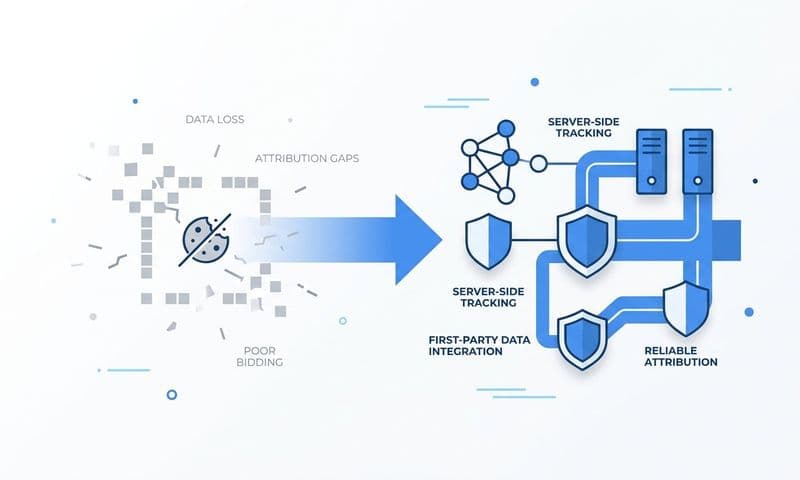
The problem is that browsers have increasingly stopped cooperating. Safari's Intelligent Tracking Prevention, Firefox's enhanced privacy protections, and ad blockers all interfere with client-side pixels. iOS App Tracking Transparency, introduced by Apple, further reduced the visibility advertisers have into mobile user behavior. The result is that pixel-based tracking alone now misses a meaningful portion of conversions, leaving ad platforms with incomplete data and marketers with inaccurate reporting.
UTM parameters offer a complementary layer of tracking. By appending UTM tags to your ad URLs (source, medium, campaign, content, and term), you can pass traffic source information into analytics tools like Google Analytics. This helps you understand which campaigns are driving website sessions and conversions at the channel level. If you want to go deeper, explore what UTM tracking is and how UTMs help your marketing. UTMs are useful, but they come with their own limitations. They rely on cookies to persist across sessions, which means they can break if a user clears cookies, switches devices, or converts in a different session than the one where they first clicked your ad.
Common UTM mistakes that silently break your data include inconsistent naming conventions (mixing "facebook" and "Facebook" as source values creates two separate entries in your analytics), missing UTMs on some ads but not others, and UTM parameters being stripped by landing page redirects. Any of these issues fragment your attribution data and make channel comparisons unreliable.
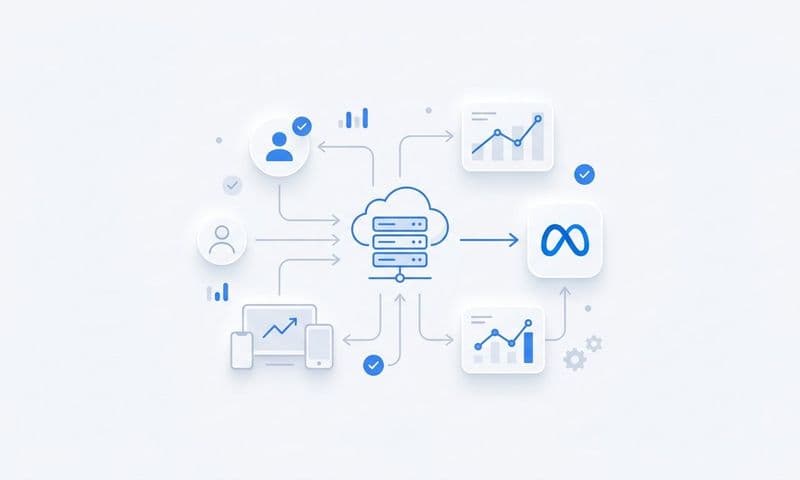
Server-side tracking has emerged as the most reliable solution for modern paid advertising. Instead of relying on a browser pixel to fire, server-side tracking sends conversion event data directly from your web server to ad platforms through their conversion APIs (like Meta's Conversions API or Google's Enhanced Conversions). Because the data travels server-to-server, it bypasses browser restrictions, ad blockers, and iOS limitations entirely.
The practical result is higher match rates between your conversion events and the users in the ad platform's system, better signal quality for the platform's machine learning algorithms, and more accurate reporting on your end. Server-side tracking does not replace client-side pixels entirely in most setups, but it fills the gaps that pixels increasingly leave behind.
For marketers serious about tracking paid advertising performance accurately, server-side tracking is no longer optional. It is a foundational part of a reliable data infrastructure.
Multi-Touch Attribution: Seeing the Full Customer Journey
Here is a scenario that plays out constantly in modern marketing: a potential customer sees a TikTok video ad on Monday, clicks a Google Search ad on Wednesday, receives a retargeting ad on Meta on Friday, and finally converts after clicking an email link on Saturday. Which channel gets credit for that conversion?
Under last-click attribution, the answer is email. Under first-click attribution, the answer is TikTok. Both answers are incomplete. Both lead to budget decisions that undervalue the channels that actually contributed to the sale.
Multi-touch attribution solves this by distributing credit across all the touchpoints that influenced a conversion. Instead of awarding 100% of the credit to one interaction, it acknowledges that the customer journey is rarely a straight line and that multiple channels often work together to drive a result. Choosing the right attribution tools for paid ads is critical for implementing this effectively.
The difference between attribution models matters enormously when you are making budget decisions. Last-click models systematically undervalue upper-funnel channels like awareness ads and branded content that introduce customers to your brand. First-click models undervalue the retargeting and conversion-focused campaigns that close the deal. Both create blind spots that lead to cutting the wrong channels or scaling the wrong ones.
Linear attribution distributes credit equally across all touchpoints. Time-decay attribution gives more credit to touchpoints closer to the conversion. Position-based (or U-shaped) attribution gives more weight to the first and last touchpoints while distributing the remainder across the middle. Data-driven attribution, available in more sophisticated tools, uses actual conversion data to determine which touchpoints have the most statistical influence.
The real power of multi-touch attribution comes from comparing models side by side. When you look at your TikTok campaigns through a last-click lens, they might look like underperformers. When you switch to a linear or time-decay model, you might discover they are consistently the first touchpoint in journeys that convert at high rates. Improving your TikTok ads tracking accuracy can reveal these hidden contributions that change how much budget you allocate to the platform.
As customer journeys grow more complex, spanning multiple devices, multiple sessions, and multiple platforms, single-touch attribution models become increasingly misleading. Multi-touch attribution is not just a reporting preference. It is a strategic necessity for any team managing spend across more than one channel.
Common Tracking Pitfalls That Drain Your Ad Budget
Even marketers who understand attribution theory often find their tracking setups quietly undermining their results. The issues are not always obvious, which makes them particularly costly.
Siloed platform reporting: Checking Meta Ads Manager, Google Ads, and TikTok Ads separately and never combining the data into a unified view is one of the most common tracking failures. When you evaluate each platform in isolation, you cannot see overlap, duplication, or the cross-channel patterns that reveal how your full funnel actually works. The ability to track ad performance across platforms in a single view is what separates informed decisions from guesswork.
Degraded ad platform algorithms: Meta and Google's ad delivery systems rely heavily on conversion signals to optimize targeting and bidding. When your conversion data is incomplete or delayed because of pixel failures or privacy restrictions, the algorithms are working with less information. This leads to higher costs per acquisition, worse audience targeting, and campaigns that plateau or decline in performance over time. Feeding accurate, enriched conversion data back to these platforms is not just good reporting hygiene; it directly affects how well your ads perform.
Broken tracking configurations: Misconfigured pixels, incorrect event mapping, and duplicate conversion events are silent killers of reporting accuracy. A pixel that fires twice on the same purchase event inflates your conversion count and makes your ROAS look better than it is. An event that is mapped to the wrong action (tracking page views as leads, for example) corrupts your CPL data entirely. Understanding why Facebook ads stop tracking conversions can help you diagnose and fix these issues before they compound.
Regularly auditing your tracking setup, checking for duplicate events, verifying that conversion values are passing correctly, and confirming that server-side and client-side events are deduplicated, is essential maintenance for any paid advertising program. The cost of ignoring it shows up in wasted budget and missed opportunities.
Building a Unified Tracking System That Scales
Once you understand what to measure, how to track it, and what can go wrong, the next step is assembling a tracking stack that brings everything together reliably and at scale.
A modern tracking infrastructure for paid advertising typically includes several connected components. Ad platform integrations pull spend, impression, and click data from Meta, Google, TikTok, LinkedIn, and other channels into a central location. A CRM connection links ad-driven leads and customers to actual sales outcomes, closing the loop between marketing activity and revenue. Server-side event capture ensures that conversion data reaches ad platforms accurately, even when browser-based tracking falls short. And a centralized attribution dashboard provides a single place to view cross-channel performance, compare attribution models, and identify where budget is working hardest.
The data flow matters as much as the tools themselves. Enriched conversion events, those that include customer identifiers, conversion values, and accurate timestamps, give ad platform algorithms the signal quality they need to optimize effectively. When you send better data to Meta and Google, their machine learning systems can find more of your best customers, bid more efficiently, and reduce wasted spend. Investing in the right solutions for optimizing paid advertising efforts is now considered a core best practice for maintaining strong paid ad performance.
This is exactly where a platform like Cometly becomes genuinely valuable. Cometly connects your ad platforms, CRM, and website data to track the entire customer journey in real time. It captures every touchpoint from ad click to CRM event, giving its AI a complete and enriched view of how customers move through your funnel. From that unified data foundation, Cometly surfaces AI-powered recommendations that identify which ads and campaigns are driving real revenue, so you can scale what works with confidence rather than guesswork.
Beyond reporting, Cometly feeds enriched, conversion-ready events back to Meta, Google, and other platforms, improving their targeting and optimization algorithms. The result is a compounding advantage: better data leads to better algorithmic performance, which leads to lower acquisition costs and stronger returns over time.
For teams managing campaigns across multiple channels, having all of this in one place eliminates the manual work of reconciling platform dashboards and gives everyone on the team a single source of truth for performance decisions.
Putting It All Together
Tracking paid advertising performance is not a reporting exercise. It is a revenue discipline. Every gap in your tracking, every siloed dashboard, every misconfigured pixel, and every over-reliance on vanity metrics translates directly into budget wasted on campaigns that do not deliver and opportunities missed because the data was not there to see them.
The path forward is clear: start with the metrics that connect to real business outcomes, build a tracking infrastructure that holds up under modern privacy constraints, use multi-touch attribution to understand the full customer journey, and unify everything into a single view that supports confident decisions at every level of the funnel.
When your tracking is accurate and your attribution is complete, you stop guessing and start scaling. You know which channels to invest in, which campaigns to cut, and which audiences are worth paying more to reach. That clarity is the competitive advantage that separates teams who grow efficiently from those who spend more to stay in place.
If you are ready to stop piecing together data from disconnected dashboards and start making decisions from a unified, accurate picture of your paid advertising performance, Cometly is built for exactly that. Get your free demo today and see how Cometly can connect every touchpoint across your campaigns, surface AI-driven recommendations, and give your team the clarity it needs to scale with confidence.