

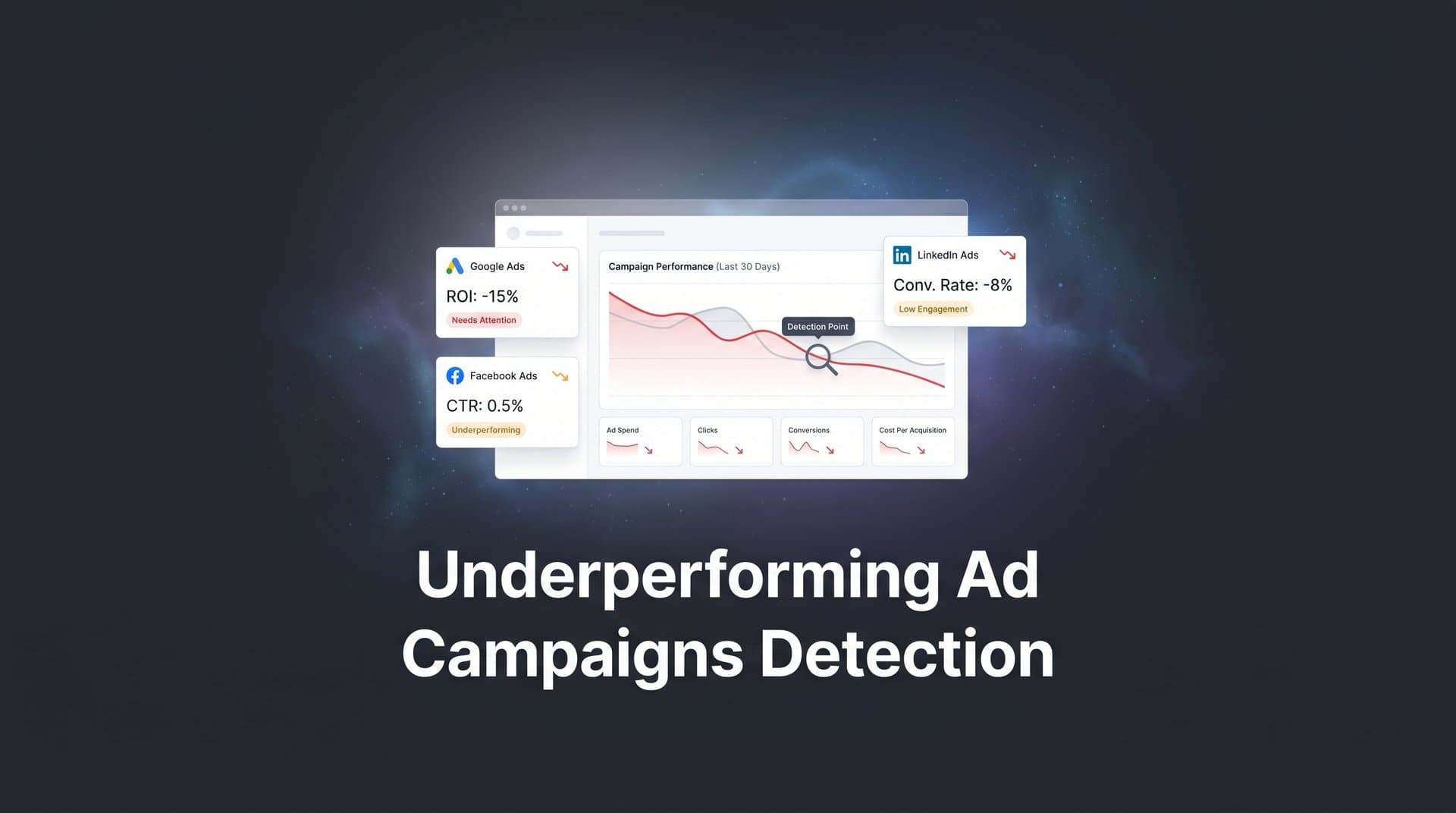
You launch a campaign with high hopes. The targeting looks solid, the creative tests well, and initial results seem promising. Three weeks later, you realize it has quietly consumed thousands of dollars while delivering a fraction of the conversions you expected. By the time you notice, the damage is done.
This scenario plays out in marketing accounts every single day. The difference between profitable growth and budget waste often comes down to detection speed. How quickly can you identify which campaigns are underperforming? How do you separate temporary fluctuations from genuine decline? And most importantly, how do you catch these issues before they drain significant resources?
The challenge is not just finding underperformers but building a systematic approach that catches them early. Platform dashboards show you metrics, but metrics alone do not tell you which campaigns deserve more budget and which need immediate shutdown. You need a framework that connects surface-level data to actual revenue, identifies warning signs before costs spiral, and gives you clear criteria for making fast decisions.
This guide walks you through a six-step framework for detecting underperforming ad campaigns across all your channels. You will learn how to set meaningful benchmarks that reflect your actual business context, connect your full customer journey data for accurate attribution, recognize early warning signs of decline, segment performance to find hidden problems, apply a consistent decision framework, and build monitoring systems that protect your budget ongoing.
Whether you manage campaigns across Meta, Google, TikTok, or multiple platforms simultaneously, this framework gives you a repeatable process for identifying underperformance fast and reallocating budget to what actually drives revenue.
Step 1: Establish Your Performance Benchmarks Before You Diagnose
You cannot identify underperformance without first defining what good performance looks like. This sounds obvious, yet many marketers skip this foundational step and rely on vague feelings or generic industry averages that have nothing to do with their specific business model.
Start by setting benchmarks that are contextual to your business. A cold prospecting campaign targeting new audiences will have different performance standards than a retargeting campaign aimed at people who already visited your pricing page. A top-of-funnel awareness campaign on TikTok should not be judged by the same conversion metrics as a bottom-funnel search campaign on Google.
Use your own historical data as the foundation. Pull performance data from your last 90 days of campaigns and segment it by channel, campaign objective, and funnel stage. Calculate the median cost per acquisition, return on ad spend, click-through rate, and conversion rate for each category. These become your baseline benchmarks.
For example, your historical data might show that Meta prospecting campaigns typically achieve a $45 CPA with a 1.2% conversion rate, while Google Search campaigns average a $62 CPA with a 3.8% conversion rate. Your retargeting campaigns might deliver a $28 CPA with a 4.5% conversion rate. These numbers reflect your actual business reality, not someone else's case study.
Create a simple benchmark document that lists these thresholds by campaign category. Include both efficiency metrics like CPA and ROAS, and engagement metrics like CTR and landing page conversion rate. This document becomes your reference point for every performance review.
Build in acceptable variance ranges. A campaign running 10% above your benchmark CPA might still be performing fine, especially if it is bringing in higher lifetime value customers. A campaign running 40% above your benchmark signals a real problem. Define these thresholds explicitly so you are not making subjective judgment calls every time you review performance.
Update your benchmarks quarterly as your account matures and market conditions change. What qualified as good performance six months ago might be mediocre today as you refine your targeting and creative approach. Your benchmarks should evolve with your expertise.
The key insight here is that underperformance is relative to your own standards, not arbitrary industry averages. A campaign that would be excellent for one business might be terrible for another. Build your detection system on your own data foundation, using analytics for paid campaigns to establish accurate baselines.
Step 2: Connect Your Full Customer Journey Data
Platform dashboards show you clicks, impressions, and conversions. What they do not show you is the complete path someone took before becoming a customer, or which touchpoints actually influenced the purchase decision. Relying solely on platform-reported metrics gives you an incomplete and often misleading picture of campaign performance.
The fundamental problem is attribution. When someone clicks your Meta ad, then later searches for your brand on Google, then converts through an email campaign, which channel gets credit? Under last-click attribution, the email gets all the credit. Under platform attribution, both Meta and Google might claim the conversion. Neither view shows you the full truth.
Connect your ad platforms, website tracking, and CRM data to see which campaigns actually drive revenue across the entire customer journey. This means implementing tracking that follows people from first ad exposure through conversion and beyond, regardless of which device they use or how many touchpoints they encounter along the way.
Server-side tracking becomes essential here because browser-based tracking misses a significant portion of conversions. iOS privacy changes, ad blockers, and cross-device behavior create blind spots that make campaigns appear less effective than they actually are. When your tracking only captures 60% of actual conversions, you will incorrectly label profitable campaigns as underperformers.
Multi-touch attribution shows you which campaigns contribute to conversions even when they are not the final click. A prospecting campaign might rarely get last-click credit but consistently introduces high-value customers who convert later through other channels. Without multi-touch visibility, you would cut this campaign thinking it underperforms when it actually plays a crucial role in your acquisition strategy. Learn more about attribution modeling for multi-channel campaigns to implement this effectively.
Set up conversion sync to feed accurate conversion data back to your ad platforms. When platforms like Meta and Google receive enriched conversion data that includes the full customer journey, their algorithms optimize more effectively. This creates a feedback loop where better data leads to better targeting, which leads to better performance.
The practical impact of connected data is dramatic. You might discover that a campaign you thought was underperforming based on platform metrics actually drives 30% more revenue when you account for multi-touch attribution and server-side tracked conversions. Or you might find that a campaign with strong platform-reported ROAS actually contributes far less revenue when you analyze true attributed value.
Detecting underperforming campaigns requires seeing the complete picture. Platform metrics are a starting point, not the full story. Build your detection system on connected, enriched data that shows you what actually drives revenue across every touchpoint.
Step 3: Identify the Early Warning Signs of Decline
Underperformance rarely happens overnight. Campaigns typically show warning signs days or weeks before costs spiral out of control. The marketers who protect their budgets most effectively are those who recognize these early indicators and act before problems compound.
Watch frequency metrics closely, especially on Meta and display campaigns. When the same people see your ad repeatedly without converting, frequency climbs and performance degrades. A frequency above 3.0 often signals creative fatigue or audience saturation. If your frequency is rising week over week while your conversion rate drops, your campaign is showing clear signs of decline.
Monitor cost per result trends rather than relying on snapshot data. A campaign might show an acceptable CPA today, but if that number has increased 15% over the past two weeks, you are watching underperformance develop in real time. Trend analysis catches problems that single-day snapshots miss.
Look for disconnects between engagement metrics and actual conversions. A campaign with strong CTR but weak conversion rate suggests a messaging mismatch. People are interested enough to click but not convinced enough to convert. This pattern indicates either wrong audience targeting or a gap between ad promise and landing page delivery.
Track your click-to-conversion time. If the average time between click and conversion starts extending significantly, it might signal that you are reaching less qualified audiences who need more convincing. This is not necessarily a problem for awareness campaigns, but for conversion-focused campaigns, it is an early warning sign.
Pay attention to placement performance within campaigns. A campaign might show acceptable overall metrics while specific placements like audience network or Stories dramatically underperform. Segment your data by placement to find these hidden underperformers that drag down your overall results.
Watch for declining quality scores on search campaigns. When Google lowers your quality score, your costs increase and your ad position drops. This creates a downward spiral where underperformance feeds on itself. Catching quality score drops early lets you address the underlying issues before costs escalate. Understanding why ad campaigns are not optimizing properly helps you intervene faster.
Set up a simple weekly check where you compare current week performance to the previous four-week average across these key metrics. This rhythm catches deteriorating performance within days rather than weeks, giving you time to intervene before significant budget waste occurs.
The goal is not to react to every small fluctuation but to recognize genuine patterns of decline. When multiple warning signs appear together, rising frequency plus declining CTR plus increasing CPA, you are looking at a campaign that needs immediate attention.
Step 4: Segment and Compare Campaign Performance
Aggregate campaign metrics hide problems. A campaign might show acceptable overall performance while specific audience segments, ad creatives, or placements severely underperform. Finding these hidden underperformers requires breaking down your data and comparing performance across multiple dimensions.
Start by segmenting performance by audience. A single campaign might target multiple audience segments with vastly different results. Your lookalike audience might convert at $40 CPA while your interest-based targeting delivers a $95 CPA. The blended number looks mediocre, but the reality is you have one strong performer and one clear underperformer.
Compare campaigns launched under similar conditions using cohort analysis for marketing campaigns. Look at all campaigns you launched in the same month, targeting similar objectives, and compare their performance curves. This shows you which campaigns are genuinely underperforming relative to their peers rather than just experiencing normal market fluctuations.
Analyze performance by creative format and messaging angle. You might discover that video ads dramatically outperform static images, or that benefit-focused messaging converts better than feature-focused messaging. These insights help you identify not just which campaigns underperform but why they underperform.
Break down results by day of week and time of day. Some campaigns might perform well Monday through Thursday but waste budget on weekends. Others might show strong performance during business hours but poor performance in the evening. Temporal segmentation reveals optimization opportunities that aggregate data obscures.
Compare platform-reported ROAS against actual revenue attribution at the campaign and ad set level. This is where connected customer journey data becomes essential. You might find campaigns where the platform claims a 3.5x ROAS but your actual attributed revenue shows only 1.8x. These discrepancies reveal underperformance that platform metrics alone would miss. If you struggle with this, explore solutions for when you can't attribute revenue to campaigns accurately.
Look at performance by device type. Mobile versus desktop performance can differ dramatically depending on your product and user experience. A campaign might show strong desktop performance but terrible mobile performance, or vice versa. Without device-level segmentation, you would not know where the problem lies.
Segment by geographic location when running campaigns across multiple regions. Some markets might deliver strong results while others consistently underperform. Rather than cutting the entire campaign, you can eliminate underperforming geos and concentrate budget on what works.
The key is moving beyond surface-level campaign metrics to understand performance at a granular level. Underperformers often hide within campaigns that look acceptable in aggregate. Systematic segmentation finds them.
Step 5: Apply the Diagnose or Cut Decision Framework
Once you identify an underperforming campaign, you face a critical decision: invest time trying to fix it or shut it down immediately and reallocate the budget? Making this call consistently requires a clear decision framework, not gut feelings.
Start with the time and spend threshold method. If a campaign has been running for less than one week or has spent less than three times your target CPA, it has not generated enough data for confident decisions. Give it more time unless performance is catastrophically bad. If a campaign has been running for three weeks and spent 10x your target CPA without hitting benchmarks, the data is clear. Shut it down.
Distinguish between fixable problems and structural issues. Creative fatigue is fixable by refreshing your ad creative. Wrong audience targeting is fixable by adjusting your audience parameters. But if you are targeting the right audience with strong creative and still seeing poor performance, you likely have a structural issue like wrong offer, wrong platform, or wrong campaign objective. Structural issues rarely improve with optimization.
Ask whether the campaign is underperforming on efficiency metrics, volume metrics, or both. A campaign with great CPA but low volume might just need more budget or broader targeting. A campaign with terrible CPA but high volume needs immediate attention because it is actively wasting money at scale. A campaign with both poor efficiency and low volume is a clear candidate for shutdown. Avoiding wasted ad spend on ineffective campaigns requires making these distinctions quickly.
Consider the optimization potential. If your segmentation analysis shows that 80% of the campaign budget goes to one underperforming placement or audience segment, you can likely salvage the campaign by eliminating that segment. If performance is weak across all segments, optimization will not save it.
Evaluate the strategic importance. Sometimes a campaign underperforms on direct response metrics but serves an important awareness or testing function. If you are testing a new market or audience that represents significant long-term opportunity, you might accept short-term underperformance to gather learning. Document this reasoning explicitly so you are not just making excuses for poor performance.
Create a simple decision matrix with four quadrants: strong performance continue and scale, acceptable performance continue and monitor, poor performance but fixable diagnose and optimize, poor performance and unfixable cut immediately. Place each underperforming campaign in the appropriate quadrant and take the corresponding action.
Document your decision rationale for every campaign you cut or optimize. This creates a knowledge base that improves your future campaign planning. You will start recognizing patterns in what works and what does not, making your initial campaign setup stronger over time.
The goal is making faster, more consistent decisions. Hesitation is expensive. Every day an underperforming campaign runs is wasted budget that could go toward your winners.
Step 6: Build an Ongoing Monitoring System
Detecting underperforming campaigns once is helpful. Building a system that detects them automatically and continuously is transformative. The difference between reactive and proactive campaign management comes down to your monitoring infrastructure.
Set up automated alerts that notify you when campaigns cross your performance thresholds. If a campaign's CPA exceeds your benchmark by 30%, you should receive an alert within 24 hours, not discover it during your weekly review. If frequency climbs above 3.5, you should know immediately. Automated alerts catch problems in real time.
Create a weekly review cadence that catches underperformers within days rather than weeks. Block 90 minutes every Monday morning to review campaign performance from the previous week. Compare current performance to your benchmarks, check for early warning signs, and make cut or optimize decisions. This rhythm prevents small problems from becoming expensive disasters.
Use AI-powered recommendations to surface optimization opportunities proactively. Modern attribution platforms analyze your campaign performance patterns and identify issues you might miss in manual review. They can spot declining performance trends, suggest budget reallocation opportunities, and flag campaigns that would benefit from creative refresh. Implementing predictive analytics for ad campaigns augments your manual review with machine intelligence.
Build performance dashboards that show your most important metrics at a glance. You should be able to open one screen and immediately see which campaigns are above benchmark, at benchmark, or below benchmark across your key metrics. A well-designed marketing dashboard for multiple campaigns speeds up decision-making dramatically.
Establish a feedback loop that improves your benchmarks over time. As you cut underperformers and scale winners, your overall account performance improves. Update your benchmarks quarterly to reflect this improvement. What qualified as good performance last quarter might be just acceptable performance this quarter as your standards rise.
Document your optimization actions and their results. When you refresh creative on a fatigued campaign, track whether performance rebounds and by how much. When you cut an underperforming audience segment, measure the impact on overall campaign efficiency. This documentation builds institutional knowledge that makes your entire team more effective.
Schedule monthly deep-dive reviews where you look beyond individual campaign performance to analyze patterns across your entire account. Are certain campaign types consistently underperforming? Do specific audience segments never hit benchmarks? Are there seasonal patterns you should anticipate? Monthly pattern analysis catches systemic issues that weekly reviews miss.
The monitoring system you build should require minimal ongoing effort while providing maximum protection. Automated alerts catch acute problems, weekly reviews maintain discipline, and monthly deep dives identify strategic opportunities. This layered approach ensures nothing slips through the cracks.
Turning Detection Into Discipline
Detecting underperforming ad campaigns is not a one-time audit but an ongoing discipline that separates profitable growth from budget waste. The marketers who scale successfully are not those who never launch underperforming campaigns but those who catch and correct them fastest.
By establishing clear benchmarks grounded in your own data, connecting your full customer journey for accurate attribution, watching for early warning signs before costs spiral, segmenting your analysis to find hidden problems, applying a consistent decision framework, and building monitoring systems that work automatically, you create a repeatable process that protects your budget and improves results over time.
Start with step one this week: document your current benchmarks by campaign type and channel. Pull your last 90 days of data, segment it by objective and funnel stage, and calculate your median performance metrics. This foundation makes everything else possible.
Then work through each subsequent step systematically. Connect your tracking to capture the full customer journey. Set up your early warning indicators. Build your segmentation analysis. Create your decision framework. Implement your monitoring system. Each step compounds the value of the previous ones.
The goal is not perfection but continuous improvement. Your first attempt at benchmarking will be imperfect. Your initial monitoring system will miss some issues. That is fine. The system improves as you use it, and even an imperfect detection system is infinitely better than no system at all.
Remember that every dollar you save by cutting an underperformer early is a dollar you can invest in your winning campaigns. The opportunity cost of letting underperformers run is not just the wasted spend but the missed opportunity to scale what actually works.
Ready to elevate your marketing game with precision and confidence? Discover how Cometly's AI-driven recommendations can transform your ad strategy. Get your free demo today and start capturing every touchpoint to maximize your conversions.


