

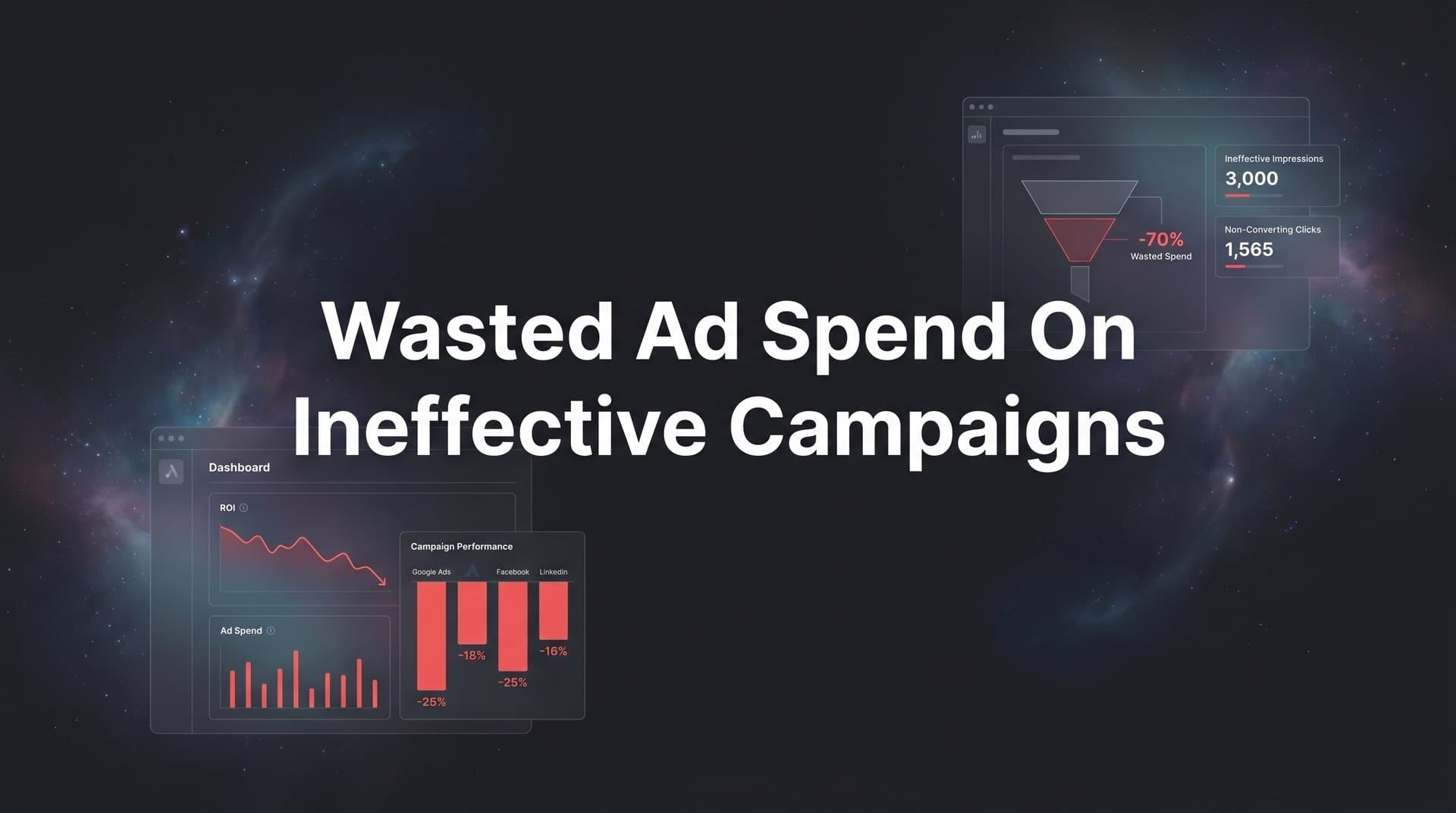
You just spent $15,000 on Facebook ads this month. The dashboard shows impressive numbers: 2.3 million impressions, 47,000 clicks, and a platform-reported ROAS of 4.2x. Your boss is happy. Your team is celebrating. Then you check your CRM.
Eight qualified leads. Three closed deals. Total revenue that barely covers half your ad spend.
This disconnect between what ad platforms tell you and what actually lands in your bank account is draining marketing budgets across every industry. The problem isn't just that some campaigns underperform. It's that most marketers can't tell which ones are actually working until thousands of dollars have already vanished into the void.
The culprit? A broken attribution system that gives credit to the wrong touchpoints, tracks incomplete customer journeys, and optimizes toward metrics that look good in reports but don't drive revenue. When you can't see which campaigns genuinely influence purchases, every budget decision becomes a gamble. You scale the wrong campaigns. You kill the ones that were actually working. And you watch your cost per acquisition climb while your actual conversions stagnate.
This guide will show you exactly how to identify where your budget is bleeding, why traditional tracking fails to catch these leaks, and what you need to build a system that connects ad spend to actual revenue. No more guessing. No more wasted budget on campaigns that generate clicks but not customers.
Why Marketing Budgets Vanish Without a Trace
The fundamental problem starts with a simple truth: ad platforms want to take credit for every conversion that happens after someone clicks their ads. It's in their business model to show you the best possible numbers, because better-looking results mean you'll spend more.
This creates what's known as the attribution gap. When someone clicks your Facebook ad, then your Google ad, then finds you through organic search before finally converting, all three platforms will claim they drove that sale. Facebook's dashboard shows it as a Facebook conversion. Google Ads reports it as theirs. Your analytics platform might credit organic search. The result? You're looking at 300% attribution when only 100% of the revenue actually exists.
But the disconnect between ad metrics and revenue outcomes runs deeper than just overlapping attribution claims. Ad platforms optimize for their own success metrics, not yours. Facebook cares about clicks and engagement because that's what keeps users on their platform. Google wants you to bid higher on keywords that drive traffic. Neither platform has complete visibility into what happens after someone leaves their ecosystem and enters yours.
Think about what your dashboards actually show you. Impressions tell you how many times your ad appeared. Clicks tell you how many people were curious enough to visit. Even conversions, as platforms define them, only tell you that someone completed an action on your website. None of these metrics answer the question that actually matters: did this campaign generate qualified leads that turned into revenue? Understanding wasted ad spend from poor attribution is the first step toward fixing this problem.
The gap between these vanity metrics and real business outcomes has always existed, but recent privacy changes have turned it into a canyon. When Apple introduced App Tracking Transparency with iOS 14.5, they gave users the power to opt out of cross-app tracking. The result was immediate and dramatic: Facebook lost visibility into a massive portion of conversions happening on iOS devices.
The deprecation of third-party cookies is having a similar effect on web-based tracking. Browser-based pixels that once tracked users across the internet are becoming less reliable every quarter. Safari and Firefox already block them by default. Chrome is phasing them out. The tracking infrastructure that marketers relied on for a decade is crumbling.
What this means in practice is that your ad platforms are making optimization decisions based on incomplete data. Facebook's algorithm thinks a campaign is performing well because it can see some conversions, but it's blind to the majority that happen outside its tracking window. You're scaling campaigns based on partial information, and the parts you can't see might tell a completely different story.
The platforms try to compensate with modeled conversions and statistical estimates, but these are educated guesses, not ground truth. When you're making budget decisions that affect thousands or millions of dollars, "probably close enough" isn't good enough. You need to know exactly which campaigns are driving revenue, which ones are stealing credit, and which ones are just burning money while generating meaningless engagement.
Red Flags That Signal Your Campaigns Are Bleeding Money
The first warning sign is the oldest trick in the book: campaigns that look amazing in your ad dashboard but somehow never translate to actual business results. You see a 5% click-through rate and think you've struck gold. Then you look at your sales pipeline and realize those clicks turned into tire-kickers, competitors doing research, or people who bounced after three seconds.
High engagement with low conversion quality is one of the most expensive traps in digital advertising. You're paying for every click, and clicks from unqualified traffic cost just as much as clicks from your ideal customers. When your targeting is too broad or your creative attracts the wrong audience, you end up with impressive traffic numbers and a sales team that can't close anyone. This is a classic case of ad spend wasted on the wrong audience.
The second red flag is more insidious: campaigns showing strong platform-reported ROAS that don't match your actual revenue data. Your Facebook Ads Manager says you're getting 6x return on ad spend. Your finance team is asking why marketing isn't hitting revenue targets. This discrepancy usually means the platform is claiming credit for conversions it didn't actually drive.
Here's how this happens in the real world. Someone sees your Facebook ad but doesn't click. Three days later, they Google your company name and convert through organic search. Facebook's view-through attribution window claims that conversion because the person saw the ad within the last seven days. Meanwhile, Google Analytics credits organic search. Your CRM just knows a lead came in. Nobody knows the truth, but Facebook is definitely overreporting its impact.
The third major red flag is audience overlap across your campaigns. You're running a prospecting campaign on Facebook, a retargeting campaign, and maybe some lookalike audiences. What you don't realize is that 40% of the people seeing your ads are being targeted by multiple campaigns simultaneously. You're essentially bidding against yourself, driving up costs while showing the same person the same message through three different campaigns.
This overlap waste compounds when you're running campaigns across multiple platforms. Someone might be in your Google retargeting audience, your Facebook Custom Audience, your LinkedIn matched audience, and your programmatic retargeting pool all at once. You're paying four different platforms to reach one person who already knows about you. That's not multi-channel marketing. That's just expensive.
Another critical warning sign is campaigns that drive conversions in the platform but those conversions never show up in your CRM as qualified leads. This happens when your tracking is set up to count any form submission as a conversion, regardless of quality. Someone downloads a piece of content, and Facebook counts it as a conversion. But that person never had purchase intent. They wanted free information and will never become a customer.
Watch for campaigns where your cost per conversion looks reasonable in the ad platform but your cost per qualified lead or cost per customer is astronomical. This gap reveals that you're optimizing toward the wrong conversion events. The platform is doing exactly what you told it to do, but what you told it to do doesn't actually align with your business goals.
The Hidden Cost of Decisions Based on Incomplete Data
When you scale a campaign based on flawed attribution, you don't just waste the new budget you allocate. You amplify the original problem. If a campaign is getting credit for conversions it didn't drive, increasing its budget by 3x won't triple those phantom results. It will triple your spend while your actual conversions stay flat or even decline.
This is how marketing budgets spiral out of control. You see what looks like a winning campaign, so you pour more money into it. The platform keeps reporting strong results because it's still claiming credit for conversions happening through other channels. Meanwhile, your actual revenue growth doesn't match your increased spend, but by the time you notice, you've burned through an extra $50,000. Learning how to reduce wasted ad spend before scaling is critical.
The compounding effect of optimizing toward vanity metrics instead of revenue creates a vicious cycle. When you tell Facebook to optimize for link clicks, it will find you the cheapest clicks possible. Those clicks might come from people who will never buy, but Facebook doesn't care. It's giving you exactly what you asked for. You're training the algorithm to get better and better at something that doesn't matter.
Every dollar you spend on an underperforming campaign carries an opportunity cost that most marketers never calculate. That $10,000 you wasted on a campaign with great CTR but terrible conversion quality could have been invested in the campaign that's actually driving your best customers. You're not just losing the money you spent poorly. You're losing the revenue you could have generated by spending it well.
Think about this in concrete terms. Let's say you have two campaigns. Campaign A shows a 4x ROAS in your ad platform but only drives 2x actual revenue when you track it to closed deals. Campaign B shows a 2.5x ROAS in the platform but drives 5x actual revenue because it attracts higher-value customers with better lifetime value. If you're making decisions based on platform data, you'll scale Campaign A and potentially kill Campaign B. You'll be moving money away from your best performer toward your worst.
The damage extends beyond individual campaigns. When your entire attribution system is broken, every strategic decision you make is built on a foundation of bad data. You might conclude that Facebook works better than Google when the opposite is true. You might think video ads outperform static images when the video ads are just better at stealing credit from other touchpoints. You might allocate your annual budget based on channel performance that doesn't reflect reality.
This creates organizational problems that go beyond wasted spend. Your team loses confidence in the data. Nobody trusts the numbers anymore, so decisions get made based on gut feeling or whoever argues loudest in the meeting. Your CEO asks why marketing spend is up 40% but revenue is only up 10%, and you don't have a good answer because you don't actually know which campaigns are working.
The worst part is that incomplete data doesn't just lead to bad decisions. It makes it impossible to learn from your mistakes. When a campaign fails, you can't figure out why because you don't have accurate data about what actually happened. Was the creative bad? The targeting? The offer? You're flying blind, so you can't improve. You just keep making the same expensive mistakes over and over.
Building a System to Track What Actually Converts
The solution starts with connecting the three critical pieces of your marketing infrastructure: your ad platforms, your website, and your CRM. Each of these systems holds part of the truth. Ad platforms know who clicked and when. Your website knows what happened during the visit. Your CRM knows which leads turned into revenue. The problem is that these systems don't talk to each other by default.
When you connect these data sources, you create a complete view of the customer journey from first touch to closed deal. Someone clicks your Facebook ad. Your tracking system captures that click along with all the campaign details: which ad, which audience, which creative. That person browses your site, fills out a form, and becomes a lead in your CRM. Your attribution system links that CRM record back to the original Facebook click. Two weeks later, they become a customer. Now you can definitively say that this specific Facebook campaign drove this specific revenue. This is how you attribute revenue to specific campaigns accurately.
This is where server-side tracking becomes essential. Browser-based tracking relies on cookies and pixels that run in the user's browser. These are increasingly blocked by privacy settings, ad blockers, and browser restrictions. When someone has tracking prevention enabled, your pixel might fire when they click your ad but fail to fire when they convert. The ad platform never sees the conversion, so it can't optimize properly.
Server-side tracking solves this by sending conversion data directly from your server to the ad platform's server. The user's browser settings don't matter because the data transmission happens entirely on the backend. When someone converts on your website, your server sends that conversion event to Facebook's Conversions API or Google's server-side tracking. The ad platform receives accurate conversion data even for users who have opted out of browser-based tracking.
But accurate tracking is only half the solution. You also need multi-touch attribution to understand which touchpoints genuinely influence purchases. Most ad platforms use last-click attribution by default, giving 100% of the credit to whatever the person clicked right before converting. This completely ignores the Facebook ad that introduced them to your brand, the YouTube video that educated them about your solution, and the retargeting campaign that kept you top of mind. Implementing attribution for multi-channel campaigns reveals the complete picture.
Multi-touch attribution models distribute credit across all the touchpoints in the customer journey. A first-touch model gives credit to whatever introduced the customer to your brand. A linear model splits credit evenly across all touchpoints. A time-decay model gives more credit to touchpoints closer to the conversion. Each model tells you something different about how your marketing works together to drive results.
The key is having the infrastructure to track every touchpoint accurately. When someone clicks your Facebook ad, that interaction needs to be recorded. When they come back through Google three days later, that needs to be tracked as a separate touchpoint but connected to the same customer journey. When they finally convert after clicking your email, you need to see all three interactions and understand how they worked together.
This level of tracking requires more than just installing a pixel on your website. You need a system that can capture UTM parameters from every traffic source, store them across multiple sessions, and tie them to individual customer records in your CRM. You need to track both anonymous website visitors and identified leads, then connect those two stages of the journey when someone converts from anonymous to known.
The technical implementation matters, but so does the data strategy. You need to establish consistent naming conventions for your campaigns so you can aggregate performance across similar initiatives. You need to decide which conversion events actually matter to your business and make sure those are the events you're tracking and optimizing toward. You need to set up your CRM to capture not just lead information but also revenue data, so you can track campaigns all the way to closed revenue, not just to lead generation.
Turning Attribution Insights Into Smarter Budget Allocation
Once you can see which campaigns actually drive revenue, the next step is acting on that information. Start by identifying your true top performers across all channels and campaigns. Don't just look at platform-reported ROAS. Look at which campaigns drive the highest quality leads, the best customer lifetime value, and the most actual revenue when you track all the way to closed deals.
You might discover that your top performer isn't the campaign with the most conversions or the lowest cost per click. It might be the campaign that drives fewer leads but those leads close at 3x the rate of everything else. Or the campaign that attracts customers who spend twice as much over their lifetime. These insights only become visible when you connect your attribution data to your revenue outcomes.
With this clarity, you can start reallocating budget from proven underperformers to campaigns with real revenue impact. This doesn't mean killing everything that isn't your top performer. It means being honest about which campaigns are actually working and which ones are just generating activity without outcomes. That campaign with the great CTR but terrible lead quality? Reduce its budget or kill it entirely. That campaign with modest clicks but excellent conversion rates? Give it more room to run. Proper marketing spend optimization requires this level of honesty.
The reallocation process should be gradual and test-driven. When you identify a winning campaign, don't immediately 10x the budget. Scale incrementally and watch whether performance holds as you increase spend. Some campaigns perform well at $1,000 per day but fall apart at $5,000 per day because you've exhausted the high-intent audience. Proper attribution helps you see when you're hitting those ceiling effects before you waste money pushing past them.
One of the most powerful applications of accurate attribution data is feeding it back to ad platform algorithms. When you send enriched conversion data to Facebook's Conversions API or Google's enhanced conversions, you're teaching their algorithms what a valuable conversion actually looks like for your business. The platforms can then optimize toward those outcomes instead of optimizing toward whatever conversions they can see through their limited tracking.
This creates a virtuous cycle. Better data leads to better algorithmic optimization. Better optimization leads to more efficient campaigns. More efficient campaigns generate better results, which gives you more data to feed back to the algorithms. Your cost per acquisition decreases while your conversion quality increases because the platforms are finally optimizing toward the right goal.
The key is sending the right conversion events with the right data enrichment. Don't just tell Facebook that a conversion happened. Tell them the conversion value, the customer's lifetime value prediction, the lead quality score from your CRM, and any other signals that help the algorithm understand which conversions matter most. The more context you provide, the better the platform can optimize.
This approach also helps you make smarter decisions about channel mix. When you can see true channel performance, you might discover that your budget allocation is completely backwards. Maybe you're spending 60% of your budget on Facebook because that's where you started, but your attribution data shows that Google actually drives better revenue at lower cost. Or that LinkedIn drives fewer conversions but those conversions close at twice the rate. Armed with this information, you can rebalance your channel mix based on actual performance, not historical inertia.
A Framework for Ongoing Optimization
Eliminating wasted spend isn't a one-time project. It's an ongoing discipline that requires regular review cycles to catch ineffective campaigns before they burn through significant budget. Establish a weekly or bi-weekly cadence where you review campaign performance not just in the ad platforms, but connected all the way through to revenue outcomes.
During these reviews, look for the warning signs we discussed earlier. Are there campaigns showing strong platform metrics but weak CRM results? Are there discrepancies between what different platforms are claiming credit for? Are there campaigns where cost per lead looks good but cost per customer is terrible? Catching these issues early means you're wasting hundreds instead of thousands. Implementing solid wasted ad spend identification strategies makes these reviews more effective.
This is where AI-powered recommendations become invaluable. Modern attribution platforms can analyze your performance data and surface optimization opportunities you might miss manually. The AI might notice that a specific audience segment is converting at 3x the rate of your average, suggesting you create a dedicated campaign for that segment. Or it might identify that campaigns using a specific ad creative are driving better revenue outcomes, even if their click-through rates are lower.
These AI recommendations work because they can process more data and identify more patterns than any human could manually. They can spot that your Tuesday campaigns outperform your Thursday campaigns, or that mobile traffic converts better in the evening while desktop traffic converts better during business hours. These micro-optimizations compound over time into significant performance improvements. Using predictive analytics for ad campaigns takes this even further.
The final piece of the framework is creating feedback loops between your attribution data and your campaign strategy. Don't just use attribution to evaluate what already happened. Use it to inform what you do next. If your data shows that customers who engage with three or more touchpoints before converting have 2x higher lifetime value, build campaigns specifically designed to create those multiple touchpoints. If you see that video content in the awareness stage leads to better conversion rates later, invest more in video even if it doesn't drive immediate conversions.
Document your learnings and make them accessible to your entire team. When you discover that a specific campaign approach works, turn that into a playbook that can be replicated. When you find something that doesn't work, make sure everyone knows to avoid it. Attribution insights are only valuable if they actually change how you run campaigns.
Build experimentation into your ongoing process. Reserve a portion of your budget for testing new channels, new audiences, and new creative approaches. Use your attribution system to measure these tests accurately, so you can identify new winners before your competitors do. The marketers who win aren't the ones who found the perfect campaign three years ago. They're the ones who continuously test, learn, and optimize based on what the data actually shows.
Taking Control of Your Marketing Budget
Wasted ad spend isn't an inevitable cost of doing digital marketing. It's a symptom of incomplete visibility into what actually drives revenue. When you can't see the full customer journey, when your tracking is unreliable, and when your attribution gives credit to the wrong touchpoints, every budget decision becomes a guess. Some of those guesses will be right. Most will be wrong. And you'll keep bleeding money into campaigns that generate activity but not outcomes.
The solution requires building proper infrastructure: connecting your ad platforms to your website to your CRM, implementing server-side tracking to capture accurate conversion data, and using multi-touch attribution to understand how your campaigns work together. This isn't optional anymore. Privacy changes and tracking restrictions have made browser-based tracking too unreliable to base serious budget decisions on.
But infrastructure alone isn't enough. You need to actually use the insights your attribution system provides. Identify your real top performers based on revenue, not vanity metrics. Reallocate budget away from campaigns that look good in dashboards but don't drive business results. Feed accurate conversion data back to ad platforms so their algorithms can optimize toward what actually matters. And establish ongoing review cycles to catch problems early and capitalize on opportunities quickly.
The marketers who master attribution don't just waste less money. They gain a competitive advantage that compounds over time. While their competitors are scaling campaigns based on flawed data, they're doubling down on what actually works. While others are optimizing toward clicks and impressions, they're optimizing toward revenue and customer lifetime value. The gap in performance grows wider every quarter.
Ready to elevate your marketing game with precision and confidence? Discover how Cometly's AI-driven recommendations can transform your ad strategy. Get your free demo today and start capturing every touchpoint to maximize your conversions.



