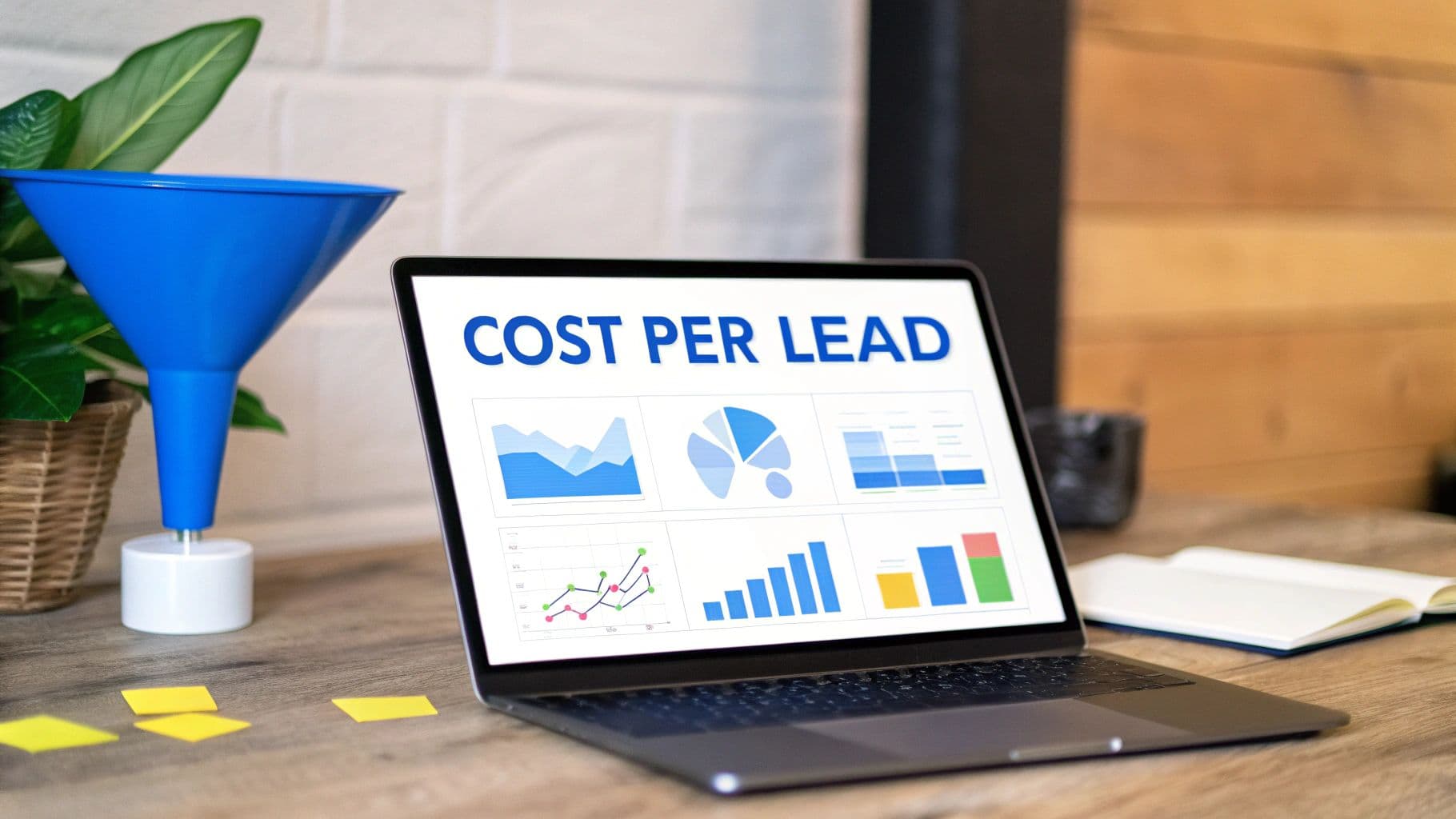
Cost Per Lead (CPL) is the exact price you pay to generate one new potential customer for your business. Think of it as the health monitor for your marketing budget—it tells you precisely how efficiently your dollars are attracting interested people.
A lower CPL means you're getting more leads for less money, which is exactly what you want for maximizing growth.
Decoding Your Marketing Price Tag
Imagine you're hosting an exclusive event to find your ideal customers. Your Cost Per Lead is simply the price of one ticket to that event.
If tickets are too expensive, you won't get enough people in the door. If they're priced just right, you fill the room with qualified prospects ready to hear what you have to say. That's what CPL helps you measure: the "ticket price" for every lead you generate.
This metric cuts through the noise. It gives you a clear, powerful number that connects your spending directly to results. It answers the fundamental question: "How much did it cost us to get that person to raise their hand and show interest?"
 Boost ROI: what is cost per lead and how to lower CPL
The Core CPL Formula
At its heart, the calculation is refreshingly simple. You just take your total investment in a campaign and divide it by the number of new leads you got from that effort.
CPL Formula: Total Marketing Spend / Total New Leads = Cost Per Lead
Let's quickly break down those two components:
- Total Marketing Spend: This is everything. It includes your ad spend on platforms like Meta or Google, agency fees, software subscriptions, and even the cost of creating the content or ads themselves.
- Total New Leads: This is the final count of everyone who showed interest by taking a specific action, like filling out a form, signing up for a webinar, or downloading a resource.
Why CPL Is a Critical Metric
Understanding your CPL is essential because it directly impacts your profitability and your ability to scale. While a low CPL is generally good, what really matters is the value that lead brings. For instance, a $200 lead that turns into a $5,000 customer is a fantastic investment.
Keeping a close eye on this metric is more important than ever. Competition in digital channels has driven lead costs up significantly. The average CPL roughly doubled from around $200 in 2017 to approximately $400 by 2023 across industries.
CPL is often discussed alongside another key metric, Cost Per Acquisition (CPA). While they're related, they measure different things. You can learn more about the differences in our guide on what is Cost Per Acquisition.
Ultimately, CPL provides the financial clarity needed to make smarter marketing decisions, ensuring every dollar you spend is working hard to grow your business.
To make things even clearer, let's break down the core concepts of CPL into a simple table. This will give you a quick reference for the key terms and their impact on your marketing strategy.
CPL Core Concepts at a Glance
Component | Plain English Meaning | Its Impact on Your Business |
|---|---|---|
Cost Per Lead (CPL) | The price you pay for one person to show interest in your business. | A direct measure of marketing efficiency. A lower CPL usually means a better return on your initial ad spend. |
Total Marketing Spend | All the money you put into a campaign including ads tools and people. | The input side of your CPL equation. To lower CPL you must reduce spend or generate more leads from the same spend. |
Total New Leads | The total number of people who took a specific action like submitting a form or signing up. | The output side of the equation. More high quality leads from the same spend lowers CPL and improves overall performance. |
This table helps put the pieces together. By understanding how each component works, you can start to pull the right levers to lower your CPL and improve your overall marketing performance.
How to Calculate Your Cost Per Lead Accurately
Knowing the Cost Per Lead (CPL) formula is one thing, but calculating it accurately is a completely different ballgame. To get a number that actually reflects what’s happening in your business, you have to be meticulous about what you include—and what you leave out.
Let's walk through how to do this right, so your CPL isn't just another vanity metric, but a real tool for growth.
The basic formula is our starting point: Total Marketing Spend / Total New Leads. The real work is in defining those two variables with total clarity.
 Boost ROI: what is cost per lead and how to lower CPL
Defining Your Total Marketing Spend
So, what costs should you actually count? Think of this like gathering all the ingredients for a recipe. If you miss one, the final dish just won't taste right. Your total marketing spend is so much more than what you pay for ads.
New to the concept? Start with our explainer on what is cost per share.
To calculate it correctly, make sure you include:
- Ad Spend: This is the most obvious one. It’s the total amount you spent on platforms like Google Ads, Meta Ads, or LinkedIn for a specific campaign or time period.
- Software and Tools: Did you use a special landing page builder, an email marketing platform, or analytics software for this campaign? A portion of those subscription costs should be attributed here.
- Creative and Content Costs: This includes fees for designers who created your ad visuals, copywriters who wrote the text, or videographers who produced a video ad.
- Agency or Freelancer Fees: If you outsourced any part of the campaign management, their fees are a direct cost of generating those leads.
Adding up all these components gives you a holistic view of your investment. Just using ad spend alone will give you an artificially low and misleading CPL.
Unpacking the Definition of a Lead
This is where a lot of businesses get their calculations wrong. Not all leads are created equal, and how you define a "lead" will dramatically change your CPL. The two most common types are Marketing Qualified Leads (MQLs) and Sales Qualified Leads (SQLs).
A Marketing Qualified Lead (MQL) is someone who has shown some initial interest, like downloading an ebook or signing up for a newsletter. An SQL (Sales Qualified Lead) is a lead that the sales team has vetted and confirmed has a genuine potential to become a customer.
Calculating CPL for both types gives you a much richer understanding of your funnel. You might have a super low CPL for MQLs, but if none of them ever convert to SQLs, you're just paying for unqualified interest.
Real World Calculation Examples
Let's put this into practice with a couple of common scenarios.
Example 1: A Simple Google Ads CampaignImagine you spent $2,000 on a Google Ads campaign to promote a webinar. This campaign generated 100 webinar sign-ups, which we'll count as MQLs.
If you're evaluating vendors, our AI video ad maker breakdown can help.
- Total Marketing Spend: $2,000
- Total New Leads (MQLs): 100
- CPL (MQL): $2,000 / 100 = $20 per MQL
Of course, getting these numbers right depends on accurate conversion tracking. Our guide on Google Ads conversion tracking can help you make sure your data is spot on.
Example 2: A Complex Multi-Channel LaunchNow for something a bit more complex. Let's say you spent $10,000 on a product launch. This included $7,000 on LinkedIn ads, $2,000 for a designer, and $1,000 for your marketing automation software. The launch generated 50 demo requests that your sales team qualified as SQLs.
- Total Marketing Spend: $7,000 + $2,000 + $1,000 = $10,000
- Total New Leads (SQLs): 50
- CPL (SQL): $10,000 / 50 = $200 per SQL
This distinction is crucial. In the B2B space, average sales leads might cost between $31 and $60, but this can vary wildly. Certain channels like LinkedIn can easily push CPL towards $100+, which could be perfectly acceptable for a high-value SQL.
When you calculate CPL accurately, with clear definitions for your costs and leads, a simple metric transforms into a strategic indicator of your marketing's true impact.
Understanding CPL Benchmarks Across Industries
Once you’ve calculated your Cost Per Lead (CPL), the next question is always the same: Is my CPL any good? Without context, your CPL is just a number floating on a spreadsheet. To turn it into a real strategic tool, you have to stack it up against industry and channel benchmarks.
This comparison is crucial. It tells you where you stand in the competitive arena—whether you're overpaying to get leads or running your campaigns with impressive efficiency. Most importantly, it helps you set realistic goals and pinpoint exactly where you can improve.
For a deeper dive, see our guide to pay per click campaign management.
Think of it like checking your car's fuel efficiency. Knowing you get 30 miles per gallon is fine, but finding out the average for your car model is 35 MPG tells you there’s room to get a tune-up or change your driving habits. CPL benchmarks give you that same vital context for your marketing.
Why CPL Varies So Drastically
You'll notice right away that there's no single "good" CPL. The numbers can swing wildly from one industry to another and from one marketing channel to the next. Several key factors drive these differences, and understanding them is vital for making a fair comparison.
These factors include:
- Customer Lifetime Value (LTV): Industries with a high LTV, like B2B SaaS or legal services, can easily justify a much higher CPL. A $650 CPL is a smart investment if that client is ultimately worth $50,000.
- Sales Cycle Length: Complex products with long sales cycles, common in IT and finance, demand more marketing touchpoints to nurture a lead from interest to purchase. This naturally drives up the cost of acquiring that lead.
- Market Competition: The more advertisers are fighting for the same audience, the higher the ad costs. This is why bidding on certain keywords on Google Ads or targeting specific job titles on LinkedIn can get very expensive, very fast.
- Audience Specificity: Reaching a niche audience, like C-suite executives in a specific industry, costs more than targeting a broad consumer base. That precision comes at a premium.
Channel and Industry CPL Benchmarks
So, what do some of these benchmarks actually look like? To give you a clearer picture, let's look at some real-world data. Just remember, these are averages—your own results will absolutely depend on the factors we just covered.
Recent analysis of Google Ads benchmarks, for example, showed a CPL of $53.52 in 2023. But that’s just the average. The legal services industry was way up at $111.05 per lead, while arts and entertainment was down at just $23.57.
The following table provides a clear baseline, breaking down the latest CPL benchmarks across major digital marketing channels and industries.
Average Cost Per Lead by Marketing Channel and Industry
Industry / Channel | Average CPL (Google Ads) | Average CPL (Meta Ads) | Average CPL (LinkedIn Ads) | Key Considerations |
|---|---|---|---|---|
Technology / SaaS | ~$150 | ~$110 | ~$310 | High LTV justifies higher spend on platforms like LinkedIn to reach decision-makers. |
E-commerce | ~$45 | ~$35 | N/A | Focus is on lower-cost, high-volume channels like Meta Ads for impulse purchases. |
Healthcare | ~$120 | ~$90 | ~$250 | Trust and compliance matter heavily; targeting is often narrow and regulated. |
Financial Services | ~$160 | ~$100 | ~$461 | High-value clients and long sales cycles justify significant investment per lead. |
Legal Services | ~$111 | ~$85 | ~$650 | Extremely competitive markets with very high client value drive the highest CPLs. |
Use this table to see where your own CPL fits in, but remember that these are starting points, not final verdicts on your performance.
Remember: These numbers are not absolute rules. They are directional guides to help you ask the right questions about your own performance.
Using Benchmarks to Your Advantage
Don't get discouraged if your CPL is higher than the average. Instead, use these numbers as a launchpad for a deeper investigation.
For instance, a high CPL on a platform like LinkedIn isn't necessarily a bad thing if it's generating highly qualified leads that convert into customers at a much better rate. To see how this plays out, you can gain more insights by exploring our dedicated guide on LinkedIn ad benchmarks.
Ultimately, benchmarks transform your CPL from a simple data point into a strategic compass. They guide you toward the channels that offer the best value for your specific industry and help you set ambitious—yet achievable—goals for your marketing engine.
The True Cost of a High CPL
A high Cost Per Lead (CPL) is more than just an expensive number on a dashboard. It’s a warning light, signaling deeper issues that can quietly sabotage your business from the inside out. When you ignore it, you’re not just overspending on ads—you're actively putting a ceiling on your company's growth potential.
When your CPL is inflated, every dollar of your marketing budget has less impact. That inefficiency directly eats away at your profit margins, making each new customer more expensive to acquire. It creates a frustrating cycle where you have to spend more and more just to stand still.
The Profitability Problem
Think of your business as a bucket you're trying to fill with water (profit). A high CPL is like a giant hole in the bottom of that bucket. No matter how much water (revenue) you pour in, a huge portion leaks out before you can accumulate anything meaningful.
This constant financial drain has some serious consequences:
- Shrinking Margins: The more it costs to get a lead, the less profit you make from the eventual sale, assuming your prices don't change.
- Stalled Growth: With less profit to reinvest, your ability to scale operations, develop new products, or expand into new markets is severely limited.
- Reduced Competitiveness: Meanwhile, competitors with a lower CPL can afford to be more aggressive with their marketing, capturing market share while you struggle to keep pace.
A consistently high CPL is often a symptom of a fundamental mismatch in your strategy. It might mean you're targeting the wrong audience, your messaging isn't landing, or your landing page experience is scaring potential customers away. It forces you to spend more just to overcome these underlying weaknesses.
CPL’s Direct Link to Your Scalability
To really grasp the danger, you have to connect CPL to two of the most critical metrics for long-term health: Customer Acquisition Cost (CAC) and Customer Lifetime Value (LTV).
Key Insight: Your Cost Per Lead is the primary driver of your Customer Acquisition Cost. While CPL measures the cost of getting an interested prospect, CAC measures the total cost to turn that prospect into a paying customer.
Let's do some simple math. If it costs you $50 to get a lead (your CPL) and you convert 1 out of every 10 leads into a customer, your CAC is $500. But if your CPL doubles to $100, your CAC skyrockets to $1,000. This shows just how fast an out-of-control CPL can make acquiring new customers unsustainably expensive.
The ultimate goal is to maintain a healthy ratio between a customer's lifetime value (LTV) and the cost to acquire them (CAC). A healthy business model typically sees an LTV that is at least 3x its CAC. When a high CPL inflates your CAC, it throws this entire model out of balance, threatening your profitability and your very ability to scale.
So, a high CPL isn’t just a marketing problem—it's a business viability problem. It’s a clear signal that your customer acquisition engine is inefficient, putting a hard cap on how fast and how profitably you can grow.
Actionable Strategies for Lowering Your CPL
Knowing your Cost Per Lead (CPL) is the first step. Getting it under control is where the real work begins.
Lowering your CPL isn’t about slashing your budget. It’s about making every dollar you spend work harder and smarter. This means tackling three key areas at once: refining your ad campaigns, optimizing your landing pages, and improving the quality of the leads you’re bringing in.
Think of it like tuning a high-performance engine. You can't just focus on the fuel; you also need to check the spark plugs and the exhaust. By making small, strategic adjustments across your entire lead generation process, you can drive your CPL down and see massive gains in efficiency.
Refine Your Ad Campaigns
The most direct way to impact your CPL is by optimizing the very ads that bring people to your door. This is your front line. Even minor tweaks here can prevent wasted spend and attract a much more relevant audience right from the start.
- Sharpen Your Targeting: Are you really reaching the right people? Go beyond basic demographics. Dig into psychographics, behaviors, and intent signals. Use exclusion lists to filter out irrelevant audiences so your ads are only shown to those most likely to convert.
- A/B Test Your Creative and Copy: Never assume you know what works best. You have to be constantly testing different headlines, images, calls-to-action (CTAs), and ad formats. A small lift in click-through rate from a more compelling ad can have a huge downstream effect on your CPL.
- Optimize Your Bidding Strategy: Don't just set it and forget it. Make sure your bidding strategy aligns with your actual campaign goals. If you're focused on generating leads, use bid strategies optimized for conversions, not just clicks or impressions. This tells the ad platform exactly what you want it to do for you.
Boost Your Landing Page Conversion Rates
Once a potential lead clicks your ad, the journey is only half over. Your landing page is where the conversion happens, and it’s often the leakiest part of the entire marketing funnel. A poorly optimized page will send your CPL through the roof, because you’re paying for clicks that never turn into leads.
Key Takeaway: A landing page that converts at 4% instead of 2% effectively cuts your CPL in half without you having to spend a single extra dollar on ads.
Here’s how to plug those leaks and turn more of your visitors into actual leads:
- Improve Page Load Speed: Every second counts. Seriously. If your page takes too long to load, visitors will bail before they even see your offer. Compress your images, minimize code, and use fast hosting to ensure a snappy user experience.
- Strengthen Your Call-to-Action (CTA): Your CTA should be impossible to miss and completely clear. Use action-oriented language (e.g., "Get Your Free Demo" instead of "Submit") and make sure the button stands out visually from the rest of the page.
- Ensure Message Match: The promise you make in your ad must be reflected on your landing page. If a user clicks an ad for a "free ebook" and lands on a page about a "product demo," they'll feel misled and bounce immediately. Consistency is key.
Fixing these elements is a core part of building a high-performing marketing funnel. For a deeper dive, you can explore more advanced conversion optimisation strategies to really dial in your approach.
Improve Your Lead Quality and Processes
Finally, lowering CPL isn't just about getting more leads—it's about getting better leads, more efficiently. A streamlined process ensures that your marketing and sales efforts are perfectly aligned, which cuts down on wasted time and resources spent on prospects who were never a good fit in the first place.
Optimizing your internal workflows can significantly reduce the costs tied to generating new leads. A great place to start is by implementing robust process improvement strategies to streamline operations and boost efficiency. This includes using things like lead scoring to prioritize the most promising prospects, which allows your sales team to focus their energy where it matters most.
You can also use clear qualification questions in your forms. Asking about company size, job role, or specific challenges helps filter out unqualified leads automatically. This simple step ensures that the leads entering your pipeline are much higher quality, making your overall marketing spend far more effective and driving down the true cost of acquiring a valuable new customer.
Eliminating CPL Blind Spots with Accurate Attribution
A high Cost Per Lead is often just a symptom of what you can’t see. Too many marketers are forced to make critical budget decisions using incomplete or flat-out misleading data, creating expensive blind spots in their strategy. This usually happens because their analytics platforms are still stuck on outdated attribution models.
The most common culprit? Last-click attribution.
This old-school model gives 100% of the credit for a new lead to the very last thing a person did before converting. For example, a customer might first see your brand in a Meta ad, read a blog post a week later, and finally sign up after clicking a Google search ad.
In a last-click world, Google Ads gets all the glory. This creates a dangerously flawed picture of what’s actually working.
The Problem with Last-Click Thinking
When your reports only show that final touchpoint, it’s easy to mistakenly conclude that your Meta ads and content marketing are duds. The logical next step seems simple: cut the budget for those "underperforming" channels.
But in reality, you’d be cutting off the very channels that started the customer journey in the first place. You’re yanking the spark plugs out but blaming the steering wheel when the car won’t start. This misinterpretation is a direct path to a higher CPL because you stop funding the top-of-funnel activities that generate real interest.
Key Insight: Relying on last-click attribution is like giving a salesperson full commission for a deal only if they got the final signature, completely ignoring the months of work the marketing team did to build the relationship.
The key is to think holistically about your lead generation strategy, from targeting all the way through conversion.
 Boost ROI: what is cost per lead and how to lower CPL
As you can see, a winning CPL strategy is a balancing act between precise targeting, a smooth conversion process, and a relentless focus on lead quality.
Gaining Clarity with a Unified View
To kill these blind spots for good, you need to see the entire customer journey from start to finish. This is where modern attribution solutions come in. By using multi-touch attribution models and solid server-side tracking, you can finally connect every single touchpoint.
A unified dashboard reveals the true performance of every ad and campaign, showing you which channels are introducing new leads and which ones are helping close them.
With this complete picture, you can finally understand the true value of each channel. You can learn more about the different models and their impact in our complete guide to marketing attribution. This level of insight empowers you to make data-backed decisions, stop wasting money on the wrong channels, and allocate your budget with confidence to truly lower your Cost Per Lead.
Frequently Asked Questions About CPL
Even when you've got the basics down, a few common questions always pop up when it's time to actually put Cost Per Lead to work. Let's run through the most frequent ones to clear up any confusion and help you use this metric with more confidence.
What Is the Difference Between CPL and CPC?
While both are key advertising metrics, they measure completely different actions and represent different stages of your funnel. It's an easy mix-up, but the distinction is crucial.
- Cost Per Click (CPC): This is simply the price you pay every single time someone clicks your ad. It doesn't matter what they do next. CPC only tells you the cost of getting traffic to your website or landing page.
- Cost Per Lead (CPL): This measures the cost to get an actual lead—someone who took a specific action you wanted, like filling out a form. It's focused on conversion, not just clicks.
Think of it this way: CPC is the cost to get someone to knock on your door. CPL is the cost to get them to step inside and give you their contact info.
How Do Different Lead Types Affect My CPL Calculation?
How you define a "lead" will dramatically change your CPL. It's not a one-size-fits-all term.
A broad definition, like a newsletter signup (Marketing Qualified Lead or MQL), will almost always give you a lower CPL. Why? Because it’s a lot easier (and cheaper) to convince someone to give you their email in exchange for free content.
On the other hand, a more qualified lead, like someone requesting a demo (Sales Qualified Lead or SQL), will have a much higher CPL. You're targeting people with serious purchase intent, which is a far more competitive and expensive audience to reach. Calculating CPL for both MQLs and SQLs is the only way to get a true picture of your funnel's health.
A low MQL cost is great for building an audience, but a sustainable SQL cost is what directly drives revenue and proves marketing's bottom-line impact.
How Do I Set a Realistic CPL Budget?
Setting a CPL budget for a new campaign can feel like a shot in the dark, but you can definitely make an educated guess. The trick is to work backward from your ultimate goal.
Start by figuring out the lifetime value (LTV) of a new customer and what your target Customer Acquisition Cost (CAC) is.
From there, you just need to estimate your lead-to-customer conversion rate. For example, if your target CAC is $1,000 and you know that you convert 1 in 10 leads into a paying customer, then your absolute maximum CPL should be $100.
To make sure you're actually tracking this accurately and not flying blind, understanding effective marketing ROI measurement is non-negotiable. This approach gives you a data-driven starting point for your budget instead of just a guess.
Ready to eliminate the guesswork and see exactly what’s driving your leads? Cometly provides crystal-clear attribution, so you can stop wasting ad spend and invest in what truly works. See how Cometly can lower your CPL today.