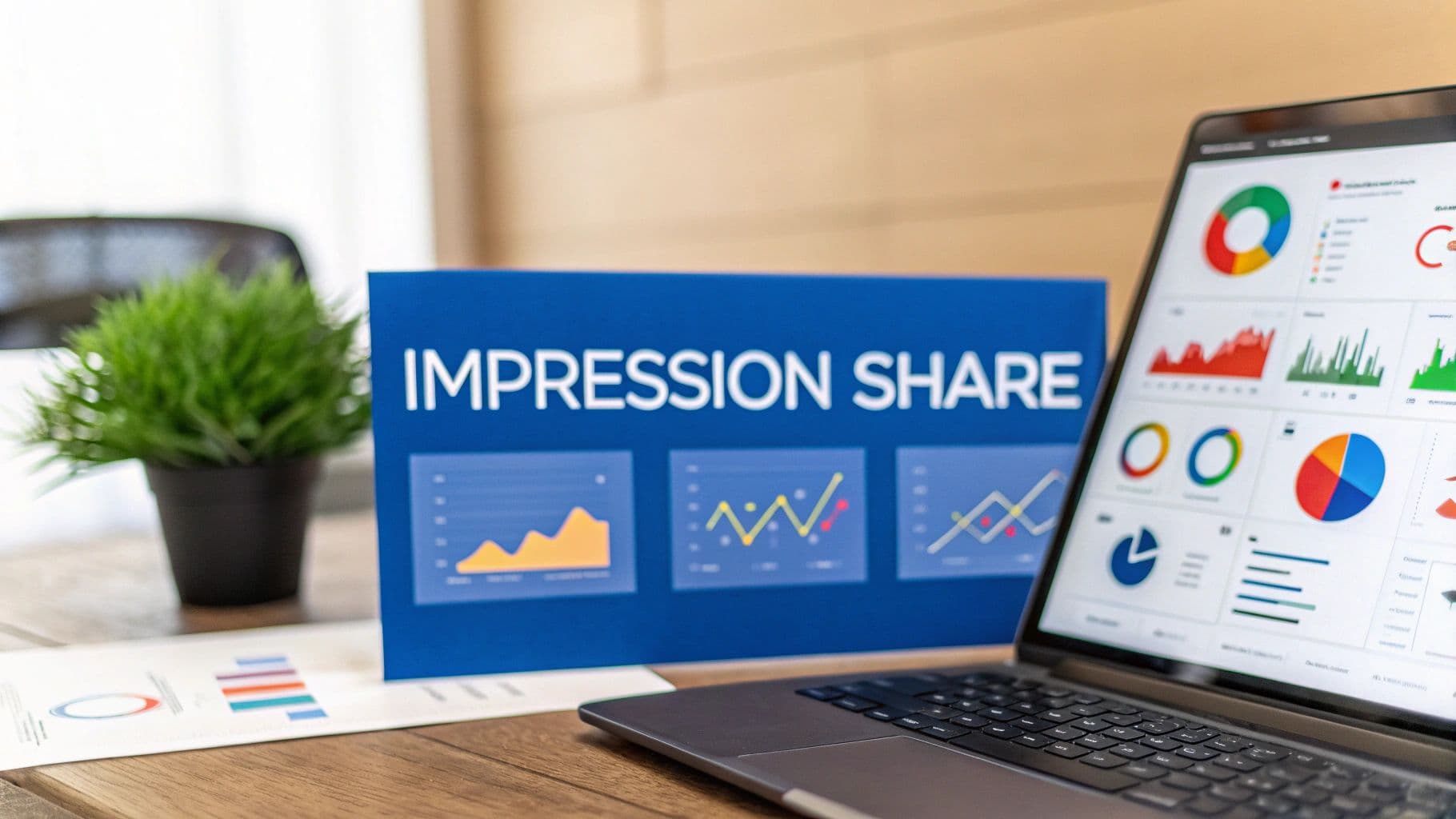
Impression share tells you the percentage of time your ads actually appeared versus the total number of times they could have appeared. It’s a direct measure of your visibility in the market—in other words, how much of the available ad space you’re actually capturing.
Understanding Your Ad Campaign Visibility
Think of your ad campaigns like a stall at a massive farmer's market. All the shoppers passing through the market represent the total potential impressions your ads could get.
Your impression share is the percentage of those shoppers who actually walk past your specific stall. It’s a critical health check for your ad performance.
If you have a 70% impression share, it means you’re visible to 7 out of every 10 potential customers. But it also means your competitors are snatching up the other three. This isn't just about vanity; it's a measure of missed opportunity. A low impression share is a clear signal that you're leaving a big chunk of the market untapped, letting competitors engage with customers you never even had a chance to reach.
Getting a handle on this metric is the first step toward smart, profitable growth.
The Simple Formula Behind It All
At its core, the calculation is pretty straightforward. Impression share is a critical metric that shows how much of the available ad space your campaigns are winning. It's calculated by dividing the impressions your ads received by the total impressions they were eligible for.
For example, if your ad gets 800 impressions out of a possible 1,000, you’ve got an 80% impression share. For many campaigns, that’s a solid number to aim for.
Impression Share = (Your Total Impressions / Total Eligible Impressions) x 100
This formula highlights a crucial distinction that many marketers miss. It’s not just about how many times your ads were seen, but how that number stacks up against what was possible.
An impression just tells you your ad was displayed. Impression share tells you how often you won the auction for that ad spot in the first place. If you want to dig deeper, you can learn more about the key differences between an impression vs a click in our detailed guide.
To break it down even further, here’s a quick reference table.
Impression Share At a Glance
This table sums up the core concepts to give you a quick, at-a-glance understanding of how impression share works and why it’s so important for advertisers.
An impression is one single instance of your ad being shown to someone on a page or screen. It’s the most basic unit of visibility, and it matters because without impressions, nothing else can happen. No clicks, no leads, no sales.
Eligible impressions represent the total number of times your ad could have been shown based on your targeting, budget, and auction eligibility. This matters because it reflects your true market opportunity. If eligible impressions are high but your actual impressions are low, you’re leaving reach and potential conversions on the table.
Impression share % is the percentage of eligible impressions that you actually won and received. It matters because it shows how much of the available market you’re capturing. A low impression share usually means you’re being limited by budget, bid strategy, or competition, while a high impression share means you’re dominating visibility in that segment.
Understanding these components is key. It shifts your focus from just counting impressions to strategically capturing more of your available market.
Diagnosing Your Lost Impression Share
So, your impression share isn't 100%. Those missed opportunities didn't just disappear into thin air. They went somewhere, and your ad platform gives you the tools to figure out exactly where. Think of it like a doctor diagnosing an illness—you can't write the right prescription until you know the cause.
Every single impression you don't win falls into one of two buckets: budget or rank. Pinpointing which one is the culprit is the most critical first step you can take. Trying to fix a rank problem by throwing more money at it is like trying to fix a leaky pipe by cranking up the water pressure—it gets expensive fast and usually makes the problem worse.
This decision tree shows the path every potential impression takes. It either ends with your ad being shown or it gets lost to a competitor.
 What Is Impression Share and How to Maximize It
As you can see, any impression you don't capture is considered "not shown." This is the visibility gap you need to close.
Lost Impression Share Due to Budget
Losing impressions to budget is the most straightforward problem to diagnose. It’s like a popular food truck running out of ingredients halfway through the lunch rush. Your daily ad spend gets used up before the day is over, and your ads are forced to go dark while potential customers are still out there searching.
The metric for this is Impression Share Lost (Budget). It tells you the exact percentage of time your ads didn't show for the simple reason that your funds ran out. If you see a high number here, it’s a clear signal that your campaigns have more demand than your budget can handle.
Lost Impression Share Due to Rank
On the other hand, losing impressions to rank is a bit more complex. This happens when your budget is perfectly fine, but your ads just aren't competitive enough to win the auction. Think of it as having a stall in a bad spot at a busy market; you’ve got plenty of product, but nobody sees you because of your poor location.
The Impression Share Lost (Rank) metric shows you the percentage of impressions you missed because of a low Ad Rank. This is a combination of your bid and your ad quality. A high number here points to issues with your bidding strategy, ad relevance, or even your landing page experience. For a deeper dive, you can learn more about what search impression share is in search ads.
To really get to the bottom of these issues, you need to think like a director of marketing who manages multiple channels and keeps a close eye on key performance metrics for online channels.
Data consistently shows that rank is often the bigger hurdle. In a study of over 500,000 campaigns, a whopping 52% of lost impressions were due to poor ad rank, while only 28% were because of budget limits. This is exactly why smart teams are constantly reallocating their ad spend to their best-performing assets.
Actionable Strategies to Recapture Lost Impressions
Knowing why you're losing visibility is the first step, but the real gains come from what you do next. Whether your ads are vanishing because your budget is tapped out or because your ad rank is too low, there are concrete strategies you can use to get back in the game and win more impressions.
Think of it like running a food truck. If you're constantly running out of ingredients (your budget), you need to manage your inventory better. But if your truck is stuck in a terrible location where no one sees it (your rank), you need to make it more appealing and move it. Two different problems, two different solutions.
 What Is Impression Share and How to Maximize It
Fixing Impression Share Lost to Budget
When your campaigns are consistently showing a high Impression Share Lost (Budget), your job is to make every dollar work harder. You don't always need a bigger budget—sometimes, you just need a smarter one.
Here are a few targeted tactics to try:
- Leverage Ad Scheduling: Don't burn money running ads 24/7 if your customers only convert during business hours. Dig into your conversion data to find peak performance times and schedule your ads to run only when they’re most likely to drive results. This focuses your spend where it has the most impact.
- Reallocate Funds: Not all campaigns are created equal. Be ruthless. Pause or slash spending on your duds—the low-performing campaigns and ad groups—and funnel that budget directly to your proven winners.
- Use Shared Budgets: Instead of micromanaging daily budgets for every campaign, group them under a shared budget. This lets the ad platform automatically send money to the campaigns with the most opportunities, so your high-potential ads don't go dark while others sit on unspent cash.
Chasing a high impression share isn't just about being seen; it's about driving performance. A higher impression share almost always correlates with better business outcomes, with top-tier accounts seeing massively higher conversion volumes.
Fixing Impression Share Lost to Rank
If Impression Share Lost (Rank) is your problem, simply throwing more money at it won't work. This issue is all about your ad's competitiveness, which comes down to your Ad Rank—a mix of your bid, ad quality, and landing page experience.
To boost your Ad Rank and start winning more auctions, focus here:
- Enhance Ad Quality: Your ad's relevance is everything. Sharpen your ad copy to align perfectly with your target keywords and what the user is actually searching for. A higher Quality Score tells the platform your ad is a great match, which can lower your costs and boost your rank.
- Optimize Your Landing Page: The user experience doesn't stop at the click. Make sure your landing page is mobile-friendly, loads fast, and delivers exactly what your ad promised. A clunky, irrelevant page will kill your Ad Rank.
- Implement a Smarter Bidding Strategy: Don't just bid higher; bid smarter. Get aggressive with bids on your most valuable, high-converting keywords where you can afford to compete. For keywords with poor conversion rates, pull back your bids to save your budget for what works.
These efforts absolutely pay off. Data from over 50,000 accounts reveals that while the average search impression share is 72%, top performers hit 88%. Those top accounts often see 35% higher conversion volumes in competitive markets. You can explore more benchmarks about impression share on DashThis.
The table below breaks down the two main reasons you lose impression share and gives you a clear game plan for fixing each one.
Fixing Impression Share Loss From Budget vs Rank
When you’re lost to budget, it means your daily budget is simply too low for the amount of demand and opportunities available. The fix is to increase your daily budget so you can stay in the auction longer, use ad scheduling to concentrate spend during peak hours, or reallocate budget away from weaker campaigns into the ones producing the best results.
You can also be lost to budget because your spend is being wasted on low-converting keywords, ad groups, or campaigns. In this case, the solution is to pause or cut the non-performers and shift that budget into proven winners. Using shared budgets can also help Google allocate spend more efficiently across campaigns without you constantly micromanaging it.
When you’re lost to rank, one of the most common causes is that your Quality Score is too low. This usually happens when your ads don’t feel tightly connected to the search intent. To fix it, improve ad relevance by tightening your keyword-to-ad-group structure, writing more specific ad copy, and increasing expected click-through rate with stronger, more aligned messaging.
Another reason you can be lost to rank is a poor landing page experience. Even if your ad is solid, Google can reduce your ability to compete if the page is slow, confusing, or doesn’t match what the ad promised. The fix is to improve page load speed, make the page fully mobile-friendly, and ensure the headline, offer, and content directly match the intent and promise of the ad.
Finally, you can be lost to rank because your bids aren’t competitive enough to win top placements. This is common in high-competition auctions where strong advertisers are aggressively bidding for position. To fix it, raise bids on your best-performing keywords, consider switching to a smart bidding strategy, and use automated bidding when it can help you compete more efficiently at scale.
By systematically tackling the root cause of your lost impressions—whether it’s the size of your wallet or the quality of your ad—you can elevate your performance and capture a much larger slice of your target market.
For a deeper dive into more advanced techniques, check out our guide on 30 tips to improve ad performance.
How Cometly Reveals Your True Ad Performance
A high impression share feels great. It means you’re showing up, winning auctions, and getting seen. But visibility alone doesn’t pay the bills. The real question is, does that increased visibility actually translate into more money?
Ad platforms are great at telling you how often you appear, but they can’t connect that visibility directly to your bottom line. Answering "what is impression share" is just the first step—the real work starts when you tie it to profitability.
This is exactly where Cometly closes the gap. It links your ad performance directly to sales revenue, shifting the conversation from "how many people saw our ad?" to "how much profit did those views actually generate?"
 What Is Impression Share and How to Maximize It
From Visibility Metrics to Revenue Facts
Let's say you decide to ramp up your ad spend and manage to boost your search impression share by 15%. Your ad platform dashboard lights up with more views and clicks, which looks like a solid win. But did that extra spend actually lead to more sales, or did it just attract window shoppers who drove up your costs?
Cometly’s advanced attribution technology gives you the real answer. It tracks every single touchpoint in the customer journey, from the first ad they see to the final purchase they make. This lets you see with total certainty whether a higher impression share is fueling profitable growth or just burning through your budget.
By connecting ad spend to actual sales data, you can finally determine your true return on ad spend (ROAS). This clarity is essential for making smart decisions about where to scale your budget and where to pull back.
The platform delivers this clarity using reliable server-side tracking and one-click conversion sync, so you can trust the data you're seeing. No more guessing games about performance; you get the facts. Diving into platforms like Cometly allows you to leverage advanced analytics in advertising to measure, manage, and sharpen your campaign performance.
Make Data-Driven Decisions with AI
Knowing why you’re losing impression share—whether it’s due to budget or rank—is critical. Cometly's powerful Ads Manager uses AI-driven insights to help you tackle these root causes head-on. It doesn't just identify the problem; it guides your strategy toward the most profitable solution.
For instance, the platform might analyze which of your high-impression-share campaigns are also driving the most revenue. It could recommend shifting your budget away from a campaign with a 90% impression share but low sales, and toward one with a 60% impression share that consistently brings in high-value customers.
This level of insight completely changes your approach. You can confidently adjust your bidding strategies, refine your targeting, and allocate your budget to maximize not just your visibility, but your overall profitability. Every dollar you spend starts working as hard as possible.
Connecting Impression Share to Business Growth
Getting the highest possible visibility is a nice idea, but it's not the real goal. The endgame isn’t just hitting a 100% impression share; it’s about owning the most profitable slice of the market. This shifts your whole perspective from just being seen to being seen by the right people, right when they're ready to buy.
The path to smarter advertising follows a pretty straightforward, logical flow. First, you have to get a handle on what your impression share actually is. Then, you dig in and figure out what’s holding you back—is it your budget, or is your ad rank just not cutting it?
Once you’ve nailed down the root cause, you can start rolling out targeted strategies to claw back that lost territory.
Turning Visibility Into Profitability
This brings us to the final, most important step: making sure all that hard-won visibility actually turns into cash. This is where you have to look beyond the platform metrics and connect your ad performance directly to your bottom line.
A tool like Cometly is essential here. It gives you the attribution data you need to prove that a higher impression share is driving real sales, not just feeding vanity metrics that look good in a report.
By focusing on profitable visibility, you move from guessing about ad performance to building a strategy backed by hard data. It’s how you start to truly dominate your market and drive sustainable growth.
Ultimately, this whole process is about tying every dollar you spend on ads directly to business results. And to really master that connection, you first need to know how to accurately calculate return on ad spend—the bedrock of any winning ad strategy.
Frequently Asked Questions About Impression Share
Even after you get the hang of what impression share is, a few specific questions always seem to pop up. Let's run through the most common ones so you can put this metric to work with confidence.
What Is a Good Impression Share to Aim For?
There’s no magic number here. The right target really depends on your goals and, more importantly, the kind of keywords you're bidding on.
But as a general rule, a good benchmark usually falls into one of two buckets:
- Branded Keywords: When people are searching for your company by name, you want to own that space. Aim for 95% or higher. Don't let a competitor sneak in and steal that click.
- Non-Branded Keywords: For more competitive, general terms, hitting an impression share between 70-80% is considered really strong. You're showing up for the vast majority of relevant searches without breaking the bank.
Ultimately, your goal is to find the sweet spot—that perfect balance where you're capturing the most high-intent traffic without overpaying and watching your returns diminish.
Should I Always Aim for 100% Impression Share?
Not at all. In fact, chasing that last 10-20% of impression share can get incredibly expensive and might completely wreck your return on ad spend (ROAS).
Reaching for 100% often requires you to make extremely aggressive bids that just aren't profitable. A smarter strategy is to focus on maximizing your profitable impression share—the point where you have high visibility among audiences most likely to convert, without overspending.
Use your attribution data to see if those higher bids are actually leading to more profit. If they’re not, you’ve found your ideal stopping point.
How Do I Check My Impression Share?
You can find this data right inside your ad platform’s reporting dashboard. The process is simple and gives you a complete picture of where you stand.
In Google Ads, just follow these quick steps:
- Navigate to your Campaigns or Ad groups view.
- Click the Columns icon, then select Modify columns.
- Head over to the Competitive Metrics section.
- Add the columns for Search impression share, Search lost IS (budget), and Search lost IS (rank).
This setup will give you all the diagnostic data you need to start optimizing your campaigns for better visibility and, ultimately, better performance.
Ready to connect your ad visibility to actual revenue? Cometly provides the advanced attribution you need to see which campaigns are truly driving growth, helping you optimize your impression share for maximum profitability. Learn more about how Cometly can transform your ad performance.