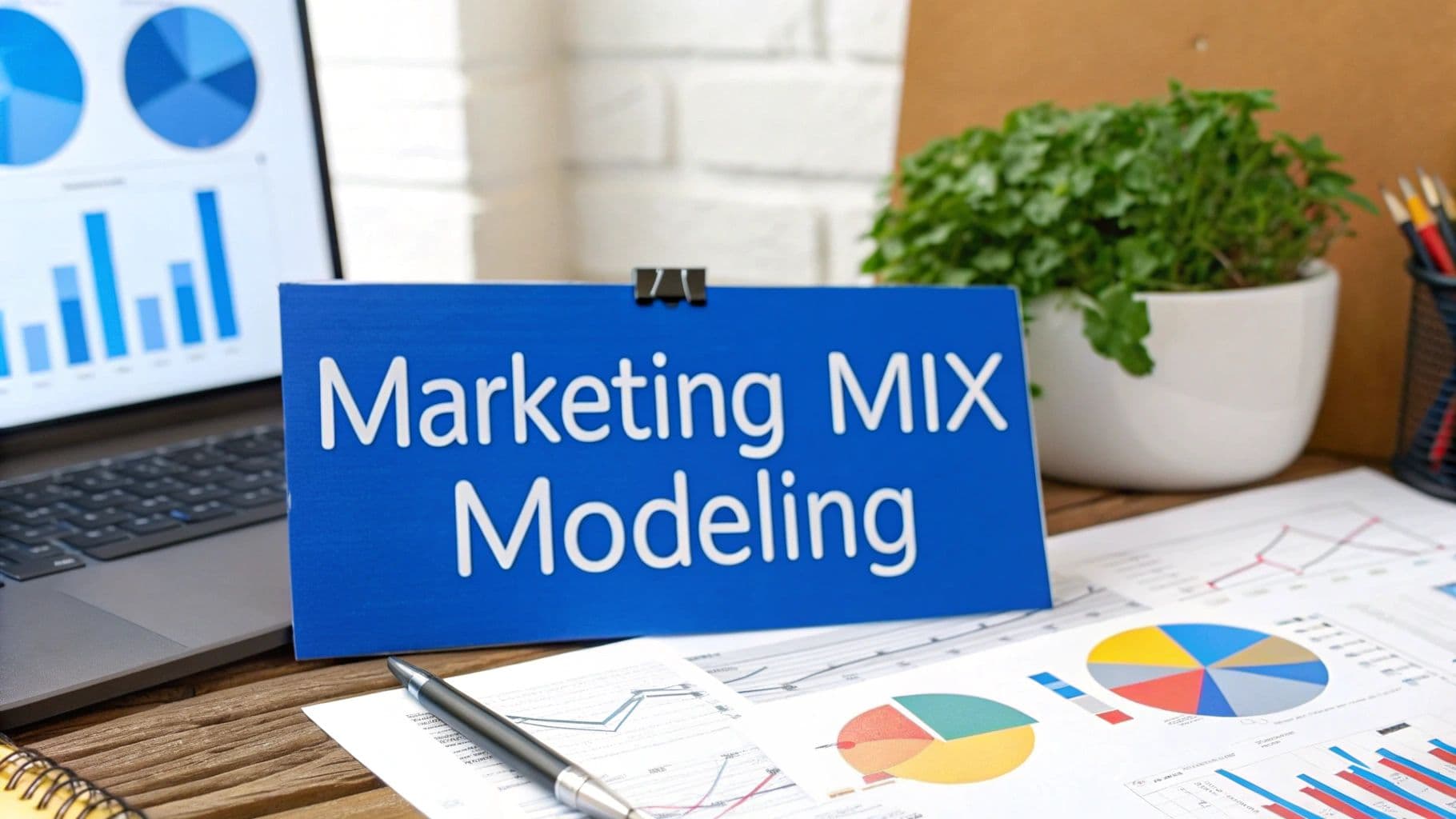
Let's cut right to it: Marketing Mix Modeling (MMM) is a way for marketers to figure out how all their different efforts—both marketing and non-marketing—actually contribute to sales. It’s a privacy-friendly statistical method that digs into historical data to show you the real impact of everything from your TV ads and social campaigns to price changes and seasonal sales.
Decoding Your Marketing Recipe
 What Is Marketing Mix Modeling A Complete Guide
Think about your marketing strategy like a recipe for growing your business. All your channels—social media, paid search, print ads, influencer collabs—are the ingredients. But other things get tossed into the mix too, like promotions, pricing shifts, and what your competitors are up to.
Marketing mix modeling is like the master chef who knows exactly how much each ingredient adds to the final dish: your revenue.
Instead of tracking individual users, MMM takes a big-picture, top-down look at your entire business. It crunches historical data, usually 2-3 years' worth, to connect the dots between your actions and your results. For instance, it can tell you how a $100,000 bump in YouTube ad spend affected store traffic last quarter, even while factoring in a price discount and a competitor's big launch.
To help you get a quick handle on the basics, here’s a simple breakdown of what makes up a marketing mix model.
Marketing Mix Modeling At a Glance
ComponentDescriptionObjectiveTo quantify how marketing and other factors impact sales or KPIs.Data ScopeAggregated, historical time-series data (e.g., weekly or monthly).Data TypesAd spend, impressions, promotions, pricing, economic trends, seasonality.MethodologyStatistical analysis (e.g., regression) to find correlations.Key OutputROI by channel, contribution to sales, and budget optimization scenarios.PrivacyHigh privacy compliance, as it doesn't use individual user data.
This table shows how MMM provides a strategic, durable way to measure performance without getting bogged down in user-level tracking.
What MMM Aims to Achieve
The main goal here is to give you a strategic, holistic view of performance. It goes way beyond simple clicks to answer the big, meaty questions you need for long-term planning. MMM is a key part of the broader world of understanding revenue attribution, as it works to pin a real number on how each marketing channel affects the bottom line.
- Strategic Budget Allocation: It shows you which channels are giving you the best return on investment (ROI), so you can move money from underperformers to the channels that are actually driving growth.
- Performance Forecasting: Once you know how things worked in the past, you can build models to predict future sales based on different budget plans.
- Holistic Measurement: It captures the impact of everything, including hard-to-track offline channels like TV, radio, and print ads.
This makes it an incredible partner to the more granular, user-level analysis you might already be doing. For a deeper look at different measurement approaches, check out our guide on what is marketing attribution.
At its core, MMM helps you answer the ultimate marketing question: "If I invest another dollar, where should it go to generate the maximum return?"
By analyzing data in aggregate, MMM provides a future-proof, privacy-first measurement solution. As cookies vanish and user tracking gets tougher, its ability to deliver insights without personal data makes it an indispensable tool for any modern marketer focused on sustainable growth and confident decisions.
The Building Blocks of a Powerful MMM
 What Is Marketing Mix Modeling A Complete Guide
Any marketing mix model is only as smart as the data it learns from. Think of it like a recipe: if you use low-quality ingredients, you’ll get a disappointing result. To build a powerful model that actually gives you trustworthy insights, you need to feed it a rich and varied diet of information.
This data really falls into three core categories, and each one provides a crucial piece of the puzzle.
First up, you have your marketing and promotional activities. This is everything you actively control to drive growth—a complete record of every lever you've pulled. It usually includes things like weekly or monthly ad spend and impression volumes for each channel you’re running.
Next, the model needs your sales and outcome data. This is what you're trying to influence, the "what happened" part of the equation that directly reflects your business performance.
Finally, a truly robust MMM has to account for external factors. These are the forces completely outside your control that can still mess with your sales, like a competitor's massive flash sale or a sudden economic downturn. If you ignore them, you might credit a campaign for a sales lift that was actually driven by something else entirely.
Core Data Inputs for Your Model
A good model pulls in variables from all corners of your business. The whole point is to create a complete picture of everything that could possibly be driving your sales.
Here’s a quick breakdown of what that usually looks like:
- Marketing Data: This is the big one. We're talking granular details on ad spend, impressions, clicks, and reach for channels like paid search, social media, TV, radio, and even print.
- Sales Data: This is your main outcome metric, usually revenue or the raw number of conversions. It’s critical that this data is timed to match your marketing data (e.g., weekly sales for weekly spend).
- External & Contextual Data: This stuff provides the "why" behind the numbers. It can include competitor ad spend, major industry events, economic indicators like consumer confidence, your own promotional calendars, and even weather patterns if you're, say, an ice cream shop.
Honestly, just gathering and cleaning up all this information is often the most time-consuming part of the whole process. To get a handle on it, checking out some data integration best practices can give you a clear roadmap for building a reliable data pipeline.
Understanding Adstock: The Lingering Effect of Ads
Once the data is in place, the model has to account for how marketing actually works. One of the most important concepts here is adstock, which deals with the delayed impact of your ads.
Imagine shouting into a canyon. Your voice doesn't just stop the second you do; an echo bounces around for a bit. Adstock is the marketing version of that echo. An ad someone sees today might not lead to a purchase until next week, and its brand-building effect can linger for much longer.
Adstock quantifies the carryover effect of advertising, ensuring the model gives credit to past campaigns for their ongoing influence on current sales.
Without accounting for adstock, you'd be assuming an ad's impact is immediate and then gone forever. This would totally undervalue channels that build brand awareness over time (like TV or content) and over-credit channels that capture immediate action (like branded search).
Modeling Diminishing Returns
Another critical concept is diminishing returns. We all know this one intuitively: the effectiveness of your advertising goes down as you spend more. That first dollar you spend is often the most powerful, but the millionth dollar? It's going to deliver a much smaller return.
Think about watering a plant. The first few drops are vital for growth. But after a certain point, more water doesn't help—it might even drown the plant. Marketing spend is the same way. Your first ads hit the most receptive people, but as you scale, you start reaching less interested audiences, and your cost to acquire each new customer goes up.
A smart MMM builds this curve right into its logic, showing you the exact point where pumping more money into a channel stops being efficient. It helps you find that "sweet spot" for your budget, preventing wasted spend and maximizing your overall ROI.
By understanding these building blocks—the data, adstock, and diminishing returns—you can start to see how an MMM translates a pile of raw numbers into a strategic map for growth.
How Marketing Mix Models Uncover Insights
 What Is Marketing Mix Modeling A Complete Guide
Think of a marketing mix model as a powerful decoder for your business. It takes a messy history of marketing activities, sales numbers, and random external events, then translates it all into a clear story about what actually drives growth. This isn't about guesswork; it's about using sophisticated statistical engines to find the real relationships between your actions and your outcomes.
At its core, MMM is all about separating the overlapping signals to figure out how much each marketing channel truly contributed to your bottom line. To pull this off, it relies on proven statistical techniques that have gotten much smarter over the years.
Traditional Regression: The Original Formula
The classic approach to marketing mix modeling is multiple regression analysis. The easiest way to think about this is creating a custom mathematical formula for your business. The model takes your main goal—like weekly sales revenue—and tries to explain it using all the different "ingredients" you've fed it.
These ingredients include your ad spend on various channels, the timing of promotions, and outside factors like competitor spending or holidays. The regression process sifts through all your historical data to figure out the weight, or importance, of each ingredient. The result is a formula that might look something like this:
Sales = (Coefficient A * TV Spend) + (Coefficient B * Social Media Spend) + Baseline Sales
This method has been the industry standard for decades because it’s great for spotting broad correlations. But it has its limits. It can be a bit rigid, treating the relationships between spend and sales as fixed and struggling to capture the nuances of today's complex marketing world.
Bayesian Methods: The Modern Standard
More recently, the field has shifted toward Bayesian modeling, a much more flexible and intelligent approach. This method has quickly become the new gold standard, powering open-source models like Google's Meridian.
Instead of a rigid formula, picture a Bayesian model as an intelligent system that can incorporate existing knowledge. It starts with a "prior belief"—an initial assumption about how a channel should perform based on industry benchmarks or past experiments. It then updates that belief as it chews through your actual data.
This approach offers two huge advantages over the old-school methods.
- Probabilistic Outputs: Instead of spitting out a single, absolute number for ROI, a Bayesian model provides a range of probable outcomes. It might tell you there's a 90% probability that your true ROI for a channel is between $3.00 and $4.50. This gives you a much clearer sense of risk and uncertainty.
- Incorporating Expertise: It allows data scientists to bake in the results from other measurement techniques, like lift studies, directly into the model. This makes the final output more accurate and grounded in real-world experiments.
A Bayesian MMM doesn't just tell you what happened; it tells you how confident you should be in the results, empowering you to make decisions with a clear understanding of potential outcomes.
Comparing MMM Modeling Approaches
Choosing the right statistical engine is a critical step in building a useful marketing mix model. Each method has its own strengths and is suited for different business needs and data maturity levels. A deeper understanding of how to measure advertising effectiveness can help frame which approach will deliver the most valuable insights for your specific goals.
Here’s a head-to-head comparison of the two main approaches.
Comparing MMM Modeling Approaches
Ultimately, the goal of any modeling approach is to move beyond surface-level metrics and uncover the true drivers of your business. While traditional regression laid the groundwork, modern Bayesian methods provide the nuance and probabilistic insights needed to navigate today's marketing complexities with far greater confidence.
An MMM isn't just a fancy report filled with complex charts; it's a strategic roadmap. The real magic isn't in the analysis itself, but in how you turn its findings into smarter, more profitable decisions for your business. This is where the rubber meets the road.
The most immediate and powerful way to use an MMM is for strategic budget allocation. The model gives you a clear, unbiased breakdown of each channel's return on investment (ROI) and its overall contribution to sales. You can finally stop guessing and start making data-backed moves with your marketing dollars.
For instance, if your model shows that YouTube ads are pulling in an ROI of $4.50 for every dollar spent, while another display network is only bringing back $1.20, the next step is pretty clear. You can confidently shift budget from the underperformer to your high-impact channel, maximizing your total return without spending a penny more.
Optimizing Your Marketing Spend
This goes way beyond just moving money around. A solid MMM also pinpoints the law of diminishing returns for each channel, helping you dial in your spending for peak efficiency. It answers the tough questions that keep marketing teams up at night:
- How much is too much? The model can flag a channel's saturation point, showing you precisely where more investment stops delivering meaningful returns.
- Where is the hidden potential? On the flip side, it might uncover an underfunded channel with a high potential ROI that could handle a lot more budget.
- What's the perfect mix? By understanding how different channels play off each other, you can build a more synergistic budget that makes every single dollar work harder.
For marketers looking to really nail this, our guide on marketing spend optimization dives deeper into turning these insights into a structured financial plan. It’s all about making sure your budget is always pulling its weight.
Forecasting the Future with Scenario Planning
Beyond tweaking your current budget, marketing mix modeling gives you a powerful forecasting tool. This happens through scenario planning, which is basically a way to ask your model sophisticated "what if" questions about what's next.
Instead of launching a new budget and just hoping it works, you can simulate different investment strategies to see their likely outcomes. Your marketing plan goes from being a reactive document to a proactive, data-driven forecast.
Scenario planning transforms marketing from an art of intuition into a science of prediction. It allows you to explore potential futures and choose the one with the highest probability of success.
For example, a business leader might ask, "What happens to Q4 sales if we slash our TV budget by 30% and pump that money into influencer marketing and paid search?" The model can run that simulation based on historical performance data and give you a forecasted impact on overall revenue.
This capability is invaluable for building a winning game plan. The insights from an MMM are crucial for shaping and refining an effective market strategy for all your campaigns.
Common Scenarios to Model
Here are a few common business challenges that scenario planning can help you navigate before you commit a single dollar:
- Budget Cut Simulations: If you're told to reduce your marketing spend by 15%, the model can show you which combination of cuts will have the smallest negative impact on sales.
- Growth Investment Planning: If you get an extra $500,000 in funding, you can simulate how to best allocate it across different channels to drive the most incremental growth.
- New Channel Exploration: The model can help estimate the potential impact of launching a new channel by using proxy data or industry benchmarks as inputs.
By running these kinds of simulations, you can de-risk major decisions, justify budget requests with hard data, and perfectly align your marketing activities with high-level business goals. It's how modern marketers build confident, resilient strategies that just plain work.
A Practical Framework for Implementing MMM
Jumping into marketing mix modeling can feel like a massive undertaking, but it’s a journey that shifts your entire measurement strategy from just looking backward to confidently predicting the future. So, where do you start? The key is breaking it down into a structured, step-by-step process. A solid framework turns what seems like a complex data science project into a clear roadmap for making smarter decisions.
The best way to tackle it is in three distinct phases. Each one builds on the last, making sure your final model isn't just statistically sound but actually plugs into your real-world strategic planning. Think of it like building a house: you need a solid foundation before you can put up the walls, and you need walls before you can furnish the rooms.
Phase 1: Data Collection and Governance
This first phase is the bedrock of your entire MMM project, and honestly, it’s where most of the heavy lifting happens. There’s an old saying in data science that couldn't be more true here: garbage in, garbage out. If your model is built on messy, incomplete, or just plain wrong data, you'll get unreliable insights that lead to bad decisions. It’s that simple.
Your main goal here is to pull together at least two to three years of clean, consistent, and aggregated historical data. Why so much? You need enough history to see the patterns, to account for seasonality, and to understand long-term trends. All of this information has to be meticulously organized and checked before you even think about building a model. For a structured way to handle this, you can learn how to set up a datalake for marketing attribution, which gives you a great blueprint for centralizing your data.
Here are the key steps in this phase:
- Identifying Variables: Make a master list of everything that could possibly drive sales. This includes marketing spend, impressions, promotions, price changes, and even external factors like what your competitors are doing or broader economic trends.
- Data Aggregation: This is the gathering stage. You'll be pulling data from dozens of different places—ad platforms, analytics tools, internal sales records, you name it.
- Cleaning and Harmonization: Now you make it all play nice together. Standardize your naming conventions, carefully fill in any missing values, and make sure every single data point lines up on the same timeline (e.g., weekly).
Phase 2: Model Building and Validation
Once you have a clean, organized dataset, you can move on to the exciting part: actually building the statistical model. This is where data science really meets marketing strategy. Your job is to pick the right modeling technique—maybe a classic regression model or a more modern Bayesian approach—and train it to accurately map the relationship between all your inputs and your sales outcomes.
But building it isn't enough. You have to validate it. This is a non-negotiable step. You need to rigorously test your model's accuracy to make sure it's a trustworthy reflection of reality. A popular way to do this is to use a "holdout" period, where you test the model's predictions against a chunk of historical data it’s never seen before. If the model can accurately "predict the past," you can feel a lot more confident about its ability to forecast the future.
A well-validated model does more than just fit the data; it proves its predictive power. This critical step separates a useful strategic tool from a mere academic exercise.
Phase 3: Insight Activation and Decision Making
This final phase is where the rubber meets the road. It’s all about turning your model's outputs into real, tangible business actions. A brilliant MMM is worthless if its insights just sit in a dashboard collecting dust. Here, you translate all those statistical coefficients and ROI curves into clear directives that guide how you allocate your budget and plan for the future.
The image below gives a great visual of how this works, showing the flow from budget allocation to scenario planning and, ultimately, forecasting growth.
 What Is Marketing Mix Modeling A Complete Guide
This shows exactly how the model’s findings directly feed into strategic financial decisions and help set expectations for what's to come.
Key activities in this activation phase include:
- Budget Optimization: Use the model’s ROI and contribution insights to shift money away from channels that aren’t pulling their weight and into the ones that are.
- Scenario Planning: Run "what-if" simulations to see what might happen to your revenue if you change your budget in different ways.
- Cross-Functional Communication: Share what you’ve learned with finance, leadership, and product teams. Getting everyone aligned around a data-driven growth strategy is how you truly win.
By following this three-phase framework, you can methodically build a marketing mix model that delivers reliable, actionable insights—giving you a powerful engine for sustainable business growth.
Where MMM Shines—And Where It Falls Short
Look, no measurement tool is a silver bullet, and anyone who tells you otherwise is selling something. Marketing mix modeling is powerful, but it's not magic. To build a killer strategy, you need to be brutally honest about its strengths and its limitations. Understanding where it fits—and where it doesn't—is the key to using it effectively.
Traditionally, MMM has had a bit of a reputation problem. Since it relies on historical data, it’s not always the fastest to react to sudden market shifts or brand-new channels that don't have a long track record. It’s also a high-level, strategic tool, which means it struggles to tell you whether it was the ad creative or the headline that made a specific campaign pop.
Shaking Off the Old Reputation
But things are changing, and they're changing fast. Modern MMM is quickly shedding its old identity as a slow, clunky process reserved for massive enterprises. With the rise of automated platforms and open-source tools like Google's Meridian, building sophisticated models is no longer a six-month ordeal.
This new generation of MMM is faster, more automated, and built for how marketing actually works today.
For example, the latest models are much better at:
- Integrating Real-World Experiments: They can pull in the results from lift studies and geo-experiments, grounding the model’s outputs in hard, causal data.
- Getting More Granular: Advances now let you dig deeper, like understanding the impact of reach and frequency on your video campaigns instead of just looking at raw impression counts.
The smartest measurement strategies today don't treat MMM as a standalone report. They use it as the strategic foundation of a much broader analytics stack, creating a complete, holistic view of performance.
A Holistic Measurement Strategy
The best companies create a complete picture by combining different measurement tools, with each tool doing a specific job. Think of it like using both a telescope and a microscope to check out the stars.
- MMM is your telescope. It gives you that big-picture, strategic view of how all your channels and external factors—like seasonality or economic trends—work together over the long haul. It's the perfect tool for annual budget planning and making those high-level strategic calls.
- Attribution and experimentation are your microscope. These tools give you the granular, real-time insights you need for day-to-day campaign optimization. This is your A/B testing, your creative swaps, and your landing page tweaks.
When you pair the strategic guidance of the telescope with the tactical details from the microscope, you can finally make smart decisions at every single level. This balanced approach means you’re not just allocating your budget wisely for next year—you're also squeezing every drop of performance out of next week’s campaigns.
Your Top MMM Questions, Answered
As marketers start digging into marketing mix modeling, a few practical questions always pop up. Getting these answered is what turns MMM from a cool theory into a tool you can actually use. Let's tackle the big ones head-on.
How Much Data Do I Need For MMM?
This is usually the first question on everyone's mind. The short answer? You'll want at least two to three years of historical data for a reliable marketing mix model.
That number isn’t just pulled out of a hat. You need that much history for the model to see the full picture—to spot seasonal patterns, identify long-term trends, and tell the difference between a successful campaign and just random luck. Without enough runway, the model can't learn the true rhythm of your business.
How Is MMM Different From Attribution?
Another big one is how MMM stacks up against multi-touch attribution (MTA). The easiest way to think about it is with the "telescope vs. microscope" analogy.
- MMM is your telescope: It gives you that high-level, strategic view of everything you’re doing. It’s perfect for big-picture decisions like annual budget planning and figuring out how all your channels, including offline ones like TV or billboards, work together.
- MTA is your microscope: It zooms way in, giving you a granular, user-level look at digital touchpoints. This is your go-to for tactical, in-the-moment tweaks like A/B testing ad creative or adjusting campaign bids.
They aren't rivals fighting for the same job; they’re partners. Use the telescope for setting your direction and the microscope for executing the day-to-day tactics. Together, they create a complete measurement framework.
Can Small Businesses Use MMM?
Finally, there’s this lingering idea that MMM is only for giant companies with bottomless budgets. That might have been true back in the day, but the game has completely changed.
The rise of automated platforms and open-source tools has made marketing mix modeling way more accessible and affordable. Modern software handles a ton of the heavy lifting and statistical work, putting powerful strategic insights within reach for growing businesses that need to make every marketing dollar count.
Ready to stop guessing and start knowing exactly what drives your revenue? Cometly unifies your marketing data, providing clear, actionable attribution insights so you can optimize your ad spend with confidence. Discover how Cometly can transform your marketing strategy today.